In short, both “onto” and “unto” are correct, but they are used in very different situations. “Onto” is a common modern preposition that shows movement toward a surface, while “unto” is an older, more formal word often found in religious, literary, or legal texts. Understanding the difference will help you choose the right word with confidence.
The Confusion Around Onto vs Unto
Imagine you’re writing an essay, an email, or even a social media post. You type a sentence and suddenly pause: should it be “onto” or “unto”?
This confusion is surprisingly common because the two words look similar and sound somewhat alike. Many writers encounter the onto vs unto question when reading older texts or trying to write more formally.
If you’ve ever wondered whether one word is simply an old-fashioned spelling of the other, you’re not alone. The good news is that these words have distinct meanings, and once you understand them, choosing the right one becomes much easier.
What Each Word Actually Means
Let’s start with “onto.”
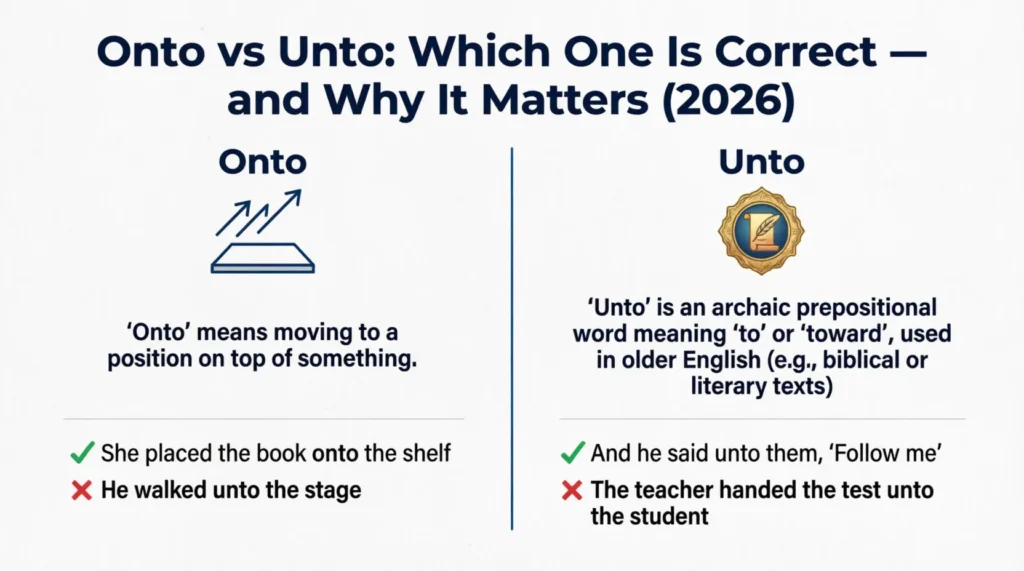
“Onto” is a preposition that usually describes movement toward or onto a surface. It tells readers that something is moving from one place to another and ends up on top of something.
Example:
The cat jumped onto the table.
In this sentence, the cat moves from one location and lands on the table.
Now let’s look at “unto.”
“Unto” is also a preposition, but it is much less common in modern English. It generally means “to,” “until,” or “toward,” depending on the context. Today, you are most likely to encounter it in religious writings, older literature, formal legal language, or historical documents.
Example:
The king gave the land unto his loyal servant.
Here, “unto” means something similar to “to.”
Unlike many word confusions, neither word is incorrect. The issue in onto vs unto is not spelling accuracy but choosing the word that fits the context.
onto vs unto: Side-by-Side Comparison
Insert AFTER the “What Each Word Actually Means” section.
Here is a quick breakdown to make the onto vs unto easier to compare at a glance.
Feature
onto
unto
Meaning
Moves to a surface
To or until; often formal
Part of Speech
Preposition
Preposition
Formality
Neutral
Formal or old-fashioned
Common Context
Everyday writing, directions
Religious, legal, historic texts
Example Sentence
The cat jumped onto the table.
Peace be unto you.
Can They Be Swapped?
Sometimes
Sometimes
Reason
Only when unto means “to.”
Not when unto has a special formal meaning.
Why People Mix Up Onto vs Unto
One reason people confuse these words is their similar appearance. Both contain the ending “-nto,” and when you read quickly, they can seem almost interchangeable.
Another reason is that many people encounter “unto” primarily in older texts. Since modern English rarely uses it in everyday conversation, readers sometimes assume it is simply a formal version of “onto.”
Language researchers have noted that readers often rely on visual patterns when processing words. Because “onto” and “unto” share a similar structure, your brain may temporarily treat them as related words even though their meanings differ.
The confusion can become even greater when people are trying to sound formal. Some writers mistakenly replace “onto” with “unto” because they believe it sounds more sophisticated, even when the sentence is describing physical movement.
The Simple Rule to Remember Which Is Which
Here’s the easiest rule:
If you’re talking about movement to a surface, use “onto.” If you can replace the word with “to” in a formal or old-fashioned sense, use “unto.”
Think of it this way:
“Onto” = movement and position.
“Unto” = formal “to.”
Examples:
She climbed onto the roof.
The child tossed the ball onto the lawn.
The ruler granted privileges unto the citizens.
Notice how the first two examples involve physical movement, while the third involves giving something to someone.
Once you remember that “onto” deals with location and movement, the onto vs unto distinction becomes much easier to recognize.
Common Mistakes People Make With Onto vs Unto
Writing “The bird flew unto the branch” when describing physical movement. Correct version: “The bird flew onto the branch.”
Using “onto” in a formal historical sentence. Correct version: “The property was transferred unto the heirs.”
Assuming “unto” is always incorrect because it sounds old-fashioned. Correct version: “Unto” remains acceptable in religious, literary, and certain legal contexts.
Replacing every instance of “to” with “unto” to sound more formal. Correct version: Use “unto” only where that traditional style is appropriate.
Real Sentence Fix — onto vs unto
See the Mistake, Fix the Mistake
Insert AFTER the “Common Mistakes People Make” section.
These are real mistakes people make with onto vs unto — and the simple fix for each one.
❌ Please upload the file unto the shared folder before noon. ✅ Please upload the file onto the shared folder before noon. 📌 Why: Use onto when something is placed on a surface or location.
❌ She climbed unto the stage and thanked everyone. ✅ She climbed onto the stage and thanked everyone. 📌 Why:Onto is the normal choice for physical movement to a surface.
❌ The teacher wrote the formula unto the whiteboard. ✅ The teacher wrote the formula onto the whiteboard. 📌 Why: Writing goes onto a board because it is added to its surface.
❌ Throw your jacket unto the chair when you get home. ✅ Throw your jacket onto the chair when you get home. 📌 Why:Onto is used when an object lands on something.
❌ Peace be onto all who gather here today. ✅ Peace be unto all who gather here today. 📌 Why:Unto is the traditional wording in formal blessings and religious writing.
❌ The gift was given onto the winner after the ceremony. ✅ The gift was given unto the winner after the ceremony. 📌 Why:Unto can mean to in formal or old-fashioned expressions.
Real-World Examples: Onto vs Unto Used Correctly
Casual conversation: “Can you place the groceries onto the kitchen counter?” Here, the groceries move onto a surface.
Professional writing: “Please upload the document onto the company portal.” The action involves moving something to a specific destination.
Academic writing: “The manuscript was passed unto subsequent generations through careful preservation.” This formal context makes “unto” appropriate.
Creative writing: “The old wizard bestowed his wisdom unto the young apprentice.” The literary tone naturally supports “unto.”
These examples show that context matters far more than formality alone.
British English vs. American English — Does It Affect Onto vs Unto?
Unlike many English spelling questions, the onto vs unto distinction is not primarily a British-versus-American issue.
Both British English and American English use “onto” for movement toward a surface. Likewise, both varieties recognize “unto” as an older or more formal word that appears mainly in specific contexts.
Because there is no significant regional difference, writers around the world tend to encounter the same confusion for the same reason: the words look similar but serve different purposes.
What Grammar Checkers and Style Guides Say About Onto vs Unto
Most grammar experts and style guides treat both words as legitimate English terms. The key concern is whether the chosen word matches the intended meaning.
Grammar-checking tools may not always catch an incorrect use because both words are correctly spelled. For example, a sentence using “unto” where “onto” is needed may pass spellcheck without any warning.
This is why understanding the rule yourself is so valuable. Context matters more than spelling software in the case of onto vs unto.
Onto vs Unto in Professional and Academic Writing
In professional writing, choosing the correct word helps communicate clearly. If you use “unto” when you mean “onto,” readers may pause and wonder whether the wording is intentional or mistaken.
Academic writing also benefits from precision. Professors, editors, and reviewers generally expect word choices to match their standard meanings. Using the wrong term can create unnecessary confusion.
The same principle applies to published articles, legal documents, and translated works. In formal and religious texts, precision in word choice matters across languages and traditions.
Fortunately, this is one of those grammar distinctions that becomes easy once you learn it. After you understand the difference, you will rarely hesitate over it again.
Quick Recap: Onto vs Unto at a Glance
Use “onto” for movement toward or onto a surface.
Use “unto” as a formal or old-fashioned version of “to.”
“Onto” is common in modern everyday English.
“Unto” appears mainly in religious, literary, historical, and legal contexts.
The difference is about meaning and context, not British versus American spelling.
Frequently Asked Questions About Onto vs Unto
Is unto the same as onto?
No. “Onto” usually describes movement toward a surface, while “unto” generally means “to” in a formal, literary, or historical sense. They serve different grammatical purposes.
Is unto still used in modern English?
Yes, but much less frequently than “onto.” You will most often see it in religious texts, traditional literature, legal language, and historical writing.
Can I use unto instead of to?
Sometimes, but only when a formal, literary, or traditional style is appropriate. In everyday writing, “to” is usually the better choice.
Why does the Bible use unto so often?
Many English Bible translations were produced in periods when “unto” was more common. The word became associated with religious language and remains familiar in many traditional translations.
Is onto one word or two words?
In most cases, “onto” is written as one word. It functions as a preposition showing movement toward a surface, such as “The child climbed onto the chair.”
Final Thoughts on Onto vs Unto
The key difference in onto vs unto is simple: “onto” refers to movement toward a surface, while “unto” is a formal or old-fashioned way of saying “to.”
If you’ve been unsure about these words, you’re in good company. Many writers encounter this confusion because the words look similar, even though they serve different purposes.
Now that you know the distinction, you can use both terms confidently when the situation calls for them. With a little practice, you’ll recognize the correct choice instantly and write with greater clarity every time.
Frequently Asked Questions
What is the primary difference between 'onto' and 'unto'?▼
‘Onto’ is a preposition that indicates movement toward a surface, while ‘unto’ is an older, more formal term that generally means ‘to,’ ‘until,’ or ‘toward.’ Understanding this distinction allows writers to choose the appropriate word based on context.
In what contexts is 'unto' typically used?▼
‘Unto’ is most commonly found in religious texts, older literature, formal legal language, or historical documents. It is less frequently used in modern everyday conversation, which can lead to confusion with ‘onto’.
Can 'onto' and 'unto' ever be used interchangeably?▼
They can sometimes be swapped, but only when ‘unto’ is used in the sense of ‘to.’ In other cases, particularly when ‘unto’ carries a formal meaning, they cannot be used interchangeably.
What is a simple rule to remember the use of 'onto' and 'unto'?▼
A straightforward rule to remember is: use ‘onto’ when discussing movement toward a surface, and use ‘unto’ when you can replace it with ‘to’ in a formal context. This helps clarify the intended meaning in your writing.
Why do people often confuse 'onto' and 'unto'?▼
The confusion often arises due to their similar appearance and sound, as both words contain the ending ‘-nto.’ Additionally, readers may primarily encounter ‘unto’ in older texts, leading them to mistakenly assume it is a formal version of ‘onto.’
Can you provide examples of each word in a sentence?▼
Certainly! An example of ‘onto’ is, ‘The cat jumped onto the table,’ indicating movement to a surface. For ‘unto,’ you might say, ‘The king gave the land unto his loyal servant,’ where it conveys a more formal meaning.
How does formality affect the choice between 'onto' and 'unto'?▼
‘Onto’ is neutral and commonly used in everyday contexts, while ‘unto’ is considered formal or old-fashioned. Choosing the right word based on the level of formality in your writing can greatly enhance clarity.
Emily Thornton holds a Master’s degree in Linguistics from the University of Chicago and has been passionate about language education for over 15 years. Her interest in language developed at a young age, fueled by a curiosity for how intricacies in language shape communication. Emily has authored several guides on grammar usage and works extensively with ESL learners to improve their fluency and confidence in English. Dedicated to clarity, she writes content that demystifies complex spelling and grammar issues, making her contributions invaluable for professionals looking for authoritative and swift language solutions. Emily continues to explore innovative ways to bridge communication gaps through accurate and effective language use. Her blend of academic rigor and practical insight ensures learners across all levels find her advice beneficial.