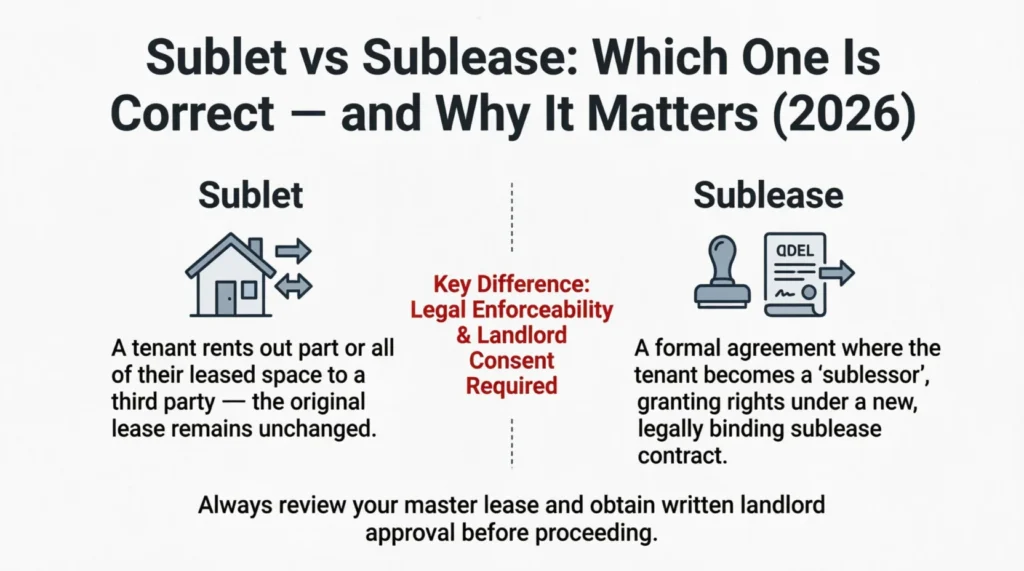
In short, sublet and sublease are often used interchangeably, but they can have slightly different legal meanings depending on context and jurisdiction. Generally, “sublease” is the more formal legal term, while “sublet” is more casual and widely used in everyday conversation. Understanding sublet vs sublease helps you avoid confusion in rental agreements and communicate more clearly in real estate situations.
If you’ve ever signed a lease or thought about renting out your apartment temporarily, you’ve probably paused at these two words. Let’s clear it up so you never second-guess yourself again.
The Confusion Around sublet vs sublease
You’re filling out a rental application, or maybe emailing your landlord about leaving town for a few months. You type “I want to sublet my apartment” and then stop. Should it be “sublease” instead? That small moment of hesitation is exactly where most people get stuck with sublet vs sublease.
This confusion is extremely common among students, renters, and even property managers. You’re not alone if both words feel interchangeable but slightly “off” depending on the sentence. Even experienced writers pause here because the difference is subtle, not obvious.
The truth is that both terms exist in real estate language, but they carry slightly different legal and stylistic weight. Once you understand the distinction, the confusion disappears quickly.
What Each Word Actually Means
To understand sublet vs sublease, you need to look at how each term is used in real life, not just in theory.
Sublease is primarily a legal noun and verb used in rental law. It means a tenant rents out all or part of their leased property to another person while still remaining responsible for the original lease. For example: You sign a lease for one year, then sublease your apartment to a friend for three months while you travel.
Example sentence: You decide to sublease your apartment to a classmate while you study abroad.
Sublet is also used as a noun and verb, but it is more informal and commonly used in everyday speech. It generally means the same action—renting out a property you already lease to someone else—but without the legal precision often associated with “sublease.”
Example sentence: You plan to sublet your room during the summer to save on rent.
In most real-world situations, both words refer to the same concept. However, legal documents and formal agreements tend to prefer “sublease” because it is more precise in contract language.
Real Sentence Fix — strips vs stripes
See the Mistake, Fix the Mistake
These are real mistakes people make with the strips vs stripes — and the simple fix for each one.
❌ The designer added colorful strips to the company’s new logo. ✅ The designer added colorful stripes to the company’s new logo. 📌 Why: A logo pattern uses lines or bands, not separate pieces.
❌ I love the strips on your sweater. ✅ I love the stripes on your sweater. 📌 Why: Clothing patterns are usually called stripes.
❌ The research paper compared zebra strips across different regions. ✅ The research paper compared zebra stripes across different regions. 📌 Why: Animal markings made of bands are called stripes.
❌ The app displays loading strips while files upload. ✅ The app displays loading bars while files upload. 📌 Why: A loading indicator is normally called a bar, not a strip.
❌ Please paint two white strips along the road. ✅ Please paint two white stripes along the road. 📌 Why: Road markings are called stripes when they are painted lines.
❌ Cut the cardboard into three stripes before packing it. ✅ Cut the cardboard into three strips before packing it. 📌 Why: Separate narrow pieces of material are called strips.
Why People Mix Up sublet vs sublease
Language researchers often point out that confusion like sublet vs sublease happens because both words share the same root idea: “letting” or renting something again. They also sound very similar, which makes your brain treat them as interchangeable.
Another reason is that everyday English tends to simplify legal or technical terms. People hear “sublet” more often in conversation, while “sublease” appears in contracts and official paperwork. This split usage naturally leads to uncertainty.
There is also a historical overlap. Both terms evolved from older property law language, and over time, casual usage and legal usage drifted apart slightly. So when you encounter them today, you’re really seeing two versions of the same concept used in different contexts.
The Simple Rule to Remember Which Is Which
Here’s an easy way to remember sublet vs sublease:
If you’re talking casually, use “sublet.” If you’re dealing with legal or formal documents, use “sublease.”
That’s it. One is everyday language, the other is contract language.
Think of it like this: “sublet” is what you say, “sublease” is what you sign.
Example sentences:
You tell your friend you want to sublet your apartment for the summer.
You sign a sublease agreement with a new tenant approved by your landlord.
You ask your property manager if subleasing is allowed under your contract.
Common Mistakes People Make With sublet vs sublease
Using “sublet” in formal contracts without realizing the legal document requires “sublease.” Correct version: You should use “sublease” in official agreements.
Assuming sublet and sublease mean different legal actions. Correct version: In most cases, they describe the same arrangement.
Thinking only “sublet” is correct in modern English. Correct version: Both are correct, but usage depends on context.
Forgetting landlord approval is often required. Correct version: Always check your lease before subletting or subleasing.
Real Sentence Fix — strips vs stripes
See the Mistake, Fix the Mistake
These are real mistakes people make with strips vs stripes — and the simple fix for each one.
❌ Please print the report with blue strips on the header. ✅ Please print the report with blue stripes on the header. 📌 Why: Stripes are lines or bands used in a design.
❌ I bought a shirt with red strips yesterday. ✅ I bought a shirt with red stripes yesterday. 📌 Why: Clothing patterns are usually called stripes, not strips.
❌ The biology chart showed zebra strips for camouflage. ✅ The biology chart showed zebra stripes for camouflage. 📌 Why: The markings on a zebra are called stripes.
❌ The website background has black and white strips. ✅ The website background has black and white stripes. 📌 Why: A repeating line pattern is described as stripes.
❌ Cut the cardboard into long stripes for the project. ✅ Cut the cardboard into long strips for the project. 📌 Why: Separate narrow pieces are called strips.
❌ The recipe says to slice the peppers into thin stripes. ✅ The recipe says to slice the peppers into thin strips. 📌 Why: Narrow pieces of food are called strips.
Real-World Examples: sublet vs sublease Used Correctly
Casual conversation: You decide to sublet your apartment while traveling for a few months. This works because informal speech naturally uses “sublet.”
Professional email: You ask your landlord if you are allowed to sublease your unit during your internship. This is correct because “sublease” fits formal communication.
Academic writing: A housing study discusses how tenants often sublease apartments in high-demand cities. This reflects formal usage in research contexts.
Creative writing: A character tries to sublet their tiny studio to afford a trip abroad. This fits storytelling tone and everyday language.
British English vs. American English — Does It Affect sublet vs sublease?
In both British and American English, sublet vs sublease is understood in very similar ways, and there is no strict regional split like you see with some spelling differences.
However, American legal documents tend to favor “sublease,” while “sublet” is more commonly used in everyday speech across both regions. British usage also leans slightly more casual with “sublet,” but the distinction is not formally standardized.
So no matter where you are, the difference is more about formality than geography. Both audiences understand both terms without confusion.
What Grammar Checkers and Style Guides Say About sublet vs sublease
Most grammar tools treat both “sublet” and “sublease” as correct words, but they may suggest consistency depending on context. If you are writing a formal document, style guides tend to prefer “sublease” because it is more precise in legal and contractual language.
Spellcheck will not usually flag either term as incorrect. However, it cannot judge context. That means it may not warn you if you use “sublet” in a formal lease agreement where “sublease” is expected.
The key takeaway is simple: tools can help, but understanding sublet vs sublease yourself is what ensures accuracy.
sublet vs sublease in Professional and Academic Writing
In professional settings, using the correct term matters because it signals clarity and attention to detail. Real estate agents, landlords, and legal professionals often expect “sublease” in documentation because it aligns with formal contract language.
In academic writing, especially in housing economics or urban studies, “sublease” is also preferred for consistency and precision. Misusing the terms may not change meaning, but it can affect how polished your writing appears.
Once you understand sublet vs sublease, you gain confidence in both casual and formal writing. You stop guessing and start choosing the right term automatically.
Quick Recap: sublet vs sublease at a Glance
Both terms describe renting out a leased property to another person
“Sublet” is more casual and conversational
“Sublease” is more formal and legal
Landlord approval is often required in both cases
The meaning is usually the same, but context decides usage
Frequently Asked Questions About sublet vs sublease
Is sublet the same as sublease?
Yes, in most everyday situations, sublet and sublease refer to the same action: renting out a leased property to another person. The main difference is tone and formality rather than meaning.
Which is more correct, sublet or sublease?
Neither is wrong, but “sublease” is considered more formal and is commonly used in legal documents. “Sublet” is more informal and widely used in conversation.
Can I use sublet and sublease interchangeably?
You can in casual speech, but in contracts or official agreements, it’s better to use the exact term required by your lease, usually “sublease.”
Do landlords prefer sublet or sublease?
Most landlords prefer “sublease” because it clearly defines legal responsibility and keeps contract language consistent.
Is subletting legal everywhere?
Subletting rules vary depending on your lease and local laws. Always check your rental agreement before subletting or subleasing your space.
Final Thoughts on sublet vs sublease
The confusion around sublet vs sublease is completely normal, especially since both terms are used in similar situations. The key difference is formality, not meaning.
Once you remember that “sublet” is casual and “sublease” is formal, the distinction becomes easy to apply in any situation. This small clarity can make your rental communication much more confident and accurate.
Now that you understand the difference, you can write, speak, and sign rental agreements without hesitation—knowing exactly which term fits where.
Frequently Asked Questions
What is the main difference between sublet and sublease?▼
The main difference lies in the formality of the terms; ‘sublease’ is the more formal legal term, while ‘sublet’ is a casual term commonly used in everyday conversation. Both terms refer to the act of renting out a leased property to another person, but ‘sublease’ often carries more legal implications.
When should I use 'sublet' instead of 'sublease'?▼
You can use ‘sublet’ in informal conversations or when discussing your plans with friends or family. However, in legal documents or formal rental agreements, it’s advisable to use ‘sublease’ for clarity and precision.
Why does it matter whether I use sublet or sublease?▼
Using the correct term is important to avoid confusion in rental agreements and to ensure clear communication with landlords and tenants. Misunderstandings can lead to legal issues, especially in formal contexts.
Can I sublet my apartment without my landlord's permission?▼
Typically, you cannot sublet your apartment without obtaining permission from your landlord, as most leases contain clauses that require landlord approval for subletting. It’s essential to review your lease agreement before proceeding.
Are there any legal responsibilities when I sublease my apartment?▼
Yes, when you sublease your apartment, you remain responsible for the original lease agreement, including rent payments and property maintenance. This means if your subtenant fails to pay rent or damages the property, you could be held accountable.
What are some common mistakes people make with sublet and sublease?▼
A common mistake is using ‘sublet’ in formal documents where ‘sublease’ is expected, which can create confusion about the legal responsibilities involved. Additionally, many people are unsure whether they need their landlord’s approval before subletting.
How can understanding the difference help me in real estate situations?▼
Understanding the distinction between sublet and sublease helps you communicate more clearly in real estate transactions and avoid potential legal pitfalls. This knowledge can also empower you to manage your rental agreements more effectively.
James Williams has been fascinated by the intricacies of the English language since his childhood days. Holding a Master’s degree in Linguistics from the University of Cambridge, he has spent over 15 years working as a professional editor and language consultant. James specializes in deciphering complex spelling and grammatical issues, and he is passionate about helping students and professionals alike gain confidence in their writing. His experience includes developing educational content for ESL learners, ensuring clarity and precision in communication. James is dedicated to providing readers with easy-to-follow guidance that resolves word confusions and common spelling errors, making WordlyRight an essential resource for anyone who needs quick, authoritative answers.