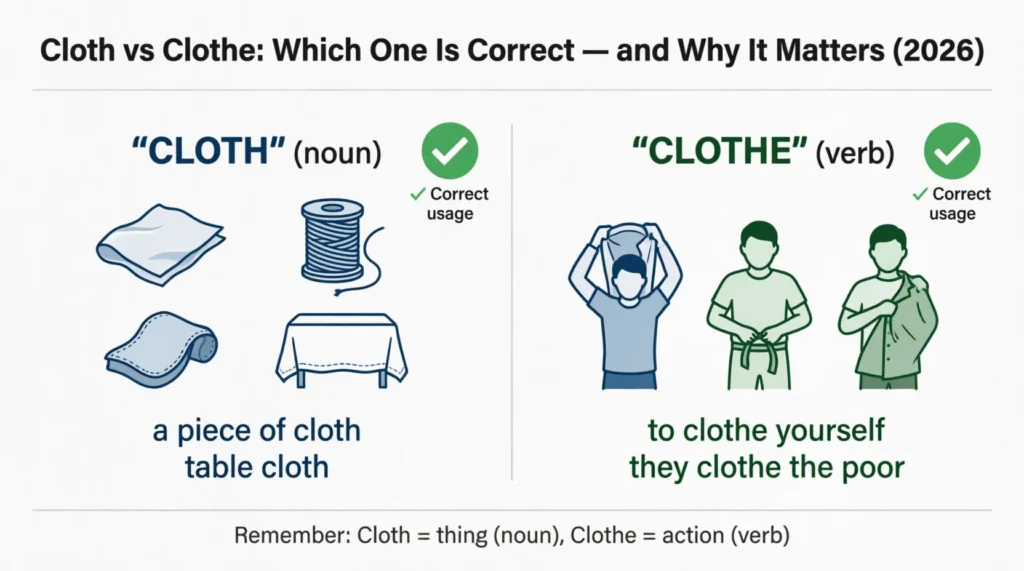
In short, “cloth” is a noun referring to fabric or material, while “clothe” is a verb meaning to dress or provide clothing. The confusion in cloth vs clothe is very common because the words look and sound similar, but they function completely differently in English. Understanding this difference will help you write with more confidence and avoid one of the most frequent word mix-ups in everyday writing.
The Confusion Around cloth vs clothe
You’re typing an essay late at night, and you pause for a second. Should it be cloth or clothe? You’ve seen both words before, but suddenly they don’t feel as simple as they used to.
Or maybe you’re writing a professional email and want to sound precise. You stop mid-sentence, second-guessing whether you’ve chosen the right form of cloth vs clothe. It feels small, but you don’t want a basic spelling issue to undermine your message.
This is exactly where many people get stuck. The confusion around cloth vs clothe happens even to confident writers, because the words are so closely related in spelling and sound. Once you understand the difference clearly, though, it becomes surprisingly easy to get right every time.
What Each Word Actually Means
Let’s break it down in the simplest way possible so you can use cloth vs clothe correctly without hesitation.
Cloth is a noun. It refers to a piece of fabric or material used to make clothes, furniture coverings, cleaning rags, and more. It is something tangible that you can touch or see.
For example: You might say, “She wiped the table with a soft cloth.” Here, cloth is a thing — an object made of fabric.
Clothe is a verb. It means to dress someone or to provide someone with clothing. It is an action, something you do rather than something you hold.
For example: “The organization helps clothe children in need.” Here, clothe describes the action of providing clothes.
A simple way to remember cloth vs clothe is that one is a thing, and the other is an action. If you’re describing material, you’re talking about cloth. If you’re describing the act of dressing, you’re talking about clothe.
cloth vs clothe: Side-by-Side Comparison
Insert AFTER the “What Each Word Actually Means” section.
Here is a quick breakdown to make the cloth vs clothe easier to compare at a glance.
Feature
Cloth
Clothe
Meaning
Fabric or material
To dress someone
Part of Speech
Noun
Verb
Formality
Neutral
Neutral
Common Context
Sewing, cleaning, textiles
Dressing people, providing clothing
Example Sentence
This cloth feels soft.
Volunteers clothe needy families.
Can They Be Swapped?
No
No — one is a noun, one a verb.
Why People Mix Up cloth vs clothe
Language researchers often point out that confusion like cloth vs clothe comes from how closely related words evolve in English. These two words share the same root, which makes them look and sound almost identical at first glance.
Another reason is pronunciation. In fast speech, the ending sounds of “cloth” and “clothe” can feel very similar, especially for learners or non-native speakers. Your brain hears a familiar pattern and assumes both are interchangeable.
Finally, modern texting and informal writing reduce attention to detail. When you’re typing quickly, your mind focuses on meaning rather than grammar, which increases mistakes in pairs like cloth vs clothe. Over time, this creates a habit of guessing instead of knowing.
The Simple Rule to Remember Which Is Which
Here’s an easy rule that will help you master cloth vs clothe instantly:
If you can hold it or touch it, use “cloth.” If someone is doing the action of dressing, use “clothe.”
That’s it. One is physical material, the other is an action.
Try it in real use:
“I need a clean cloth to wipe the glass.” (You can touch it, so it’s cloth.)
“Parents clothe their children every morning.” (It’s an action, so it’s clothe.)
“The tailor cut the cloth carefully before sewing.” (Material again, so cloth.)
Once you train your mind with this rule, cloth vs clothe becomes almost automatic in your writing.
Common Mistakes People Make With cloth vs clothe
Using “clothe” when referring to fabric Wrong: “She bought soft clothe for curtains.” Correct: “She bought soft cloth for curtains.”
Using “cloth” when describing the act of dressing Wrong: “They cloth the homeless every winter.” Correct: “They clothe the homeless every winter.”
Thinking both words are nouns Wrong assumption: “Clothe is another type of fabric.” Correct idea: “Clothe is a verb meaning to dress.”
Mixing spelling in plural or extended forms Wrong: “cloth people in need” Correct: “clothe people in need” or “provide clothing for people in need.”
These mistakes are normal, especially when you’re writing quickly. The good news is that once you recognize them, you’ll stop repeating them in your own writing.
Real Sentence Fix — cloth vs clothe
See the Mistake, Fix the Mistake
Insert AFTER the “Common Mistakes People Make” section.
These are real mistakes people make with cloth vs clothe — and the simple fix for each one.
❌ The company will cloth all new employees with safety gear. ✅ The company will clothe all new employees with safety gear. 📌 Why: Use clothe when talking about dressing people.
❌ Grandma used an old clothe to clean the table. ✅ Grandma used an old cloth to clean the table. 📌 Why: Use cloth when talking about a piece of fabric.
❌ The report explains how charities cloth families during winter. ✅ The report explains how charities clothe families during winter. 📌 Why:Clothe is the correct word for providing clothing to people.
❌ Download the clothe texture for your game project. ✅ Download the cloth texture for your game project. 📌 Why: A fabric texture is called a cloth texture.
❌ Please hand me a clean clothe for the kitchen counter. ✅ Please hand me a clean cloth for the kitchen counter. 📌 Why: A cleaning rag or fabric piece is a cloth.
❌ The shelter works hard to cloth homeless children every winter. ✅ The shelter works hard to clothe homeless children every winter. 📌 Why:Clothe means to provide people with clothing.
Real-World Examples: cloth vs clothe Used Correctly
Casual writing: “I spilled coffee on the cloth covering the table.” This is correct because it refers to a physical fabric item.
Professional writing: “The company works to clothe vulnerable communities during winter.” This is correct because it describes an action.
Academic writing: “Historical records show efforts to clothe soldiers during wartime shortages.” This uses clothe as a verb in a formal context.
Creative writing: “She held the worn cloth tightly as memories flooded back.” Here, cloth is used as a descriptive object in storytelling.
Each example shows how cloth vs clothe depends entirely on whether you’re talking about a material or an action.
British English vs. American English — Does It Affect cloth vs clothe?
There is no major difference between British and American English when it comes to cloth vs clothe. Both varieties use the same meanings and spellings in the same way.
You might see slight differences in usage frequency or phrasing, but the core rule stays identical across regions. Writers in both British and American English rely on the same distinction: cloth is a noun, and clothe is a verb.
So no matter where you are writing from, the confusion comes from structure, not regional spelling differences.
What Grammar Checkers and Style Guides Say About cloth vs clothe
Most grammar tools are designed to catch mistakes like cloth vs clothe, especially when the word is used in the wrong grammatical role. However, they are not always perfect, particularly if the sentence still “looks” correct structurally.
Style guides consistently emphasize understanding word function over relying on spellcheck. The key issue is context: grammar tools can suggest corrections, but they may not fully understand your intended meaning.
That’s why language experts often recommend learning the rule instead of depending entirely on software. When you understand cloth vs clothe yourself, you won’t need to second-guess automated suggestions.
cloth vs clothe in Professional and Academic Writing
Getting cloth vs clothe right matters more than you might think in formal writing. In job applications, essays, reports, or published content, small errors can affect how polished your work appears.
If you use the wrong form, readers may briefly question your attention to detail, even if your idea is strong. That’s why clarity in word choice is important — it helps your writing feel more credible and intentional.
The good news is that cloth vs clothe is one of those mistakes you only need to learn once. After that, you will rarely, if ever, mix them up again.
Quick Recap: cloth vs clothe at a Glance
Cloth = noun (fabric or material you can touch)
Clothe = verb (to dress or provide clothing)
Cloth is a thing, clothe is an action
The spelling difference reflects meaning, not style
Context is always the key to choosing correctly
Frequently Asked Questions About cloth vs clothe
Is it cloth or clothe when talking about fabric?
When you’re talking about fabric or material, the correct word is “cloth.” It refers to something physical you can touch, like cotton cloth or cleaning cloth. “Clothe” is not used for materials.
What is the difference between cloth vs clothe in simple terms?
The difference is simple: cloth is a noun meaning fabric, while clothe is a verb meaning to dress someone. One is a thing, the other is an action.
Can clothe be used as a noun?
No, “clothe” is not used as a noun in modern English. The noun form related to it is “clothing,” which refers to garments in general.
Why do people confuse cloth vs clothe so often?
People confuse them because they look and sound very similar and come from the same root word. In fast writing or speaking, the distinction can feel blurry, which leads to mistakes.
Is clothing related to cloth vs clothe?
Yes, “clothing” is related to both. It comes from the same word family, but it functions as a noun meaning garments, sitting between the material (cloth) and the action (clothe).
Final Thoughts on cloth vs clothe
The difference between cloth vs clothe is actually quite simple once you see it clearly: one is a material you can touch, and the other is an action of dressing. The confusion is natural, especially since the words are so closely related in spelling and sound.
Now that you understand this distinction, you don’t have to hesitate or second-guess yourself when writing. You’ve essentially removed one of those small but annoying grammar doubts that often slow writers down.
With this rule in mind, you can move forward as a more confident and precise writer, knowing you’ve mastered one of the most common word mix-ups in English.
Frequently Asked Questions
What is the main difference between 'cloth' and 'clothe'?▼
The main difference is that ‘cloth’ is a noun referring to fabric or material, while ‘clothe’ is a verb meaning to dress or provide clothing. Understanding this distinction is crucial for clear and accurate writing.
Why do people often confuse 'cloth' and 'clothe'?▼
People often confuse ‘cloth’ and ‘clothe’ because they look and sound similar, which can lead to mix-ups, especially in fast speech. Additionally, modern texting habits can lead to a lack of attention to detail, further contributing to this confusion.
Can 'cloth' and 'clothe' be used interchangeably in sentences?▼
No, ‘cloth’ and ‘clothe’ cannot be used interchangeably because they serve different grammatical functions; one is a noun and the other is a verb. Using them correctly enhances the clarity of your writing.
What is a simple way to remember when to use 'cloth' versus 'clothe'?▼
A simple rule to remember is: if you can hold it or touch it, use ‘cloth.’ If you are describing the action of dressing someone, then use ‘clothe.’
What are some common contexts where 'cloth' is used?▼
‘Cloth’ is commonly used in contexts related to sewing, cleaning, and textiles, as it refers to physical fabric or material. Examples include talking about clothing, furniture coverings, or cleaning rags.
What are some examples that illustrate the correct usage of 'cloth' and 'clothe'?▼
An example of ‘cloth’ would be, ‘This cloth feels soft,’ indicating a physical material. In contrast, an example of ‘clothe’ is, ‘Volunteers clothe needy families,’ where it describes the action of dressing people.
How can I avoid making mistakes with 'cloth' and 'clothe' in my writing?▼
To avoid mistakes, it’s essential to remember the definitions and contexts for each word. Take a moment to consider whether you’re referring to a tangible material or the action of dressing, which will help you choose the correct term.
James Williams has been fascinated by the intricacies of the English language since his childhood days. Holding a Master’s degree in Linguistics from the University of Cambridge, he has spent over 15 years working as a professional editor and language consultant. James specializes in deciphering complex spelling and grammatical issues, and he is passionate about helping students and professionals alike gain confidence in their writing. His experience includes developing educational content for ESL learners, ensuring clarity and precision in communication. James is dedicated to providing readers with easy-to-follow guidance that resolves word confusions and common spelling errors, making WordlyRight an essential resource for anyone who needs quick, authoritative answers.