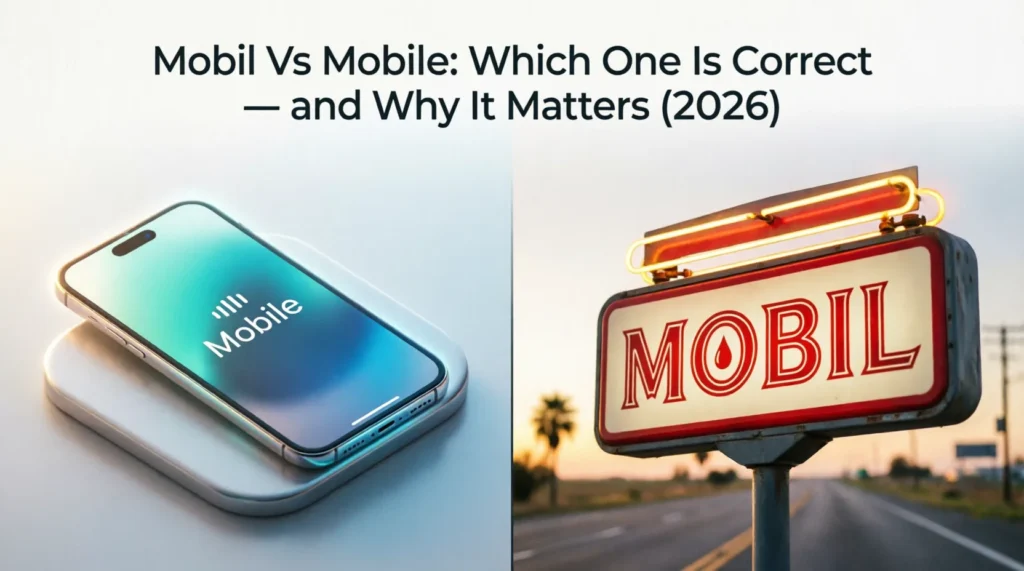
In short, “mobile” is the correct English spelling, while “mobil” is usually an incorrect shortened form or a word from other languages that is sometimes mistakenly used in English writing. The correct term depends on context like phones, technology, or movement, and understanding it will help you avoid one of the most common spelling confusions in digital communication.
The Confusion Around mobil vs mobile
You’re typing a message quickly—maybe a school assignment, a product description, or a social media post. You pause for a second. Is it mobil vs mobile? It feels like both could work, especially because you’ve probably seen “mobil” in logos, brand names, or even casual texting.
This moment of doubt is more common than you think. Many people hesitate when writing mobil vs mobile, especially when switching between languages or typing fast on a phone keyboard. It’s one of those small spelling uncertainties that can interrupt your flow even when you already know the topic well.
The confusion becomes even stronger online, where brands, apps, and informal writing sometimes shorten or stylize words. That makes it easy to assume both versions are acceptable in standard English.
What Each Word Actually Means
Let’s clear this up in a simple, practical way so you can use the right form confidently every time.
Mobile is the correct English word. It can be used as an adjective or a noun. As an adjective, it means something that can move or is not fixed in one place. In modern usage, it most commonly refers to mobile phones or mobile technology.
Example sentence:
“I bought a new mobile phone yesterday.”
As a noun in some contexts, especially in British English, “mobile” can also refer to a mobile phone itself.
“She forgot her mobile at home.”
Now let’s look at “mobil.” In standard English, “mobil” is not a recognized word. It is often a shortened spelling used in branding (like company names) or borrowed from other languages such as German or Indonesian. However, in formal English writing, it is considered incorrect.
Example:
Incorrect: “I need to charge my mobil.”
Correct: “I need to charge my mobile.”
Understanding this difference in mobil vs mobile immediately removes confusion in both academic and everyday writing.
mobil vs mobile: Side-by-Side Comparison
Here is a quick breakdown to make the mobil vs mobile easier to compare at a glance.
Feature
mobil
mobile
Meaning
Misspelling of mobile
Correct spelling for phone or movable
Part of Speech
Not a standard English word
Noun or adjective
Formality
Not appropriate
Neutral
Common Context
Typing mistakes
Technology and everyday English
Example Sentence
I bought a new mobil.
I bought a new mobile.
Can They Be Swapped?
No — mobil is a misspelling.
No — use mobile correctly.
Why People Mix Up mobil vs mobile
One major reason people confuse mobil vs mobile is pronunciation. When spoken quickly, “mobile” often sounds like “moh-bil” or “moh-byle,” depending on accent. This leads some writers to assume the spelling might drop the final “e.”
Linguists often explain this type of error as a phonetic simplification mistake—your brain tries to match spelling with sound, even when English spelling rules don’t follow pronunciation strictly.
Another reason is multilingual influence. In several languages, such as French-influenced or Southeast Asian usage, “mobil” is a valid word or root form. So learners who switch between languages may unconsciously carry that spelling into English.
Finally, branding and tech culture play a role. You may see “Mobil” used in company names or product branding, which makes it look legitimate. But in standard English grammar, mobil vs mobile is not a true choice—only “mobile” is correct.
The Simple Rule to Remember Which Is Which
Here’s an easy rule you can always rely on:
If you are writing in English and talking about movement, phones, or technology, always use mobile with an “e” at the end. “Mobil” is never standard English.
Think of it this way: “Mobile is always complete in English.”
Examples:
You carry a mobile phone every day.
Your body has mobile joints that allow movement.
Mobile apps run on smartphones.
Once you remember this, mobil vs mobile becomes a non-issue in your writing.
Common Mistakes People Make With mobil vs mobile
Writing “mobil phone” instead of “mobile phone” You might write “I need a new mobil phone.” The correct form is “mobile phone.”
Assuming “mobil” is a shorter English version Some people think dropping the “e” is acceptable informal English, but it is not.
Mixing branding with grammar You may see “Mobil” in company names and assume it applies to general writing, which leads to errors.
Translating directly from other languages You might carry over “mobil” from another language into English writing, which creates confusion in mobil vs mobile usage.
Real-World Examples: mobil vs mobile Used Correctly
Real Sentence Fix — mobil vs mobile
See the Mistake, Fix the Mistake
These are real mistakes people make with the mobil vs mobile — and the simple fix for each one.
❌ Please send the confirmation code to my mobil number. ✅ Please send the confirmation code to my mobile number. 📌 Why: Mobile is the correct English spelling for a phone number.
❌ My new mobil has an amazing camera. ✅ My new mobile has an amazing camera. 📌 Why: The word mobil is a spelling mistake.
❌ The survey asked students how often they use a mobil device. ✅ The survey asked students how often they use a mobile device. 📌 Why: Academic writing should always use the correct spelling.
❌ Turn on your mobil data before opening the app. ✅ Turn on your mobile data before opening the app. 📌 Why: The correct term is mobile data.
❌ Dad forgot his mobil at home this morning. ✅ Dad forgot his mobile at home this morning. 📌 Why: Mobile is the standard word for a mobile phone.
❌ My mobile is out of battery. ✅ My mobile is out of battery power. 📌 Why: The natural expression is out of battery power or the battery is dead.
Casual conversation: “I always keep my mobile with me when I go out.” This shows natural everyday usage referring to a phone.
Professional writing: “The application is optimized for mobile devices.” This demonstrates correct technical usage in a workplace context.
Academic writing: “Mobile learning technologies are reshaping education systems worldwide.” This shows formal use of the adjective form in research writing.
Creative writing: “She checked her mobile under the dim streetlight.” This adds realism and clarity in storytelling.
Each example highlights why mobile is the correct and consistent form in English.
British English vs. American English — Does It Affect mobil vs mobile?
In the case of mobil vs mobile, there is no spelling difference between British and American English. Both regions use “mobile” in exactly the same way.
In the UK, people may say “mobile phone,” while in the US, “cell phone” is more common, but the spelling “mobile” remains unchanged in both varieties.
So regardless of region, “mobil” is not considered standard English. This makes the rule simple and global—once you learn it, you can use it anywhere confidently.
What Grammar Checkers and Style Guides Say About mobil vs mobile
Grammar checkers consistently flag “mobil” as a spelling error in English writing. Standard style guides used in publishing, education, and journalism all recognize “mobile” as the correct form.
However, while tools can catch obvious mistakes, they don’t always explain why something is wrong. That means you might fix the word but still feel unsure in future situations.
This is why understanding mobil vs mobile yourself is more powerful than relying only on autocorrect or grammar software. Tools help, but knowledge keeps you confident.
mobil vs mobile in Professional and Academic Writing
In professional communication, small spelling errors can subtly affect how your message is received. If someone sees “mobil” in a business email or report, it may appear careless or unpolished, even if your idea is strong.
In academic writing, precision is even more important. Using correct spelling shows attention to detail and strengthens your credibility as a writer or researcher.
The good news is that once you understand mobil vs mobile, you will rarely make this mistake again. It becomes a permanent part of your writing accuracy, helping you communicate more clearly and confidently in every context.
Quick Recap: mobil vs mobile at a Glance
“Mobile” is the correct English spelling
“Mobil” is not standard English
“Mobile” refers to phones, movement, or flexibility
Both UK and US English use “mobile”
Context never changes the spelling rule
Frequently Asked Questions About mobil vs mobile
Is it mobil or mobile in English?
The correct spelling is “mobile.” “Mobil” is not standard English and should not be used in formal or informal writing.
Why do people write mobil instead of mobile?
People often drop the final “e” due to pronunciation habits, fast typing, or influence from other languages where “mobil” is a valid word form.
Does mobil mean anything in English?
No, “mobil” has no meaning in standard English. It is only seen in branding or foreign language usage, not in correct English grammar.
Is mobile only used for phones?
No, “mobile” can describe anything that moves or is portable, but it is most commonly used today for smartphones and mobile technology.
Can I ever use mobil in writing?
In standard English writing, you should never use “mobil.” The correct and accepted form is always “mobile.”
Final Thoughts on mobil vs mobile
The difference between mobil vs mobile is actually very simple: only “mobile” is correct in English, and “mobil” is always a misspelling in this context. Once you see the pattern, it becomes easy to avoid the mistake completely.
This is one of those small language details that can instantly improve your writing clarity and professionalism. Now that you know the rule, you can write without hesitation and trust your spelling every time you use the word.
With this understanding, you’re no longer guessing—you’re writing with confidence and accuracy.
Frequently Asked Questions
What is the correct spelling: mobil or mobile?▼
The correct spelling is ‘mobile’ in standard English. ‘Mobil’ is generally considered a misspelling or a shortened form used in branding or other languages.
Why do people confuse mobil and mobile?▼
People often confuse ‘mobil’ and ‘mobile’ due to pronunciation differences, where ‘mobile’ can sound like ‘moh-bil’ or ‘moh-byle.’ Additionally, multilingual influences and branding can lead to the incorrect use of ‘mobil’ in English.
Can mobil be used in any context in English?▼
In standard English, ‘mobil’ is not recognized as a valid word and should not be used. It is often found in branding or borrowed from other languages, but in formal writing, ‘mobile’ is the correct term.
Is mobile used only for phones?▼
While ‘mobile’ commonly refers to mobile phones, it can also be used as an adjective for anything that can move or is not fixed in one place. For example, it can describe mobile technology or services.
What is a simple rule to remember the difference between mobil and mobile?▼
A simple rule to remember is that ‘mobile’ is the correct spelling to use in all contexts related to phones or movement. If you’re unsure, always choose ‘mobile’ to avoid mistakes.
How does branding affect the use of mobil and mobile?▼
Brands may use ‘Mobil’ in their names to create a distinct identity, which can lead to confusion among consumers. However, in standard English writing, only ‘mobile’ is correct, regardless of its presence in branding.
Are there any common mistakes people make when writing mobil vs mobile?▼
Common mistakes include using ‘mobil’ due to phonetic simplification or because of influences from other languages where ‘mobil’ is valid. It’s essential to remember that in formal contexts, only ‘mobile’ is appropriate.
Maria Ramirez is an experienced editor and language consultant with over 10 years in the publishing world. She holds a Bachelor’s degree in Journalism and deeply appreciates the power of the written word. Her expertise lies in dissecting the complexities of English grammar and providing straightforward guidance for contemporary writers. Maria’s work focuses on simplifying spelling and usage rules, assisting both seasoned writers and budding authors in presenting their ideas with precision. Her involvement with WordlyRight stems from a commitment to nurture a global audience’s command over English, ensuring learners and professionals don’t just understand language nuances but use them effectively in varied contexts. As someone who passionately believes in lifelong learning, Maria continuously seeks to inspire this ethos in her readers.