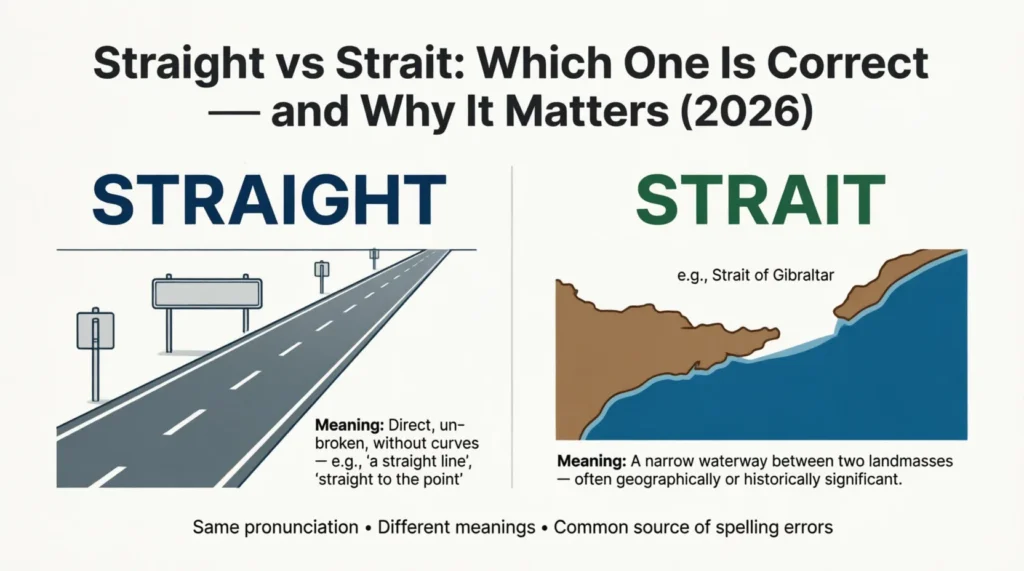
In short, straight vs strait are both correct words, but they are not interchangeable. “Straight” usually means something that is not curved or is direct, while “strait” refers to a narrow passage of water or a difficult situation. Understanding straight vs strait will help you avoid one of the most common English spelling confusions and write with more confidence.
The Confusion Around straight vs strait
You’re typing an email, and you want to say something is “not complicated.” You pause. Is it straight or strait? The words look almost identical, and your brain hesitates just long enough to make you doubt yourself.
This is exactly where most people stumble with straight vs strait. You’re not alone—students, professionals, and even experienced writers mix them up because they sound the same when spoken. The difference only becomes obvious when you slow down and look closely at meaning.
If you’ve ever second-guessed yourself in the middle of writing, this confusion is probably familiar. The good news is that once you understand the logic behind straight vs strait, it becomes very easy to remember.
What Each Word Actually Means
Let’s break straight vs strait into simple, real-world meanings so you can clearly see the difference.
Straight is most commonly an adjective, though it can also be an adverb or noun in some contexts. It means something that is not curved, not bent, or something done in a direct way. You might also use it to describe honesty or clarity.
Example: She drew a straight line across the page.
You can also use it in everyday speech: Go straight home after school.
On the other hand, strait is a noun. It refers to a narrow passage of water connecting two larger bodies of water. It is also used metaphorically to describe a difficult or stressful situation, often in the plural form “straits.”
Example: The ship passed through the Strait of Gibraltar.
So when you compare straight vs strait, one is about direction, shape, or clarity, while the other is about geography or hardship.
straight vs strait: Side-by-Side Comparison
Here is a quick breakdown to make the straight vs strait easier to compare at a glance.
Feature
straight
strait
Meaning
Without curves; direct
Narrow waterway connecting seas
Part of Speech
Adjective, adverb, verb
Noun
Formality
Neutral
Neutral
Common Context
Directions, lines, behavior
Geography, maps, travel
Example Sentence
Drive straight home.
The ship crossed the strait.
Can They Be Swapped?
No
No — They have different meanings.
Why People Mix Up straight vs strait
The confusion around straight vs strait happens for a few clear reasons that language researchers often point out.
First, both words are pronounced almost exactly the same in modern English. When spoken aloud, there is no clear difference, so your brain stores them as identical sounds.
Second, English spelling is not always logical. Two words can sound the same but come from completely different roots. This creates a natural trap for learners and even native speakers.
Finally, your writing tools don’t always help. Spellcheck might accept both words because both are valid English terms, even though their meanings are very different. That makes straight vs strait especially tricky in fast writing situations.
The Simple Rule to Remember Which Is Which
Here’s an easy way to lock straight vs strait into your memory:
Straight has a “GHT” like “right” or “light,” which feels open and clear. Strait is tight and narrow, like a restricted space.
Think of it this way:
Straight = smooth, direct, no turns
Strait = tight, narrow, limited space or difficult situation
Try these examples:
You walk in a straight line when you want the shortest direct path.
Ships pass through a strait when the waterway is narrow and confined.
You give a straight answer when you’re being clear and honest.
Once you connect the idea of “open vs tight,” straight vs strait becomes much easier to separate in your mind.
Real Sentence Fix — straight vs strait
See the Mistake, Fix the Mistake
These are real mistakes people make with the straight vs strait — and the simple fix for each one.
❌ Please drive strait to the office after lunch. ✅ Please drive straight to the office after lunch. 📌 Why: Use straight when talking about direction or moving without turning.
❌ We walked strait to the beach after breakfast. ✅ We walked straight to the beach after breakfast. 📌 Why:Straight describes going directly from one place to another.
❌ The report explains how the straight separates two larger bodies of water. ✅ The report explains how the strait separates two larger bodies of water. 📌 Why: A strait is a narrow passage of water between larger bodies of water.
❌ The GPS says to continue through the straight before reaching the island. ✅ The GPS says to continue through the strait before reaching the island. 📌 Why: Navigation uses strait when the route passes through a narrow waterway.
❌ Keep the picture frame strait on the wall. ✅ Keep the picture frame straight on the wall. 📌 Why:Straight means properly aligned and not crooked.
❌ Our ferry crossed the straight in less than an hour. ✅ Our ferry crossed the strait in less than an hour. 📌 Why: Use strait when talking about a narrow channel of water.
Common Mistakes People Make With straight vs strait
Here are some realistic mistakes you might see in writing—and how to fix them:
“He kept his strait face during the meeting.” Correct: “He kept his straight face during the meeting.” (Wrong word used for expression)
“The road goes through a straight between the mountains.” Correct: “The road goes through a strait between the mountains.” (Confusing geography term)
“She lives in a strait line from the office.” Correct: “She lives in a straight line from the office.” (Direction error)
“They are in financial straight after losing the contract.” Correct: “They are in financial straits after losing the contract.” (Plural form needed for hardship)
These mistakes happen often because straight vs strait feels interchangeable when you’re typing quickly, but meaning changes completely.
Real-World Examples: straight vs strait Used Correctly
Let’s see how straight vs strait works in real life:
Casual conversation: “Just go straight down this road and you’ll find the shop.” This is correct because it describes direction.
Professional writing: “The company took a straight approach to solving the issue.” This works because it means direct and simple.
Academic writing: “The vessel navigated through a narrow strait between the islands.” This is correct because it refers to a geographic water passage.
Creative writing: “The village was in dire straits after the storm destroyed crops.” This is correct because it describes hardship.
Each example shows how context decides whether straight or strait is correct.
British English vs. American English — Does It Affect straight vs strait?
In the case of straight vs strait, there is no meaningful difference between British and American English spelling. Both regions use the same forms with the same meanings.
However, confusion still happens globally because pronunciation is identical and both words are valid English vocabulary. Linguists often note that this type of confusion is universal rather than regional.
So whether you’re writing in the UK, the US, or anywhere else, the rule stays the same: straight and strait are separate words with separate meanings.
What Grammar Checkers and Style Guides Say About straight vs strait
Most grammar tools will not always catch mistakes involving straight vs strait because both are correctly spelled words. That means if you use the wrong one, the system might still accept it.
Style guides generally emphasize context over spelling correction in this case. They assume the writer must understand meaning rather than rely on automated checks.
The key takeaway is simple: tools can help, but they won’t always save you from straight vs strait confusion. Your understanding is the most reliable guide.
straight vs strait in Professional and Academic Writing
In professional and academic settings, using the wrong version of straight vs strait can change the meaning of your sentence entirely. That can lead to confusion or even misinterpretation.
For example, writing about “financial straight” instead of “financial straits” could make your sentence unclear or incorrect in a formal report. Similarly, using “strait line” instead of “straight line” in technical writing would be considered a serious error.
The positive side is that once you master straight vs strait, you eliminate a common source of mistakes. It also shows attention to detail, which is valued in academic and workplace writing. After learning this difference, you’ll rarely second-guess yourself again.
Quick Recap: straight vs strait at a Glance
Straight means direct, not curved, or honest
Strait means a narrow water passage or difficult situation
Straight is more common in everyday writing
Strait is mostly used in geography or “in dire straits”
Both sound the same but have completely different meanings
Frequently Asked Questions About straight vs strait
Is it straight or strait line?
The correct phrase is “straight line.” It means a line that does not bend or curve. “Strait line” is incorrect in this context and is often a spelling mistake caused by pronunciation similarity.
What does strait mean in simple words?
Strait is a noun that describes a narrow body of water between two larger areas of land. It can also mean a difficult or stressful situation when used in the phrase “in dire straits.”
Why do straight and strait sound the same?
They sound the same because English pronunciation merges certain vowel and consonant patterns. Despite identical pronunciation, their meanings come from different historical word origins.
Can straight and strait ever mean the same thing?
No, they cannot be used interchangeably. Straight relates to direction or clarity, while strait relates to geography or hardship. Mixing them changes the meaning completely.
What is a good way to remember straight vs strait?
Think of “straight = smooth path” and “strait = tight space.” This simple contrast helps you quickly choose the correct word in writing.
Final Thoughts on straight vs strait
The confusion between straight vs strait is one of those small English challenges that can feel bigger than it actually is. Once you understand the difference, it becomes surprisingly easy to spot the correct word in any sentence.
At its core, straight means direct and clear, while strait refers to narrow passages or difficult situations. That single distinction removes almost all uncertainty.
Now that you understand straight vs strait, you can write with more accuracy and confidence, knowing you’ve mastered one of English’s most common spelling traps.
Frequently Asked Questions
What is the main difference between 'straight' and 'strait'?▼
‘Straight’ means something that is not curved or is direct, while ‘strait’ refers to a narrow passage of water or a difficult situation. Understanding this distinction can help prevent common spelling errors.
Why do many people confuse 'straight' and 'strait'?▼
The confusion arises because both words are pronounced almost identically in modern English, leading to misremembering their meanings. Additionally, the irregularities of English spelling contribute to this mix-up.
Can 'straight' and 'strait' be used interchangeably?▼
No, they cannot be swapped as they have different meanings. ‘Straight’ relates to direction or clarity, while ‘strait’ pertains to geography or hardship.
What are some common contexts where 'straight' is used?▼
‘Straight’ is often used in contexts involving directions, lines, or behavior, such as telling someone to go straight home. It can also describe honesty or clarity in communication.
What does 'strait' mean in a metaphorical sense?▼
Metaphorically, ‘strait’ describes a difficult or stressful situation, often referred to in the plural form as ‘straits.’ This usage highlights challenging circumstances one may face.
How can I remember the difference between 'straight' and 'strait'?▼
A helpful mnemonic is that ‘straight’ includes ‘GHT,’ reminiscent of clarity and openness, while ‘strait’ suggests tightness and narrowness. This visual association can aid in recalling their meanings.
What is an example sentence for each word?▼
An example sentence for ‘straight’ is: ‘Drive straight home.’ For ‘strait,’ you could say: ‘The ship crossed the strait.’ These sentences illustrate their distinct usages.
James Williams has been fascinated by the intricacies of the English language since his childhood days. Holding a Master’s degree in Linguistics from the University of Cambridge, he has spent over 15 years working as a professional editor and language consultant. James specializes in deciphering complex spelling and grammatical issues, and he is passionate about helping students and professionals alike gain confidence in their writing. His experience includes developing educational content for ESL learners, ensuring clarity and precision in communication. James is dedicated to providing readers with easy-to-follow guidance that resolves word confusions and common spelling errors, making WordlyRight an essential resource for anyone who needs quick, authoritative answers.