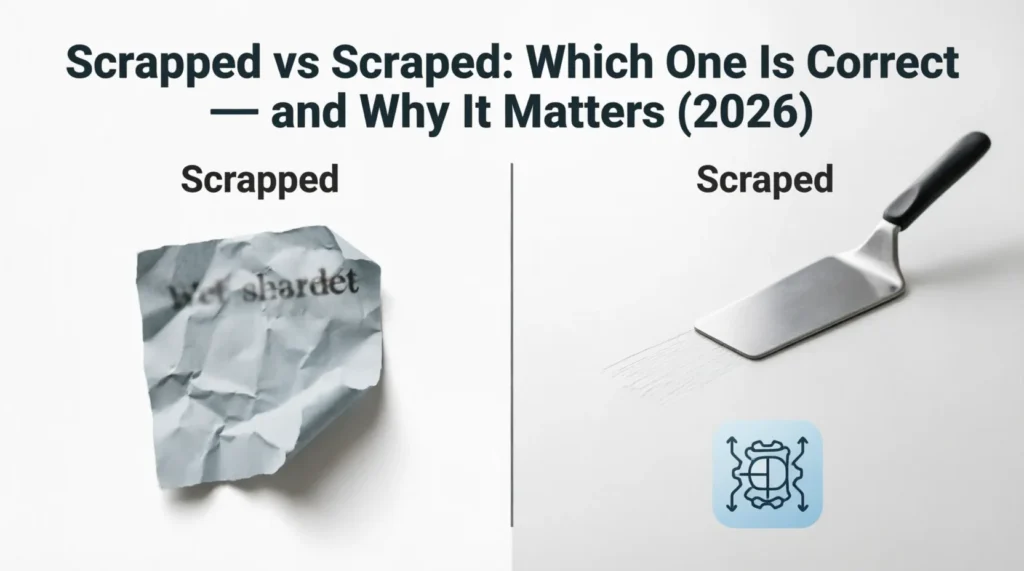
In short, “scrapped” and “scraped” are both correct words, but they mean completely different things. “Scrapped” usually refers to canceling or discarding something, while “scraped” refers to rubbing, collecting, or lightly scratching a surface. Understanding scrapped vs scraped helps you avoid embarrassing writing mistakes and communicate your ideas clearly in both casual and professional contexts.
If you’ve ever paused mid-sentence wondering which spelling fits, you’re not alone — let’s break it down so you never hesitate again.
The Confusion Around scrapped vs scraped
You’re writing an email, and you want to say the project was canceled. You type “scraped the project” and suddenly it looks… wrong. Or maybe you’re describing peeling paint and you accidentally write “scrapped the wall.”
This is exactly where scrapped vs scraped trips people up. The words look similar, sound slightly similar, and even show up in similar contexts involving “removal” or “damage.”
Because of that overlap, your brain often treats them like interchangeable spellings. But they are not. One is about abandoning something. The other is about physically or lightly removing something from a surface.
When you understand this distinction, your writing instantly becomes clearer and more confident.
What Each Word Actually Means
Let’s break scrapped vs scraped into simple, everyday meanings so you can see the difference clearly.
Scrapped is a verb (past tense of “scrap”) meaning to discard, cancel, or get rid of something entirely. You use it when a plan, object, or idea is thrown away or abandoned. It has nothing to do with physical rubbing.
Example: The company scrapped the new marketing strategy after poor results.
Here, “scrapped” means the idea was completely dropped.
Scraped is also a verb (past tense of “scrape”) meaning to rub a surface, remove a thin layer, or collect something by dragging a tool or object across a surface.
Example: She scraped the mud off her shoes before entering the house.
Here, “scraped” involves physical contact and removal through friction.
So in scrapped vs scraped, one is about cancellation, and the other is about physical action on a surface.
scrapped vs scraped: Side-by-Side Comparison
Insert AFTER the “What Each Word Actually Means” section
Here is a quick breakdown to make the scrapped vs scraped easier to compare at a glance.
Feature
Scrapped
Scraped
Meaning
Thrown away or canceled
Rubbed against or removed
Part of Speech
Verb
Verb
Formality
Neutral
Neutral
Common Context
Projects, plans, vehicles
Skin, surfaces, web data
Example Sentence
They scrapped the proposal.
She scraped her knee.
Can They Be Swapped?
No
No — each has a different meaning.
Why People Mix Up scrapped vs scraped
Language researchers often point out that confusion like this comes from phonetic similarity — the words sound almost identical in fast speech. The difference between the “p” and “t” sound at the end can easily blur when spoken quickly.
Another reason is meaning overlap. Both words can involve “removing something,” so your brain assumes they belong to the same family. But linguistically, they come from different roots and evolved separately.
You also see both words frequently in modern writing — news articles, social media posts, and emails — which increases exposure but not necessarily understanding. That repetition makes scrapped vs scraped a common mistake even for fluent writers.
The Simple Rule to Remember Which Is Which
Here’s a simple way to lock it in your memory:
If it’s canceled or thrown away, use scrapped. If it involves rubbing or scratching a surface, use scraped.
Think of it like this: “scrapped” = “trash it,” “scraped” = “scratch it.”
Now let’s apply that to scrapped vs scraped in real sentences:
The meeting was scrapped due to scheduling issues.
He scraped the label off the bottle with his fingernail.
The idea was scrapped after feedback from the team.
Once you link scrapped to “cancel” and scraped to “surface,” your brain stops mixing them up.
Common Mistakes People Make With scrapped vs scraped
Mistake: “She scraped the old policy and replaced it.” Correct: She scrapped the old policy and replaced it.
Mistake: “He scrapped his knee while falling.” Correct: He scraped his knee while falling.
Mistake: “The project was scraped last minute.” Correct: The project was scrapped last minute.
Mistake: “I scraped my plans for the weekend.” Correct: I scrapped my plans for the weekend.
Real Sentence Fix — scrapped vs scraped
See the Mistake, Fix the Mistake
Insert AFTER the “Common Mistakes People Make” section
These are real mistakes people make with scrapped vs scraped — and the simple fix for each one.
❌ The company scraped the expansion plan after the budget cuts. ✅ The company scrapped the expansion plan after the budget cuts. 📌 Why: Use scrapped when something is canceled or abandoned.
❌ I scrapped my knee while riding my bike. ✅ I scraped my knee while riding my bike. 📌 Why: Use scraped for a small injury caused by rubbing against something.
❌ The researchers scrapped data from several public websites. ✅ The researchers scraped data from several public websites. 📌 Why: Use scraped when collecting data from websites.
❌ We decided to scrape the old science project and start over. ✅ We decided to scrap the old science project and start over. 📌 Why: Use scrap when choosing to throw away or stop a project.
❌ The old paint was scrapped off the wall before repainting. ✅ The old paint was scraped off the wall before repainting. 📌 Why: Use scraped when something is removed by rubbing with a tool.
❌ They scraped the broken office chairs because they could not be repaired. ✅ They scrapped the broken office chairs because they could not be repaired. 📌 Why: Use scrapped when items are discarded or sent for disposal.
Real-World Examples: scrapped vs scraped Used Correctly
The city scrapped the renovation plan after public opposition. This shows cancellation of an entire project, making “scrapped” correct in a professional context.
She scraped paint off the old wooden door before refinishing it. This involves physical removal from a surface, so “scraped” fits naturally.
The startup scrapped its original app idea and pivoted to a new model. “Scrapped” reflects abandoning a business direction.
He scraped ice off the windshield early in the morning. A clear physical action involving a tool and surface.
British English vs. American English — Does It Affect scrapped vs scraped?
There is no major British vs American spelling difference in scrapped vs scraped. Both forms are used the same way across regions.
However, pronunciation may slightly vary, especially in how clearly speakers enunciate the final consonant sounds. Despite that, grammar experts agree that the meanings remain consistent in both varieties of English.
So no matter where you are writing — the UK, the US, or anywhere else — the rules for scrapped vs scraped stay the same.
What Grammar Checkers and Style Guides Say About scrapped vs scraped
Most grammar tools can catch incorrect usage when context is obvious, but they are not perfect. If you write “scraped the project,” some tools may miss the error if the sentence is vague.
Style guides generally treat this as a context-based vocabulary issue rather than a spelling mistake. That means correctness depends on meaning, not just letters.
In other words, relying only on spellcheck is not enough. With scrapped vs scraped, understanding the meaning is what prevents mistakes, not software alone.
scrapped vs scraped in Professional and Academic Writing
In professional settings, using the wrong word can quietly change your meaning. Saying a “project was scraped” suggests something physical happened to it, which can confuse readers. Saying it was “scrapped” clearly communicates cancellation.
In academic writing, precision matters even more. A small error like this can distract from your argument or make your work look less polished.
Once you master scrapped vs scraped, your writing becomes sharper, more intentional, and easier for readers to trust.
Quick Recap: scrapped vs scraped at a Glance
Scrapped = canceled, discarded, abandoned
Scraped = rubbed, scratched, or removed from a surface
They sound similar but have completely different meanings
Context is the only reliable way to choose correctly
One mistake can change your entire sentence meaning
Frequently Asked Questions About scrapped vs scraped
Is it scrapped or scraped the project?
The correct form is “scrapped the project.” It means the project was canceled or abandoned. “Scraped the project” is incorrect in this context and would confuse readers.
What is the difference between scrapped and scraped?
“Scrapped” refers to discarding or canceling something entirely, while “scraped” refers to physically rubbing or removing something from a surface. They are not interchangeable.
Can scraped ever mean canceled?
No, “scraped” does not mean canceled. If you are talking about stopping or abandoning something, “scrapped” is the correct word.
Why do people confuse scrapped vs scraped so often?
They sound very similar in speech and both can relate loosely to “removal,” which makes them easy to mix up when writing quickly.
Is scrapped vs scraped a grammar mistake or spelling mistake?
It’s mainly a vocabulary usage mistake, not a spelling error. The words are spelled correctly individually, but used in the wrong context.
Final Thoughts on scrapped vs scraped
The difference between scrapped vs scraped comes down to meaning, not spelling. One is about canceling or discarding, and the other is about physical scraping or rubbing.
This is one of those small language details that can easily trip you up, but once you understand it, you rarely forget it. You now have a clear mental rule to rely on whenever the confusion appears.
From here on, you can write with more confidence, knowing you won’t second-guess whether something was scrapped or scraped — you’ve got it covered.
Frequently Asked Questions
What is the main difference between 'scrapped' and 'scraped'?▼
‘Scrapped’ means to cancel or discard something entirely, while ‘scraped’ refers to rubbing or removing a thin layer from a surface. Understanding this distinction helps prevent writing errors and enhances clarity in communication.
Can 'scrapped' and 'scraped' be used interchangeably?▼
No, ‘scrapped’ and ‘scraped’ cannot be swapped, as they have distinct meanings. Using them incorrectly can lead to confusion in both casual and professional contexts.
Why do people often confuse 'scrapped' and 'scraped'?▼
The confusion arises from their phonetic similarity and overlapping contexts involving removal. Additionally, both words are commonly seen in modern writing, which can reinforce misunderstandings.
How can I remember when to use 'scrapped' vs 'scraped'?▼
A simple rule is to remember that ‘scrapped’ means ‘trash it’ while ‘scraped’ means ‘scratch it.’ Associating these phrases with their meanings can help you use the words correctly.
What are some examples of using 'scrapped' in a sentence?▼
An example of ‘scrapped’ would be, ‘The company scrapped the new marketing strategy after poor results.’ This illustrates its meaning of completely abandoning a plan or idea.
In what contexts are 'scrapped' and 'scraped' commonly used?▼
‘Scrapped’ is commonly used in contexts involving projects, plans, or vehicles, while ‘scraped’ is used when discussing skin, surfaces, or when collecting data from the web. Recognizing these contexts can help you choose the correct word.
What should I do if I am unsure which word to use while writing?▼
If you’re unsure whether to use ‘scrapped’ or ‘scraped,’ pause and consider the meaning you wish to convey. Think about whether you’re talking about canceling something or physically removing a layer, and choose accordingly.
Maria Ramirez is an experienced editor and language consultant with over 10 years in the publishing world. She holds a Bachelor’s degree in Journalism and deeply appreciates the power of the written word. Her expertise lies in dissecting the complexities of English grammar and providing straightforward guidance for contemporary writers. Maria’s work focuses on simplifying spelling and usage rules, assisting both seasoned writers and budding authors in presenting their ideas with precision. Her involvement with WordlyRight stems from a commitment to nurture a global audience’s command over English, ensuring learners and professionals don’t just understand language nuances but use them effectively in varied contexts. As someone who passionately believes in lifelong learning, Maria continuously seeks to inspire this ethos in her readers.