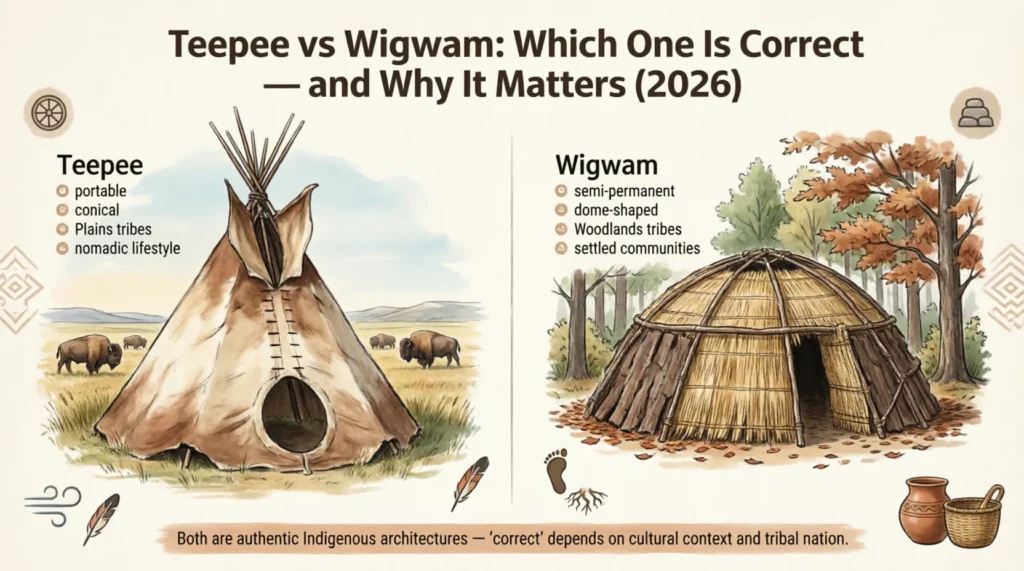
In short, both “teepee” (also spelled “tipi”) and “wigwam” are correct words, but they refer to two very different Indigenous dwellings with distinct shapes, materials, and cultural origins. A teepee is a conical, portable structure, while a wigwam is a dome-shaped, semi-permanent home. Understanding teepee vs wigwam helps you use each term correctly and respectfully, especially when writing or learning about Native American cultures.
The Confusion Around teepee vs wigwam
You’re writing a school essay and pause for a second. Is it teepee or wigwam? Or maybe you’re captioning a travel photo and suddenly doubt whether you’re using the right word. This moment of hesitation is exactly where most people encounter the confusion around teepee vs wigwam.
You’re not alone in this. Many learners, writers, and even adults mix up these terms because they often appear together in books, documentaries, or museum displays. At a glance, both look like “Native American houses,” so your brain tends to group them as the same thing.
The problem is that teepee vs wigwam actually describes two completely different structures. Once you understand the difference, you’ll never confuse them again.
What Each Word Actually Means
Let’s break down teepee vs wigwam in simple, clear language so you can finally separate them in your mind.
A teepee (also spelled tipi) is a noun that refers to a cone-shaped tent traditionally used by some Plains Indigenous peoples of North America. It is made from long wooden poles arranged in a circle and covered with animal hides or fabric. Teepees are designed to be portable, meaning people could move them easily when following buffalo herds.
Example sentence: The family set up their teepee quickly after arriving at the campsite.
A wigwam, on the other hand, is also a noun. It refers to a dome-shaped dwelling traditionally used by some Indigenous peoples of the Northeastern Woodlands. Wigwams are typically built with a frame of bent saplings covered in bark, mats, or reeds. Unlike teepees, they are usually more stationary and suited for longer-term settlement.
Example sentence: The wigwam was built near the river using bent branches and bark sheets.
When you compare teepee vs wigwam, the biggest difference is shape and mobility: cone-shaped and portable versus dome-shaped and semi-permanent.
You are an expert English grammar writer for a site that helps everyday readers understand confusing word pairs, spelling corrections, and grammar choices.
KEYWORD: [INSERT KEYWORD HERE] (Use Teepee vs Wigwam exactly as given above. Wherever an instruction, heading, or example mentions “Teepee vs Wigwam”, substitute that keyword directly into the text. Do NOT ask for confirmation, do NOT request a keyword, and do NOT leave any placeholder — begin writing the full article immediately.)
Your task is to write 2 NEW SECTIONS to be added to an existing blog post about Teepee vs Wigwam.
The existing post already covers: what each word means, why people confuse them, common mistakes, real-world examples, British vs American English, and a quick recap. Do NOT repeat or summarize any of those sections.
Write a clean comparison table with these 5 columns:
Feature
[Word 1]
[Word 2]
Include these 6 rows:
Meaning — one-line definition of each
Part of Speech — (noun / verb / adjective etc.)
Formality — (casual / formal / neutral)
Common Context — where you\’d see each word used
Example Sentence — one short sentence for each
Can They Be Swapped? — Yes / No / Sometimes (with a one-line reason)
Format as a standard markdown table. Keep every cell short (under 12 words). Write the intro line before the table as a single sentence: \”Here is a quick breakdown to make Teepee vs Wigwam easier to compare at a glance.\”
Do not add any text after the table.
SECTION 2: Real Sentence Fix — Teepee vs Wigwam Subtitle: See the Mistake, Fix the Mistake
Write a short intro (1 sentence): \”These are real mistakes people make with Teepee vs Wigwam — and the simple fix for each one.\”
Then write exactly 6 sentence pairs in this format:
❌ [Wrong sentence — a realistic mistake a real person would write in an email, school essay, or social media post] ✅ [Corrected sentence] 📌 Why: [One clear sentence explaining the fix — no jargon, Grade 7 reading level]
Rules for the 6 sentence pairs:
Each wrong sentence must reflect a genuinely common mistake (not an obvious/absurd error)
Cover different contexts: at least 1 professional/work, 1 casual/social, 1 academic, 1 digital/tech (if applicable to Teepee vs Wigwam), and 2 everyday life
The fix must change only what\’s necessary — keep the rest of the sentence identical
The \”Why\” explanation must be one sentence, plain English, no grammar jargon
Do not repeat the same mistake type twice
PLACEMENT INSTRUCTIONS (tell the writer where to insert):
Section 1 (Quick Comparison Table): Insert AFTER the \”What Each Word Actually Means\” section
Section 2 (Real Sentence Fix): Insert AFTER the \”Common Mistakes People Make\” section
WRITING STYLE RULES:
Grade 7-8 reading level (Flesch-Kincaid)
Warm, clear, and encouraging tone — like a patient teacher
No fluff, no filler sentences
Do not start any sentence with \”I\”
Do not include any FAQ section
Do not write a conclusion or closing paragraph
Output only the two sections, nothing else — no preamble, no \”here are your sections\” intro
INPUT: Keyword: Teepee vs Wigwam
Why People Mix Up teepee vs wigwam
The confusion around teepee vs wigwam comes from a mix of visual similarity and cultural oversimplification. From a distance, both structures look like simple “tent-like homes,” especially in cartoons, toys, or early school illustrations.
Linguists often point out that English learners tend to group unfamiliar cultural terms into one category when they share a theme. In this case, both terms relate to Indigenous housing, so your brain naturally blends them together.
Another reason is media representation. Movies, textbooks, and even museums sometimes fail to clearly distinguish between teepees and wigwams. When you repeatedly see them presented side by side without explanation, teepee vs wigwam starts to feel interchangeable—even though it isn’t.
The Simple Rule to Remember Which Is Which
Here’s an easy way to lock it in your memory: think “cone vs dome.”
A teepee is a cone. A wigwam is a dome. That’s it. Once you connect shape to word, teepee vs wigwam becomes much easier to separate in your mind.
You can also use this quick logic trick:
If you can imagine long poles meeting at a single point, it’s a teepee.
If you imagine a curved, rounded hut, it’s a wigwam.
Example sentences to reinforce it:
You saw a cone-shaped shelter in the documentary, so you correctly identified it as a teepee.
You described the rounded forest dwelling as a wigwam during your presentation.
You remembered the “cone vs dome” rule and finally stopped mixing up teepee vs wigwam.
Common Mistakes People Make With teepee vs wigwam
Using “wigwam” for any Native American tent — This is incorrect because wigwams are specifically dome-shaped structures. Correct version: “The museum displayed a wigwam with a curved wooden frame.”
Calling a teepee a permanent house — This is wrong because teepees are designed for mobility. Correct version: “The teepee could be dismantled and moved within hours.”
Assuming both words mean the same thing — This flattens two distinct cultural designs into one. Correct version: “The teepee vs wigwam distinction shows different architectural traditions.”
Swapping the words based on appearance alone — This happens when you guess from shape without knowing history. Correct version: “The cone-shaped teepee is different from the dome-shaped wigwam.”
Real Sentence Fix — teepee vs wigwam
See the Mistake, Fix the Mistake
These are real mistakes people make with teepee vs wigwam — and the simple fix for each one.
❌ The museum display showed a wigwam used by Plains tribes. ✅ The museum display showed a teepee used by Plains tribes. 📌 Why: Plains tribes are most commonly associated with teepees.
❌ We built a teepee model for our project on Eastern Woodland communities. ✅ We built a wigwam model for our project on Eastern Woodland communities. 📌 Why: Wigwams are traditionally linked to many Eastern Woodland communities.
❌ The report described the wigwam as easy to take down and move. ✅ The report described the teepee as easy to take down and move. 📌 Why: Teepees were designed to be portable.
❌ Just posted photos from the festival’s giant wigwam tent! ✅ Just posted photos from the festival’s giant teepee tent! 📌 Why: A cone-shaped tent is usually called a teepee.
❌ The camping app uses a wigwam icon to represent a portable tent. ✅ The camping app uses a teepee icon to represent a portable tent. 📌 Why: A teepee better matches the idea of a portable shelter.
❌ The history exhibit explained how families lived year-round in teepees in the forest region. ✅ The history exhibit explained how families lived year-round in wigwams in the forest region. 📌 Why: Wigwams were often used as longer-term homes in forested areas.
Real-World Examples: teepee vs wigwam Used Correctly
Casual conversation: “I always thought a wigwam and a teepee were the same, but now I can clearly tell them apart.” This shows everyday learning and correction of teepee vs wigwam confusion.
Professional writing: “The exhibit includes both a teepee and a wigwam to illustrate regional architectural differences.” This uses precise terminology in an educational context.
Academic writing: “The teepee vs wigwam distinction reflects diverse environmental adaptations among Indigenous cultures.” This demonstrates accurate, formal usage.
Creative writing: “Under the stars, the teepee stood tall on the open plains while the wigwam rested quietly in the forest.” This highlights visual and cultural contrast.
British English vs. American English — Does It Affect teepee vs wigwam?
There is no meaningful British or American English difference in teepee vs wigwam spelling or usage. Both terms are used internationally in the same way, and neither changes form based on region.
However, you may sometimes see “teepee” and “tipi” used interchangeably, with “tipi” being considered closer to the original Lakota spelling. Even so, both are widely accepted in modern writing.
So when you’re using teepee vs wigwam, your focus should be on meaning and cultural accuracy—not regional spelling differences.
What Grammar Checkers and Style Guides Say About teepee vs wigwam
Most grammar tools recognize both “teepee” and “wigwam” as valid nouns, but they don’t always explain the cultural distinction. That means autocorrect will usually not warn you if you misuse them.
Style guides tend to emphasize clarity and cultural respect. Language researchers often stress that understanding context matters more than spelling alone, especially when writing about Indigenous topics.
So while tools can help, they won’t fully protect you from confusion in teepee vs wigwam usage. Your understanding is the real key.
teepee vs wigwam in Professional and Academic Writing
Getting teepee vs wigwam right matters more than you might think in formal writing. In academic essays, using the wrong term can signal a lack of cultural understanding or research accuracy.
In professional settings like museum descriptions, educational content, or travel writing, precision builds credibility. Readers trust your work more when you correctly distinguish between these structures.
The good news is that once you understand the difference, you’ll rarely second-guess yourself again. You’ll write with more confidence and clarity every time.
Quick Recap: teepee vs wigwam at a Glance
A teepee is cone-shaped and portable
A wigwam is dome-shaped and more permanent
Teepees were commonly used on open plains
Wigwams were used in forested regions
The key difference in teepee vs wigwam is shape and structure
Frequently Asked Questions About teepee vs wigwam
Are teepees and wigwams the same thing?
No, they are not the same. A teepee is cone-shaped and portable, while a wigwam is dome-shaped and usually more permanent. People often confuse them, but teepee vs wigwam refers to two distinct structures.
Which is bigger, a teepee or a wigwam?
It depends on the design, but wigwams are often more compact and rounded, while teepees can be taller due to their cone structure. The purpose of each affects its size more than a fixed rule.
What is the main difference between teepee and wigwam?
The main difference is shape and mobility. Teepees are conical and designed for movement, while wigwams are dome-shaped and built for longer-term use. This is the core of teepee vs wigwam.
Can you use teepee and wigwam interchangeably?
No, you should not. Even though they are both traditional dwellings, they belong to different Indigenous cultures and serve different purposes. Using them correctly shows respect and accuracy.
Why do books confuse teepee vs wigwam so often?
Many books simplify Indigenous housing for younger audiences, which can blur the distinction. This is why teepee vs wigwam often appears incorrectly treated as the same thing.
Bonus Tip: A Third Term Often Confused With Both
A related structure, the “wickiup,” is sometimes lumped in with teepees and wigwams but is a distinct dome-shaped shelter historically used by Great Basin and Southwestern peoples, built from brush and grass rather than bark or hide. Knowing it exists helps you avoid flattening several distinct Indigenous dwelling traditions into just two words.
Final Thoughts on teepee vs wigwam
The difference between teepee vs wigwam comes down to something simple but important: shape, structure, and cultural origin. One is cone-shaped and portable, the other dome-shaped and more permanent.
This is one of those word pairs that seems confusing at first but becomes crystal clear once you visualize it. Now that you understand teepee vs wigwam, you can use both terms confidently and correctly in any context.
With this clarity, you’re not just memorizing vocabulary—you’re writing with more accuracy, awareness, and confidence than before.
Frequently Asked Questions
What is the main difference between a teepee and a wigwam?▼
A teepee is a conical, portable structure traditionally used by Plains Indigenous peoples, while a wigwam is a dome-shaped, semi-permanent home used by Indigenous peoples of the Northeastern Woodlands. Their shapes and intended uses reflect their cultural origins and lifestyles.
Why do people confuse the terms teepee and wigwam?▼
Many people mix up these terms because both look like ‘Native American houses’ and are often mentioned together in various media. This leads to a generalization that overlooks their distinct characteristics and cultural significance.
Can I use teepee and wigwam interchangeably?▼
No, you should not use teepee and wigwam interchangeably as they refer to different structures. Each term has specific cultural and historical contexts that must be respected.
What materials are used to construct a teepee?▼
A teepee is typically made from long wooden poles arranged in a circle and covered with animal hides or fabric. This construction allows for portability, making it ideal for nomadic lifestyles.
What is a common context where the term wigwam is used?▼
The term wigwam is often used in discussions about Indigenous cultures, particularly in educational settings or historical contexts related to the Northeastern Woodlands. It may also appear in literature or documentaries about Native American history.
How can understanding the difference between teepee and wigwam be beneficial?▼
Understanding the difference helps ensure respectful and accurate communication when discussing Native American cultures. It also enhances your knowledge about the diverse lifestyles and traditions of Indigenous peoples.
Are there any spelling variations for teepee?▼
Yes, teepee can also be spelled as ‘tipi.’ Both spellings are correct and refer to the same conical structure.
Maria Ramirez is an experienced editor and language consultant with over 10 years in the publishing world. She holds a Bachelor’s degree in Journalism and deeply appreciates the power of the written word. Her expertise lies in dissecting the complexities of English grammar and providing straightforward guidance for contemporary writers. Maria’s work focuses on simplifying spelling and usage rules, assisting both seasoned writers and budding authors in presenting their ideas with precision. Her involvement with WordlyRight stems from a commitment to nurture a global audience’s command over English, ensuring learners and professionals don’t just understand language nuances but use them effectively in varied contexts. As someone who passionately believes in lifelong learning, Maria continuously seeks to inspire this ethos in her readers.