
9 min read
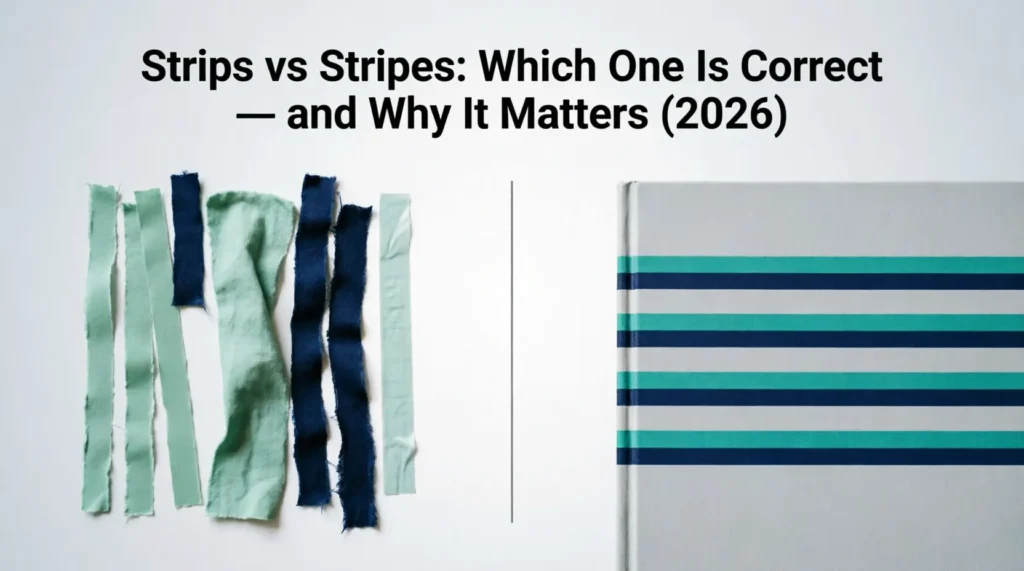
In short, “strips” and “stripes” are both correct English words, but they mean completely different things. “Strips” usually refers to thin pieces of material or the act of removing something, while “stripes” refers to lines or patterns. Understanding the difference will instantly improve your writing clarity and help you avoid one of the most common spelling confusions in English.
The Confusion Around Strips vs Stripes
You’re writing an email, finishing a school essay, or maybe posting something online, and suddenly you pause: should it be strips or stripes? It looks like both could work, and that tiny “e” makes you second-guess yourself.
This confusion around strips vs stripes is incredibly common because the words look almost identical at a glance. One extra letter completely changes the meaning, and that’s where many people get stuck.
You’re definitely not alone if you’ve ever mixed them up. Even confident writers sometimes hesitate when typing these two words quickly.
What Each Word Actually Means
Let’s break it down simply so you can see the difference clearly.
Strips is usually a noun or verb. As a noun, it means long, narrow pieces of something. As a verb, it means to remove or take something away.
Example: She cut the paper into thin strips for the project.
You can also use it as a verb: He strips the old paint from the wall.
On the other hand, stripes is always a noun in everyday use. It refers to lines, bands, or patterns—often repeated and decorative.
Example: The zebra has black and white stripes.
So while strips is about pieces or removal, stripes is about visual patterns and designs.
strips vs stripes: Side-by-Side Comparison
Here is a quick breakdown to make Strips vs Stripes easier to compare at a glance.
| Feature | Strips | Stripes |
|---|---|---|
| Meaning | Long narrow pieces | Long narrow lines or bands |
| Part of Speech | Noun, verb | Noun |
| Formality | Neutral | Neutral |
| Common Context | Paper, fabric, food pieces | Clothing, animals, patterns |
| Example Sentence | Cut the paper into strips. | The shirt has blue stripes. |
| Can They Be Swapped? | Sometimes | Sometimes |
| Refers to separate pieces. | Refers to lines or patterns. |
Why People Mix Up Strips vs Stripes
The main reason people confuse strips vs stripes is simple: they sound almost identical when spoken quickly. Linguists often point out that English spelling confusion frequently comes from words that are phonetically close but semantically different.
Another reason is visual similarity. The only difference is one extra “e,” and your brain can easily skip over it when typing fast or not paying full attention.
There’s also a cognitive pattern at play: people tend to assume a word is just a plural form or variation of another word they already know. That’s why many learners incorrectly assume both words mean similar things.
The Simple Rule to Remember Which Is Which
Here’s an easy trick that will help you never confuse strips vs stripes again:
If you’re talking about pieces or removal, use strips. If you’re talking about lines or patterns, use stripes.
Think of it like this: stripes have “lines” in them, and the extra “e” can remind you of “equal lines.”
Examples:
- The chef cuts the chicken into strips for cooking.
- The flag has red and white stripes.
- She strips the sticker off the bottle, but notices the striped design underneath.
Common Mistakes People Make With Strips vs Stripes
- Using “stripes” when talking about cutting food into pieces
Incorrect: She made stripes of chicken for the salad.
Correct: She made strips of chicken for the salad. - Using “strips” to describe clothing patterns
Incorrect: He wore a shirt with blue strips.
Correct: He wore a shirt with blue stripes. - Confusing verb and noun usage
Incorrect: The zebra strips are black and white.
Correct: The zebra stripes are black and white. - Assuming both words are interchangeable
Incorrect: The design has both strips and stripes. (when only patterns are meant)
Correct: The design has stripes.
Real Sentence Fix — strips vs stripes
See the Mistake, Fix the Mistake
These are real mistakes people make with strips vs stripes — and the simple fix for each one.
❌ The new company logo uses colorful strips across the background.
✅ The new company logo uses colorful stripes across the background.
📌 Why: A logo design uses lines or bands, not separate pieces.
❌ Just bought a shirt with red strips and white strips.
✅ Just bought a shirt with red stripes and white stripes.
📌 Why: Clothing patterns are called stripes.
❌ The zebra’s strips help it blend into its environment.
✅ The zebra’s stripes help it blend into its environment.
📌 Why: The markings on a zebra are stripes.
❌ The webpage header contains blue strips for decoration.
✅ The webpage header contains blue stripes for decoration.
📌 Why: Decorative lines on a screen are usually called stripes.
❌ Cut the carrots into thin stripes before cooking.
✅ Cut the carrots into thin strips before cooking.
📌 Why: Long narrow pieces of food are strips.
❌ For the science project, glue several paper stripes onto the poster.
✅ For the science project, glue several paper strips onto the poster.
📌 Why: Separate pieces of paper are strips, not stripes.
Real-World Examples: Strips vs Stripes Used Correctly
- Casual conversation: I bought bacon strips for breakfast this morning.
This works because you’re referring to thin pieces of food. - Professional writing: The packaging includes adhesive strips for easy sealing.
Here, “strips” describes functional materials. - Academic context: The study analyzed visual perception of zebra stripes in natural environments.
This uses “stripes” correctly as a pattern reference. - Creative writing: Moonlight fell across the curtains in soft silver stripes.
This uses “stripes” to describe visual imagery and artistic effect.
British English vs. American English — Does It Affect Strips vs Stripes?
There is no significant British vs American spelling difference when it comes to strips vs stripes. Both forms are used the same way in all major English dialects.
The confusion isn’t regional—it’s structural. The two words exist side by side in both varieties of English, and they simply mean different things.
So whether you’re writing in the UK, the US, or anywhere else, the rule stays the same. Context, not geography, determines which word you should use.
What Grammar Checkers and Style Guides Say About Strips vs Stripes
Most grammar tools and style guides treat strips vs stripes as a context-based distinction rather than a spelling error. If you use the wrong one, it may or may not be flagged depending on the sentence.
For example, if your sentence still forms a valid word, autocorrect might not catch the mistake. That’s why relying only on spellcheck can be risky.
Language experts generally emphasize understanding meaning over depending on tools. If you know the rule, you’ll write more accurately than any automated checker can guarantee.
Strips vs Stripes in Professional and Academic Writing
Getting strips vs stripes right matters more than it might seem, especially in formal writing. In job applications, academic essays, or published content, small word errors can distract the reader and reduce clarity.
For example, writing “stripes of metal” instead of “strips of metal” could confuse your meaning entirely. Precision shows attention to detail, which is highly valued in professional communication.
The good news is that once you understand the difference, you rarely forget it. You gain confidence in your writing, and you stop second-guessing yourself every time these words appear.
Quick Recap: Strips vs Stripes at a Glance
- Strips = thin pieces or the act of removing something
- Stripes = lines or repeated patterns
- The extra “e” in stripes signals visual patterns
- Strips is often a verb or noun related to cutting or removing
- Stripes is always about design, markings, or patterns
Frequently Asked Questions About Strips vs Stripes
Is it strips or stripes for clothing patterns?
It is always “stripes” when talking about clothing patterns. The word refers to lines or designs on fabric, like a striped shirt or dress.
What is the difference between strips and stripes in food?
“Strips” refers to pieces of food cut into long shapes, like chicken strips or bacon strips. “Stripes” would not be correct in this context.
Why do strips and stripes sound the same?
They sound the same because they share the same root pronunciation, but the added “e” in stripes changes the meaning entirely. This is a common English spelling trap.
Can strips and stripes ever mean the same thing?
No, they cannot be used interchangeably. Each word has a distinct meaning, and using the wrong one changes the sentence’s meaning.
How do I quickly remember strips vs stripes?
Remember: strips are pieces you cut, stripes are lines you see. That simple contrast helps most people avoid confusion instantly.
Final Thoughts on Strips vs Stripes
The difference between strips vs stripes comes down to meaning, not just spelling. One refers to pieces or removal, while the other refers to patterns and lines.
Once you internalize this simple distinction, you’ll stop hesitating every time you use either word. This is one of those small grammar wins that makes your writing instantly clearer and more professional.
Now that you understand it, you can write with more confidence and never mix them up again.
Frequently Asked Questions
What is the main difference between 'strips' and 'stripes'?▼
‘Strips’ refers to thin pieces of material or the act of removing something, while ‘stripes’ denotes lines or patterns. Understanding this difference can enhance your writing clarity and help prevent common spelling mistakes.
Can 'strips' and 'stripes' be used interchangeably in sentences?▼
While there are contexts where they might seem interchangeable, generally, they cannot be swapped without changing the meaning. ‘Strips’ relates to pieces or removal, while ‘stripes’ relates to lines or patterns.
What are some common contexts for using 'strips'?▼
‘Strips’ is commonly used in contexts involving paper, fabric, or food, such as cutting vegetables or materials into narrow pieces. For example, you might say, ‘She cut the paper into strips for the project.’
How can I remember which word to use between 'strips' and 'stripes'?▼
A simple trick is to remember that if you are discussing pieces or removal, use ‘strips’. If you are referring to lines or patterns, opt for ‘stripes’, since ‘stripes’ contains the word ‘lines’.
What are some common mistakes people make with 'strips' and 'stripes'?▼
Common mistakes include using ‘stripes’ when referring to cutting food into pieces or using ‘strips’ to describe clothing patterns. For instance, saying ‘She made stripes of chicken’ is incorrect; the correct phrase is ‘She made strips of chicken’.
Why do people often confuse 'strips' and 'stripes'?▼
The confusion arises mainly because the two words sound similar when spoken quickly and look almost identical in writing. The addition of just one letter can lead to misunderstandings, especially for those who assume they are variations of each other.
Is there a formal context where 'strips' and 'stripes' are used differently?▼
Both ‘strips’ and ‘stripes’ are considered neutral in formality and can be used in various contexts, including writing and conversation. However, their meanings remain distinct regardless of the setting.
Quick Tip: Singular Usage Still Trips People Up
Even in the singular, the distinction holds: “a strip” is one narrow cut piece (a strip of paper), while “a stripe” is one single band of color or pattern (a stripe on a flag). Related read: if you also mix up look-alike plural pairs, see our Stripes vs Strips comparison for the reverse-order version of this same pair.

Rebecca Nguyen brings a diverse background in journalism and education to her role at WordlyRight. A graduate of the University of Toronto with a focus in English and Linguistics, she has spent over 12 years honing her skills as a writer and educator. Rebecca’s expertise lies in her ability to simplify daunting grammar rules and rectify frequent spelling mistakes in a way that resonates with students and professionals alike. Her articles on WordlyRight zero in on the most common word confusions encountered by writers, turning complex concepts into clear, actionable insights. With a passion for lifelong learning, Rebecca continually seeks to refine her understanding of language to better serve her audience.