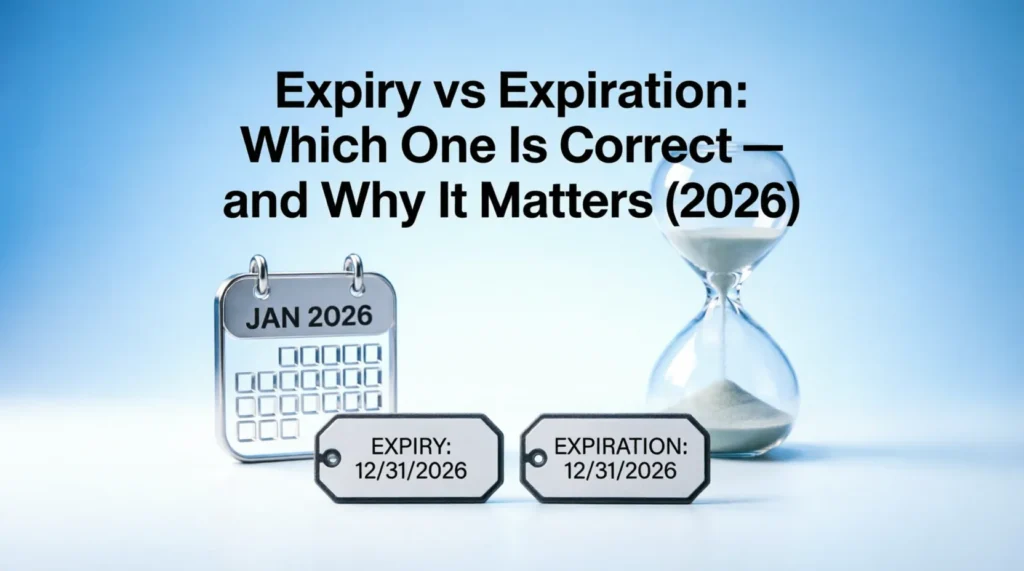
In short, both expiry and expiration are correct, but they are used in different varieties of English. “Expiry” is more common in British English, while “expiration” is preferred in American English, especially in formal or legal contexts. Understanding which one fits your situation will help you write more naturally and confidently.
If you’ve ever paused while writing a label, email, or essay and wondered which form sounds right, you’re not alone — this confusion comes up more often than you think, and the difference is easier to understand than it first appears.
The Confusion Around expiry vs expiration
You’re typing a message, maybe reminding someone about a document deadline, and suddenly you hesitate. Should you write expiry vs expiration? Both look correct. Both sound formal. Yet something tells you only one is “right.”
This moment of doubt is extremely common. Students writing essays, professionals drafting policies, and even content writers often stop mid-sentence over this exact choice.
The confusion usually grows because you see both versions in real life. Medicine labels might say “expiry date,” while legal or business documents use “expiration date.” That overlap makes it feel like there’s a hidden rule you’re missing.
The truth is simpler: the difference is not about correctness, but about regional preference and context. Once you understand that, expiry vs expiration stops being a problem and becomes a choice you can make confidently.
What Each Word Actually Means
Let’s break it down in plain language so you can clearly see how expiry vs expiration works in real usage.
Expiry is a noun. It refers to the moment something ends or becomes invalid. It is widely used in British English and in everyday situations like packaging, medicine, and informal communication.
For example:
“Check the expiry date on the milk before drinking it.”
Here, expiry simply means the point when something is no longer usable.
Expiration is also a noun. It means the same basic idea — the end of validity — but it is more common in American English and formal contexts like law, business, and official documents.
For example:
“The expiration of the contract will occur next month.”
In this case, expiration feels more formal and structured, which is why it often appears in legal and administrative writing.
So, when comparing expiry vs expiration, you’re not comparing meaning — you’re comparing usage style and regional preference rather than definition.
expiry vs expiration: Side-by-Side Comparison
Here is a quick breakdown to make the expiry vs expiration easier to compare at a glance.
Feature
expiry
expiration
Meaning
The end of validity
The end of validity
Part of Speech
Noun
Noun
Formality
Neutral
Neutral
Common Context
UK documents, labels
US documents, labels
Example Sentence
Check the expiry date.
Check the expiration date.
Can They Be Swapped?
Sometimes
Sometimes — depends on regional preference.
Why People Mix Up expiry vs expiration
The confusion around expiry vs expiration happens for a few clear reasons, and linguists often point to overlap in exposure as the main cause.
First, both words come from the same Latin root “exspirare,” meaning “to breathe out” or “come to an end.” That shared origin makes them feel interchangeable in modern English.
Second, you encounter both in daily life depending on context. A medicine bottle might say “expiry date,” while a visa document says “expiration date.” Your brain naturally assumes both are standard everywhere.
Finally, pronunciation similarity plays a role. When spoken, the words feel almost interchangeable, so your mind stores them as equivalents even though their usage patterns differ.
All of this creates the impression that expiry vs expiration is a grammar rule you must memorize, when in reality it is mostly about regional convention and style preference.
The Simple Rule to Remember Which Is Which
Here’s an easy way to never get stuck on expiry vs expiration again:
Use expiry when you want a shorter, more everyday British-style word.
Use expiration when you want a formal, American-style or legal tone.
A simple memory trick: “E for Extended formal, X for everyday expiry confusion” — think of expiration as the more official version.
Now let’s see it in action:
“The expiry of the product makes it unsafe to use after today.”
“The expiration of the subscription will be notified by email.”
“Always check the expiry date before taking medication.”
Once you apply this rule a few times, expiry vs expiration becomes automatic rather than confusing.
Common Mistakes People Make With expiry vs expiration
Here are some realistic errors people make when dealing with expiry vs expiration:
Using “expiry” in formal legal writing Incorrect: “The expiry of the agreement is binding.” Correct: “The expiration of the agreement is binding.”
Using “expiration” in casual packaging labels Incorrect: “Check the expiration date on the yogurt.” (British usage context) Correct: “Check the expiry date on the yogurt.”
Assuming one is incorrect Incorrect belief: “Expiry is not proper English.” Correct understanding: Both are correct depending on region.
Mixing tone within one document Incorrect: Switching between expiry and expiration in the same policy. Correct: Choose one style and stay consistent throughout.
Real Sentence Fix — expiry vs expiration
See the Mistake, Fix the Mistake
These are real mistakes people make with the expiry vs expiration — and the simple fix for each one.
❌ Please check the expiration date before renewing your passport. ✅ Please check the expiry date before renewing your passport. 📌 Why: In British English, expiry date is the more natural choice.
❌ My gym membership reaches its expiration next week. ✅ My gym membership reaches its expiry next week. 📌 Why: Expiry fits better after “reaches its” in this everyday situation.
❌ The report discusses the expiry of radioactive materials. ✅ The report discusses the expiration of radioactive materials. 📌 Why: Academic and scientific writing often prefers expiration.
❌ Your password expiry is set for tomorrow in the app. ✅ Your password expiration is set for tomorrow in the app. 📌 Why: Many software systems and digital settings use password expiration.
❌ Don’t forget to check the milk’s expiration if you’re shopping. ✅ Don’t forget to check the milk’s expiry if you’re shopping. 📌 Why: Expiry is the usual wording on many British food labels.
❌ The coupon expiry is December 31 on the website. ✅ The coupon expiration is December 31 on the website. 📌 Why: Many American websites and promotions use expiration for coupons.
Real-World Examples: expiry vs expiration Used Correctly
“Please check the expiry date on the medicine before use.” This is common in everyday consumer packaging, especially in British English regions.
“The expiration of your passport must be renewed before travel.” This fits formal government and travel documentation.
“We will notify you before the expiry of your subscription.” This is typical in customer service communication.
“The contract’s expiration triggered a renegotiation process.” This shows formal business writing where precision matters.
British English vs. American English — Does It Affect expiry vs expiration?
Yes, this is where most of the difference comes from in expiry vs expiration.
In British English, “expiry” is widely preferred in everyday usage, especially in consumer products, packaging, and informal writing. You’ll see it on medicine bottles, food packaging, and general instructions.
In American English, “expiration” is the standard term, particularly in legal, financial, and administrative contexts. It appears on credit cards, legal contracts, and official documents.
Both forms are understood globally, and neither is wrong. However, mixing them in one document can make your writing feel inconsistent.
Language researchers often note that this difference is more about convention than grammar rules, which means your audience determines the better choice.
What Grammar Checkers and Style Guides Say About expiry vs expiration
Most grammar tools and style guidelines treat expiry vs expiration as a regional variation rather than an error. You might notice that spellcheck does not flag either word because both are valid nouns.
However, style guides emphasize consistency. If you start with “expiry,” you should continue using it throughout the document. The same applies to “expiration.”
The key takeaway is that tools can help you catch spelling mistakes, but they cannot decide which regional style you are following. That decision is yours as a writer.
expiry vs expiration in Professional and Academic Writing
In professional writing, choosing correctly between expiry vs expiration helps your work look polished and intentional.
In business emails, using the wrong version for your audience can make your writing feel slightly out of place. For example, using “expiry” in a strict American legal document may seem informal.
In academic writing, especially in linguistics, law, or international studies, precision matters even more. The correct usage shows awareness of audience and context, not just grammar knowledge.
Once you understand this distinction, you stop second-guessing yourself and start writing with more confidence. The choice becomes strategic rather than stressful.
Quick Recap: expiry vs expiration at a Glance
Both words are correct nouns meaning the end of validity
“Expiry” is more common in British English
“Expiration” is preferred in American English
Context and audience decide which one you should use
Consistency matters more than the choice itself
Frequently Asked Questions About expiry vs expiration
Is expiry the same as expiration?
Yes, expiry and expiration mean the same thing in terms of definition. The only difference is regional usage, with expiry being more common in British English and expiration in American English.
Which is more formal, expiry or expiration?
Expiration is generally considered more formal, especially in legal and administrative writing. Expiry is more common in everyday usage and product labeling.
Can I use expiry and expiration interchangeably?
You can, but only if your audience does not require strict regional consistency. In professional writing, it is better to stick to one form throughout.
Why do some products say expiry date and others expiration date?
This depends on the country and language standard used by the manufacturer. British-influenced regions often use expiry date, while American-influenced regions use expiration date.
Is expiry wrong in American English?
No, it is not wrong, but it is less commonly used. In American English, expiration is the preferred standard form in most formal contexts.
Final Thoughts on expiry vs expiration
The difference between expiry vs expiration is not about right or wrong — it’s about style, region, and context. Both words describe the same idea: something coming to an end.
Once you understand that expiry vs expiration depends on audience and tone, you stop worrying about mistakes and start making intentional writing choices.
With this clarity, you can now use both forms confidently, knowing exactly when each one belongs — and that alone makes your writing stronger and more professional going forward.
Frequently Asked Questions
What is the main difference between expiry and expiration?▼
The main difference lies in regional usage; ‘expiry’ is more commonly used in British English, while ‘expiration’ is preferred in American English. Both terms refer to the end of validity, but their application can vary depending on the context.
In what contexts should I use expiry versus expiration?▼
Use ‘expiry’ in everyday situations like packaging and informal communication, especially in British contexts. Conversely, ‘expiration’ is best suited for formal scenarios such as legal documents and business communications, particularly in American English.
Can I use expiry and expiration interchangeably?▼
While both terms convey the same meaning, their interchangeability depends on regional preference. In informal British contexts, ‘expiry’ is preferred, whereas ‘expiration’ is the choice for formal American contexts.
Why do people often confuse expiry and expiration?▼
The confusion arises from their shared Latin root ‘exspirare’ and the overlap in their usage in daily life. Additionally, the similar pronunciation can lead to the perception that they are interchangeable.
What are some examples of how to use expiry and expiration in sentences?▼
You might say, ‘Check the expiry date on the milk’ to refer to a British context. In a legal context, you would use, ‘The expiration of the contract will occur next month’ to indicate formality and American usage.
Is there a simple rule to remember when to use expiry or expiration?▼
A simple rule is to associate ‘expiry’ with British English and informal contexts, while linking ‘expiration’ to American English and formal situations. Understanding this regional preference can help you choose the correct term confidently.
What should I do if I'm unsure which term to use?▼
If you’re unsure, consider the audience and context of your writing. If it’s formal and American, use ‘expiration’; for informal and British contexts, go with ‘expiry’ to ensure clarity and appropriateness.
James Williams has been fascinated by the intricacies of the English language since his childhood days. Holding a Master’s degree in Linguistics from the University of Cambridge, he has spent over 15 years working as a professional editor and language consultant. James specializes in deciphering complex spelling and grammatical issues, and he is passionate about helping students and professionals alike gain confidence in their writing. His experience includes developing educational content for ESL learners, ensuring clarity and precision in communication. James is dedicated to providing readers with easy-to-follow guidance that resolves word confusions and common spelling errors, making WordlyRight an essential resource for anyone who needs quick, authoritative answers.