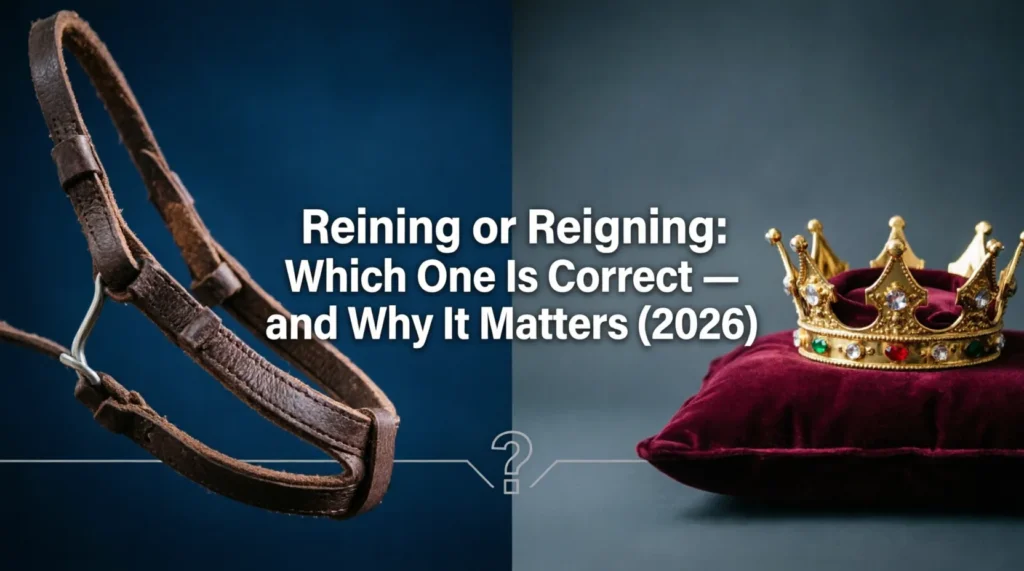
In short, “reigning” is the correct word when talking about ruling, dominating, or being the current champion, while “reining” refers to controlling a horse using reins. These two words sound identical but have completely different meanings, which is why confusion is so common. Keep reading to finally master reining or reigning with confidence in any writing situation.
The Confusion Around reining or reigning
You’re writing an email, and you want to say someone is the “current champion.” You pause. Is it reining or reigning? It looks simple, but suddenly your brain second-guesses everything.
Or maybe you’re typing a social media caption about a leader “still at the top,” and again, reining or reigning pops into your mind. You know what you mean—but the spelling doesn’t feel safe.
This is one of those English traps where your intuition almost works against you. The words sound identical, so your fingers hesitate even when your meaning is clear.
What Each Word Actually Means
Let’s break down reining or reigning in the simplest way possible.
“Reigning” is a verb form of the word reign, which means to rule or hold power. It is also used for someone who is currently the best or champion in a category. In everyday writing, this is the word you will use most often.
Example: The reigning world champion defended her title successfully.
“Reining” comes from the noun rein, which refers to the straps used to control a horse. As a verb, it means to guide, control, or restrain something, usually a horse.
Example: The rider is reining the horse through the obstacle course.
So when comparing reining or reigning, only one relates to power, leadership, or dominance, while the other is about physical control of an animal.
reining or reigning: Side-by-Side Comparison
Here is a quick breakdown to make the reining or reigning easier to compare at a glance.
Feature
Reining
Reigning
Meaning
Controlling or holding back
Ruling or being dominant
Part of Speech
Verb (present participle)
Verb (present participle)
Formality
Neutral
Neutral
Common Context
Horses, control, limits
Royalty, leadership, dominance
Example Sentence
She is reining in spending.
The team is reigning champions.
Can They Be Swapped?
No
No
Means controlling something.
Means ruling or leading.
Why People Mix Up reining or reigning
The confusion around reining or reigning exists mainly because they are perfect homophones—they sound exactly the same when spoken. Linguists often point out that English has many such word pairs where pronunciation gives no clue about spelling.
Another reason is that both words feel like they could be correct. English learners often assume “reining” might be a creative spelling of “reign-ing,” especially because the word “reign” already exists. This makes the mistake feel logical, even though it is incorrect in most contexts.
Finally, modern typing habits make the issue worse. When you’re writing quickly on phones or keyboards, your brain relies on sound rather than structure. That’s why reining or reigning becomes a frequent search query for writers trying to double-check themselves.
The Simple Rule to Remember Which Is Which
Here’s an easy trick that works every time:
If you’re talking about power, leadership, or being the best → use “reigning.” If you’re talking about horses or physical control → use “reining.”
Think of it this way: a king reigns, a rider reins.
Now apply reining or reigning in real context:
The reigning champion stayed undefeated all season.
She is reigning over the competition with confidence.
The trainer is reining the horse gently through the arena.
Common Mistakes People Make With reining or reigning
Using “reining champion” instead of “reigning champion” Incorrect: He is the reining boxing champion. Correct: He is the reigning boxing champion.
Assuming “reining” means ruling Incorrect: She is reining over the company. Correct: She is reigning over the company.
Over-correcting and replacing “reining” incorrectly Incorrect: The rider is reigning the horse. Correct: The rider is reining the horse.
Mixing both words in the same sentence due to uncertainty Incorrect: The reigning rider was reining the horse perfectly. Correct: The reigning champion watched the rider reining the horse perfectly.
Real Sentence Fix — reining or reigning
See the Mistake, Fix the Mistake
These are real mistakes people make with the reining or reigning — and the simple fix for each one.
❌ The company is reigning in unnecessary expenses this quarter. ✅ The company is reining in unnecessary expenses this quarter. 📌 Why: Use reining in when talking about controlling or reducing something.
❌ We are all reigning in our excitement until the announcement. ✅ We are all reining in our excitement until the announcement. 📌 Why: The phrase means holding back emotions, not ruling over them.
❌ The government is reigning in inflation through new policies. ✅ The government is reining in inflation through new policies. 📌 Why: Inflation is being controlled, so reining in is the correct choice.
❌ The software update is reigning in spam messages. ✅ The software update is reining in spam messages. 📌 Why: The update is limiting spam, which matches the meaning of reining in.
❌ The reigning champion tried to rein in her opponent. ✅ The reigning champion tried to rein in her opponent. 📌 Why: Reigning champion means the current title holder, so no extra “g” is needed in rein.
❌ The reigning queen was reining the kingdom for decades. ✅ The reigning queen was reigning over the kingdom for decades. 📌 Why: A queen rules a kingdom, so reigning is the correct word.
Real-World Examples: reining or reigning Used Correctly
The reigning Olympic champion is expected to compete again next year. This works because it describes someone currently holding a title.
She is reining in her emotions before giving the speech. This shows “reining” used metaphorically as control, derived from horse riding.
The reigning monarch addressed the nation during the ceremony. This is correct because it refers to a person in power.
The rider practiced reining techniques for better control in competitions. This is correct in an equestrian context.
British English vs. American English — Does It Affect reining or reigning?
There is no major British vs. American spelling difference when it comes to reining or reigning. Both varieties of English use “reigning” for rule or dominance and “reining” for horse control.
This means the confusion is global, not regional. Language researchers note that this type of spelling issue comes from sound similarity rather than dialect differences.
So no matter where you are writing from, the same rule applies consistently.
What Grammar Checkers and Style Guides Say About reining or reigning
Most grammar tools correctly flag “reining” when you mean ruling or dominance. However, they don’t always catch the mistake if your sentence is too vague.
Style guides consistently recommend relying on context rather than spelling similarity alone. The meaning of reining or reigning depends entirely on whether you are referring to control of power or control of movement.
In practice, this means you cannot fully rely on autocorrect. Understanding the difference yourself is far more reliable than depending on software suggestions.
reining or reigning in Professional and Academic Writing
In professional writing, using the correct form of reining or reigning is important because it directly affects clarity. A wrong spelling can make a strong sentence look careless, especially in resumes, articles, or academic essays.
For example, writing “reining champion” in a sports article can confuse readers and weaken credibility, even if the rest of the content is strong.
Once you master the distinction, you eliminate one of the most common English slip-ups. That small confidence boost shows up in every email, document, and publication you write.
Quick Recap: reining or reigning at a Glance
“Reigning” = ruling, leading, or currently the best
“Reining” = controlling a horse or guiding movement
They sound identical but are never interchangeable
Context is the only way to choose correctly
“A king reigns, a rider reins” is the key memory trick
Frequently Asked Questions About reining or reigning
Is it reigning champion or reining champion?
It is “reigning champion.” This refers to someone who currently holds a title or position. “Reining” is incorrect in this context because it relates to horse control, not competition or dominance.
What does reining mean in simple English?
Reining means guiding or controlling a horse using reins. It can also be used metaphorically to mean controlling emotions or actions, but its root meaning is always tied to horse riding.
Why do reining or reigning sound the same?
They are homophones, which means they are pronounced the same but spelled differently. English has many such word pairs, and this is a common source of spelling confusion.
Can reigning be used without a king or queen?
Yes. “Reigning” is often used for sports champions, leaders in industries, or anyone currently holding the top position in a category.
Is reining ever used in formal writing?
Yes, but only in equestrian contexts or metaphorical expressions about control. It is not used for leadership or ranking situations.
Final Thoughts on reining or reigning
The difference between reining or reigning comes down to one simple idea: one is about power, and the other is about control of movement. Once you see that distinction clearly, the confusion disappears almost instantly.
This is one of those English pairings that trips up even confident writers, so you are not alone in second-guessing it. Now that you understand the rule, you can use both words correctly without hesitation.
With this clarity, you’ll write more confidently, avoid a common mistake, and never pause again when choosing between reining or reigning.
Frequently Asked Questions
What is the difference between 'reining' and 'reigning'?▼
‘Reigning’ refers to ruling or being the current champion, while ‘reining’ involves controlling a horse using reins. Despite sounding the same, these words have distinct meanings that are important in writing.
When should I use 'reigning' in a sentence?▼
‘Reigning’ should be used when discussing leadership, power, or championship status. For example, you would say, ‘The reigning world champion defended her title successfully’ to indicate someone currently holds that title.
Can I use 'reining' when talking about a leader?▼
No, ‘reining’ should not be used to describe a leader or champion. It specifically refers to controlling a horse, so the correct term in a leadership context is ‘reigning’.
Why do people confuse 'reining' and 'reigning'?▼
The confusion arises because both words are homophones, sounding identical when spoken. Additionally, English learners may mistakenly assume ‘reining’ is a variation of ‘reign’, further complicating the issue.
What is an easy way to remember which word to use?▼
A simple trick is to associate ‘reigning’ with power and leadership, while ‘reining’ relates to horses and physical control. Remember: a king reigns, and a rider reins.
Can I say 'reining champion' instead of 'reigning champion'?▼
No, ‘reining champion’ is incorrect; the proper phrase is ‘reigning champion’. The term ‘reigning champion’ correctly conveys that someone currently holds the championship title.
What context is appropriate for using 'reining'?▼
You should use ‘reining’ when discussing horse control or related activities. For instance, ‘The rider is reining the horse through the obstacle course’ accurately describes the action of guiding a horse.
Rebecca Nguyen brings a diverse background in journalism and education to her role at WordlyRight. A graduate of the University of Toronto with a focus in English and Linguistics, she has spent over 12 years honing her skills as a writer and educator. Rebecca’s expertise lies in her ability to simplify daunting grammar rules and rectify frequent spelling mistakes in a way that resonates with students and professionals alike. Her articles on WordlyRight zero in on the most common word confusions encountered by writers, turning complex concepts into clear, actionable insights. With a passion for lifelong learning, Rebecca continually seeks to refine her understanding of language to better serve her audience.