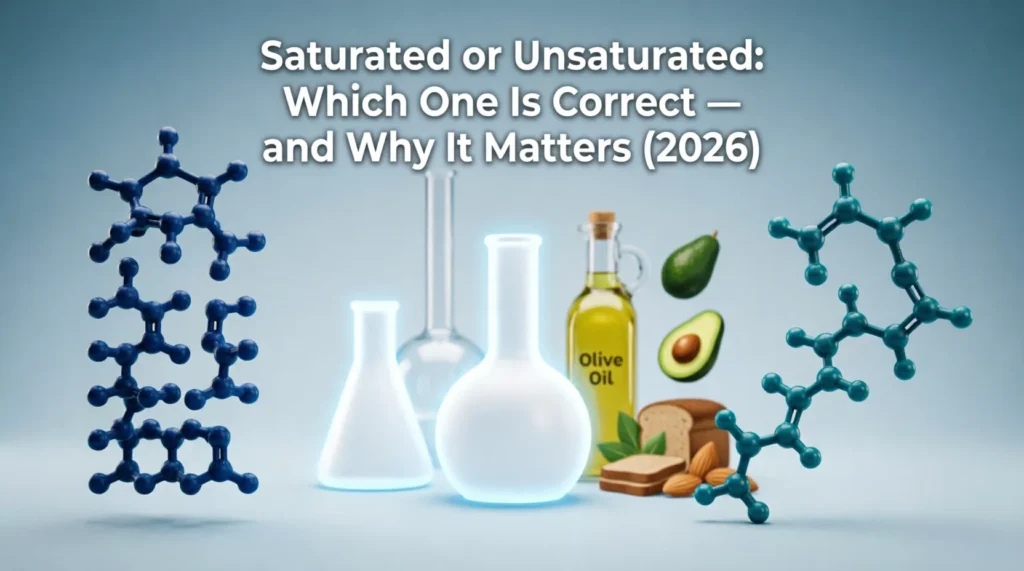
In short, both terms are correct, but they are not interchangeable because they describe different chemical states of fats, bonds, or solutions depending on context. People often confuse them because they sound similar and appear in everyday topics like food labels and science lessons. Once you understand the difference, you’ll never second-guess their meaning again.
The Confusion Around saturated or unsaturated
You’re writing a biology answer or reading a nutrition label, and suddenly you pause. Is it “saturated fat” or “unsaturated fat,” and what exactly is the difference? That moment of doubt is exactly where most people get stuck with saturated or unsaturated.
Students, writers, and even health-conscious shoppers often mix these terms up because they show up side by side in the same topics. You might see them on cooking oil bottles, diet articles, or science exams, and your brain assumes they’re just variations of the same idea.
The truth is, saturated or unsaturated refers to two different chemical conditions. The confusion is completely normal, and you’re definitely not the only one who hesitates when choosing the right term.
What Each Word Actually Means
To understand saturated or unsaturated, you need to think about how molecules are built, especially fats in food chemistry.
Saturated is an adjective used in chemistry and nutrition. It describes a fat or compound where carbon atoms are fully “filled” with hydrogen atoms and contain no double bonds. In simple terms, everything in the structure is tightly packed. Example: Butter is rich in saturated fat, which is solid at room temperature.
Unsaturated is also an adjective, but it describes fats that have one or more double bonds in their structure, meaning they are not fully “filled” with hydrogen. This creates bends or gaps in the molecule. Example: Olive oil contains unsaturated fats, which tend to stay liquid.
So when you see saturated or unsaturated, you’re really comparing two structural states of fats rather than two random vocabulary choices. One is fully filled; the other has space or flexibility in its structure.
saturated or unsaturated: Side-by-Side Comparison
Here is a quick breakdown to make the saturated or unsaturated easier to compare at a glance.
Feature
Saturated
Unsaturated
Meaning
Filled to capacity
Not filled to capacity
Part of Speech
Adjective
Adjective
Formality
Neutral
Neutral
Common Context
Chemistry, fats, colors, markets
Chemistry, fats, markets, solutions
Example Sentence
The soil was saturated after rain.
The solution remained unsaturated.
Can They Be Swapped?
Sometimes
Sometimes
Depends on whether fullness is intended.
Depends on whether fullness is intended.
Why People Mix Up saturated or unsaturated
The confusion around saturated or unsaturated mainly comes from how closely the words appear in everyday language. They are taught together in school, often in the same lesson, which makes your brain store them as a pair instead of opposites.
Linguists often point out that pairing similar-sounding scientific adjectives increases recall errors. Since both words share the same root idea of “saturation,” it becomes easy to assume they are just degrees of the same thing rather than distinct categories.
Another reason is context switching. You might hear them in nutrition, chemistry, and even skincare discussions, where the meaning shifts slightly. That overlap makes it harder to lock in a single, stable definition in your memory.
The Simple Rule to Remember Which Is Which
Here’s an easy way to remember saturated or unsaturated: think of “S” for “solid and stacked,” and “U” for “unstable and unsmooth.”
If it’s saturated, the structure is packed tight with no gaps. If it’s unsaturated, the structure has bends or spaces because it is not fully filled.
You can test it in your mind: if the fat is solid at room temperature, it’s saturated; if it is liquid, it’s unsaturated.
Examples:
Butter is saturated because it stays solid in the fridge and even at room temperature.
Olive oil is unsaturated because it flows easily and stays liquid.
Coconut oil is mostly saturated but behaves differently depending on temperature.
Common Mistakes People Make With saturated or unsaturated
Writing “unsaturated fat” when describing butter. The correct version is “saturated fat,” since butter is solid and structurally full.
Assuming all oils are unsaturated. Some oils, like coconut oil, are mostly saturated depending on processing and temperature.
Using the terms as synonyms in essays. Saying they mean the same thing is incorrect because they describe opposite structures.
Confusing dietary meaning with chemical meaning. Some students write about saturated or unsaturated without linking it to molecular structure, which weakens accuracy.
Real Sentence Fix — saturated or unsaturated
See the Mistake, Fix the Mistake
These are real mistakes people make with saturated or unsaturated — and the simple fix for each one.
❌ This market is unsaturated with competitors, so entering it will be difficult. ✅ This market is saturated with competitors, so entering it will be difficult. 📌 Why: A crowded market is described as saturated, not unsaturated.
❌ The ground was unsaturated after three days of heavy rain. ✅ The ground was saturated after three days of heavy rain. 📌 Why: Heavy rain usually fills the soil with water.
❌ The report explains how saturated fats are usually liquid at room temperature. ✅ The report explains how unsaturated fats are usually liquid at room temperature. 📌 Why: Unsaturated fats are more commonly liquid at room temperature.
❌ My phone battery is saturated, so I need to charge it. ✅ My phone battery is unsaturated, so I need to charge it. 📌 Why: Something needing more charge is not yet full.
❌ The sponge stayed unsaturated even after soaking in the bucket all night. ✅ The sponge stayed saturated even after soaking in the bucket all night. 📌 Why: A sponge soaked for that long is likely fully filled with water.
❌ The professor described the solution as unsaturated because no more salt could dissolve. ✅ The professor described the solution as saturated because no more salt could dissolve. 📌 Why: A solution is saturated when it cannot dissolve more material.
Real-World Examples: saturated or unsaturated Used Correctly
In casual conversation: “I’m trying to eat less saturated fat and more foods with unsaturated fats for a healthier diet.” This is correct because it compares two dietary fat types clearly.
In professional writing: “The product contains a blend of saturated and unsaturated fatty acids for improved texture.” This is accurate in food science descriptions.
In academic writing: “Unsaturated compounds exhibit different bonding characteristics compared to saturated hydrocarbons.” This works in chemistry explanations.
In creative writing: “The chef balanced rich, saturated flavors with light, unsaturated oils to create contrast.” This uses the concept metaphorically but still correctly.
British English vs. American English — Does It Affect saturated or unsaturated?
There is no meaningful difference between British and American English when it comes to saturated or unsaturated. Both regions use the same spelling and scientific definitions in academic, nutritional, and chemical contexts.
Linguists and style guides agree that these terms are standardized internationally because they come from scientific classification rather than everyday language evolution. That means you don’t need to worry about regional spelling changes here.
Whether you are reading a UK nutrition label or a US chemistry textbook, the meaning stays consistent, so the confusion comes from concept difficulty rather than language variation.
What Grammar Checkers and Style Guides Say About saturated or unsaturated
Grammar checkers usually do not flag either term because both are valid English words. However, they cannot verify whether you used saturated or unsaturated correctly in context.
Style guides used in academic and scientific writing emphasize precision over spelling in this case. They focus on whether the term matches the correct chemical structure rather than whether the word is “right” or “wrong” on its own.
This is why relying only on tools can be risky. You need to understand the concept, because software will not catch incorrect scientific usage if the sentence is grammatically fine.
saturated or unsaturated in Professional and Academic Writing
Using saturated or unsaturated correctly is especially important in science exams, nutrition reports, and professional food labeling. A small mistake can change the meaning of your explanation and make your writing appear less reliable.
In academic settings, these terms show that you understand molecular structure, not just vocabulary. In professional contexts like food science or health writing, accuracy helps build trust with readers and clients.
Once you clearly understand the difference, you stop guessing and start writing with confidence. That clarity makes your work stronger and more credible every time you use these terms.
Quick Recap: saturated or unsaturated at a Glance
Saturated fats are fully “filled” with hydrogen atoms and are usually solid.
Unsaturated fats contain double bonds and are usually liquid.
The difference comes from molecular structure, not just naming.
Both terms are scientifically correct but describe opposite conditions.
Context determines which term you should use.
Frequently Asked Questions About saturated or unsaturated
What is the main difference between saturated and unsaturated fats?
The main difference is their chemical structure. Saturated fats have no double bonds and are fully filled with hydrogen, while unsaturated fats contain one or more double bonds. This structural difference affects whether they are solid or liquid at room temperature.
Why are saturated fats considered less healthy?
Saturated fats are often linked to higher cholesterol levels when consumed in excess. However, they are not “bad” in small amounts. The key is balance, as both saturated and unsaturated fats play roles in the body.
Are all vegetable oils unsaturated?
Most vegetable oils are primarily unsaturated, but not all of them are 100% unsaturated. Some contain small amounts of saturated fat depending on their source and processing method.
Can a food contain both saturated and unsaturated fats?
Yes, many foods naturally contain both types of fats. For example, meat, dairy, and plant-based oils often have a mix, though one type usually dominates.
Is coconut oil saturated or unsaturated?
Coconut oil is mostly saturated fat, even though it is plant-based. It behaves differently from most vegetable oils because of its unique fatty acid structure.
Final Thoughts on saturated or unsaturated
The difference between these two terms comes down to structure, not style. Once you understand that saturated fats are tightly packed and unsaturated fats have flexible bonds, the confusion disappears.
This is one of those concepts that feels tricky at first but becomes simple with a clear mental image. Now that you understand saturated or unsaturated, you can read labels, answer questions, and write explanations with much more confidence going forward.
Frequently Asked Questions
What is the main difference between saturated and unsaturated fats?▼
Saturated fats are those where carbon atoms are fully filled with hydrogen atoms and contain no double bonds, making them solid at room temperature, like butter. Unsaturated fats, on the other hand, have one or more double bonds in their structure, resulting in a liquid state at room temperature, such as olive oil.
Why do people often confuse saturated and unsaturated terms?▼
The confusion arises because both terms are taught together in school and often appear side by side in contexts like nutrition and chemistry. This pairing leads to recall errors, as they share a root idea of ‘saturation’ but describe distinct categories.
Can the terms saturated and unsaturated be used interchangeably?▼
Sometimes they can be swapped, but it depends on the context and whether fullness is intended. In discussions about fats, using the correct term is crucial for understanding their structural differences.
How can I easily remember which is which between saturated and unsaturated?▼
A simple mnemonic is to think of ‘S’ for ‘solid and stacked’ for saturated, indicating its tightly packed structure. Conversely, think of ‘U’ for ‘unstable and unsmooth’ for unsaturated fats, which have bends or spaces in their molecular structure.
In what everyday contexts might I encounter these terms?▼
You will often see saturated and unsaturated on food labels, particularly in cooking oils and dietary articles. They also appear in educational settings, such as science lessons and examinations related to chemistry and nutrition.
What happens to the structure of fats at room temperature?▼
Saturated fats remain solid at room temperature due to their fully filled structure, while unsaturated fats tend to remain liquid because of the double bonds that create bends and gaps in their molecular structure.
Why is it important to understand the difference between saturated and unsaturated fats?▼
Understanding the difference helps in making informed dietary choices, as the health implications of consuming saturated versus unsaturated fats can vary significantly. This knowledge is essential for maintaining a balanced diet and recognizing the nutritional value of foods.
Emily Thornton holds a Master’s degree in Linguistics from the University of Chicago and has been passionate about language education for over 15 years. Her interest in language developed at a young age, fueled by a curiosity for how intricacies in language shape communication. Emily has authored several guides on grammar usage and works extensively with ESL learners to improve their fluency and confidence in English. Dedicated to clarity, she writes content that demystifies complex spelling and grammar issues, making her contributions invaluable for professionals looking for authoritative and swift language solutions. Emily continues to explore innovative ways to bridge communication gaps through accurate and effective language use. Her blend of academic rigor and practical insight ensures learners across all levels find her advice beneficial.