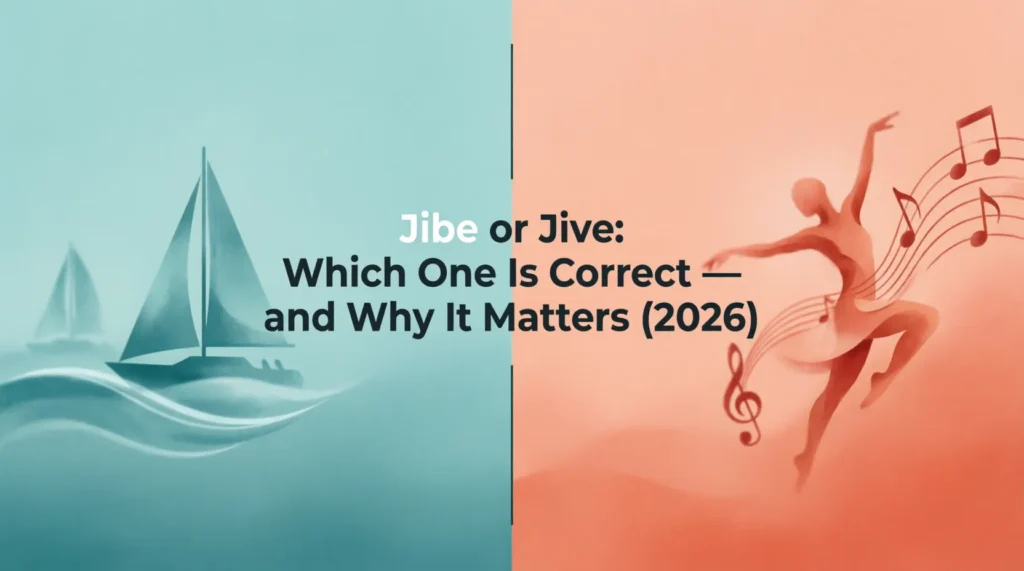
In short, “jibe” is the correct word when you mean agreement or matching up, while “jive” usually refers to a style of dance or informal talk. These two words sound almost identical, which is why people often confuse them in writing. Understanding the difference will instantly make your writing clearer and more professional.
If you’ve ever paused mid-sentence wondering whether to write jibe or jive, you’re not alone—and by the end of this guide, you’ll never second-guess it again.
The Confusion Around jibe or jive
You’re writing an email, trying to sound professional, and suddenly you stop. Should it be “That doesn’t jibe with the data” or “That doesn’t jive with the data”?
Or maybe you’re editing an essay and your brain whispers, Wait… are these even different words?
This is exactly where most people get stuck with jibe or jive. The words sound almost identical when spoken, especially in casual conversation. So your brain assumes they must be interchangeable. They are not—and that small difference can change how polished your writing looks.
Even confident writers hesitate here because English loves to trap us with words that sound right but aren’t.
What Each Word Actually Means
Let’s clear this up in the simplest way possible so you never mix up jibe or jive again.
Jibe (verb) means to agree, match, or be consistent with something. It is often used in formal or semi-formal writing.
For example:
“Her story doesn’t jibe with the evidence.”
Here, “jibe” is about alignment. You’re checking whether two things fit together logically.
On the other hand, jive (noun/verb) has a very different life. As a noun, it refers to a lively style of jazz-based dance. As a verb, it can mean dancing or speaking in a misleading or exaggerated way.
For example:
“They danced to jive music at the party.”
“Don’t jive me with excuses.”
So when you compare jibe or jive, you’re really comparing agreement vs. dance/speech style. They are not interchangeable in meaning, even though they sound similar.
Jibe or Jive: Side-by-Side Comparison
Here is a quick breakdown to make the Jibe or Jive easier to compare at a glance.
Feature
Jibe
Jive
Meaning
To agree or match
A music style or lively talk
Part of Speech
Verb, noun
Noun, verb
Formality
Neutral
Mostly casual
Common Context
Opinions, facts, plans
Music, dancing, slang
Example Sentence
Your story jibes with mine.
They danced to jive music.
Can They Be Swapped?
Sometimes
Sometimes
Means “agree” in some uses
Means “agree” only in informal use
Why People Mix Up jibe or jive
The confusion between jibe or jive comes mostly from pronunciation. In many accents, especially casual speech, both words sound almost identical. Linguists often point out that English contains many “homophones” or near-homophones that confuse writers.
Another reason is context blur. In spoken English, people rarely pause to clarify spelling, so your brain stores the sound but not the spelling difference. Later, when you write, both options feel equally valid.
There’s also a psychological factor: “jive” looks more modern or slang-like, so people assume it fits everywhere. But style preference is not the same as grammatical correctness, and that’s where mistakes happen.
The Simple Rule to Remember Which Is Which
Here’s a quick way to lock in the difference for jibe or jive:
If you’re talking about agreement or consistency, use jibe. If you can replace the word with “match,” “agree,” or “fit,” then “jibe” is correct.
If you’re talking about music, dancing, or playful/insincere talk, use jive.
Try this mental shortcut: Jibe = match facts. Jive = move or talk loosely.
Examples:
“His explanation doesn’t jibe with reality.”
“The numbers jibe perfectly with our forecast.”
“They learned to jive at the dance workshop.”
Once you apply this rule, jibe or jive becomes much easier to separate in your mind.
Common Mistakes People Make With jibe or jive
Using “jive” in formal writing about facts Incorrect: “The report doesn’t jive with the data.” Correct: “The report doesn’t jibe with the data.”
Assuming both words mean “agree” Incorrect: “These figures jive with the findings.” Correct: “These figures jibe with the findings.”
Overusing “jibe” in casual speech about dancing Incorrect: “We learned to jibe at the party.” Correct: “We learned to jive at the party.”
Treating them as interchangeable synonyms Incorrect: “Her story doesn’t jive/jibe depending on context.” Correct: Choose based on meaning, not sound.
Real Sentence Fix — Jibe or Jive
See the Mistake, Fix the Mistake
These are real mistakes people make with the Jibe or Jive — and the simple fix for each one.
❌ The numbers in the report don’t jive with last quarter’s results. ✅ The numbers in the report don’t jibe with last quarter’s results. 📌 Why: In formal work writing, jibe is usually preferred for “agree” or “match.”
❌ That explanation doesn’t jive with what happened yesterday. ✅ That explanation doesn’t jibe with what happened yesterday. 📌 Why: Jibe is the standard word when two things do not match.
❌ The professor said the evidence jived with the theory. ✅ The professor said the evidence jibed with the theory. 📌 Why: The past tense of jibe is jibed when meaning “agreed with.”
❌ This update finally jibes my phone with the app. ✅ This update finally syncs my phone with the app. 📌 Why: Jibe means “agree” or “match,” not “connect devices.”
❌ We listened to jibe music all evening. ✅ We listened to jive music all evening. 📌 Why: Jive is the word used for the music style.
❌ Her story doesn’t jive with the receipt she found. ✅ Her story doesn’t jibe with the receipt she found. 📌 Why: Use jibe when one fact matches or conflicts with another.
Real-World Examples: jibe or jive Used Correctly
“The witness statement doesn’t jibe with the security footage.” This works because you are comparing two pieces of factual evidence.
“They performed a fast-paced jive at the competition.” Here, it refers to a dance style, not agreement.
“Your explanation doesn’t jibe with what I observed yesterday.” This is correct in a workplace or academic context.
“The comedian used jive talk to entertain the crowd.” This shows informal or playful speech usage.
British English vs. American English — Does It Affect jibe or jive?
In the case of jibe or jive, the difference is not about British vs. American spelling. Both regions use “jibe” for agreement and “jive” for dance or slang.
However, you may notice that British English sometimes prefers slightly different phrasing or idioms, but the core meanings of these words stay consistent across regions.
So unlike words like “colour/color,” this confusion is global—not regional. People everywhere mix them up for the same reason: they sound almost identical.
What Grammar Checkers and Style Guides Say About jibe or jive
Most grammar tools and style guides clearly separate jibe or jive based on meaning. “Jibe” is flagged as correct when referring to agreement, while “jive” is accepted only in dance or informal speech contexts.
However, autocorrect systems sometimes miss this distinction because they rely on spelling rather than context. That means both words may slip through even when used incorrectly.
This is why language experts emphasize understanding usage rules instead of relying only on digital tools. Knowing the difference gives you control that spellcheck cannot always provide.
jibe or jive in Professional and Academic Writing
In professional writing, using jibe or jivecorrectly matters more than you might think. A single word used incorrectly can make your work look less precise, especially in reports, essays, or business communication.
For example, saying “the data doesn’t jive” in a formal report may feel too casual or even incorrect to some readers. On the other hand, “jibe” signals accuracy and alignment, which is what professional writing demands.
In academic or formal contexts, precision is everything. Once you understand the difference in jibe or jive, you eliminate a small but noticeable source of confusion—and your writing instantly feels more confident and polished.
Quick Recap: jibe or jive at a Glance
“Jibe” = agreement, consistency, or matching facts
“Jive” = dance style or informal/slang talk
They sound the same but are not interchangeable
“Jibe” is preferred in formal writing
“Jive” is mostly used in music or casual speech
Frequently Asked Questions About jibe or jive
Is it “jibe with” or “jive with”?
The correct phrase is “jibe with” when you mean something matches or agrees. “Jive with” is sometimes used informally, but it is generally considered incorrect in formal writing.
What does “doesn’t jive” mean?
“Doesn’t jive” is informal and usually means something doesn’t make sense or doesn’t match. However, in proper grammar usage, “doesn’t jibe” is preferred.
Are jibe and jive homophones?
Yes, they are near-homophones, meaning they sound almost the same in most accents. This is one of the main reasons people confuse jibe or jive when writing.
Can jive ever mean agree?
In modern standard English, no. “Jive” is not used to mean “agree” in formal contexts. That meaning is considered slang or outdated in many style guides.
Why do people say “that doesn’t jive”?
People often use “jive” informally because it sounds natural in speech. However, in writing—especially formal writing—“jibe” is the correct and recommended form.
Final Thoughts on jibe or jive
At the end of the day, the difference between jibe or jive comes down to meaning, not sound. One is about agreement and accuracy, while the other is about dance and informal expression.
This is one of those small English distinctions that trips up even experienced writers, but once you see it clearly, it becomes second nature. You now have a simple rule, real examples, and context to guide you every time you write.
With this clarity, you can move forward more confidently and avoid one of the most common word mix-ups in English writing.
Frequently Asked Questions
What is the main difference between 'jibe' and 'jive'?▼
‘Jibe’ means to agree or match, while ‘jive’ usually refers to a style of dance or informal talk. Understanding this distinction can enhance the clarity and professionalism of your writing.
In what contexts should I use 'jibe'?▼
‘Jibe’ is appropriate in formal or semi-formal writing when discussing agreement or consistency. For example, you might say, ‘Her story doesn’t jibe with the evidence’ to indicate a mismatch.
Can 'jive' be used in formal writing?▼
Generally, ‘jive’ is considered more casual and is often associated with music, dancing, or informal conversation. It is less suitable for formal writing where precision is important.
Why do people confuse 'jibe' and 'jive'?▼
The confusion arises primarily from their similar pronunciation, especially in casual speech. Additionally, people often blur the context in which they use these words, leading to uncertainty.
What are some examples of using 'jibe' in a sentence?▼
You can use ‘jibe’ in sentences like ‘The data jibes with our initial findings’ or ‘Her opinions jibe with mine.’ Both demonstrate agreement or logical consistency.
How can I remember which word to use?▼
A simple rule to remember is: if you’re discussing agreement or consistency, use ‘jibe.’ If the context involves music, dancing, or informal talk, opt for ‘jive.’ This mental shortcut can help clarify your choices.
Are there any situations where 'jibe' and 'jive' can be swapped?▼
While there are some informal contexts where ‘jive’ can imply agreement, it is not widely accepted. Typically, ‘jibe’ is the correct term for expressing alignment, while ‘jive’ remains tied to music and informal conversation.
Maria Ramirez is an experienced editor and language consultant with over 10 years in the publishing world. She holds a Bachelor’s degree in Journalism and deeply appreciates the power of the written word. Her expertise lies in dissecting the complexities of English grammar and providing straightforward guidance for contemporary writers. Maria’s work focuses on simplifying spelling and usage rules, assisting both seasoned writers and budding authors in presenting their ideas with precision. Her involvement with WordlyRight stems from a commitment to nurture a global audience’s command over English, ensuring learners and professionals don’t just understand language nuances but use them effectively in varied contexts. As someone who passionately believes in lifelong learning, Maria continuously seeks to inspire this ethos in her readers.