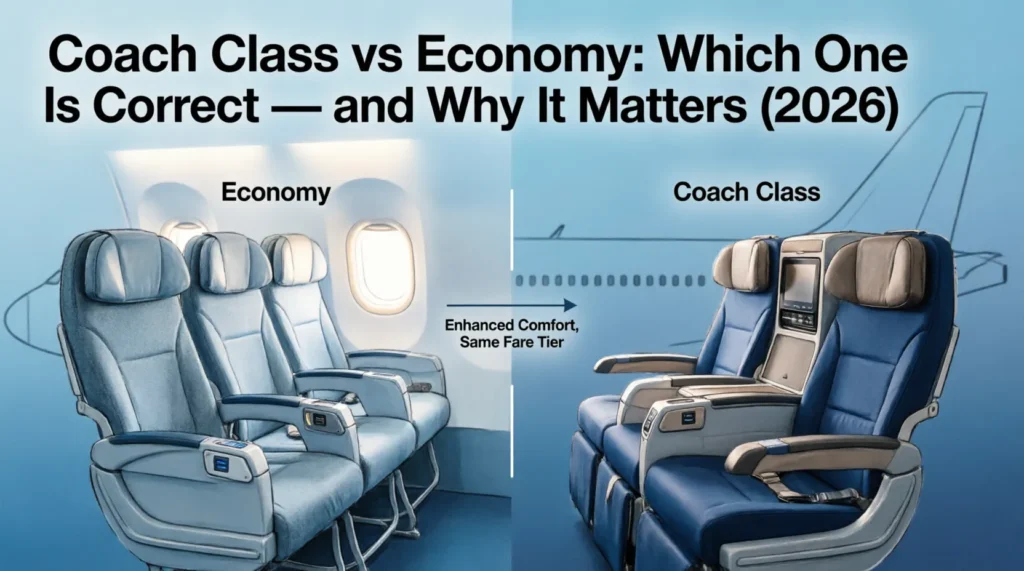
In short, economy class is the correct and standard term used by airlines worldwide today, while coach class is an older, mostly American English term that still appears in casual speech. Both refer to the same basic seating category on a plane, but one is more modern and widely accepted. Understanding this difference in coach class vs economy will help you sound more accurate and confident when you book flights or write about travel.
Keep reading to see exactly why both terms exist, when to use each one, and how to avoid mixing them up in real-life situations.
The Confusion Around Coach Class vs Economy
You’re booking a flight late at night. The website shows “Economy,” but your friend casually says, “Just take coach.” You pause for a second. Are they the same thing or completely different?
This is exactly where confusion around coach class vs economy starts for most people. You see both terms used in travel blogs, airline websites, and even movies, and you naturally assume they might mean different seating levels.
If you’ve ever second-guessed yourself while writing an email, planning a trip, or comparing flight tickets, you’re not alone. Many travelers use coach and economy interchangeably, even though modern airlines mostly stick to one official term.
What Each Word Actually Means
To clear up coach class vs economy, you need to understand what each term actually refers to in everyday language.
Economy class is a noun phrase used in aviation to describe the most basic and affordable seating section on an airplane. It is the standard term used by airlines globally today. For example: “I booked an economy class ticket for my trip to Dubai.”
Coach class is also a noun phrase, but it is mostly used in American English and informal conversation. It refers to the same seating section as economy class. For example: “She flew coach to New York last weekend.”
In simple terms, both words describe the same thing: the standard seating area on a commercial flight where most passengers sit. The difference is not in meaning, but in usage and modern preference.
coach class vs economy: Side-by-Side Comparison
Here is a quick breakdown to make the coach class vs economy easier to compare at a glance.
Feature
Coach Class
Economy
Meaning
Standard passenger seating
Lowest standard travel class
Part of Speech
Noun phrase
Noun
Formality
Casual
Neutral
Common Context
Mainly North American travel
Airlines and travel worldwide
Example Sentence
We booked coach class.
We flew in economy.
Can They Be Swapped?
Sometimes — often the same travel class.
Sometimes — depends on airline wording
Why People Mix Up Coach Class vs Economy
The confusion around coach class vs economy exists mainly because language evolves over time, but people keep using older habits.
Linguists explain that “coach class” became popular in the mid-20th century in the United States, especially when commercial air travel started becoming more common. Over time, airlines shifted toward the term “economy class” because it sounded more neutral, global, and professional.
Another reason you get mixed up is exposure. If you grew up hearing movies or older travelers say “coach,” that term sticks in your mind. But when you visit airline websites today, you mostly see “economy,” which creates a mental mismatch.
You also see regional overlap. Some people still say “coach” in casual conversation, while travel companies and booking platforms almost always use “economy.” That split naturally leads to confusion.
The Simple Rule to Remember Which Is Which
Here’s an easy way to remember coach class vs economy:
If you’re reading or writing something official, use “economy class.” If you’re speaking casually, “coach” is just a relaxed, older way to say the same thing.
Think of it like this: economy is the “formal label,” and coach is the “nickname.”
Examples:
You are booking a flight online, so you say: “I selected economy class for the cheapest fare.”
You are talking to a friend, so you say: “I usually fly coach when I travel alone.”
You are writing a blog post, so you stick with: “Most passengers choose economy class for affordability.”
This simple rule removes most of the confusion around coach class vs economy in everyday use.
Common Mistakes People Make With Coach Class vs Economy
Using “coach class” in formal writing: You might write “economy is better than coach class,” but in modern usage, “economy class” is preferred in professional contexts.
Thinking they are different seats: You might assume coach is lower than economy, but they actually mean the same thing in airline seating.
Mixing terms in one sentence: You might say “economy coach seat,” which sounds redundant and incorrect.
Overcorrecting usage: You might avoid “coach” completely even in casual speech, making your conversation sound overly formal.
Real Sentence Fix — coach class vs economy
See the Mistake, Fix the Mistake
These are real mistakes people make with coach class vs economy — and the simple fix for each one.
❌ Please book me an economy class seat in the train. ✅ Please book me a coach class seat on the train. 📌 Why: Trains often use coach class, not economy, for standard seating.
❌ We found cheap coach class tickets for our flight overseas. ✅ We found cheap economy tickets for our flight overseas. 📌 Why: Many airlines simply call the standard cabin economy.
❌ My report compares business class with coach on international airlines. ✅ My report compares business class with economy on international airlines. 📌 Why: Academic writing usually follows the airline’s official term.
❌ The booking website only lets me choose coach for this flight. ✅ The booking website only lets me choose economy for this flight. 📌 Why: Flight booking sites often label the standard cabin as economy.
❌ We always choose economy when riding the train to the city. ✅ We always choose coach class when riding the train to the city. 📌 Why: Coach class is the more common term for standard train seating.
❌ My friend said the airline upgraded us from coach train seats to business class. ✅ My friend said the airline upgraded us from economy to business class. 📌 Why: Flights use economy and business class, not train seating terms.
Real-World Examples: Coach Class vs Economy Used Correctly
Casual conversation: “I booked a cheap ticket, so I’ll be flying coach next week.” This works because you’re speaking informally and the meaning is clear.
Travel website description: “Economy class passengers can bring one carry-on bag.” This is correct because airlines use standardized terminology.
Academic writing: “Airfare trends show increased demand for economy class seating.” This is appropriate for formal or research-based contexts.
Blog storytelling: “After a long day, I finally settled into my economy seat and relaxed.” This fits because it uses neutral, widely understood wording for readers.
British English vs. American English — Does It Affect Coach Class vs Economy?
In the case of coach class vs economy, there is no major British vs American spelling difference. However, there is a usage difference.
American English is more likely to use “coach” in casual speech, while both British and American airline industries primarily use “economy class” in official contexts.
So even though you might hear “coach” more in everyday American conversation, “economy class” is the globally accepted standard used by airlines across regions.
Both audiences understand both terms, but “economy class” is the safer choice if you want clarity anywhere in the world.
What Grammar Checkers and Style Guides Say About Coach Class vs Economy
Most grammar tools and professional writing standards favor “economy class” as the correct and modern term. “Coach class” is usually recognized as informal or outdated but not technically wrong in conversational contexts.
Autocorrect tools typically do not flag “coach class,” but they may suggest “economy class” in formal writing situations. This shows that context matters more than strict correctness.
Language experts generally agree that using “economy class” ensures clarity, especially in professional or international communication. In short, tools can help, but your understanding of usage is what truly matters.
Coach Class vs Economy in Professional and Academic Writing
When you are writing a resume, travel article, academic paper, or business email, choosing the right term matters more than you might think.
Using “economy class” shows precision and awareness of modern aviation language. It helps your writing look polished and up to date.
If you mistakenly use “coach class” in a formal report, it won’t usually break understanding, but it may feel slightly outdated to readers. Once you understand coach class vs economy, you stop second-guessing yourself and write with more confidence in any professional situation.
Quick Recap: Coach Class vs Economy at a Glance
Economy class is the modern, official airline term
Coach class is informal and mostly used in casual speech
Both refer to the same basic airplane seating section
Airlines and booking platforms prefer “economy class”
You can use “coach” when speaking casually, but not in formal writing
Frequently Asked Questions About Coach Class vs Economy
Is coach class the same as economy class?
Yes, coach class and economy class refer to the same type of airplane seating. The difference is only in wording, not in comfort level or service category. Airlines today prefer the term economy class.
Why do people still say coach instead of economy?
People still say coach because it is an older term that became popular in American English. Many travelers continue using it out of habit, even though airlines now officially use economy class.
Which term should I use when booking a flight?
When booking a flight, you should use “economy class” because that is the standard term used by airlines and booking systems. It ensures you understand the fare type correctly.
Is coach class considered outdated?
Coach class is not incorrect, but it is considered more informal and slightly outdated in professional travel language. Economy class is the modern standard.
Do airlines ever use the word coach anymore?
Most airlines do not use “coach” in official listings anymore. However, passengers and travel agents may still use it in casual conversation, especially in the United States.
Final Thoughts on Coach Class vs Economy
At the end of the day, coach class vs economy is not a battle between two different seating types—it’s a difference in language history and modern usage. Both terms point to the same travel experience, but one is clearly more current and widely accepted.
Now that you understand the distinction, you can confidently choose the right term whether you’re booking a flight, writing about travel, or simply talking to someone about your trip. That small clarity makes your communication smoother, more accurate, and more professional going forward.
Frequently Asked Questions
What is the main difference between coach class and economy class?▼
The main difference lies in the terminology: economy class is the standard term used by airlines worldwide today, while coach class is an older term primarily used in American English. Both terms refer to the same basic seating category, but economy is more modern and widely accepted.
Why do people confuse coach class with economy class?▼
The confusion stems from the evolution of language and the different contexts in which each term is used. Many travelers grew up hearing ‘coach’ in casual conversation, while airlines have largely adopted ‘economy,’ leading to mixed usage.
When should I use 'economy class' versus 'coach class'?▼
You should use ‘economy class’ in official writing or when booking flights to align with modern airline terminology. In casual conversation, ‘coach’ is acceptable and reflects a more relaxed way of speaking about the same seating category.
Are coach class and economy class interchangeable terms?▼
Yes, in most contexts, coach class and economy class can be used interchangeably as they refer to the same seating level. However, it’s important to note that ‘economy’ is the preferred term in formal settings.
How did 'coach class' become popular in the United States?▼
‘Coach class’ gained popularity in the mid-20th century as commercial air travel became more common in the U.S. Over time, airlines moved towards the term ‘economy class’ for its neutral and professional connotation.
What should I remember to avoid mixing up coach class and economy class?▼
A simple rule to remember is to use ‘economy class’ for formal situations like writing and booking, while ‘coach’ can be used in casual conversations. This distinction will help you communicate more accurately about air travel.
Is there a regional difference in the usage of coach class and economy class?▼
Yes, ‘coach’ is primarily used in North America, especially in informal settings, while ‘economy’ is the term used by airlines and travel companies globally. This regional variation contributes to the confusion between the two terms.
Maria Ramirez is an experienced editor and language consultant with over 10 years in the publishing world. She holds a Bachelor’s degree in Journalism and deeply appreciates the power of the written word. Her expertise lies in dissecting the complexities of English grammar and providing straightforward guidance for contemporary writers. Maria’s work focuses on simplifying spelling and usage rules, assisting both seasoned writers and budding authors in presenting their ideas with precision. Her involvement with WordlyRight stems from a commitment to nurture a global audience’s command over English, ensuring learners and professionals don’t just understand language nuances but use them effectively in varied contexts. As someone who passionately believes in lifelong learning, Maria continuously seeks to inspire this ethos in her readers.