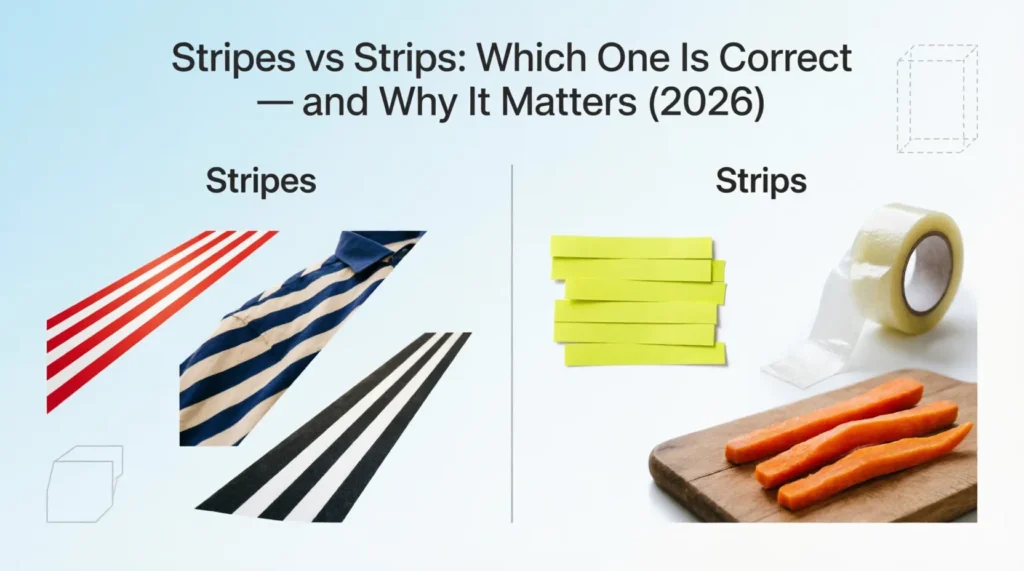
In short, “stripes” refers to lines or bands of color or pattern, while “strips” refers to narrow pieces of something or the verb “to strip.” In most cases, the confusion comes from spelling similarity, not meaning overlap. Once you understand the difference, you’ll never hesitate again when choosing between stripes vs strips.
Keep reading to see simple examples, memory tricks, and real-world usage so you can use both words confidently every time.
The Confusion Around Stripes vs Strips
You’re writing a school essay about clothing patterns, and you pause for a second. Is it “black and white stripes” or “black and white strips”? Your fingers hover over the keyboard because it sounds right either way.
Or maybe you’re sending a work email describing materials or design details, and suddenly stripes vs strips starts looking like a spelling trap you didn’t expect.
This confusion is extremely common. The words look almost identical, and in fast typing or casual speech, they can easily get mixed up. That’s exactly why stripes vs strips shows up so often in grammar searches.
The good news is that the difference is actually very simple once you break it down clearly.
What Each Word Actually Means
Let’s start with “stripes.” “Stripes” is a noun. It refers to long, narrow bands of color, pattern, or marking. You usually see it in clothing, animals, flags, or designs.
Example: The zebra has black and white stripes across its body.
Here, stripes clearly means patterned lines.
Now let’s look at “strips.” “Strips” can be either a noun or a verb form. As a noun, it means thin, narrow pieces of something. As a verb, it comes from “to strip,” meaning to remove covering, clothing, or layers.
Example (noun): She cut the paper into thin strips. Example (verb): He strips the paint off the wall.
So in the stripes vs strips confusion, only “stripes” relates to patterns, while “strips” relates to pieces or removing something. That’s the core difference you need to remember.
stripes vs strips: Side-by-Side Comparison
Here is a quick breakdown to make the stripes vs strips easier to compare at a glance.
Feature
Stripes
Strips
Meaning
Long narrow lines or bands
Long narrow pieces of something
Part of Speech
Noun (plural)
Noun (plural)
Formality
Neutral
Neutral
Common Context
Clothing, animals, designs
Paper, fabric, food, materials
Example Sentence
The shirt has blue stripes.
Cut the paper into strips.
Can They Be Swapped?
No
No — they describe different things.
Why People Mix Up Stripes vs Strips
The confusion between stripes vs strips happens mostly because the words are almost identical in spelling and pronunciation. Linguists often point out that when two words differ by just one letter and sound similar, the brain tends to blend them during quick writing.
Another reason is visual memory. People often remember the idea of “lines” or “bands” and think of “strips” because it also suggests something long and narrow. That mental overlap creates spelling uncertainty.
There’s also the speed factor. When typing quickly, your fingers often choose the more familiar pattern, not necessarily the correct one. Since “strip” is a common everyday verb, many people accidentally extend it into “strips” when they actually mean “stripes.”
The Simple Rule to Remember Which Is Which
Here’s a super simple way to lock it in:
If you’re talking about a pattern or design, use “stripes.” If you’re talking about cutting, removing, or pieces, use “strips.”
Think of it this way:
Stripes = style and pattern
Strips = slicing or separation
Examples:
The shirt has blue and yellow stripes.
She strips the paper into thin pieces before crafting.
The football jersey has bold stripes across the chest.
Once you connect “stripes” with visual design, your brain stops mixing stripes vs strips in real writing situations.
Common Mistakes People Make With Stripes vs Strips
Writing “animal strips” instead of “animal stripes” — This happens when describing zebras or tigers. Correct version: The tiger has orange and black stripes.
Using “strips” for clothing patterns — People sometimes write “striped shirt” incorrectly as “strips shirt.” Correct version: He wore a striped shirt.
Confusing action vs pattern — Mixing the verb “strip” with visual design. Correct version: She strips wallpaper from the wall.
Over-correcting and changing the right word — Some writers change “stripes” to “strips” thinking it looks more natural. Correct version: The flag has red and white stripes.
Real Sentence Fix — stripes vs strips
See the Mistake, Fix the Mistake
These are real mistakes people make with stripes vs strips — and the simple fix for each one.
❌ The designer added colorful strips to the team uniform. ✅ The designer added colorful stripes to the team uniform. 📌 Why:Stripes are lines or patterns, while strips are separate pieces.
❌ Those candy stripes are perfect for decorating the cake. ✅ Those candy strips are perfect for decorating the cake. 📌 Why: Candy cut into long pieces is called strips, not stripes.
❌ The biology report described the tiger’s black strips. ✅ The biology report described the tiger’s black stripes. 📌 Why: The markings on an animal are called stripes.
❌ Upload the image in stripes to improve loading speed. ✅ Upload the image in strips to improve loading speed. 📌 Why: Long pieces or sections are called strips, even in digital design.
❌ Please cut the fabric into even stripes before sewing. ✅ Please cut the fabric into even strips before sewing. 📌 Why: Pieces of fabric are strips, not pattern lines.
❌ She wore a scarf with bright strips across it. ✅ She wore a scarf with bright stripes across it. 📌 Why: A repeating line pattern on clothing is made of stripes.
Real-World Examples: Stripes vs Strips Used Correctly
Casual conversation: I love your new shirt with green stripes. This shows everyday fashion usage where stripes refers to a pattern.
Professional writing: The design team approved the logo with diagonal stripes. Here, stripes is used in a design context, common in marketing or branding.
Academic writing: The experiment used strips of paper to measure absorption rates. This correctly uses strips as physical pieces of material.
Creative writing: Moonlight fell in pale stripes across the bedroom floor. This shows how stripes can describe visual light patterns in storytelling.
Each example highlights how choosing the correct form of stripes vs strips depends entirely on meaning, not just spelling.
British English vs. American English — Does It Affect Stripes vs Strips?
In the case of stripes vs strips, there is no meaningful difference between British and American English. Both regions use the same spelling rules and definitions.
“Stripes” always refers to patterns, and “strips” always refers to narrow pieces or the verb form “strip.” Unlike some English words that change spelling across regions, this pair stays consistent worldwide.
Language researchers often note that confusion here is universal, not regional, because the issue comes from similarity in structure rather than dialect differences.
What Grammar Checkers and Style Guides Say About Stripes vs Strips
Most grammar tools and style guides treat “stripes vs strips” as a clear-cut meaning issue rather than a stylistic preference. They typically flag incorrect usage when “strips” is used in place of “stripes” in pattern-related contexts.
However, tools are not perfect. They may miss errors if the sentence structure still looks valid, even when the meaning is wrong. That’s why understanding the rule yourself is more reliable than depending on autocorrect.
Style guides emphasize meaning first: if you are describing a visual pattern, “stripes” is always the correct choice, regardless of sentence form.
Stripes vs Strips in Professional and Academic Writing
Getting stripes vs strips right becomes more important in formal writing because clarity matters. In job applications, academic papers, or published content, a small word error can distract readers or weaken credibility.
For example, using “strips” when describing a design pattern might confuse readers or suggest lack of attention to detail. On the other hand, correct usage shows precision and language control.
The positive side is that once you understand the difference, you rarely make this mistake again. It becomes automatic, especially in professional writing where accuracy matters most.
Quick Recap: Stripes vs Strips at a Glance
Stripes = patterns, lines, or decorative bands
Strips = thin pieces or the action of stripping
Stripes are visual and descriptive
Strips involve cutting, removing, or dividing
Context decides meaning, not just spelling
Frequently Asked Questions About Stripes vs Strips
What is the difference between stripes and strips?
The difference is meaning. “Stripes” refers to patterned lines, while “strips” refers to narrow pieces or the act of removing something. They are not interchangeable.
Is it stripes or strips on clothing?
It is always “stripes” when talking about clothing patterns. For example, a striped shirt has stripes, not strips.
Can strips ever mean a pattern?
No, “strips” does not refer to patterns. It only refers to pieces or the verb “strip,” so using it for designs is incorrect.
Why do people confuse stripes vs strips so often?
People confuse them because the words look and sound very similar. Fast typing and mental association with “thin lines” also contribute to the mistake.
Is striped related to stripes or strips?
“Striped” comes from “stripes,” not “strips.” It describes something that has stripes as a pattern.
Final Thoughts on Stripes vs Strips
The difference between stripes vs strips is actually simpler than it first appears. One refers to patterns, and the other refers to pieces or removal, and that single distinction clears up most confusion instantly.
Stripes vs strips is one of those grammar questions that almost everyone gets wrong at least once, so there’s nothing unusual about mixing them up. Now that you understand the rule, you can write with more confidence and precision in any situation.
With this clarity, you’ll no longer second-guess yourself when choosing between these two similar-looking words—you’ll just know.
Frequently Asked Questions
What is the main difference between 'stripes' and 'strips'?▼
‘Stripes’ refers to long, narrow bands of color or pattern, while ‘strips’ refers to thin, narrow pieces of something or the action of removing layers. Understanding this distinction can help avoid confusion in writing.
In what contexts should I use 'stripes'?▼
‘Stripes’ is commonly used in contexts related to clothing, animals, and designs. For example, you would say ‘the shirt has blue stripes’ when describing a pattern.
When should I use 'strips' instead of 'stripes'?▼
‘Strips’ can be used when referring to cutting or removing something, such as ‘she cut the paper into strips.’ It can also refer to the action of stripping, like ‘he strips the paint off the wall.’
Why do people confuse 'stripes' and 'strips'?▼
The confusion often arises due to the similarities in spelling and pronunciation of the two words. When writing quickly, it’s easy to mix them up, especially since both can suggest something long and narrow.
Are 'stripes' and 'strips' interchangeable in sentences?▼
No, they are not interchangeable as they describe different concepts. Using ‘stripes’ when discussing patterns and ‘strips’ when referring to pieces or removal is essential for clear communication.
Can you provide a memory trick to remember the difference?▼
A simple memory trick is to associate ‘stripes’ with style and design, while ‘strips’ relates to slicing or separation. This mental connection can help clarify which word to use in various situations.
What are some examples of each word in a sentence?▼
For ‘stripes’, you could say, ‘The football jersey has bold stripes across the chest.’ For ‘strips’, an example would be, ‘She strips the paper into thin pieces before crafting.’
Emily Thornton holds a Master’s degree in Linguistics from the University of Chicago and has been passionate about language education for over 15 years. Her interest in language developed at a young age, fueled by a curiosity for how intricacies in language shape communication. Emily has authored several guides on grammar usage and works extensively with ESL learners to improve their fluency and confidence in English. Dedicated to clarity, she writes content that demystifies complex spelling and grammar issues, making her contributions invaluable for professionals looking for authoritative and swift language solutions. Emily continues to explore innovative ways to bridge communication gaps through accurate and effective language use. Her blend of academic rigor and practical insight ensures learners across all levels find her advice beneficial.