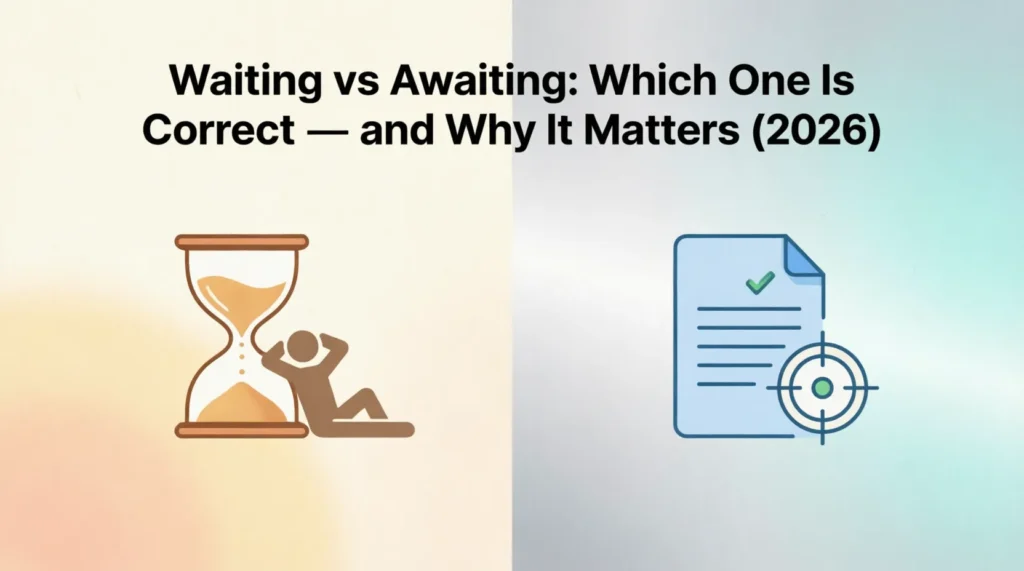
In short, both waiting and awaiting are correct, but they are not interchangeable in all situations. “Waiting” is more casual and widely used, while “awaiting” is more formal and usually requires a direct object. Understanding this difference will instantly improve your writing clarity, and you’ll see exactly when each one fits as you read further.
The Confusion Around Waiting vs Awaiting
You’re writing an email, and you pause for a second. Should you say you are waiting for your results or awaiting your results? It feels like both are right, but something about it makes you hesitate.
That exact moment of doubt is where waiting vs awaiting trips up millions of English users every day. You’re not alone if you’ve ever second-guessed this in an essay, a job application, or even a simple text message.
The confusion is so common because both words feel nearly identical in meaning. But as you’ll see, the way you use them in a sentence makes all the difference.
What Each Word Actually Means
To understand waiting vs awaiting, you need to look at how each word behaves in real sentences, not just dictionary definitions.
“Waiting” is a verb (present participle) that usually means you are staying in one place or delaying action until something happens. It can stand alone or be followed by “for.” It is flexible and commonly used in everyday speech.
For example: You are waiting for the bus at the station.
Here, “waiting” feels natural and conversational. You could use it in texts, emails, or casual conversation without sounding formal.
“Awaiting” is also a verb (present participle), but it is more formal and more structured. It almost always requires a direct object and does not use “for.”
For example: You are awaiting your exam results.
Notice how you don’t say “awaiting for your exam results.” That would be incorrect.
In short, waiting vs awaiting is not about meaning, but about grammar structure and tone.
waiting vs awaiting: Side-by-Side Comparison
Here is a quick breakdown to make the waiting vs awaiting easier to compare at a glance.
Feature
Waiting
Awaiting
Meaning
Staying until something happens
Expecting something to happen
Part of Speech
Verb (present participle)
Verb (present participle)
Formality
Neutral to casual
More formal
Common Context
Conversations, daily situations
Business, official writing
Example Sentence
I am waiting for the bus.
We are awaiting approval.
Can They Be Swapped?
Sometimes
Sometimes
Needs “for” before an object
Often takes an object directly
Why People Mix Up Waiting vs Awaiting
One major reason waiting vs awaiting causes confusion is that both words come from similar Old English roots and carry the same general idea of “expecting something.”
Linguists explain that the brain treats them as synonyms because in modern usage they often overlap in meaning. You are mentally “holding in place” until something happens, whether you say waiting or awaiting.
Another reason is sound similarity. When spoken quickly, both words feel almost identical, especially in everyday conversation. This makes it easy to assume they follow the same grammatical rules.
Finally, exposure plays a role. Many learners see “waiting for” constantly in casual English, while “awaiting” appears in formal writing like emails, official notices, or academic texts. That contrast creates uncertainty about which one is “more correct,” even though both are correct in different contexts.
The Simple Rule to Remember Which Is Which
Here’s a simple rule that makes waiting vs awaiting instantly clear:
Use waiting for something in casual or general English, and use awaiting something when you want a more formal tone and no “for” follows.
Think of it like this: If you need “for,” choose waiting. If you don’t, and you want formality, choose awaiting.
Examples:
You are waiting for your friend at the café.
You are awaiting your friend’s arrival.
You are waiting for confirmation from the bank.
You are awaiting confirmation from the bank.
Once you apply this rule a few times, waiting vs awaiting stops feeling confusing and becomes automatic in your writing.
Common Mistakes People Make With Waiting vs Awaiting
Using “awaiting for” in formal writing Wrong: You are awaiting for your package. Correct: You are awaiting your package.
Overusing “awaiting” in casual conversation Wrong: I am awaiting the bus. Correct: I am waiting for the bus.
Treating both words as fully interchangeable Wrong: I am waiting my results. Correct: I am awaiting my results or waiting for my results.
Mixing tone in the same sentence Wrong: I am awaiting for the food at the restaurant. Correct: I am waiting for the food at the restaurant.
Each mistake happens because you are trying to force one rule onto both words, which is exactly where waiting vs awaiting confusion begins.
Real Sentence Fix — waiting vs awaiting
See the Mistake, Fix the Mistake
These are real mistakes people make with waiting vs awaiting — and the simple fix for each one.
❌ We are awaiting for your response before moving forward. ✅ We are awaiting your response before moving forward. 📌 Why: Awaiting is usually followed directly by the thing expected.
❌ I’m waiting your reply before I book the tickets. ✅ I’m waiting for your reply before I book the tickets. 📌 Why: Waiting normally needs “for” before the thing expected.
❌ The researchers are awaiting for the final results. ✅ The researchers are awaiting the final results. 📌 Why: Awaiting does not usually use “for.”
❌ The app is waiting the verification code from my phone. ✅ The app is waiting for the verification code from my phone. 📌 Why: Waiting needs “for” when mentioning what is expected.
❌ We are waiting the pizza to arrive. ✅ We are waiting for the pizza to arrive. 📌 Why: Use “for” after waiting when naming the thing you expect.
❌ Can’t wait to see you, I’m awaiting for the weekend! ✅ Can’t wait to see you, I’m awaiting the weekend! 📌 Why: Awaiting takes a direct object without “for.”
Real-World Examples: Waiting vs Awaiting Used Correctly
Casual conversation: You are waiting for your ride outside the mall. This feels natural because everyday speech prefers simplicity.
Professional email: You are awaiting confirmation from the hiring team. This sounds formal and appropriate for workplace communication.
Academic writing: You are awaiting the final approval of the research proposal. The tone is precise and structured, which fits academic expectations.
Creative writing: The character is waiting for sunrise, unsure of what comes next. This adds emotional depth and rhythm to the narrative.
Each example shows how waiting vs awaiting shifts tone without changing meaning.
British English vs. American English — Does It Affect Waiting vs Awaiting?
In the case of waiting vs awaiting, there is no significant difference between British and American English. Both varieties use “waiting” in casual speech and “awaiting” in formal writing in the same way.
Language researchers note that this is one of those rare cases where global English is fairly consistent. You won’t find one region preferring a completely different rule.
So whether you are writing in London, New York, or anywhere else, the same structure applies. The real difference is formality, not geography.
What Grammar Checkers and Style Guides Say About Waiting vs Awaiting
Most grammar tools will not flag either “waiting” or “awaiting” as incorrect because both are valid words. However, they may suggest tone changes depending on context.
Style guides generally prefer “awaiting” in formal documents when no preposition is needed, and “waiting for” in conversational writing.
The important takeaway is that tools can assist you, but they cannot fully understand your intent. With waiting vs awaiting, context matters more than automated correction.
Waiting vs Awaiting in Professional and Academic Writing
In professional settings, waiting vs awaitingbecomes more than just grammar—it affects tone and perception. Using “awaiting” correctly can make your writing feel more polished and precise.
If you misuse it, it can create a small impression of inexperience, especially in formal emails, job applications, or academic papers. Even if the meaning is clear, readers notice structure.
The good news is that once you understand the rule, you stop hesitating. You start choosing words based on tone, not guesswork. And that is when your writing becomes more confident and controlled.
Quick Recap: Waiting vs Awaiting at a Glance
“Waiting” is casual and often used with “for”
“Awaiting” is formal and does not use “for”
Both mean expecting something to happen
Structure, not meaning, is the key difference
Tone determines which one you should choose
Frequently Asked Questions About Waiting vs Awaiting
Is it correct to say awaiting for?
No, “awaiting for” is not correct in standard English. The verb “await” already includes the idea of “for,” so adding it is unnecessary. You should say “awaiting your response” instead of “awaiting for your response.”
What is the difference between waiting and awaiting?
The main difference in waiting vs awaiting is structure and tone. “Waiting” is more casual and often uses “for,” while “awaiting” is formal and does not use “for.” Both express expectation, but in different styles.
Can I use awaiting in everyday conversation?
You can, but it may sound overly formal in casual speech. In daily conversation, “waiting for” is more natural. Using “awaiting” is usually reserved for written or professional contexts.
Which is more polite, waiting or awaiting?
Neither is more polite in meaning, but “awaiting” often feels more formal and respectful in professional writing. Politeness depends more on context than on the word itself in waiting vs awaiting usage.
Why does awaiting sound more formal than waiting?
“Awaiting” comes from older, more structured English usage and is typically used without prepositions. This gives it a more formal tone compared to the more flexible and conversational “waiting.”
Final Thoughts on Waiting vs Awaiting
At the end of the day, waiting vs awaiting is not about right or wrong—it’s about tone, structure, and context. Both words are correct, but they belong in different situations.
Once you remember that “waiting” is casual and “awaiting” is formal and direct, the confusion disappears quickly. This is one of those grammar points that feels tricky at first but becomes second nature with a little practice.
Now that you understand the difference, you can write with more confidence and stop second-guessing this choice in your emails, essays, and everyday communication. That small clarity makes your writing noticeably stronger going forward.
Frequently Asked Questions
What is the main difference between 'waiting' and 'awaiting'?▼
The main difference lies in formality and grammatical structure. ‘Waiting’ is more casual and can stand alone or be followed by ‘for’, while ‘awaiting’ is more formal, requiring a direct object without ‘for’.
Can I use 'waiting' and 'awaiting' interchangeably?▼
They can sometimes be swapped, but it’s important to consider context. ‘Waiting’ is suitable for casual conversations, whereas ‘awaiting’ is preferred in formal writing.
Why do people often confuse 'waiting' and 'awaiting'?▼
The confusion arises because both words have similar meanings and roots in Old English. Additionally, their sound similarity in quick speech can lead to assumptions about their grammatical rules.
When should I use 'waiting for' instead of 'awaiting'?▼
Use ‘waiting for’ in casual or general English situations, such as everyday conversations or texts. If you want to convey a more formal tone without using ‘for’, then ‘awaiting’ is the appropriate choice.
Are there specific contexts where one is preferred over the other?▼
Yes, ‘waiting’ is commonly used in casual conversations and daily situations, while ‘awaiting’ is more appropriate for business and official writing. Understanding the context will help improve your writing clarity.
Can 'awaiting' be used without a direct object?▼
No, ‘awaiting’ almost always requires a direct object and cannot be used with ‘for’. For example, you would say ‘awaiting your exam results’ rather than ‘awaiting for your exam results’.
How can I remember when to use 'waiting' or 'awaiting'?▼
A simple rule to remember is: if you need ‘for’, choose ‘waiting’, and if you want a formal tone without ‘for’, go with ‘awaiting’. This guideline will help clarify your usage in different contexts.
Quick Tip: The Preposition Test
A reliable shortcut: try inserting “for” right after the verb. “I am waiting for the results” sounds natural, but “I am awaiting for the results” is redundant and wrong — “awaiting” already carries that meaning, so it takes the object directly (“I am awaiting the results”). If the sentence needs “for” to sound right, use “waiting”; if adding “for” feels repetitive, use “awaiting.”
James Williams has been fascinated by the intricacies of the English language since his childhood days. Holding a Master’s degree in Linguistics from the University of Cambridge, he has spent over 15 years working as a professional editor and language consultant. James specializes in deciphering complex spelling and grammatical issues, and he is passionate about helping students and professionals alike gain confidence in their writing. His experience includes developing educational content for ESL learners, ensuring clarity and precision in communication. James is dedicated to providing readers with easy-to-follow guidance that resolves word confusions and common spelling errors, making WordlyRight an essential resource for anyone who needs quick, authoritative answers.