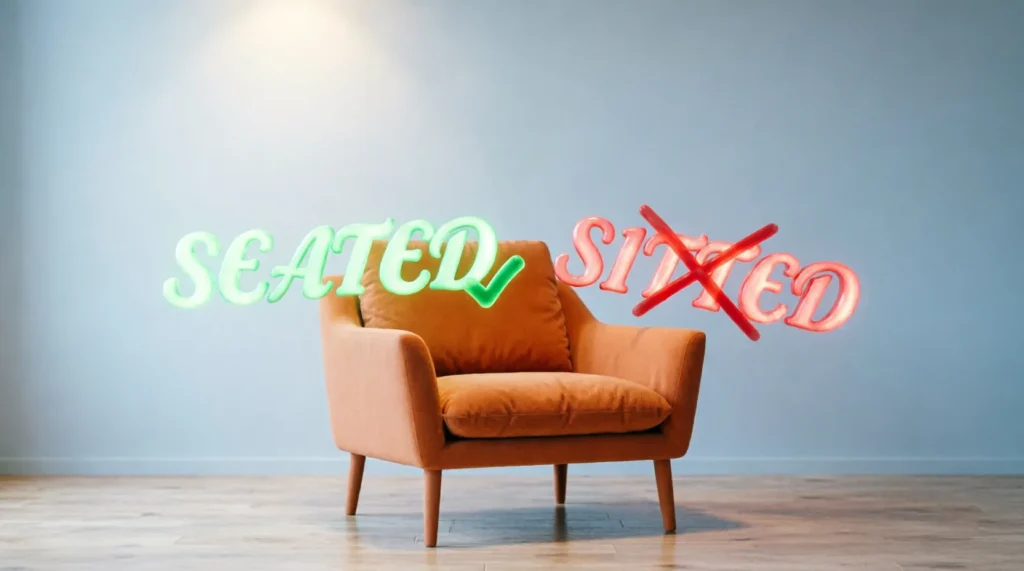
In short, seated is the standard and correct word in modern English when describing someone who is sitting or has taken a seat. While you may occasionally see “sitted” in older texts or very specific contexts, it is generally considered nonstandard today. Understanding the difference will help you write with confidence and avoid a surprisingly common mistake.
The Confusion Around Sitted or Seated
Imagine you’re finishing an essay, writing a work email, or posting a blog article. You type, “The guests were sitted at the table,” and suddenly pause. Should it be “sitted” or “seated”?
You’re not alone if you’ve wondered about sitted or seated. Many English learners and native speakers alike stop and second-guess themselves because both words seem like they should work.
The confusion becomes even stronger because English often forms past participles by adding “-ed” to a verb. Since we say “sit,” it feels natural to assume that “sitted” might be correct. However, English doesn’t always follow the patterns we expect.
What Each Word Actually Means
To understand the difference, it helps to start with the verb “sit.”
“Sit” is an irregular verb. Its common forms are:
Sit (present tense)
Sat (past tense)
Sat (past participle)
For example:
“The students sat quietly during the lecture.”
Now let’s look at “seated.”
“Seated” comes from the verb “seat,” which means to place someone in a seat or to take a seat. It functions as both a verb form and an adjective.
For example:
“The guests were seated before the ceremony began.”
In this sentence, “seated” describes the guests’ position.
What about “sitted”?
In modern standard English, “sitted” is generally not accepted as the normal past tense or past participle of “sit.” Most grammar experts and style guides recommend avoiding it. While it appears in some historical writings and certain dialects, it is not the preferred choice in contemporary writing.
For example, instead of:
“The audience was sitted.”
You would write:
“The audience was seated.”
Or:
“The audience sat down.”
Why People Mix Up Sitted or Seated
The main reason people confuse sitted or seated is that English contains both regular and irregular verbs. Language researchers have long noted that speakers naturally try to apply regular patterns to irregular words.
Most English verbs form their past tense with “-ed.” Words such as “walk” become “walked,” and “jump” becomes “jumped.” Because of this pattern, many people assume “sit” should become “sitted.”
Another reason is that “seated” sounds more formal than “sat.” When writers want a polished or professional tone, they often reach for “seated.” Over time, some people mistakenly create “sitted” because it seems logically connected to “sit.”
Linguists also point out that irregular verbs are among the most commonly confused parts of English grammar because they don’t always follow predictable rules.
The Simple Rule to Remember Which Is Which
Here’s the easiest rule:
If you’re talking about someone being in a chair or taking a place, use “seated” or “sat” — not “sitted.”
Think of it this way:
Sit → Sat
Seat → Seated
The word “seated” belongs to the verb “seat,” not “sit.”
Examples:
Correct: “The family was seated near the window.”
Correct: “The family sat near the window.”
Incorrect: “The family was sitted near the window.”
Another example:
Correct: “All passengers must remain seated.”
Incorrect: “All passengers must remain sitted.”
Once you connect “seated” with “seat,” the distinction becomes much easier to remember.
Common Mistakes People Make With Sitted or Seated
Writing “The students were sitted in rows.” The problem is that “sitted” is not the standard form here. Correct version: “The students were seated in rows.”
Writing “Please stay sitted until the presentation ends.” This uses a nonstandard form. Correct version: “Please stay seated until the presentation ends.”
Writing “The guests have sitted at their tables.” The past participle is incorrect. Correct version: “The guests have sat at their tables.”
Writing “Everyone was satted down before lunch.” This incorrectly creates another regular verb form. Correct version: “Everyone was seated before lunch.”
Real-World Examples: Sitted or Seated Used Correctly
Casual conversation: “We arrived early and were seated right away at the restaurant.”
This sounds natural because “seated” describes being shown to a table.
Professional writing: “All attendees should remain seated during the safety briefing.”
Professional documents frequently use “seated” because it is clear and formal.
Academic writing: “Participants remained seated throughout the observation period.”
Researchers often choose “seated” when describing conditions in a study.
Creative writing: “She sat quietly by the fireplace as the rain tapped against the windows.”
In storytelling, “sat” is often more natural when describing a person’s action.
These examples show that both “sat” and “seated” have important roles, while “sitted” generally does not.
British English vs. American English — Does It Affect Sitted or Seated?
Unlike some spelling differences in English, this confusion is not really about British versus American usage.
Both British and American English generally prefer “sat” and “seated.” Neither variety considers “sitted” the standard choice in formal writing.
That said, you may occasionally encounter “sitted” in regional dialects, older literature, or historical documents. These examples reflect specific language traditions rather than current mainstream grammar. For modern communication, readers in both regions will expect “sat” or “seated.”
What Grammar Checkers and Style Guides Say About Sitted or Seated
Most major style guides and grammar experts treat “seated” and “sat” as the correct standard forms. In formal writing, “sitted” is usually flagged as unusual, outdated, or incorrect.
Spellcheck can sometimes catch this issue, but not always. Because “sitted” has appeared in historical English, some writing tools may not automatically mark it as an error. That’s why understanding the rule yourself is more reliable than depending entirely on software.
Sitted or Seated in Professional and Academic Writing
In professional settings, word choice affects how readers perceive your writing. Using the correct form helps your message appear polished and credible.
Imagine submitting a job application, preparing a business report, or writing a university paper. If you use “sitted” where “seated” or “sat” is expected, readers may become distracted by the mistake rather than focusing on your ideas.
Precision matters in many fields, including academic, legal, and translated documents, where small language differences can affect clarity. The good news is that once you understand the distinction between sitted or seated, the choice becomes straightforward.
You don’t need to memorize a complicated grammar rule. Just remember that modern English uses “sat” and “seated,” and you’ll rarely have reason to hesitate again.
Quick Recap: Sitted or Seated at a Glance
“Seated” is the standard modern form when describing someone in a seat.
“Sat” is the past tense and past participle of “sit.”
“Sitted” is generally considered nonstandard in modern English.
Both British and American English prefer “sat” and “seated.”
When in doubt, choose “seated” or “sat,” not “sitted.”
Frequently Asked Questions About Sitted or Seated
Is “sitted” a real word?
Yes, “sitted” has existed in historical English and appears in some dialects. However, it is not considered standard in modern English writing. Most writers should use “sat” or “seated” instead.
Should I say “I was seated” or “I was sitted”?
You should say “I was seated.” This is the accepted and natural form in modern English. “I was sitted” sounds incorrect to most readers and listeners.
Why is “sit” not changed to “sitted”?
Because “sit” is an irregular verb. English has many irregular verbs that do not follow the usual “-ed” pattern. The correct past tense and past participle are “sat,” not “sitted.”
Is “seated” more formal than “sat”?
Yes, in many situations. “Sat” often sounds more conversational, while “seated” is common in professional, academic, and formal contexts. Both are correct when used appropriately.
Do native English speakers use “sitted”?
Most native speakers do not use “sitted” in everyday standard English. While it may appear in certain regional dialects or older texts, “sat” and “seated” remain the preferred forms.
Final Thoughts on Sitted or Seated
The answer to the sitted or seated question is simpler than it first appears. In modern English, “seated” and “sat” are the forms you should use, while “sitted” is generally considered nonstandard.
If you’ve ever hesitated before choosing between these words, you’re in good company. This is a common point of confusion because English irregular verbs don’t always behave the way we expect.
Now that you know the rule, you can write with greater confidence. The next time you encounter sitted or seated, you’ll know exactly which form belongs on the page.
James Williams has been fascinated by the intricacies of the English language since his childhood days. Holding a Master’s degree in Linguistics from the University of Cambridge, he has spent over 15 years working as a professional editor and language consultant. James specializes in deciphering complex spelling and grammatical issues, and he is passionate about helping students and professionals alike gain confidence in their writing. His experience includes developing educational content for ESL learners, ensuring clarity and precision in communication. James is dedicated to providing readers with easy-to-follow guidance that resolves word confusions and common spelling errors, making WordlyRight an essential resource for anyone who needs quick, authoritative answers.