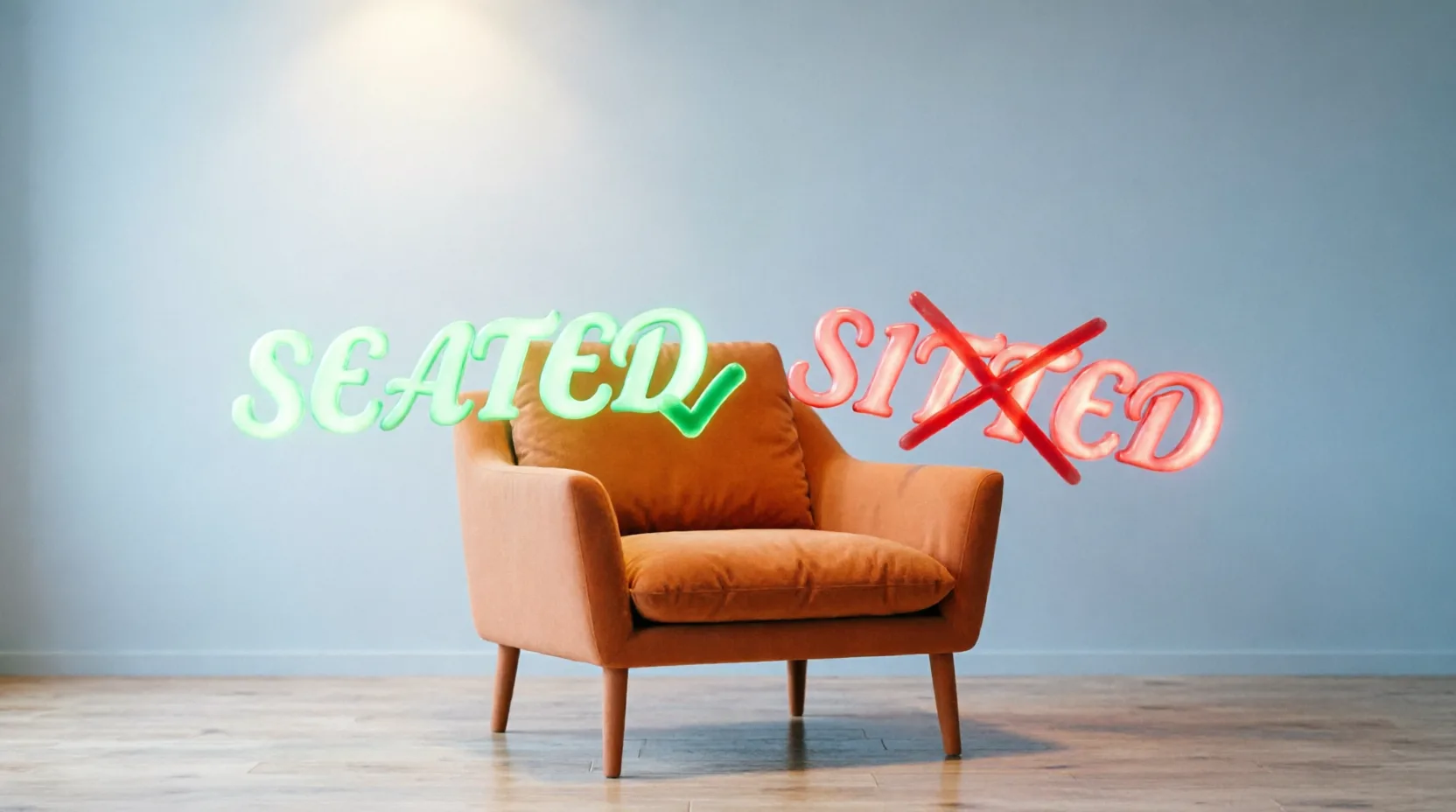
In short, “sit” is a verb that means to place yourself in a seated position, while “seat” is usually a noun or a verb meaning to provide or assign a place to sit. People confuse them because they both relate to sitting, but they are used in different grammatical roles. Once you understand the difference, you’ll stop second-guessing yourself in writing forever.
The Confusion Around seat or sit
You’re writing a simple sentence and suddenly you pause: should you say “please sit here” or “please seat here”? It feels like both should work, but something doesn’t look right.
This is exactly where most people struggle with seat or sit. You might be writing an email, helping someone with directions, or finishing a school assignment when doubt creeps in. The words feel connected, so your brain assumes they are interchangeable.
Even confident writers hesitate here because the difference is subtle in meaning but important in grammar. And once you notice it, you start seeing the confusion everywhere.
What Each Word Actually Means
Let’s break it down in the simplest way so you can finally feel clear about seat or sit.
“Sit” is a verb. It describes what you do when you lower your body onto a chair or surface. It is an action you perform yourself.
Example: You sit on the sofa after a long day and finally relax.
“Seat” is usually a noun or a verb, but it behaves differently. As a noun, it refers to a place where you can sit. As a verb, it means to arrange or place someone in a seat.
Example (noun): You found a seat near the window on the bus. Example (verb): The teacher seated the students in alphabetical order.
So when you are talking about your own action, you use “sit.” When you are talking about arranging or providing a place, you use “seat.”
seat or sit: Side-by-Side Comparison
Here is a quick breakdown to make seat or sit easier to compare at a glance.
Feature
seat
sit
Meaning
Place someone in a position
Rest in a seated position
Part of Speech
Noun, verb
Verb
Formality
Neutral to formal
Neutral
Common Context
Events, furniture, arrangements
Daily actions, posture
Example Sentence
Please seat the guests.
Please sit here.
Can They Be Swapped?
Sometimes
Sometimes
Reason
Depends on sentence structure
Different roles in a sentence
Why People Mix Up seat or sit
Linguists often point out that confusion like seat or sit happens because the words are closely related in meaning and sound natural in similar contexts. Your brain groups them together because they both deal with chairs, positions, and rest.
Another reason is language habit. In fast speech and casual writing, people don’t pause to think about grammar rules. So you might hear “seat down” in some informal speech patterns, which reinforces the mistake.
Also, both words are short and common, so your mind assumes they should be interchangeable. But English is strict about function: one describes an action you do, and the other describes placement or arrangement.
The Simple Rule to Remember Which Is Which
Here is an easy rule that will help you master seat or sit instantly:
If you are doing the action yourself, use “sit.” If someone is placing you or assigning a place, use “seat.”
Think of it like this: you sit alone, but someone seats you.
Example sentences:
You sit on the bench while waiting for the bus.
The usher seats you at the theater.
Please sit quietly while the meeting starts.
Once you apply this rule, you will rarely confuse them again.
Common Mistakes People Make With seat or sit
Here are some realistic mistakes people often make with seat or sit, along with corrections:
Using “seat” instead of “sit” for personal action Wrong: You should seat here. Correct: You should sit here.
Using “sit” when assigning someone a place Wrong: The waiter will sit you at your table. Correct: The waiter will seat you at your table.
Mixing noun and verb meanings incorrectly Wrong: I need a sit near the door. Correct: I need a seat near the door.
Overcorrecting and avoiding both words Wrong: Please be in a sitting position here. Correct: Please sit here.
Each mistake happens because your brain tries to simplify grammar, but English requires specific word roles.
Real Sentence Fix — seat or sit
See the Mistake, Fix the Mistake
These are real mistakes people make with seat or sit — and the simple fix for each one.
❌ Please sit the visitors near the front desk. ✅ Please seat the visitors near the front desk. 📌 Why: Use “seat” when placing other people in a position.
❌ We were seated on the couch and talked all night. ✅ We sat on the couch and talked all night. 📌 Why: “Sat” fits better when describing your own action.
❌ The teacher asked the students to seat quietly. ✅ The teacher asked the students to sit quietly. 📌 Why: Use “sit” when someone takes a seated position.
❌ Click the button and seat for a moment while it loads. ✅ Click the button and sit for a moment while it loads. 📌 Why: “Sit” is the correct action for waiting in a chair.
❌ The host told us to sit at table five. ✅ The host told us to be seated at table five. 📌 Why: “Be seated” is a more natural instruction in this context.
❌ The conference room can sit 40 people. ✅ The conference room can seat 40 people. 📌 Why: Rooms and venues “seat” people because they provide places for them.
Real-World Examples: seat or sit Used Correctly
Casual conversation: You can sit next to me if there’s space. This works because you are doing the action yourself.
Professional writing: The manager will seat the guests upon arrival. This is correct because someone is assigning places.
Academic writing: Students must sit quietly during examinations. This describes expected behavior.
Creative writing: She chose a quiet seat by the lake to think. Here, “seat” is a noun referring to a place.
Each example shows how seat or sit depends entirely on action versus position.
British English vs. American English — Does It Affect seat or sit?
The good news is that seat or sit does not change between British and American English. Both regions use the same rules for these words.
You will not find spelling differences here, unlike words such as “colour” or “organise.” Instead, the confusion is universal because it comes from meaning, not spelling.
So whether you are writing in Pakistan, the UK, or the US, the rule stays the same: “sit” is what you do, and “seat” is what is given or arranged.
What Grammar Checkers and Style Guides Say About seat or sit
Grammar tools usually catch mistakes with seat or sit, but not always. That’s because context matters. A sentence like “He will seat here” might be flagged, but subtle errors can still slip through.
Style guides generally reinforce the same rule: “sit” for self-action and “seat” for placement. They emphasize clarity over memorization.
The key takeaway is simple: tools help, but your understanding is what keeps your writing accurate every time.
seat or sit in Professional and Academic Writing
In professional and academic settings, using seat or sit correctly matters more than you might think. Small grammar errors can affect how polished your writing appears.
For example, in job applications or formal emails, saying “I will seat here during the meeting” can create confusion or reduce credibility. On the other hand, “I will sit here during the meeting” sounds natural and correct.
In academic writing, precision is even more important. Scholars and educators expect correct usage because it reflects attention to detail. Once you master this distinction, you remove one more source of doubt from your writing.
Quick Recap: seat or sit at a Glance
“Sit” = an action you do yourself
“Seat” = a place or the act of placing someone
You sit alone, but someone seats you
“Seat” can be a noun or verb depending on context
The confusion happens because both relate to chairs and positions
Frequently Asked Questions About seat or sit
Is it correct to say “please seat down”?
No, this is incorrect. The correct phrase is “please sit down” because you are asking someone to perform the action themselves.
What is the difference between sit and seat in grammar?
“Sit” is an intransitive verb meaning to place yourself down, while “seat” is a transitive verb or noun meaning to place someone or something in a position.
Can I say “I will seat here”?
No, that is incorrect. You should say “I will sit here” because you are referring to your own action.
Is seat ever used for people sitting?
Yes, but only when someone else is arranging or assigning the place. For example, “The host seated the guests at the table.”
Why do people confuse sit and seat so often?
People confuse them because both words relate to chairs and positioning, and they sound closely related in everyday speech, making the difference easy to overlook.
Final Thoughts on seat or sit
The difference between seat or sit comes down to one simple idea: action versus placement. Once you understand that “sit” is what you do and “seat” is what is given or arranged, everything becomes clearer.
This is one of those small grammar points that confuses almost everyone at some stage, so you are not alone in wondering about it. Now that you know the rule, your writing will feel more confident and precise.
The next time you pause mid-sentence, you won’t have to guess—you’ll already know exactly which word belongs.
Frequently Asked Questions
What is the main difference between 'seat' and 'sit'?▼
The main difference is that ‘sit’ is a verb that describes the action of lowering your body into a seated position, while ‘seat’ can be a noun referring to a place to sit or a verb meaning to arrange someone in a seat.
Can I use 'seat' and 'sit' interchangeably in my writing?▼
Generally, no. While both words relate to sitting, they serve different grammatical roles: ‘sit’ refers to the action you perform, whereas ‘seat’ refers to the placement or arrangement of someone in a seated position.
What are some common mistakes people make with 'seat' and 'sit'?▼
A common mistake is using ‘seat’ instead of ‘sit’ in phrases like ‘please seat here,’ when the correct phrase should be ‘please sit here.’ This confusion often arises due to their similar meanings and casual speech habits.
How can I remember when to use 'sit' versus 'seat'?▼
A simple rule to remember is: if you are performing the action yourself, use ‘sit.’ If someone else is placing you or assigning a place, then use ‘seat.’
In what contexts should I use 'seat'?▼
You should use ‘seat’ when referring to the physical location where someone can sit, as in ‘I found a seat at the table,’ or when describing the action of arranging someone in a seat, like ‘the host seated the guests.’
Why do people often mix up 'seat' and 'sit'?▼
People mix them up because they are closely related in meaning and often appear in similar contexts, leading to confusion. Additionally, linguistic habits and informal speech patterns contribute to this mix-up.
Are there specific examples that illustrate the use of 'seat' and 'sit'?▼
Yes, for example, you would say ‘You sit on the sofa’ when describing your action, and ‘The teacher seated the students’ when talking about placing someone in a seat. These examples highlight their distinct roles in a sentence.
Emily Thornton holds a Master’s degree in Linguistics from the University of Chicago and has been passionate about language education for over 15 years. Her interest in language developed at a young age, fueled by a curiosity for how intricacies in language shape communication. Emily has authored several guides on grammar usage and works extensively with ESL learners to improve their fluency and confidence in English. Dedicated to clarity, she writes content that demystifies complex spelling and grammar issues, making her contributions invaluable for professionals looking for authoritative and swift language solutions. Emily continues to explore innovative ways to bridge communication gaps through accurate and effective language use. Her blend of academic rigor and practical insight ensures learners across all levels find her advice beneficial.