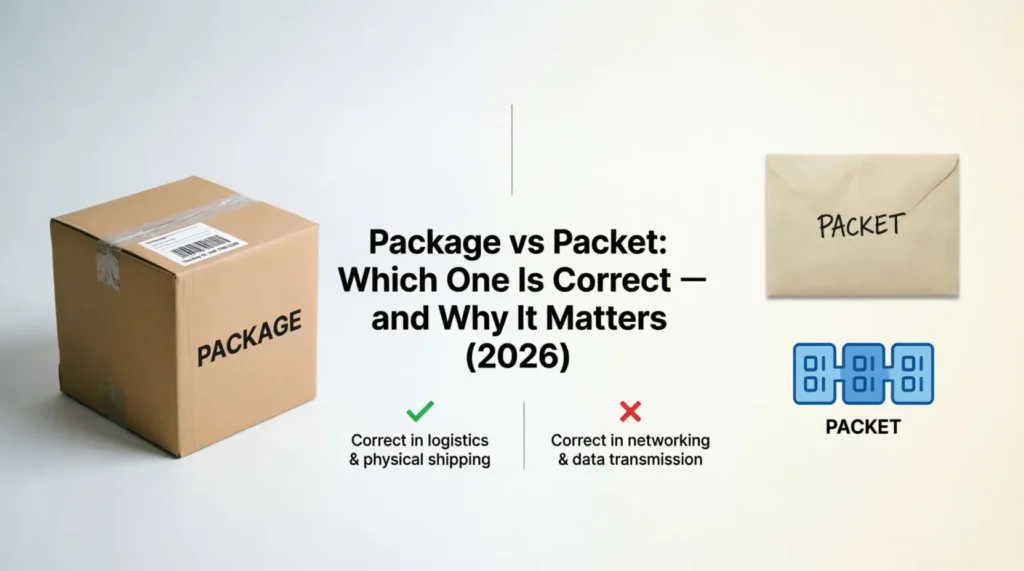
In short, “package” and “packet” are both correct words, but they are used in different contexts and cannot be freely swapped. A package is usually a larger wrapped item or shipment, while a packet refers to something smaller, often a single portion or pouch. Understanding this difference will instantly improve your writing clarity and confidence as you continue reading.
The Confusion Around package vs packet
You’ve probably been there — writing an email, filling out a form, or even chatting online, and suddenly you pause. Should you say package or packet? The uncertainty around package vs packet is surprisingly common, even for fluent English speakers.
Maybe you’re ordering something online and wondering whether the delivery note should say “package” or “packet.” Or you’re writing about food items like chips or sauce sachets and hesitate for a second. This tiny moment of doubt is exactly where most people get stuck.
The confusion around package vs packet happens because both words feel similar in size and meaning, but they actually belong to different usage categories. Once you understand that difference, the hesitation disappears completely.
What Each Word Actually Means
Let’s break down package vs packet in the simplest way possible so you can use both words correctly without second-guessing yourself again.
Package is a noun, and sometimes a verb. As a noun, it refers to a wrapped or boxed item that is ready for transport, delivery, or storage. It is usually something larger or more formal in nature.
For example: “I received a package from an online store today.” Here, package refers to a boxed delivery containing one or more items.
As a verb, it means to wrap or prepare something for shipping. For example: “They package the products carefully before shipping.”
Packet, on the other hand, is a noun. It refers to a small, sealed container or pouch that holds a limited quantity of something. Think of sugar packets, sauce packets, or small information bundles.
For example: “She opened a ketchup packet with her fries.” This shows packet being used for something small and single-use.
So in simple terms, package vs packet is really about size and purpose: one is usually larger and shipped, the other is smaller and portioned.
package vs packet: Side-by-Side Comparison
Here is a quick breakdown to make the package vs packet easier to compare at a glance.
Feature
Package
Packet
Meaning
A wrapped item or shipment
A small sealed container or bundle
Part of Speech
Noun
Noun
Formality
Neutral
Neutral
Common Context
Shipping, deliveries, gifts
Food, data, medicine, sauces
Example Sentence
The package arrived today.
Open the sugar packet.
Can They Be Swapped?
Sometimes
Sometimes — depends on size and purpose
Why People Mix Up package vs packet
The confusion between package vs packet exists mainly because the words sound very similar and share the same Latin root idea of “something packed.” Linguists often point out that English borrowed and evolved both terms in slightly different directions, which creates overlap in modern usage.
Another reason is everyday exposure. You see “food packets,” “data packets,” and “shipping packages” all in daily life, often without a clear explanation of why one word is used over the other. That constant mixing blurs the boundary in your mind.
Finally, in fast speech, both words sound almost identical in rhythm, so your brain stores them as interchangeable even though they are not. This is why even confident writers sometimes hesitate when choosing between package vs packet.
The Simple Rule to Remember Which Is Which
Here’s an easy rule that makes package vs packet instantly clear:
If it’s large, delivered, or contains multiple items → use “package.” If it’s small, single-use, or portioned → use “packet.”
This simple size-and-purpose test works almost every time without fail.
Now let’s see it in action:
“I received a package from the courier service.” (A shipped box or parcel)
“She tore open a salt packet at the restaurant.” (A small single-use pouch)
“The company will package the order today.” (Action of preparing goods for shipping)
Once you apply this rule a few times, choosing between package vs packet becomes automatic.
Common Mistakes People Make With package vs packet
Using “packet” for large deliveries: “I got a packet from Amazon” → Corrected: “I got a package from Amazon.”
Using “package” for food portions: “Pass me a ketchup package” → Corrected: “Pass me a ketchup packet.”
Confusing in technical writing: “data package” instead of “data packet” in networking contexts → Corrected: “data packet.”
Treating both words as interchangeable in emails: “Your packet has been shipped” → Corrected: “Your package has been shipped.”
Real Sentence Fix — package vs packet
See the Mistake, Fix the Mistake
These are real mistakes people make with package vs packet — and the simple fix for each one.
❌ Please collect your packet from the reception desk before 5 p.m. ✅ Please collect your package from the reception desk before 5 p.m. 📌 Why: A shipped item waiting for pickup is usually called a package.
❌ Can you grab a package of ketchup for my fries? ✅ Can you grab a packet of ketchup for my fries? 📌 Why: A small single-use container is called a packet.
❌ The teacher handed each student a package of worksheets. ✅ The teacher handed each student a packet of worksheets. 📌 Why: A group of papers given together is commonly called a packet.
❌ The network package was lost during transmission. ✅ The network packet was lost during transmission. 📌 Why: In computer networking, the correct term is packet.
❌ A small package of sugar comes with every coffee. ✅ A small packet of sugar comes with every coffee. 📌 Why: Sugar for one serving is normally sold in a packet.
❌ The courier delivered a packet with my new headphones. ✅ The courier delivered a package with my new headphones. 📌 Why: Items shipped by a delivery service are usually called packages.
Real-World Examples: package vs packet Used Correctly
Casual conversation: “Don’t forget to bring a snack packet for the trip.” This works because it refers to a small, portable food portion.
Professional writing: “Your package will arrive within 3–5 business days.” Here, it refers to a shipped delivery item.
Academic context: “A data packet travels through the network in milliseconds.” This is correct in technical communication.
Creative writing: “She slipped a tiny love note into the packet of chocolates.” This shows emotional storytelling with a small contained item.
Each example shows how package vs packet depends entirely on size and context.
British English vs. American English — Does It Affect package vs packet?
In the case of package vs packet, there is no major British vs American spelling difference. Both words are used in the same way across regions.
However, British English sometimes uses “packet” slightly more commonly for everyday items like crisps (chips in American English), while American English tends to favor “package” in commercial shipping contexts.
Despite these subtle usage trends, linguists agree that the core distinction remains universal: size and function, not geography.
What Grammar Checkers and Style Guides Say About package vs packet
Most grammar checkers correctly distinguish package vs packet based on context, especially when “packet” is mistakenly used for shipping or “package” is used for small sachets.
Style guides generally reinforce the same idea: “package” is for parcels and shipments, while “packet” refers to small containers or technical units like data in computing.
However, tools alone are not perfect. They often rely on patterns rather than meaning, so they may miss subtle errors depending on sentence structure. Understanding the rule yourself is always more reliable than depending on software suggestions.
package vs packet in Professional and Academic Writing
Getting package vs packet right matters more than you might think in formal writing. In job applications, business communication, or academic essays, incorrect usage can make your writing seem less precise.
For example, using “packet” instead of “package” in a logistics report could confuse readers or signal lack of familiarity with industry terms. Similarly, in technical fields, confusing “data packet” with “data package” changes meaning entirely.
The good news is that once you fully understand this distinction, you’ll rarely make the mistake again. Writers, editors, and language experts all agree that clarity in word choice builds credibility, and this is one of those small but powerful details.
Quick Recap: package vs packet at a Glance
“Package” = larger item, parcel, or shipment
“Packet” = small pouch or single-use portion
Size and function determine the correct choice
“Packet” is common in food and technical contexts
“Package” is standard for shipping and delivery
Frequently Asked Questions About package vs packet
Is it package or packet when ordering online?
When ordering online, the correct word is “package.” It refers to the boxed or wrapped item delivered to your address. “Packet” is not used in this context.
Can packet and package mean the same thing?
No, they cannot. While they share a similar idea of “something packed,” their usage is different. A packet is small and limited, while a package is larger and meant for delivery or transport.
What is a data packet vs data package?
A data packet is a small unit of digital information sent over a network. A data package is not commonly used in networking and is generally incorrect in that technical context.
Why do people confuse package vs packet?
People confuse them because they sound similar and both relate to things being “packed.” The difference becomes clearer once you focus on size and usage context.
Which word is more formal: package or packet?
“Package” is generally more formal and widely used in business, shipping, and professional communication. “Packet” is more casual or technical depending on context.
Final Thoughts on package vs packet
The difference between package vs packet comes down to something surprisingly simple: size and purpose. One is for larger deliveries and shipments, while the other is for small, individual portions or units.
Now that you understand this distinction clearly, you can use both words with confidence in emails, writing, and everyday conversation. This is one of those small grammar details that instantly improves how precise and professional your communication sounds. From here on, you won’t need to hesitate when choosing between them again.
Frequently Asked Questions
What is the main difference between a package and a packet?▼
A package is typically a larger wrapped item or shipment, while a packet refers to a smaller, sealed container or pouch, often holding a single portion of something. Understanding this distinction can enhance your writing clarity.
In what contexts should I use 'package' versus 'packet'?▼
Use ‘package’ when referring to larger items intended for shipping, deliveries, or gifts. In contrast, use ‘packet’ for smaller, single-use items, such as sauce or sugar packets.
Why do people often confuse 'package' and 'packet'?▼
The confusion arises because both words sound similar and share a common Latin root related to ‘something packed.’ Additionally, their frequent use in daily life without clear distinctions can blur their meanings.
Can 'package' and 'packet' ever be used interchangeably?▼
Yes, they can sometimes be swapped, but it depends on the context, particularly size and purpose. For instance, you might refer to a small delivery as a ‘packet’ if it contains only one item.
What are some examples of when to use 'package'?▼
You would use ‘package’ in sentences like ‘I received a package from an online store,’ which indicates a larger delivery. It’s appropriate for items that are wrapped for transport and contain multiple goods.
What are common contexts for using 'packet'?▼
‘Packet’ is commonly used in contexts involving food, such as ‘sugar packet,’ or in technology, like ‘data packets.’ These generally refer to smaller, single-use or portioned items.
Is there a simple rule to remember the difference between 'package' and 'packet'?▼
Yes, a simple rule is: use ‘package’ for large, delivered items containing multiple things, and use ‘packet’ for small, single-use portions. This guideline helps clarify which term to use in various situations.
Rebecca Nguyen brings a diverse background in journalism and education to her role at WordlyRight. A graduate of the University of Toronto with a focus in English and Linguistics, she has spent over 12 years honing her skills as a writer and educator. Rebecca’s expertise lies in her ability to simplify daunting grammar rules and rectify frequent spelling mistakes in a way that resonates with students and professionals alike. Her articles on WordlyRight zero in on the most common word confusions encountered by writers, turning complex concepts into clear, actionable insights. With a passion for lifelong learning, Rebecca continually seeks to refine her understanding of language to better serve her audience.