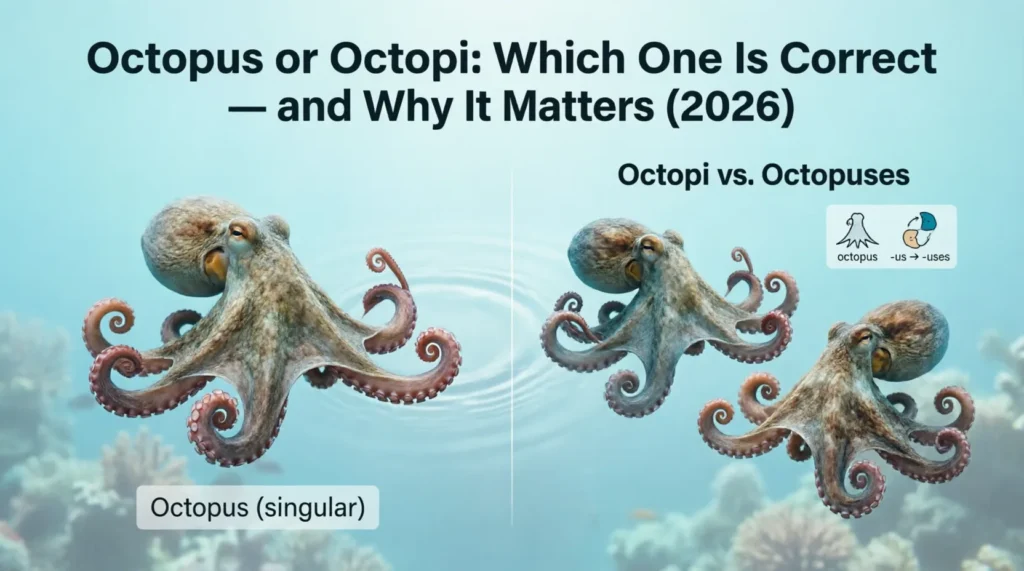
In short, both “octopus” and “octopi” are used in English, but “octopuses” is actually the most widely accepted plural today. “Octopi” sounds educated because of its Latin-style ending, yet many grammar experts consider it technically incorrect for historical reasons. The full story is more interesting than most people expect.
The Confusion Around Octopus or Octopi
You are writing a school essay, a marine biology post, or even a fun social media caption when suddenly you pause: is the plural of octopus “octopus,” “octopi,” or “octopuses”?
A lot of people second-guess themselves here. Even confident writers often hesitate because all three forms sound believable in conversation. That uncertainty is exactly why searches for “octopus or octopi” keep showing up year after year.
Part of the confusion comes from the fact that English borrows words from many languages. When you mix Greek roots, Latin patterns, and modern English habits together, you end up with a plural debate that has lasted for decades.
What Each Word Actually Means
“Octopus” is a noun. It refers to the sea animal with eight arms known for its intelligence, camouflage, and problem-solving abilities.
Example: The octopus escaped from the aquarium tank overnight.
“Octopi” is also used as a plural noun by many English speakers. People often assume it follows the same pattern as Latin words like “cactus” becoming “cacti.” However, linguists point out that “octopus” originally comes from Greek, not Latin, which makes “octopi” historically inconsistent.
Example: Several octopi were spotted near the coral reef.
“Octopuses” is the standard English plural form preferred by many dictionaries and style guides today. It follows normal English plural rules by simply adding “-es.”
Example: The documentary featured giant Pacific octopuses living in deep ocean caves.
You may also occasionally see “octopodes,” which follows the original Greek plural pattern. While technically defensible, it is extremely rare in everyday English and can sound overly formal or theatrical.
octopus or octopi: Side-by-Side Comparison
Here is a quick breakdown to make the octopus or octopi easier to compare at a glance.
Feature
octopus
octopi
Meaning
Singular sea animal
Plural form of octopus
Part of Speech
Noun
Noun
Formality
Neutral
Neutral
Common Context
One animal discussed
Multiple animals discussed
Example Sentence
The octopus hid quickly.
Several octopi escaped.
Can They Be Swapped?
Sometimes
Sometimes
Reason
Depends on singular use
Depends on plural use
Why People Mix Up Octopus or Octopi
The biggest reason people confuse octopus or octopi is pattern recognition. English speakers naturally compare “octopus” to words like “fungus/fungi” or “alumnus/alumni.” Since those are familiar Latin plurals, “octopi” feels logical.
Language researchers say our brains often prefer familiar sound patterns over historical accuracy. That is why “octopi” became popular even though the word itself did not originate from Latin.
Another reason is that dictionaries and media sources have accepted multiple forms over time. If you learned “octopi” in school, heard “octopuses” in documentaries, and saw “octopus” used casually online, it makes sense that you would feel uncertain.
The internet has also amplified the confusion. Different websites confidently declare different answers, leaving many readers unsure which version is actually safest to use.
The Simple Rule to Remember Which Is Which
Here is the easiest rule:
If you want the safest and most modern standard English plural, use octopuses.
You can remember it this way: most English nouns simply add “-es” to form the plural, and octopus follows that pattern naturally in modern usage.
“Octopi” is still widely recognized and not usually treated as a serious mistake in casual conversation. But if you want the form most grammar experts and style guides prefer, “octopuses” is your best choice.
Examples:
The aquarium recently added two octopuses to its marine exhibit.
Marine scientists studied how octopuses solve puzzles.
My little brother still says “octopi,” and most people understand him perfectly.
Once you remember that “octopus” behaves like a normal English noun today, the confusion becomes much easier to handle.
Common Mistakes People Make With Octopus or Octopi
Writing “octopi” because it “sounds smarter” without realizing the word is Greek in origin. Correct version: Many language experts recommend “octopuses” in formal writing.
Assuming “octopus” itself is already plural. Correct version: One octopus, two octopuses.
Using “octopodes” in everyday writing where it sounds unnatural or distracting. Correct version: The researcher observed several octopuses during the dive.
Believing only one form is universally accepted everywhere. Correct version: “Octopi” exists in common usage, but “octopuses” is generally preferred in modern English.
Real-World Examples: Octopus or Octopi Used Correctly
Casual conversation: “Did you know octopuses can open jars?” This sounds natural and fits modern everyday English.
Professional writing: “The aquarium imported three octopuses from a marine conservation center.” Formal contexts usually favor the standard English plural.
Academic writing: “Researchers observed octopuses using tools in controlled environments.” Academic and scientific writing often prefers clarity and consistency over dramatic wording.
Creative writing: “The old sailor swore the octopi followed his ship through the fog.” In fiction or stylized writing, “octopi” may be chosen for rhythm or atmosphere.
These examples show that context matters. You can technically encounter multiple forms, but some feel more natural depending on the situation.
British English vs. American English — Does It Affect Octopus or Octopi?
Unlike some spelling debates, octopus or octopi is not mainly a British-versus-American English issue. Both forms appear in the United States, the United Kingdom, Canada, Australia, and other English-speaking regions.
The real distinction is between traditional usage and modern language preference. Most contemporary style guides in both British and American English lean toward “octopuses” because it follows standard English plural rules.
That said, “octopi” still appears regularly in media, advertising, and informal speech worldwide. People recognize it instantly, even if grammar experts debate its historical accuracy.
Real Sentence Fix — octopus or octopi
See the Mistake, Fix the Mistake
These are real mistakes people make with octopus or octopi — and the simple fix for each one.
❌ The aquarium recently added three octopus to its main exhibit. ✅ The aquarium recently added three octopi to its main exhibit. 📌 Why: A number greater than one needs a plural form.
❌ I saw an octopi hiding under a rock at the beach. ✅ I saw an octopus hiding under a rock at the beach. 📌 Why: Only one animal is being mentioned.
❌ Our science report focused on how octopi changes color. ✅ Our science report focused on how octopi change color. 📌 Why: A plural subject needs a plural verb.
❌ The app uses an octopi icon to represent the mascot. ✅ The app uses an octopus icon to represent the mascot. 📌 Why: The sentence refers to a single mascot.
❌ That octopi at the pet store looks really smart. ✅ That octopus at the pet store looks really smart. 📌 Why: “That” points to one animal, not several.
❌ We watched an octopi swim across the tank during lunch. ✅ We watched an octopus swim across the tank during lunch. 📌 Why: The article “an” is used with a singular noun.
What Grammar Checkers and Style Guides Say About Octopus or Octopi
Most modern style guides accept “octopuses” as the safest standard plural. Grammar experts often explain that because “octopus” entered English through Greek roots, the Latin plural ending in “-i” is not technically correct.
At the same time, many dictionaries still list “octopi” as an acceptable alternative because it has been used for so long in real English conversation. Spellcheck tools may not flag either version, which is why relying only on autocorrect can leave you confused.
This is one of those cases where understanding the reasoning yourself is more useful than depending entirely on software suggestions.
Octopus or Octopi in Professional and Academic Writing
In professional writing, precision matters. If you are preparing an academic paper, a published article, or educational material, using “octopuses” usually creates the clearest and most modern impression.
Readers often associate “octopi” with outdated grammar lessons or internet trivia debates. While it rarely damages meaning, some editors may view it as less accurate than the standard English plural.
In scientific and academic contexts, consistency is especially important. Marine biology texts, research papers, and educational publishers commonly prefer “octopuses” because it avoids unnecessary distraction from the actual subject matter.
The good news is that once you understand the difference, you probably will not hesitate again. You now know not only which version is preferred, but also why the confusion exists in the first place.
Quick Recap: Octopus or Octopi at a Glance
“Octopus” is singular.
“Octopuses” is the most widely recommended modern plural.
“Octopi” is common but historically inconsistent.
“Octopodes” exists but is very rare in normal English.
In formal writing, “octopuses” is usually your safest choice.
Frequently Asked Questions About Octopus or Octopi
Is octopi grammatically correct?
“Octopi” is widely used and understood, so many dictionaries accept it. However, many linguists and grammar experts prefer “octopuses” because “octopus” comes from Greek rather than Latin. In modern formal English, “octopuses” is usually considered the safest option.
What is the technically correct plural of octopus?
From a modern English perspective, “octopuses” is generally considered the standard plural. Historically, the Greek-style plural would be “octopodes,” but that form is extremely uncommon today.
Why do people say octopi instead of octopuses?
People often assume “octopus” follows the same pattern as Latin words ending in “-us,” like “cactus/cacti.” Since “octopi” sounds familiar and sophisticated, it became popular over time even though the word’s origin is Greek.
Do scientists say octopi or octopuses?
Many scientists, educators, and academic publishers prefer “octopuses” because it aligns with standard English grammar conventions. Still, you may occasionally hear “octopi” in casual speech or media interviews.
Is octopodes a real word?
Yes, “octopodes” is a real plural form based on the original Greek roots of the word. However, it is very rare in everyday English and can sound overly formal to most readers.
Final Thoughts on Octopus or Octopi
The debate around octopus or octopi has lasted so long because English mixes influences from many languages, and our brains naturally search for familiar patterns. That is why more than one version can sound correct at first glance.
If you want the clearest modern answer, use “octopuses” in most situations. “Octopi” is still commonly understood, but it is not the preferred choice for many grammar experts and style guides.
This confusion trips up writers everywhere, so you were never alone in wondering about it. Now that you know the reasoning behind the words, you can write with much more confidence the next time the question comes up.
Frequently Asked Questions
What is the most widely accepted plural form of octopus?▼
The most widely accepted plural form of octopus today is ‘octopuses.’ This form follows standard English pluralization rules by simply adding ‘-es’ to the end of the word.
Why do some people use 'octopi' instead of 'octopuses'?▼
Many people use ‘octopi’ because it resembles the Latin pluralization patterns seen in words like ‘cactus’ becoming ‘cacti.’ However, ‘octopus’ originates from Greek, making ‘octopi’ historically inconsistent according to linguists.
What does 'octopodes' mean, and is it commonly used?▼
‘Octopodes’ is a plural form that follows the original Greek pluralization pattern of the word ‘octopus.’ While it is technically correct, it is extremely rare in everyday English and can come across as overly formal.
Why do people often confuse 'octopus' and 'octopi'?▼
The confusion arises primarily from pattern recognition, as English speakers tend to compare ‘octopus’ to familiar Latin-derived words like ‘fungus/fungi.’ This leads to the assumption that ‘octopi’ is a logical plural form, despite its historical inaccuracy.
Can 'octopus' and 'octopi' be used interchangeably?▼
Yes, ‘octopus’ and ‘octopi’ can sometimes be used interchangeably, but it depends on the context. ‘Octopus’ refers to a single animal, while ‘octopi’ refers to multiple, though ‘octopuses’ is the preferred plural form in modern usage.
What is the simplest rule for using octopus in writing?▼
The simplest rule to remember is to use ‘octopuses’ for the safest and most modern standard plural in English. This aligns with how most English nouns form their plurals by adding ‘-es’.
How has the internet influenced the usage of 'octopus' and 'octopi'?▼
The internet has amplified the confusion by presenting different sources that confidently declare various forms as correct. This has left many readers uncertain about which version to use, especially when both ‘octopi’ and ‘octopuses’ are seen in different contexts.
Maria Ramirez is an experienced editor and language consultant with over 10 years in the publishing world. She holds a Bachelor’s degree in Journalism and deeply appreciates the power of the written word. Her expertise lies in dissecting the complexities of English grammar and providing straightforward guidance for contemporary writers. Maria’s work focuses on simplifying spelling and usage rules, assisting both seasoned writers and budding authors in presenting their ideas with precision. Her involvement with WordlyRight stems from a commitment to nurture a global audience’s command over English, ensuring learners and professionals don’t just understand language nuances but use them effectively in varied contexts. As someone who passionately believes in lifelong learning, Maria continuously seeks to inspire this ethos in her readers.