

10 min read
In short, Ms. and ma’am are both correct, but they are not interchangeable. Ms. is a title used before a woman’s name, while ma’am is a polite form of address used when speaking to or writing to a woman. Understanding the difference can help you avoid awkward mistakes in professional, academic, and everyday communication.
The Confusion Around Ms vs Maam
Imagine you’re writing an email to a teacher, manager, or client. You pause for a moment and wonder whether to begin with “Ms. Johnson” or “Ma’am.” It seems like a small detail, but suddenly you’re unsure which form is appropriate.
This is exactly why the question of ms vs maam comes up so often. Both terms are associated with showing respect to women, and they can appear in similar situations. Because of that, many people assume they mean the same thing.
Whether you’re a student, job seeker, blogger, or professional, you’re not alone if you’ve hesitated over this choice. The distinction is simple once you understand the role each word plays.
What Each Word Actually Means
Let’s start with Ms.
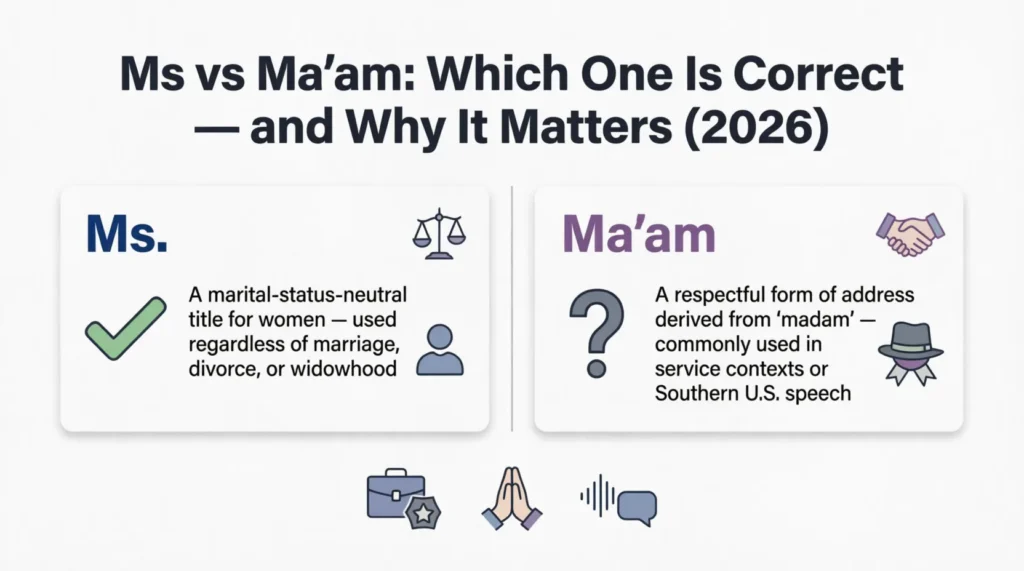
Ms. is a title used before a woman’s surname or full name. It functions much like Mr. does for men. One reason it became widely used is that it does not indicate whether a woman is married or unmarried.
Example:
“Ms. Carter will lead today’s meeting.”
In this sentence, Ms. is a title attached to the person’s name.
Now let’s look at ma’am.
Ma’am is a polite form of address used when speaking directly to a woman or when referring to her respectfully in conversation. It is not normally placed before a surname.
Example:
“Excuse me, ma’am, I think you dropped your wallet.”
Here, ma’am is being used to address the woman directly.
When comparing ms vs maam, the key difference is that Ms. is a title used with a name, while ma’am is a respectful way to address someone directly.
ms vs maam: Side-by-Side Comparison
Here is a quick breakdown to make the ms vs maam easier to compare at a glance.
| Feature | Ms | Ma’am |
|---|---|---|
| Meaning | Title for a woman | Polite way to address a woman |
| Part of Speech | Honorific title | Noun of address |
| Formality | Formal to neutral | Polite and respectful |
| Common Context | Names, letters, forms | Conversations, customer service |
| Example Sentence | Ms. Khan will speak today. | Thank you, ma’am. |
| Can They Be Swapped? | Sometimes | Sometimes |
| Used before a surname. | Used when speaking directly. |
Why People Mix Up Ms vs Maam
The confusion exists because both words are connected to politeness and respect. In many situations, you might use either one when interacting with the same person.
For example, you might begin an email with “Dear Ms. Wilson” but then speak to the same person in person and say, “Yes, ma’am.” Since both expressions show respect, many people assume they serve the same grammatical purpose.
Language researchers note that people often confuse words that appear in similar social situations. In the case of ms vs maam, the overlap comes from context rather than meaning.
Another reason is pronunciation. In casual speech, people hear respectful forms of address frequently but may not encounter their written forms as often. As a result, they may not realize that Ms. and ma’am belong to different grammatical categories.
The Simple Rule to Remember Which Is Which
Here’s an easy rule:
If the word comes before a person’s name, use Ms. If you’re speaking directly to the person without using their name, use ma’am.
Think of Ms. as a label attached to a name and ma’am as a respectful replacement for a name.
Examples:
- “Ms. Thompson will review your application.”
- “Thank you, ma’am, for your assistance.”
- “I spoke with Ms. Thompson yesterday.”
- “Yes, ma’am, I’ll complete the assignment today.”
If you can place the word directly before a surname, Ms. is probably the correct choice. If you’re addressing someone directly, ma’am is usually the better option.
Common Mistakes People Make With Ms vs Maam
- Writing “Ma’am Johnson will attend the meeting.” The issue is that ma’am is not normally used as a title before a surname. Correct version: “Ms. Johnson will attend the meeting.”
- Starting a formal email with “Dear Ma’am Smith.” This combines two different forms incorrectly. Correct version: “Dear Ms. Smith.”
- Addressing someone in conversation as “Excuse me, Ms.” without knowing their name. This can sound incomplete. Correct version: “Excuse me, ma’am.”
- Assuming Ms. means a woman is unmarried. Modern usage does not indicate marital status. Correct version: Use “Ms.” regardless of whether you know the person’s marital status.
Real Sentence Fix — ms vs maam
See the Mistake, Fix the Mistake
These are real mistakes people make with ms vs maam — and the simple fix for each one.
❌ Dear Ma’am Johnson, thank you for your reply.
✅ Dear Ms. Johnson, thank you for your reply.
📌 Why: Use Ms. before a person’s last name in formal writing.
❌ Ms, could you help me find this book?
✅ Ma’am, could you help me find this book?
📌 Why: Ma’am is used when speaking directly to someone, not Ms.
❌ My essay was reviewed by Ma’am Smith.
✅ My essay was reviewed by Ms. Smith.
📌 Why: A teacher’s last name should be introduced with Ms. in writing.
❌ Hello Ms, my internet is still not working.
✅ Hello Ma’am, my internet is still not working.
📌 Why: Customer support chats usually use Ma’am when addressing someone directly.
❌ Thank you, Ms., for your kindness.
✅ Thank you, ma’am, for your kindness.
📌 Why: Ma’am fits direct speech, while Ms. is used before a name.
❌ Please welcome ma’am Davis to the stage.
✅ Please welcome Ms. Davis to the stage.
📌 Why: Use Ms. before a surname when introducing someone formally.
Real-World Examples: Ms vs Maam Used Correctly
- Casual conversation: “Ma’am, I think this seat is available.” The speaker is addressing a woman directly and respectfully.
- Professional writing: “Ms. Rodriguez will present the quarterly report.” The title appears before the person’s surname, making it appropriate for a business setting.
- Academic writing: “According to research conducted by Ms. Patel, the results were significant.” The title identifies the researcher in a formal context.
- Creative writing: “Yes, ma’am,” the young soldier replied quietly. The character uses a respectful form of address in dialogue.
These examples show that the choice in ms vs maam depends entirely on how the word is being used, not on the level of respect being shown.
British English vs. American English — Does It Affect Ms vs Maam?
Unlike some English-language spelling debates, ms vs maam is not primarily a British-versus-American issue. The distinction between the two words remains essentially the same across major English-speaking regions.
There are, however, minor differences in style and frequency. In American English, ma’am is commonly used in customer service, the military, and formal interactions. In British English, speakers may use it less frequently in everyday conversation, though it is still understood and used in certain contexts.
The grammatical difference remains unchanged worldwide: Ms. is a title used with a name, while ma’am is a direct form of address.
What Grammar Checkers and Style Guides Say About Ms vs Maam
Grammar experts and style guides consistently treat Ms. and ma’am as different types of words. Standard usage guides recognize Ms. as a courtesy title and ma’am as a respectful term of address.
Most grammar tools will catch obvious errors, such as placing ma’am before a surname. However, context matters. Automated tools do not always understand exactly how you intend to address someone.
That’s why learning the rule yourself is valuable. Once you understand the distinction, you can make the correct choice even when software fails to flag a mistake.
Ms vs Maam in Professional and Academic Writing
In professional communication, first impressions matter. Using the correct form demonstrates attention to detail and an understanding of standard etiquette.
For example, addressing a hiring manager as “Ms. Williams” in a cover letter is usually appropriate. Writing “Ma’am Williams” would appear unusual and may distract readers from your message.
The same applies in academic settings. Professors, administrators, and researchers are often addressed using titles before their names. Knowing when to use Ms. and when to use ma’am helps your writing appear polished and professional.
The good news is that the rule is straightforward. Once you understand the difference, you can use both forms confidently without second-guessing yourself.
Quick Recap: Ms vs Maam at a Glance
- Ms. is a title placed before a woman’s name.
- Ma’am is a respectful way to address a woman directly.
- Ms. does not indicate marital status.
- Ma’am is generally not used before a surname.
- The distinction is the same in most English-speaking countries.
Frequently Asked Questions About Ms vs Maam
Is Ms the same as ma’am?
No. Ms. is a title used before a woman’s name, while ma’am is a respectful form of direct address. They can be used with the same person, but they serve different grammatical functions.
Can you call someone ma’am instead of Ms?
Yes, but only in the appropriate context. If you are speaking directly to a woman and do not use her name, ma’am is often suitable. If you are referring to her by name, Ms. is generally the correct choice.
Is it rude to call a woman ma’am?
Usually not. In many cultures and professional settings, ma’am is considered respectful. However, preferences vary, and some people may prefer other forms of address depending on the situation.
Does Ms mean unmarried?
No. One of the main reasons Ms. became popular is that it does not reveal or emphasize a woman’s marital status. It can be used regardless of whether a woman is married, single, divorced, or widowed.
Should I use Ms or ma’am in an email?
If you know the person’s name, use Ms. before the surname in the greeting, such as “Dear Ms. Brown.” If you do not know the person’s name, “Dear Ma’am” may be acceptable in some contexts, though many professionals now prefer more specific greetings whenever possible.
Final Thoughts on Ms vs Maam
The difference between ms vs maam is simple once you see it clearly: Ms. is a title used before a name, while ma’am is a respectful way to address a woman directly. Both are correct, but they belong in different situations.
This confusion is extremely common because both terms are associated with politeness and respect. Even experienced writers occasionally pause to double-check which one fits the context.
Now that you understand the distinction, you can choose the right form with confidence. The next time you write an email, submit an assignment, or speak in a professional setting, you’ll know exactly which word belongs where.
Frequently Asked Questions
What is the main difference between Ms. and ma'am?▼
Ms. is a title used before a woman’s name, similar to Mr. for men, and does not indicate marital status. Ma’am, on the other hand, is a polite form of address used when speaking directly to a woman.
Can I use Ms. and ma'am interchangeably?▼
No, Ms. and ma’am are not interchangeable. Ms. is used before a surname or full name, while ma’am is used as a direct address without a name.
In what contexts should I use Ms.?▼
You should use Ms. in formal contexts such as emails, letters, and official documents when addressing a woman by her surname or full name. It conveys respect without implying her marital status.
When is it appropriate to use ma'am?▼
Ma’am is appropriate when speaking directly to a woman, especially in polite conversation or customer service interactions. It shows respect and is often used when you don’t know the woman’s name.
Why do some people confuse Ms. and ma'am?▼
The confusion arises because both terms are associated with showing respect and can be used in similar social situations. Additionally, people may hear the spoken forms more often than they encounter the written forms, leading to misunderstanding.
What is a simple rule to remember when to use each term?▼
A straightforward rule is: use Ms. when it precedes a person’s name and ma’am when addressing someone directly without using their name. This distinction helps clarify their grammatical roles.
Can I use Ms. in casual conversations?▼
While Ms. is typically used in formal contexts, it can also be used in casual conversations if addressing a woman respectfully. However, ma’am is more common in everyday spoken interactions.
Quick Tip: Regional Usage Differences
“Ma’am” is far more common in American English, especially in the southern United States and in formal service contexts (customer service, military, law enforcement). In British English, “ma’am” is used mainly for addressing royalty or senior female officers, and “Ms.” is used far more broadly in everyday writing. If you are writing for a UK audience, lean on “Ms.” in text and save “ma’am” for spoken, formal address only.

James Williams has been fascinated by the intricacies of the English language since his childhood days. Holding a Master’s degree in Linguistics from the University of Cambridge, he has spent over 15 years working as a professional editor and language consultant. James specializes in deciphering complex spelling and grammatical issues, and he is passionate about helping students and professionals alike gain confidence in their writing. His experience includes developing educational content for ESL learners, ensuring clarity and precision in communication. James is dedicated to providing readers with easy-to-follow guidance that resolves word confusions and common spelling errors, making WordlyRight an essential resource for anyone who needs quick, authoritative answers.