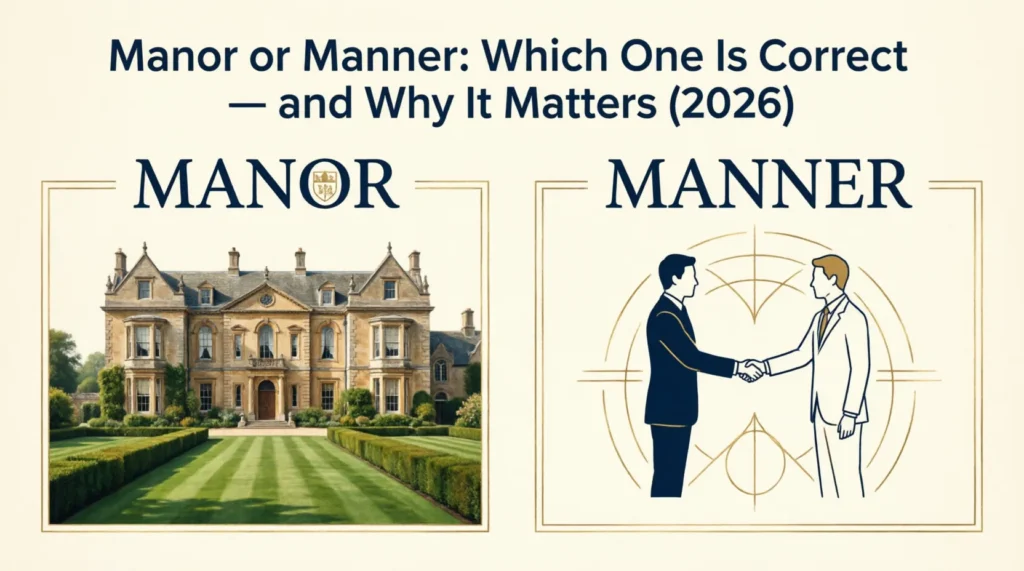
In short, “manor” and “manner” are both correct English words, but they mean completely different things. “Manor” refers to a large house or estate, while “manner” describes the way you do something. The confusion in manor or manner usually comes from their similar spelling and sound, so understanding their meanings will help you use them confidently every time.
The Confusion Around manor or manner
You’re writing an email, and you pause for a second. Should it be “He spoke in a polite manor” or “manner”? It looks right either way, but something feels off. That small moment of doubt is exactly where most people get stuck with manor or manner.
You’re not alone in this. Students, professionals, and even experienced writers often hesitate when these two words appear. They look similar, sound almost identical, and show up in writing situations where you want to sound polished and correct.
This is exactly why manor or manner keeps confusing you — and why clearing it up once and for all will instantly make your writing feel more confident.
What Each Word Actually Means
Let’s break it down in the simplest way possible so you never mix them up again.
Manor is a noun. It refers to a large house, estate, or property, often historically owned by wealthy families or landlords. Think of old castles, countryside estates, or grand homes with land around them.
For example: “The family lived in a beautiful manor surrounded by gardens and forests.”
Here, you can clearly picture a place — a physical building or estate.
Now, manner is also a noun, but it means the way something is done. It describes behavior, style, or approach.
For example: “She spoke in a polite manner during the interview.”
Here, you’re not talking about a place at all — you’re talking about how she spoke.
So when you compare manor or manner, the key difference is simple: one is a place, the other is a behavior or style.
Here is a quick breakdown to make manor or manner easier to compare at a glance.
Feature
Manor
Manner
Meaning
Large estate or house
Way of doing something
Part of Speech
Noun
Noun
Formality
Neutral / formal
Neutral / formal
Common Context
History, large homes
Behavior, style, etiquette
Example Sentence
The old manor sits on hill.
She spoke in a polite manner.
Can They Be Swapped?
No
No — different meanings
Why People Mix Up manor or manner
The confusion around manor or manner happens mainly because of how similar they sound when spoken aloud. Linguists often point out that English has many homophones and near-homophones, and this pair sits right in that tricky category.
When you hear the words instead of seeing them written, your brain doesn’t get a strong visual clue. Both words start with “man-” and end with a soft sound, so your mind easily blends them together.
Another reason is spelling intuition. You might assume “manor” is just a shortened or alternative spelling of “manner,” especially since English has many irregular patterns. But in reality, they come from different linguistic roots and evolved separately, even though they ended up sounding similar.
So when you’re writing quickly, your brain sometimes guesses — and that’s where manor or manner mistakes sneak in.
The Simple Rule to Remember Which Is Which
Here’s an easy trick you can rely on every time you hesitate with manor or manner:
Manor = Mansion (both start with “M” and refer to places)
Manner = Method (both relate to how something is done)
That’s it. One connects to a physical structure, the other connects to behavior or action style.
Now apply it in real sentences:
“The old manor stood on top of the hill overlooking the village.”
“He handled the situation in a calm manner.”
“They inherited a historic manor from their ancestors.”
If you remember “manor = mansion,” you will almost never confuse manor or manner again.
Common Mistakes People Make With manor or manner
Here are some of the most frequent errors you might recognize in your own writing:
Using “manor” when describing behavior Wrong: “She spoke in a polite manor.” Correct: “She spoke in a polite manner.”
Using “manner” when referring to a building or estate Wrong: “They visited a historic manner in the countryside.” Correct: “They visited a historic manor in the countryside.”
Assuming both words are interchangeable Wrong: “His manor of speaking was confident.” Correct: “His manner of speaking was confident.”
Overthinking and switching between the two in the same paragraph Wrong: mixing manor/manner inconsistently in writing Correct: choosing the correct word based on meaning and sticking with it consistently
SECTION 2: Real Sentence Fix — manor or manner Subtitle: See the Mistake, Fix the Mistake
These are real mistakes people make with manor or manner — and the simple fix for each one.
❌ Please respond in a professional manor to this email. ✅ Please respond in a professional manner to this email. 📌 Why: “Manner” is the correct word for behavior or style.
❌ He spoke in a rude manor during the meeting. ✅ He spoke in a rude manner during the meeting. 📌 Why: “Manner” describes how someone speaks or acts.
❌ The author’s manor of writing is very clear and simple. ✅ The author’s manner of writing is very clear and simple. 📌 Why: “Manner” refers to the style of writing.
❌ The app changes your login manor for better security. ✅ The app changes your login manner for better security. 📌 Why: “Manner” is used when describing a method or way.
❌ She handled the situation in a calm manor. ✅ She handled the situation in a calm manner. 📌 Why: “Manner” describes how something is done.
❌ We visited a historic manner in England last summer. ✅ We visited a historic manor in England last summer. 📌 Why: “Manor” means a large old house or estate.
Real-World Examples: manor or manner Used Correctly
Here’s how you’ll actually see these words used in real life:
Casual conversation: “That old manor looks like something from a movie.” This works because you’re clearly referring to a physical place.
Professional writing: “Please respond in a professional manner when dealing with clients.” This is correct because it describes behavior and tone.
Academic writing: “The study examined the manner in which students process language.” This is correct because it focuses on method and process.
Creative writing: “The abandoned manor whispered stories of its past through cracked walls.” This works because it sets a visual scene of a building.
Each example shows how choosing the right word in manor or manner changes the meaning completely.
British English vs. American English — Does It Affect manor or manner?
There is no British vs. American English difference in manor or manner. Both words are spelled exactly the same in all major English variations.
However, people worldwide still confuse them because pronunciation is similar and writing speed often leads to guesswork. So regardless of where you are learning English, the confusion is universal and not region-specific.
What Grammar Checkers and Style Guides Say About manor or manner
Grammar tools usually catch mistakes involving manor or manner when context is clearly wrong. For example, if you write “polite manor,” most tools will flag it because “manor” doesn’t fit the sentence meaning.
However, style guides emphasize that context is more important than spelling alone. You need to understand meaning, not just rely on automated correction.
Language experts often highlight that tools can help, but they cannot fully replace your understanding of word meaning. Once you learn the difference, you will depend less on corrections and more on your own confidence.
manor or manner in Professional and Academic Writing
In professional settings, using manor or manner correctly matters more than you might think. A small error in word choice can make your writing look careless, even if your ideas are strong.
In job applications, saying “in a polite manor” instead of “manner” can subtly reduce the impression of accuracy. In academic writing, precision is even more important because every word carries meaning.
The good news is that once you understand the difference, you rarely make this mistake again. And that instantly improves how professional and polished your writing looks.
They sound similar but have completely different meanings
Context is the key to choosing the correct word
Frequently Asked Questions About manor or manner
Is it “manor of speaking” or “manner of speaking”?
It is “manner of speaking.” You use “manner” because you are describing how someone speaks, not a physical place.
Why do people confuse manor or manner so often?
People confuse them because they sound very similar when spoken and have almost identical spelling patterns, making it easy to mix them up in fast writing.
Can “manor” ever mean behavior?
No, “manor” never refers to behavior. It only refers to a large house or estate, usually in a historical or formal context.
What is the easiest way to remember manor or manner?
Think “manor = mansion” and “manner = method.” This simple association helps you choose the correct word instantly.
Is one of them more common in modern English?
Yes, “manner” is far more common in everyday writing because it relates to behavior and communication, while “manor” is mostly used in historical or descriptive contexts.
Final Thoughts on manor or manner
The confusion between manor or manner is one of the most common small mistakes in English, but it becomes easy once you understand the meaning behind each word. One describes a place, and the other describes behavior or style.
Now that you know the difference, you can write with more confidence and avoid one of those tiny errors that often slip into everyday writing. With a bit of practice, you’ll never second-guess manor or manner again — and your writing will instantly feel more precise and professional.
Frequently Asked Questions
What is the main difference between 'manor' and 'manner'?▼
The main difference is that ‘manor’ refers to a large house or estate, while ‘manner’ describes the way something is done. Understanding these definitions helps prevent confusion when writing.
Why do people often confuse 'manor' and 'manner'?▼
People commonly confuse ‘manor’ and ‘manner’ because they sound similar and have similar spellings. This confusion is further compounded by the lack of strong visual cues when the words are spoken aloud.
Can 'manor' and 'manner' be used interchangeably in sentences?▼
No, ‘manor’ and ‘manner’ cannot be swapped in sentences as they have distinct meanings. Using them incorrectly can lead to misunderstandings in communication.
What is an easy way to remember the difference between 'manor' and 'manner'?▼
A simple trick is to associate ‘manor’ with ‘mansion,’ both of which refer to places, while ‘manner’ can be linked to ‘method,’ relating to how something is done. This mnemonic can help clarify their meanings.
What types of contexts are 'manor' and 'manner' commonly used in?▼
‘Manor’ is often used in historical contexts or when discussing large homes and estates, while ‘manner’ is used in conversations about behavior, style, or etiquette. Knowing the context can help you choose the correct word.
Can you provide an example sentence using 'manor'?▼
Certainly! An example sentence is: ‘The old manor sits on the hill, surrounded by lush gardens and tall trees.’ This illustrates the physical aspect of a manor.
Can you provide an example sentence using 'manner'?▼
Sure! An example sentence is: ‘She spoke in a polite manner during the interview, which left a positive impression.’ This highlights how ‘manner’ relates to behavior.
Emily Thornton holds a Master’s degree in Linguistics from the University of Chicago and has been passionate about language education for over 15 years. Her interest in language developed at a young age, fueled by a curiosity for how intricacies in language shape communication. Emily has authored several guides on grammar usage and works extensively with ESL learners to improve their fluency and confidence in English. Dedicated to clarity, she writes content that demystifies complex spelling and grammar issues, making her contributions invaluable for professionals looking for authoritative and swift language solutions. Emily continues to explore innovative ways to bridge communication gaps through accurate and effective language use. Her blend of academic rigor and practical insight ensures learners across all levels find her advice beneficial.