In short, both loss and lose are correct words, but they have different jobs in a sentence. Lose is a verb that means to misplace something, fail to win, or no longer have something, while loss is a noun that refers to the result of losing. Understanding this difference makes your writing clearer and helps you avoid one of the most common English mistakes.
The Confusion Around Loss vs Lose
Imagine you’re finishing an important email and writing, “We experienced a significant lose this quarter.” Something feels off, but you’re not quite sure why.
Or maybe you’re working on a school assignment and pause when writing, “I don’t want to loss points on this project.” You know one of the words is right, but choosing between them can be surprisingly difficult.
The confusion around loss vs lose affects students, professionals, bloggers, and native English speakers alike. Because the words are closely related in meaning and look similar in spelling, it’s easy to second-guess yourself.
What Each Word Actually Means
To understand loss vs lose, it helps to remember that these words belong to different parts of speech.
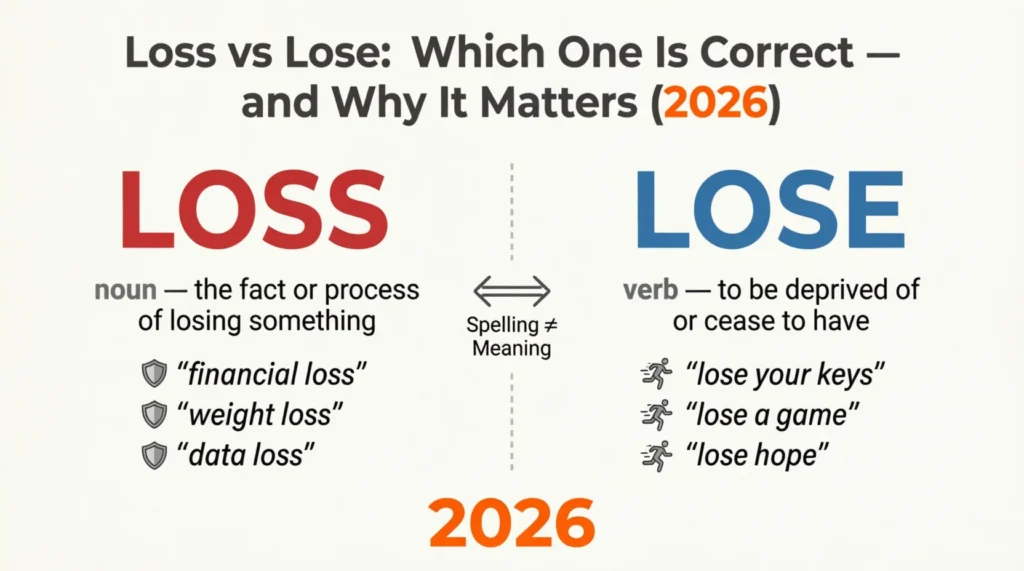
Lose is a verb. It describes an action. When you lose something, you no longer have it, cannot find it, or fail to keep it.
Example:
“I don’t want to lose my keys again.”
In this sentence, lose describes the action of misplacing the keys.
Loss is a noun. It refers to the thing, event, or outcome that results from losing.
Example:
“The company reported a financial loss last year.”
Here, loss names the result rather than describing an action.
A simple way to think about it is this:
Lose = the action
Loss = the result
Consider another pair of examples:
“I might lose the game if I make another mistake.”
“The team’s loss was disappointing.”
The first sentence focuses on the act of failing to win. The second focuses on the outcome itself.
loss vs lose: Side-by-Side Comparison
Here is a quick breakdown to make the loss vs lose easier to compare at a glance.
Feature
loss
lose
Meaning
The act of losing something
To no longer have something
Part of Speech
Noun
Verb
Formality
Neutral
Neutral
Common Context
Business, sports, health, finance
Daily actions, games, objects
Example Sentence
The team accepted the loss.
Try not to lose your keys.
Can They Be Swapped?
No — different word types
No — different word types
Why People Mix Up Loss vs Losepara
One major reason people confuse loss vs lose is that the words come from the same family and share similar meanings.
The spelling is also deceptive. Many English learners expect lose to rhyme with “nose” because of its spelling, and it does. Meanwhile, loss rhymes with “boss.” The difference in pronunciation is not always obvious when you’re writing.
Language researchers have long noted that English spelling patterns are not always predictable. In this case, the double “s” in loss and the single “s” in lose make the words look related while serving different grammatical functions.
Another reason for confusion is that many noun-verb pairs in English look nearly identical. Since loss and lose are conceptually connected, writers sometimes accidentally swap them when focusing on meaning rather than grammar.
The Simple Rule to Remember Which Is Which
Here’s the easiest rule:
If you’re talking about an action, use lose. If you’re talking about a thing, result, or outcome, use loss.
Think of it this way:
You lose something.
You experience a loss.
Try these examples:
“I don’t want to lose my wallet while traveling.”
“The loss of my wallet created a lot of stress.”
“If we lose the match, we’ll practice harder next week.”
“The team’s loss motivated everyone to improve.”
Whenever you can identify whether you’re describing an action or naming a result, choosing the correct word becomes much easier.
Common Mistakes People Make With Loss vs Lose
“I hope I don’t loss my phone again.” The writer needed a verb here. Correct version: “I hope I don’t lose my phone again.”
“The company suffered a major lose this year.” The sentence requires a noun. Correct version: “The company suffered a major loss this year.”
“Students can loss marks for late submissions.” The action of giving up marks requires a verb. Correct version: “Students can lose marks for late submissions.”
“Their lose in the championship was unexpected.” The sentence is referring to the outcome. Correct version: “Their loss in the championship was unexpected.”
Real Sentence Fix — loss vs lose
See the Mistake, Fix the Mistake
These are real mistakes people make with loss vs lose — and the simple fix for each one.
❌ Please do not loss the client files before the meeting. ✅ Please do not lose the client files before the meeting. 📌 Why: Use lose when talking about something that can disappear or be misplaced.
❌ Nobody wants to loose their phone at a concert. ✅ Nobody wants to lose their phone at a concert. 📌 Why:Lose is the correct spelling for the verb, not loose.
❌ The experiment showed a lose of energy over time. ✅ The experiment showed a loss of energy over time. 📌 Why: Use loss when naming something that has been lost.
❌ The app says I might loss my saved progress. ✅ The app says I might lose my saved progress. 📌 Why:Lose is used for an action that could happen.
❌ Walking every day helped her loss weight. ✅ Walking every day helped her lose weight. 📌 Why: Use lose when talking about reducing weight.
❌ The company reported a lose during the last quarter. ✅ The company reported a loss during the last quarter. 📌 Why:Loss is the noun used for money or value that is gone.
Real-World Examples: Loss vs Lose Used Correctly
Casual conversation: “Be careful not to lose your sunglasses at the beach.” Here, lose is correct because it describes the action of misplacing something.
Professional writing: “The business recorded a net loss during the first quarter.” Loss is correct because it refers to a financial outcome.
Academic writing: “Researchers observed a measurable loss of data during the transfer process.” The word loss names the result being discussed.
Creative writing: “She feared she would lose everything she had worked for.” Lose is appropriate because the sentence focuses on a possible action or event.
These examples show that the choice depends on grammar rather than topic. Whether you’re writing casually or formally, the same rule applies.
British English vs. American English — Does It Affect Loss vs Lose?
Unlike some spelling differences in English, loss vs lose is not a British-versus-American issue.
Both British English and American English use the same spellings and meanings. A writer in London, New York, Sydney, or Toronto follows the same rule: lose is the verb, and loss is the noun.
Because there is no regional variation here, people around the world tend to make this mistake for the same reason—similar spelling combined with related meanings.
What Grammar Checkers and Style Guides Say About Loss vs Lose
Grammar experts and style guides consistently treat loss and lose as separate words with distinct grammatical roles. The distinction is considered standard English and applies across formal and informal writing.
Spellcheck can sometimes catch mistakes, but not always. If you write “a lose” instead of “a loss,” many tools will flag it. However, context-based errors can occasionally slip through. That’s why understanding the rule yourself is more reliable than depending entirely on software.
Loss vs Lose in Professional and Academic Writing
Getting loss vs lose right matters because readers often notice common word-choice mistakes immediately.
In job applications, business reports, academic papers, and published articles, confusing these words can distract readers from your message. The issue is usually not the mistake itself but the impression that the writing was not carefully reviewed.
Precision also matters in translated documents, scholarly writing, and cross-cultural communication, where a single word can affect clarity.
The good news is that this is one of the easiest grammar problems to fix. Once you remember that lose is an action and loss is the outcome, you’ll rarely hesitate again.
Quick Recap: Loss vs Lose at a Glance
Lose is a verb that describes an action.
Loss is a noun that names a result or outcome.
You lose a game, but you experience a loss.
The distinction is the same in British and American English.
Remember: action = lose, result = loss.
Frequently Asked Questions About Loss vs Lose
Is it “loss” or “lose weight”?
The correct phrase is “lose weight.” The word lose is a verb describing the action of reducing weight. Loss would only be used as a noun, such as in “weight loss.”
Why is lose spelled with one “s” but loss has two?
English spelling developed over many centuries, and not all related words follow the same pattern. Linguists note that many noun-verb pairs evolved differently over time, which is why lose and loss have different spellings despite being closely connected.
Can “loss” ever be used as a verb?
No. In standard English, loss functions only as a noun. If you need a verb, use lose.
What is the difference between “at a loss” and “lose”?
“At a loss” is an expression meaning confused or unsure what to do. The word loss is used as a noun in that phrase. Lose remains a verb that means to misplace something, fail to win, or no longer possess something.
Why do so many people confuse loss and lose?
The words have similar meanings, come from the same word family, and look very similar in writing. Many people focus on the idea being expressed rather than the grammatical role, which makes mix-ups common.
Final Thoughts on Loss vs Lose
The difference between loss vs lose comes down to grammar: lose is a verb, and loss is a noun. One describes the action, while the other names the result.
If you’ve ever hesitated before choosing between these two words, you’re in good company. This is one of the most common writing mistakes in English, and even experienced writers occasionally pause to double-check.
Now that you know the rule, you can use both words with confidence. The next time you encounter loss vs lose, you’ll know exactly which one belongs in your sentence.
Frequently Asked Questions
What is the main difference between 'loss' and 'lose'?▼
The main difference is that ‘loss’ is a noun that refers to the result of losing something, while ‘lose’ is a verb that describes the action of misplacing or failing to keep something. Understanding this distinction helps clarify your writing.
Why do people often confuse 'loss' and 'lose'?▼
People confuse ‘loss’ and ‘lose’ primarily because the words come from the same family, share similar meanings, and have deceptive spellings. Additionally, many English learners mistakenly expect ‘lose’ to rhyme with ‘nose,’ which contributes to the confusion.
Can 'loss' and 'lose' be used interchangeably in sentences?▼
No, ‘loss’ and ‘lose’ cannot be swapped as they serve different grammatical functions; ‘loss’ is a noun while ‘lose’ is a verb. Using them incorrectly can lead to misunderstandings in your writing.
What are examples of how to use 'loss' and 'lose' in sentences?▼
For ‘lose,’ you might say, ‘I don’t want to lose my keys again,’ focusing on the action. In contrast, an example using ‘loss’ would be, ‘The company reported a financial loss last year,’ which highlights the result of losing.
How can I remember when to use 'loss' versus 'lose'?▼
A simple rule to remember is: if you’re discussing an action, use ‘lose’; if you’re referring to a result or outcome, use ‘loss.’ This distinction can help you choose the correct word in your writing.
What common contexts are 'loss' and 'lose' used in?▼
The term ‘loss’ is often used in contexts like business, sports, and finance, where it refers to the outcome of losing. On the other hand, ‘lose’ is commonly used in daily actions, games, and everyday objects.
What should I do if I'm unsure which word to use?▼
If you’re unsure whether to use ‘loss’ or ‘lose,’ take a moment to identify whether you’re describing an action or referring to the outcome of that action. This can clarify your choice and improve the accuracy of your writing.
James Williams has been fascinated by the intricacies of the English language since his childhood days. Holding a Master’s degree in Linguistics from the University of Cambridge, he has spent over 15 years working as a professional editor and language consultant. James specializes in deciphering complex spelling and grammatical issues, and he is passionate about helping students and professionals alike gain confidence in their writing. His experience includes developing educational content for ESL learners, ensuring clarity and precision in communication. James is dedicated to providing readers with easy-to-follow guidance that resolves word confusions and common spelling errors, making WordlyRight an essential resource for anyone who needs quick, authoritative answers.