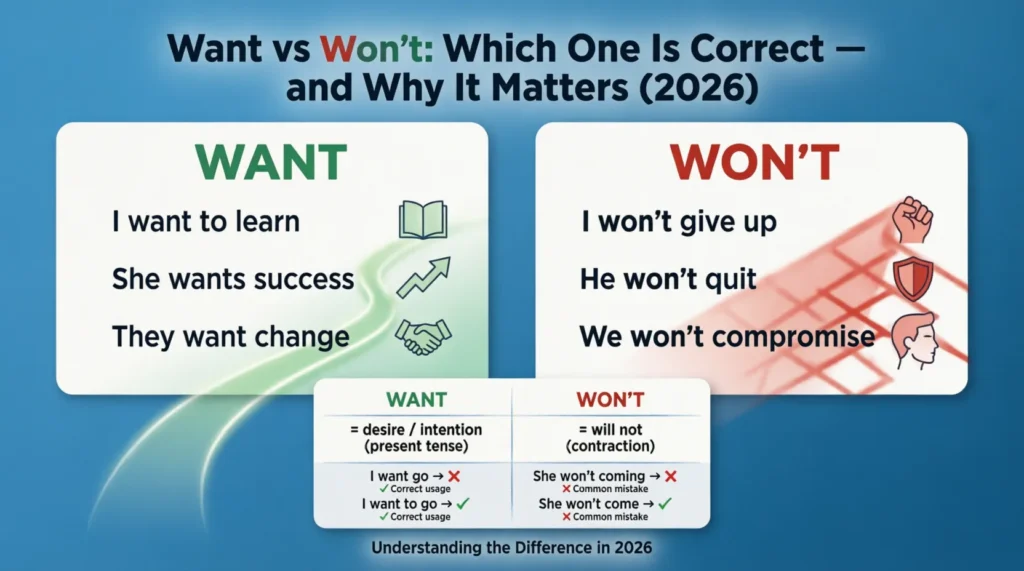
In short, both “want” and “wont” are correct words, but they mean completely different things. “Want” usually refers to a desire or need, while “wont” is a much less common word meaning a habit or customary behavior. Understanding the difference can help you avoid a surprisingly common writing mistake.
The Confusion Around Want vs Wont
Imagine you’re writing an email, a school essay, or even a social media post. You type a sentence quickly and pause when you see “wont” on the screen. Did you mean “want” or “wont”?
The confusion around want vs wont is more common than many people realize. Since the two words differ by only one letter, it’s easy for your fingers to slip while typing. Autocorrect does not always catch the mistake either.
Many writers assume “wont” is simply a misspelling of “want.” In reality, both words exist in English, but they serve very different purposes. That distinction is exactly where the confusion begins.
What Each Word Actually Means
Let’s start with “want.”
“Want” is usually a verb that means to desire, wish for, or need something. It is one of the most common words in everyday English.
Example:
I want a cup of coffee before work.
“Want” can also function as a noun in some contexts, meaning a lack or need.
Example:
The community suffered from a want of resources.
Now let’s look at “wont.”
“Wont” is typically an adjective meaning accustomed to or in the habit of doing something. It can also be used as a noun referring to a person’s usual habit or customary behavior.
Example:
She was wont to arrive early for every meeting.
As a noun:
Reading before bed was his wont.
The key difference is that “want” expresses desire, while “wont” refers to habit. Although both words are legitimate English words, “wont” appears far less frequently in modern conversation and writing.
want vs wont: Side-by-Side Comparison
Insert AFTER the “What Each Word Actually Means” section.
Here is a quick breakdown to make the want vs wont easier to compare at a glance.
Feature
want
wont
Meaning
To desire or need something
A person’s usual habit
Part of Speech
Verb, noun
Noun, adjective
Formality
Neutral
Mostly formal or literary
Common Context
Daily conversations, requests
Formal writing, literature
Example Sentence
I want more time.
Early walks were her wont.
Can They Be Swapped?
No
No — they have different meanings.
Why People Mix Up Want vs Wont
The main reason people confuse want vs wont is visual similarity. The words differ by just a single letter, and when you’re typing quickly, it’s easy to hit the wrong key.
Another factor is familiarity. Most people use “want” every day, but many rarely encounter “wont.” When they see “wont” in a text, they often assume it must be a typo.
Language researchers have noted that readers tend to recognize words by their overall shape rather than by examining every letter individually. Because “want” and “wont” look so similar, your brain can easily overlook the difference.
There’s also a pronunciation factor. While the words are not pronounced exactly the same, the distinction may be subtle in fast speech or across different accents, making the confusion even more understandable.
The Simple Rule to Remember Which Is Which
Here’s an easy trick:
If the sentence involves a desire, need, or wish, use “want.” If the sentence describes someone’s usual habit or customary behavior, use “wont.”
Think of it this way:
Want = wish
Wont = habit
Examples:
I want to learn Spanish this year.
She was wont to take a morning walk before breakfast.
They want more information about the project.
If you can replace the word with “wish for,” then “want” is almost certainly the correct choice. If you can replace it with “accustomed to,” then “wont” is probably right.
Common Mistakes People Make With Want vs Wont
Writing “I wont a new laptop.” The sentence expresses desire, so the correct version is: “I want a new laptop.”
Using “want” when describing a habit. Correct version: “He was wont to read the newspaper every morning.”
Assuming “wont” is always a typo. In reality, “wont” is a valid English word with its own meaning.
Confusing “wont” with the contraction “won’t.” Correct version: “I won’t attend the meeting tomorrow.” The apostrophe changes the meaning entirely.
Real Sentence Fix — want vs wont
See the Mistake, Fix the Mistake
Insert AFTER the “Common Mistakes People Make” section.
These are real mistakes people make with the want vs wont — and the simple fix for each one.
❌ My daily want is to check emails before breakfast. ✅ My daily wont is to check emails before breakfast. 📌 Why: Wont means a usual habit, not a desire.
❌ I wont to join you for dinner tonight. ✅ I want to join you for dinner tonight. 📌 Why: Want is used to express a wish or desire.
❌ The report says it was his want to arrive early. ✅ The report says it was his wont to arrive early. 📌 Why: Wont describes something someone regularly does.
❌ The app says, “I wont to save this file.” ✅ The app says, “I want to save this file.” 📌 Why: Want is the correct word for expressing an intended action.
❌ She always says she wont a cup of tea after work. ✅ She always says she wants a cup of tea after work. 📌 Why: Use wants when talking about something a person desires.
❌ Weekend hikes are something we want. ✅ Weekend hikes are something we are wont to do. 📌 Why: Want means desire, while wont refers to a regular habit.
Real-World Examples: Want vs Wont Used Correctly
Casual conversation: “I want pizza for dinner tonight.” Here, the speaker is expressing a desire.
Professional writing: “We want to thank all participants for their contributions.” The word indicates intention or appreciation.
Academic writing: “The researcher was wont to revisit earlier studies before forming conclusions.” This use highlights a recurring habit.
Creative writing: “The old sailor was wont to tell stories whenever the sea grew calm.” The word “wont” emphasizes a customary behavior.
These examples show how different the two words really are despite their similar appearance.
British English vs. American English — Does It Affect Want vs Wont?
Unlike some spelling debates, want vs wont is not a British-versus-American English issue. Both forms exist in both varieties of English.
Writers in the United States, the United Kingdom, Canada, Australia, and other English-speaking regions use “want” and “wont” with the same meanings.
The confusion happens worldwide because the words look similar, not because of regional spelling differences. Whether you’re writing for a British or American audience, the rule remains exactly the same: desire equals “want,” habit equals “wont.”
What Grammar Checkers and Style Guides Say About Want vs Wont
Most grammar experts and style guides recognize both words as correct English. The challenge is that they are correct in different contexts.
Because “wont” is a legitimate word, spellcheck may not flag it when you’ve accidentally typed it instead of “want.” This means automated tools can miss the error entirely.
That’s why context matters more than spelling alone. Knowing the meaning of each word helps you catch mistakes that software may overlook. In many cases, understanding the rule yourself is more reliable than depending on autocorrect.
Want vs Wont in Professional and Academic Writing
In professional and academic settings, precision matters. A single misplaced word can make readers pause and question what you intended to say.
If you write “wont” when you mean “want,” your sentence may appear careless or confusing. Readers might wonder whether it was a typo or an intentional word choice.
The good news is that once you understand the distinction, the mistake becomes much easier to avoid. Whether you’re preparing a job application, submitting a research paper, publishing online content, or drafting an important email, using the correct word helps your writing appear polished and clear.
Quick Recap: Want vs Wont at a Glance
“Want” means to desire, need, or wish for something.
“Wont” refers to a habit or customary behavior.
Both words are correct English words.
“Want” is extremely common; “wont” is relatively rare.
If you’re talking about a wish, choose “want.”
Frequently Asked Questions About Want vs Wont
Is “wont” a real word?
Yes. “Wont” is a real English word. It usually means accustomed to something or refers to a person’s habitual behavior. It is much less common than “want,” which is why many people assume it is a typo.
What is the difference between “want” and “wont”?
“Want” expresses desire, need, or intention. “Wont” refers to a habit or something someone regularly does. The meanings are completely different even though the spellings are similar.
Is “wont” the same as “won’t”?
No. “Won’t” is the contraction of “will not.” “Wont” without an apostrophe is a separate word that relates to habit or customary behavior.
Why doesn’t spellcheck always catch “wont”?
Because “wont” is a legitimate dictionary word. Spellcheck tools often look for spelling errors, not meaning errors. If you use the wrong word in the wrong context, the software may not recognize the problem.
Which word is more commonly used, “want” or “wont”?
“Want” is vastly more common in everyday English. Most people use it regularly in conversation and writing. “Wont” tends to appear mainly in formal, literary, or older-style writing.
Final Thoughts on Want vs Wont
The difference between want vs wont comes down to one simple idea: “want” expresses desire, while “wont” describes habit. Although the words look remarkably similar, their meanings are completely different.
If you’ve ever hesitated while choosing between them, you’re far from alone. This is one of those small English distinctions that catches even experienced writers from time to time.
Now that you know the rule, you can spot the difference quickly and use each word with confidence. The next time you encounter want vs wont, you’ll know exactly which one belongs in your sentence.
Frequently Asked Questions
What is the main difference between 'want' and 'wont'?▼
The main difference is that ‘want’ refers to a desire or need for something, while ‘wont’ signifies a person’s usual habit or customary behavior. Understanding this distinction can prevent common writing mistakes.
Why do people confuse 'want' and 'wont'?▼
People often confuse ‘want’ and ‘wont’ due to their visual similarity; they differ by just one letter. Additionally, ‘want’ is used frequently in everyday language, whereas ‘wont’ is less common, leading to assumptions that ‘wont’ is a typo.
Can 'want' and 'wont' be used interchangeably?▼
No, ‘want’ and ‘wont’ cannot be swapped because they have different meanings. Using them incorrectly can lead to misunderstandings in communication.
In what contexts is 'wont' typically used?▼
‘Wont’ is mostly used in formal writing and literature, often to describe habitual actions or customary behaviors. For example, one might say, ‘She was wont to arrive early for every meeting.’
What are some examples of using 'want' in a sentence?▼
Examples of ‘want’ include: ‘I want more time’ and ‘They want more information about the project.’ In these sentences, ‘want’ expresses a desire or need.
How can I remember when to use 'want' versus 'wont'?▼
A simple rule to remember is: if the sentence involves a desire, need, or wish, use ‘want.’ If it describes someone’s usual habit or behavior, use ‘wont.’
What part of speech is 'wont'?▼
‘Wont’ can function as both a noun and an adjective. As a noun, it refers to a person’s usual habit, and as an adjective, it describes someone accustomed to a particular behavior.
Rebecca Nguyen brings a diverse background in journalism and education to her role at WordlyRight. A graduate of the University of Toronto with a focus in English and Linguistics, she has spent over 12 years honing her skills as a writer and educator. Rebecca’s expertise lies in her ability to simplify daunting grammar rules and rectify frequent spelling mistakes in a way that resonates with students and professionals alike. Her articles on WordlyRight zero in on the most common word confusions encountered by writers, turning complex concepts into clear, actionable insights. With a passion for lifelong learning, Rebecca continually seeks to refine her understanding of language to better serve her audience.