In short, his is a correct English word, while hes is generally not a standard word in English. Most of the time, people write “hes” by mistake when they mean “he’s” or “his.” Understanding the difference can help you avoid a very common writing error and communicate more clearly.
The Confusion Around His vs Hes
Imagine you’re finishing an essay, sending a work email, or posting on social media. You type quickly and suddenly pause: should it be “his” or “hes”?
You’re not alone. The confusion around his vs hes happens every day because the two forms look similar, especially when people are typing fast or skipping punctuation.
Many writers only notice the issue after spellcheck highlights it—or worse, after they’ve already sent the message. If you’ve ever second-guessed yourself about his vs hes, you’re asking a very common question.
What Each Word Actually Means
Let’s start with the easy part: his is a real English word.
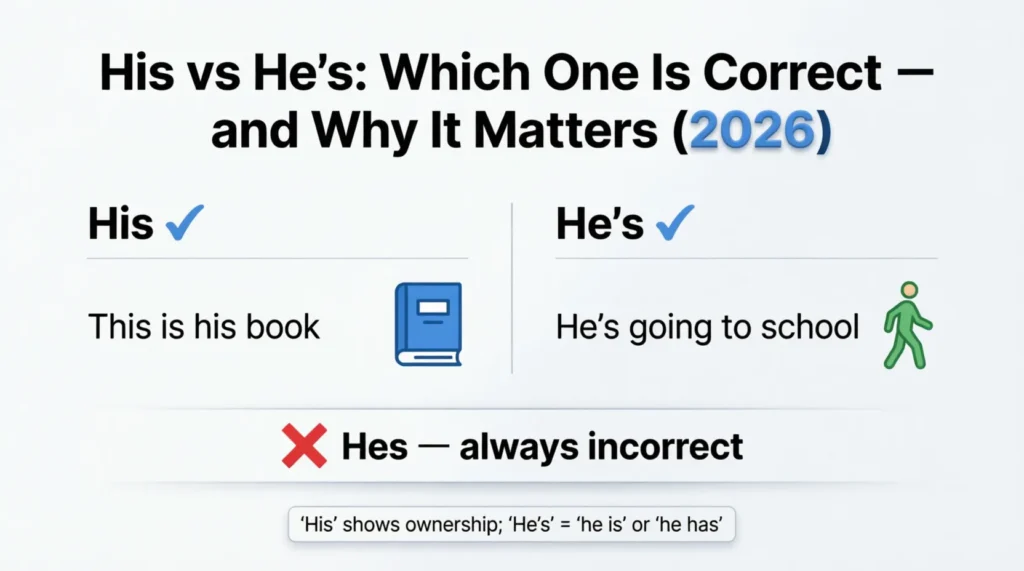
“His” is a possessive determiner and possessive pronoun. It shows that something belongs to a male person or male animal.
Example:
His backpack is on the chair.
In this sentence, the backpack belongs to him.
Now let’s look at “hes.”
In standard English, “hes” is not a recognized word. Most often, it appears because someone intended to write “he’s” but forgot the apostrophe.
Example of the intended form:
He’s going to the meeting later.
Here, “he’s” is a contraction of “he is” or “he has.”
Sometimes people accidentally type “hes” when they mean “his,” especially on phones or keyboards where speed matters more than accuracy.
So when comparing his vs hes, only “his” is normally correct. If you see “hes,” check whether the writer meant “his” or “he’s.”
his vs hes: Side-by-Side Comparison
Here is a quick breakdown to make the his vs hes easier to compare at a glance.
Feature
his
hes
Meaning
Shows something belongs to a male
Misspelling of “he’s”
Part of Speech
Possessive determiner
Not a standard English word
Formality
Neutral
Informal typo
Common Context
Writing about ownership
Texting or typing mistakes
Example Sentence
His backpack is blue.
Hes coming soon.
Can They Be Swapped?
No
No — one is incorrect English.
Why People Mix Up His vs Hes
The main reason people confuse his vs hes is that English contains many short words that differ by only one letter or punctuation mark.
Language researchers have long noted that our brains often process familiar words as whole units rather than letter by letter. When you’re typing quickly, it’s easy to miss an apostrophe or swap letters without noticing.
Another reason is pronunciation. In fast speech, “his” and “he’s” can sound somewhat similar depending on the speaker, accent, and surrounding words. Because “hes” visually resembles both forms, it often appears as an accidental spelling.
Digital communication also contributes to the confusion. Text messages, chats, and social media posts encourage speed, which increases the chance of dropping apostrophes and creating forms like “hes.”
The Simple Rule to Remember Which Is Which
Here’s the easiest rule:
If you’re talking about something that belongs to a male person, use “his.” If you’re trying to say “he is” or “he has,” use “he’s.” Never use “hes” in standard writing.
Think of it this way: “his” shows ownership, while “he’s” is a shortened version of two words.
Examples:
His laptop needs a software update.
He’s working from home today.
His presentation impressed the entire team.
If you can replace the word with “he is” and the sentence still makes sense, you need “he’s” rather than “his.”
Common Mistakes People Make With His vs Hes
Writing “hes” instead of “he’s” because the apostrophe was forgotten.
Correct version: He’s excited about the trip.
Writing “hes” instead of “his” while typing quickly.
Correct version: His notes were very detailed.
Using “his” when the sentence actually requires “he’s.”
Correct version: He’s planning to apply for the scholarship.
Assuming spellcheck will always catch the error.
Correct version: Proofread manually to ensure you used his or he’s correctly.
Real Sentence Fix — his vs hes
See the Mistake, Fix the Mistake
These are real mistakes people make with his vs hes — and the simple fix for each one.
❌ Hes leading today’s team meeting. ✅ He’s leading today’s team meeting. 📌 Why: Use he’s because it means he is.
❌ I think his going to love this movie. ✅ I think he’s going to love this movie. 📌 Why: He’s means he is, which fits the sentence.
❌ The teacher said he’s notebook was missing. ✅ The teacher said his notebook was missing. 📌 Why: Use his to show the notebook belongs to him.
❌ Please update hes profile before logging in. ✅ Please update his profile before logging in. 📌 Why: His shows ownership, while hes is a typing mistake.
❌ His always late for family dinners. ✅ He’s always late for family dinners. 📌 Why: He’s means he is, which completes the sentence correctly.
❌ The report says his absent today. ✅ The report says he’s absent today. 📌 Why: Use he’s because the sentence means he is absent.
Real-World Examples: His vs Hes Used Correctly
Casual conversation: “His phone has been ringing all morning.” This is correct because the phone belongs to him.
Professional writing: “His report was submitted ahead of schedule.” The report belongs to or was prepared by the person being discussed.
Academic writing: “His research contributed significantly to the discussion.” The possessive form shows ownership of the research work.
Creative writing: “His footsteps echoed through the empty hallway.” The sentence uses “his” to identify whose footsteps they were.
Notice that none of these examples use “hes.” In standard English, you would choose either “his” or “he’s,” depending on the meaning.
British English vs. American English — Does It Affect His vs Hes?
No. The distinction between his vs hes is not a British-versus-American English issue.
Whether you’re writing in the United States, the United Kingdom, Canada, Australia, or elsewhere, “his” remains the correct possessive form. Likewise, “he’s” remains the standard contraction of “he is” or “he has.”
The confusion exists worldwide because it is primarily a spelling and punctuation issue rather than a regional spelling difference. Writers everywhere can accidentally omit an apostrophe or mistype a word.
What Grammar Checkers and Style Guides Say About His vs Hes
Grammar experts and major style guides treat “his” as a standard possessive word and “he’s” as a standard contraction. In most contexts, “hes” is considered an error rather than an accepted alternative spelling.
Many grammar-checking tools will flag “hes” immediately. However, technology is not perfect. Depending on the platform, the mistake might slip through, especially in informal writing environments.
That’s why understanding the rule yourself is more reliable than depending entirely on spellcheck. When you know the difference, you can spot the error instantly.
His vs Hes in Professional and Academic Writing
In professional settings, small language mistakes can affect how polished your writing appears. A manager, client, editor, or recruiter may notice an obvious error such as “hes” and assume the text was not carefully reviewed.
Academic writing also benefits from precision. Professors and instructors expect standard grammar and spelling, especially in essays, research papers, and formal assignments.
The good news is that this is one of the easiest mistakes to fix. Once you understand that “his” is correct and “hes” is usually a typo for either “his” or “he’s,” you’ll be much less likely to make the error again.
Quick Recap: His vs Hes at a Glance
“His” is a correct English word showing possession.
“Hes” is not a standard English word.
Many people write “hes” when they mean “he’s.”
Use “he’s” when you mean “he is” or “he has.”
Use “his” when something belongs to him.
Frequently Asked Questions About His vs Hes
Is “hes” a real word in English?
In standard modern English, “hes” is generally not considered a proper word. It is usually a typing mistake for either “his” or “he’s.” In formal writing, you should avoid using it.
Should I use “his” or “he’s”?
Use “his” to show ownership and “he’s” as a contraction of “he is” or “he has.” The correct choice depends entirely on what you want the sentence to mean.
Why does “hes” appear so often online?
People often type quickly on phones, tablets, and computers. As a result, apostrophes are sometimes omitted, turning “he’s” into “hes.”
Will spellcheck catch “hes”?
Often, yes. Many grammar and spelling tools recognize “hes” as an error. However, not every platform checks spelling equally well, so proofreading is still important.
Is the difference between “his” and “hes” important in formal writing?
Yes. Formal writing values accuracy and clarity. Using “his” correctly and avoiding “hes” helps your work appear more professional and polished.
Final Thoughts on His vs Hes
The answer to the his vs hes question is straightforward: “his” is a correct English word, while “hes” is usually a typo or punctuation mistake. In some cases, the writer may have intended to write “he’s” instead.
This confusion is extremely common because the words are short, similar-looking, and often typed quickly. Even experienced writers occasionally make the mistake.
Now that you understand the difference, you can recognize it immediately and write with greater confidence. The next time you see his vs hes, you’ll know exactly which form belongs on the page.
Frequently Asked Questions
What is the difference between 'his' and 'hes'?▼
‘His’ is a possessive determiner indicating ownership by a male, while ‘hes’ is not a standard English word. Most often, ‘hes’ is a typographical error for ‘he’s,’ which is a contraction for ‘he is’ or ‘he has.’
Why do people confuse 'his' with 'hes'?▼
The confusion arises because ‘his’ and ‘he’s’ sound similar in fast speech and are visually similar when typed quickly. Additionally, English has many short words that differ by just a letter or punctuation, leading to common mistakes like ‘hes’ appearing instead of the correct form.
What should I use when referring to ownership?▼
When referring to ownership, you should always use ‘his.’ For example, in the sentence ‘His backpack is on the chair,’ ‘his’ clearly shows that the backpack belongs to a male.
When is it appropriate to use 'he's'?▼
You should use ‘he’s’ when you want to say ‘he is’ or ‘he has.’ For instance, in the sentence ‘He’s going to the meeting later,’ ‘he’s’ is correctly used as a contraction.
How can I avoid making mistakes with 'his' and 'hes'?▼
To avoid confusion, remember that ‘his’ shows ownership, while ‘he’s’ is a contraction. Take a moment to proofread your writing, especially in fast communication like texting, to ensure you don’t accidentally use ‘hes’.
Is 'hes' ever considered correct in any context?▼
No, ‘hes’ is not considered correct in standard English writing. It is typically a typographical error, and using ‘his’ or ‘he’s’ is always preferred.
What examples can help me remember the difference?▼
A helpful way to remember is to think about sentences like ‘His laptop needs a software update’ for ownership and ‘He’s working from home today’ to denote ‘he is.’ If you can replace ‘he’s’ with ‘he is’ in your sentence, then you know you should use ‘he’s.’
James Williams has been fascinated by the intricacies of the English language since his childhood days. Holding a Master’s degree in Linguistics from the University of Cambridge, he has spent over 15 years working as a professional editor and language consultant. James specializes in deciphering complex spelling and grammatical issues, and he is passionate about helping students and professionals alike gain confidence in their writing. His experience includes developing educational content for ESL learners, ensuring clarity and precision in communication. James is dedicated to providing readers with easy-to-follow guidance that resolves word confusions and common spelling errors, making WordlyRight an essential resource for anyone who needs quick, authoritative answers.