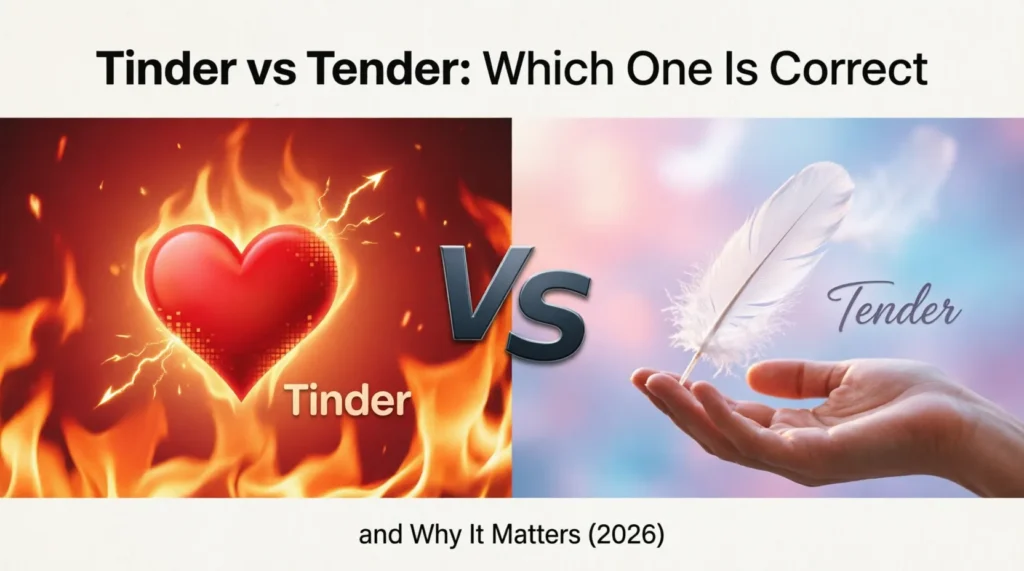
In short, “tinder” and “tender” are both correct words, but they have completely different meanings and uses, and confusing them can change your entire message. Tinder refers to dry material used for starting a fire or a dating app, while tender usually means gentle, soft, or an official offer in business. Understanding tinder vs tender will help you avoid embarrassing writing mistakes and communicate clearly every time.
The Confusion Around Tinder vs Tender
You’re writing a sentence and suddenly pause. Should it be “tinder” or “tender”? It feels like both sound right, but something doesn’t sit comfortably in your mind. This moment of hesitation is exactly where many writers get stuck with tinder vs tender.
Maybe you’re a student finishing an essay late at night, or you’re drafting an email and want to sound professional. You type one word, delete it, type the other, and still feel unsure. The confusion is more common than you think.
The tricky part is that tinder vs tender look similar, sound slightly alike, and even appear in everyday language—but they belong to totally different meanings. That’s why so many people second-guess themselves when writing.
What Each Word Actually Means
Let’s break down tinder vs tender in a simple, human way so you can finally feel confident using both.
Tinder is a noun. It has two main meanings. The traditional meaning refers to dry material used for starting a fire, like dry leaves or paper that catches flame easily. For example: “He gathered tinder to start the campfire.” The modern meaning is also a proper noun—Tinder is a dating app where people swipe to meet others.
On the other hand, tender is more flexible. It can be an adjective, noun, or even a verb depending on context. As an adjective, it means soft, gentle, or sensitive. For example: “She has a tender heart.” As a noun, it can mean an official offer, especially in business or government. For example: “The company submitted a tender for the construction project.”
So when you compare tinder vs tender, you’re not choosing between right and wrong—you’re choosing between completely different ideas.
Why People Mix Up Tinder vs Tender
Language researchers often point out that confusion like tinder vs tender comes from a mix of sound similarity and spelling proximity. The human brain tends to group words that look and sound alike, even when their meanings are unrelated.
Another reason is fast typing and autocorrect reliance. When you’re typing quickly, your fingers often choose the closest familiar pattern. Since both words are real English words, your phone or computer might not always correct you, which reinforces the confusion.
Finally, English is full of irregular word relationships. There’s no clear rule that visually separates tinder vs tender at a glance, so your brain has to rely on memory instead of logic. That’s where mistakes happen most often.
The Simple Rule to Remember Which Is Which
Here’s an easy way to remember tinder vs tender without stress:
Tinder = fire or dating app (something that sparks)
Tender = gentle or official offer (something soft or formal)
Think of it this way: tinder creates a spark, while tender describes something soft or careful.
Try these examples:
“We used dry leaves as tinder to start the fire in seconds.”
“She made a tender apology after the misunderstanding.”
“The company won the tender for the new project after submitting a strong proposal.”
Once you connect tinder with “spark” and tender with “softness or formal offers,” your brain will naturally separate them.
Common Mistakes People Make With Tinder vs Tender
Using “tender” when talking about fire-starting material Correction: “He collected tinder to light the campfire.”
Writing “tinder heart” instead of “tender heart” Correction: “She has a tender heart toward animals.”
Confusing business language by saying “tinder offer” instead of “tender offer” Correction: “The contractor submitted a tender offer for the project.”
Assuming both words mean emotional softness Correction: “Tender” describes emotion or care, while “tinder” does not relate to feelings at all.
Real-World Examples: Tinder vs Tender Used Correctly
Casual conversation: “We ran out of tinder, so we couldn’t start the fire during the picnic.” This shows tinder used in its traditional fire-starting meaning.
Professional writing: “The government opened a tender for new highway construction bids.” Here, tender is used correctly in a business context.
Academic writing: “Dry leaves and bark were used as tinder in early human fire-making techniques.” This demonstrates accurate historical usage.
Creative writing: “His voice turned tender as he spoke about his childhood memories.” This highlights emotional softness in descriptive writing.
British English vs. American English — Does It Affect Tinder vs Tender?
When it comes to tinder vs tender, there is no major British or American spelling difference that changes the words themselves. Both terms are spelled the same in all major English varieties.
However, usage frequency can differ slightly. For example, “tender” as a business term is widely used in British, Australian, and international legal contexts. Meanwhile, “Tinder” as a dating app is globally recognized in modern digital culture.
So regardless of region, the confusion in tinder vs tender comes from meaning—not spelling variation.
What Grammar Checkers and Style Guides Say About Tinder vs Tender
Grammar tools typically recognize both tinder vs tender as correct words, but they rely heavily on context. That means spellcheck won’t always catch misuse if the sentence still forms a valid structure.
Style guides emphasize meaning over spelling accuracy here. They stress that writers should understand context because both words are legitimate in English.
In practical terms, grammar tools are helpful—but they won’t replace your understanding of when tinder vs tender actually fits your sentence.
Tinder vs Tender in Professional and Academic Writing
Getting tinder vs tender right matters more than it might seem, especially in professional or academic settings. A small mistake can completely change the meaning of a sentence and confuse your reader.
Imagine submitting a report where you meant “tender offer” but accidentally wrote something else. It could make your writing look careless, even if your ideas are strong.
The good news is that once you understand tinder vs tender clearly, you won’t have to second-guess yourself again. It becomes a simple mental switch between “spark/fire” and “soft/formal.”
Quick Recap: Tinder vs Tender at a Glance
Tinder relates to fire-starting material or a dating app
Tender means gentle, soft, or an official business offer
They sound similar but have unrelated meanings
Context is the only way to choose correctly
One word creates a “spark,” the other shows “softness or formality”
Frequently Asked Questions About Tinder vs Tender
Is it tinder or tender when talking about fire?
The correct word is tinder. It refers to dry material used to start a fire, such as leaves, paper, or wood shavings.
What does tender mean in business?
Tender refers to an official offer submitted for a job, project, or contract, often used in government or corporate settings.
Is Tinder related to tender?
No, Tinder is unrelated to tender. Tinder is a noun for fire-starting material and also the name of a dating app, while tender has different meanings involving softness or formal offers.
Why do people confuse tinder vs tender?
People confuse them because the words look and sound similar, and fast typing or autocorrect often reinforces mistakes without correcting meaning.
Can tender mean emotional?
Yes, tender can describe emotions, such as kindness or softness, like in “a tender moment” or “a tender heart.”
Final Thoughts on Tinder vs Tender
At the end of the day, tinder vs tender is not about which word is “better”—it’s about understanding two very different meanings that just happen to look similar.
Once you remember that tinder relates to sparks and fire, while tender relates to softness or formal offers, the confusion disappears quickly. This is one of those small grammar distinctions that instantly improves your clarity as a writer.
Now that you understand tinder vs tender clearly, you can write with more confidence and never hesitate over these words again.
Maria Ramirez is an experienced editor and language consultant with over 10 years in the publishing world. She holds a Bachelor’s degree in Journalism and deeply appreciates the power of the written word. Her expertise lies in dissecting the complexities of English grammar and providing straightforward guidance for contemporary writers. Maria’s work focuses on simplifying spelling and usage rules, assisting both seasoned writers and budding authors in presenting their ideas with precision. Her involvement with WordlyRight stems from a commitment to nurture a global audience’s command over English, ensuring learners and professionals don’t just understand language nuances but use them effectively in varied contexts. As someone who passionately believes in lifelong learning, Maria continuously seeks to inspire this ethos in her readers.