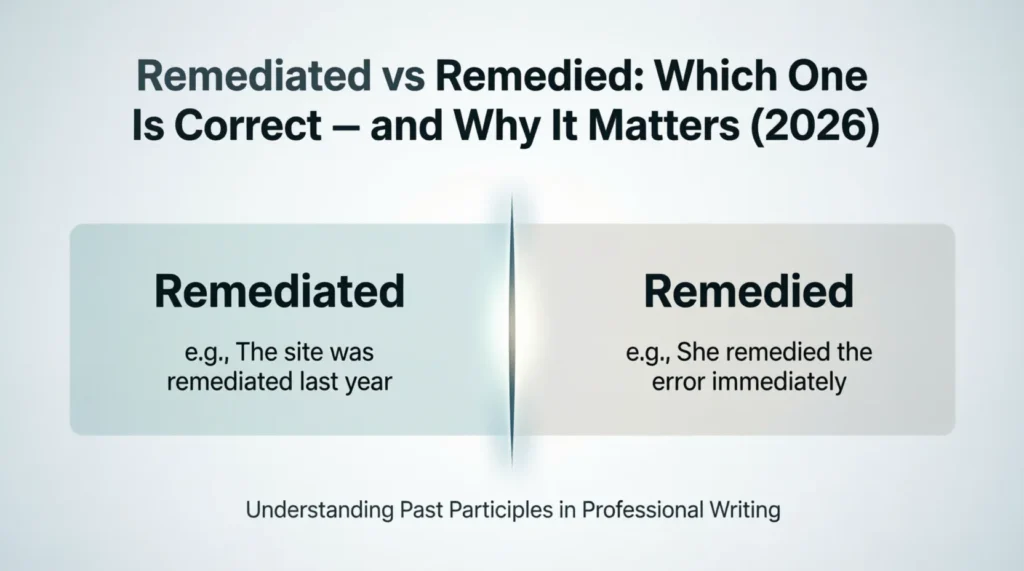
In short, both “remediated” and “remedied” are correct, but they are not interchangeable. “Remedied” is the more general word for fixing a problem, while “remediated” is used in technical, environmental, legal, or formal contexts. Understanding the difference will instantly make your writing clearer and more professional.
The Confusion Around remediated vs remedied
You’re writing an essay, email, or report, and you pause. Should you say the issue was remediated or remedied? Both look right. Both sound formal. But something feels off, and you hesitate before hitting send.
This is exactly where most people get stuck with remediated vs remedied. You might hear one in school, another at work, and suddenly you’re not sure which fits your sentence.
The confusion is completely normal. Even experienced writers mix them up because the words overlap in meaning but belong to slightly different worlds of English usage.
What Each Word Actually Means
Let’s break down remediated vs remedied in the simplest way possible.
Remedied is a verb (past tense of “remedy”). It means to fix, correct, or solve a problem. It is used in everyday English and applies to almost any situation where something goes wrong and gets fixed.
Example:
She remedied the mistake in her assignment before submitting it.
This works in casual, academic, and professional writing without sounding too technical.
Remediated is also a verb (past tense of “remediate”), but it is more formal and technical. It usually refers to fixing something serious, complex, or harmful, such as environmental damage, cybersecurity issues, or compliance problems.
Example:
The contaminated soil was remediated after the chemical spill.
In short, “remedied” is general and everyday, while “remediated” is specialized and formal. That difference is the heart of remediated vs remedied.
remediated vs remedied: Side-by-Side Comparison
Here is a quick breakdown to make the remediated vs remedied easier to compare at a glance.
Feature
Remediated
Remedied
Meaning
Fixed a specific problem
Corrected or solved an issue
Part of Speech
Verb (past tense/past participle)
Verb (past tense/past participle)
Formality
Formal, technical
Neutral to formal
Common Context
IT, security, compliance
Health, daily problems, situations
Example Sentence
The vulnerability was remediated.
The issue was remedied quickly.
Can They Be Swapped?
Sometimes
Sometimes
Often used for technical fixes.
Broader and less specialized.
Why People Mix Up remediated vs remedied
Linguists often point out that confusion like remediated vs remedied comes from shared roots and overlapping meanings. Both words come from ideas of “making something right again,” so your brain naturally treats them as synonyms.
Another reason is sound similarity. When spoken quickly, “remedied” and “remediated” feel almost interchangeable. That makes it harder to remember which one belongs in formal writing versus general use.
There’s also a modern influence from professional language. In workplaces, especially in IT, healthcare, and environmental science, “remediated” is used frequently. So people start using it everywhere, even when “remedied” would be more natural.
The Simple Rule to Remember Which Is Which
Here’s an easy way to lock in remediated vs remedied:
If you are talking about a simple fix, use remedied. If you are talking about a serious, technical, or regulated fix, use remediated.
Think of it like this:
Remedy = everyday fix
Remediate = formal correction process
Example sentences:
You remedied the typo in your email before sending it.
The company remediated the data breach after the security audit.
She remedied the confusion in the instructions quickly and politely.
Common Mistakes People Make With remediated vs remedied
Here are some real-world errors people make when using remediated vs remedied:
Using “remediated” in casual writing Wrong: I remediated my spelling mistake in the essay. Correct: I remedied my spelling mistake in the essay.
Using “remedied” for technical issues Wrong: The server issue was remedied by the IT team. Correct: The server issue was remediated by the IT team.
Assuming both words are fully interchangeable Wrong: The problem was remediated in the story plot. Correct: The problem was remedied in the story plot.
Overusing “remediated” to sound professional Wrong: I remediated my schedule conflict. Correct: I remedied my schedule conflict.
Real Sentence Fix — remediated vs remedied
See the Mistake, Fix the Mistake
These are real mistakes people make with the remediated vs remedied — and the simple fix for each one.
❌ The cybersecurity team remedied all system vulnerabilities before launch. ✅ The cybersecurity team remediated all system vulnerabilities before launch. 📌 Why: Technical security problems are often described as being remediated.
❌ The headache was remediated after some rest. ✅ The headache was remedied after some rest. 📌 Why: Everyday health problems are usually said to be remedied.
❌ The researcher remediated the error in the survey results. ✅ The researcher remedied the error in the survey results. 📌 Why: A mistake in research is normally described as remedied.
❌ We finally remediated our friendship after the argument. ✅ We finally remedied our friendship after the argument. 📌 Why: Personal relationship issues are generally remedied, not remediated.
❌ The customer complaint was remediated with a refund. ✅ The customer complaint was remedied with a refund. 📌 Why: Service and customer issues are usually remedied.
❌ The company remedied the compliance findings identified in the audit. ✅ The company remediated the compliance findings identified in the audit. 📌 Why: Audit and compliance corrections often use the more technical word remediated.
Real-World Examples: remediated vs remedied Used Correctly
Here’s how remediated vs remedied works in real life:
Casual writing: “I remedied the misunderstanding with my friend before it became a bigger issue.” This works because it describes a simple, everyday correction.
Professional context: “The audit findings were remediated within the compliance deadline.” This fits formal business language where structured correction is involved.
Academic writing: “The researcher remedied inconsistencies in the dataset before analysis.” This shows careful correction in a scholarly environment.
Creative writing: “He quickly remedied the broken dialogue, giving the scene more clarity.” This fits storytelling where the fix is simple and narrative-focused.
Each example shows how choosing the right word in remediated vs remedied shapes tone and clarity.
British English vs. American English — Does It Affect remediated vs remedied?
When it comes to remediated vs remedied, there is no major British vs American spelling difference. Both English varieties use “remedied” as the general term and “remediated” in formal or technical contexts.
Language researchers note that this distinction is not regional but functional. It depends more on field of use than geography. Whether you are in the UK, US, or elsewhere, the same usage pattern applies.
So no matter where you are writing, the rule stays consistent: “remediated” is technical, “remedied” is general.
What Grammar Checkers and Style Guides Say About remediated vs remedied
Grammar tools often accept both words, but they don’t always flag incorrect context. That means you could use the wrong one and still pass spellcheck.
Style guides generally encourage choosing clarity over formality. In other words, they prefer “remedied” unless you are writing in a technical field that specifically requires “remediated.”
The key takeaway is simple: tools can help, but they cannot fully judge context. You need to understand remediated vs remedied to make the right choice yourself.
remediated vs remedied in Professional and Academic Writing
In professional writing, choosing between remediated vs remedied can affect how your message is perceived. Using “remediated” in the right context signals precision and technical awareness. It shows you understand structured processes like compliance, engineering fixes, or environmental corrections.
However, using it in the wrong place can make your writing feel overly complicated or unnatural. For example, saying you “remediated a typo” sounds unnecessarily formal and slightly awkward.
In academic writing, clarity is especially important. You want your reader to focus on your ideas, not your word choice. Once you understand this distinction, you will stop second-guessing yourself and write with more confidence.
Quick Recap: remediated vs remedied at a Glance
“Remedied” is used for general fixes and everyday problems
“Remediated” is used for technical, formal, or structured corrections
Both words are correct but not interchangeable
Context decides which word fits best
“Remedied” is safer in most writing situations
Frequently Asked Questions About remediated vs remedied
Is “remediated” a real word or just jargon?
Yes, “remediated” is a real and valid English word. It comes from “remediate” and is widely used in technical, environmental, and professional contexts. However, it is less common in everyday conversation compared to “remedied.”
Can I use “remediated” instead of “remedied” in writing?
You can, but only if the context is technical or formal. In general writing, “remedied” is more natural and widely accepted. Using “remediated” incorrectly can make your sentence sound overly complex.
Why does “remediated vs remedied” confuse so many people?
The confusion happens because both words come from the same root idea of fixing something. They also sound very similar when spoken. This makes it easy to mix them up, especially when writing quickly.
Is “remedied” always the safer choice?
In most everyday situations, yes. “Remedied” works in casual, academic, and professional writing without sounding out of place. “Remediated” is best reserved for specialized contexts.
Do grammar checkers catch mistakes in remediated vs remedied?
Not always. Grammar tools often accept both words without checking context. That’s why understanding the difference is more reliable than depending on software alone.
Final Thoughts on remediated vs remedied
The difference between remediated vs remedied is smaller than it first appears, but it matters more than most people realize. One is general and flexible, while the other is formal and technical.
Once you understand this simple distinction, you stop guessing and start choosing words with confidence. That small shift improves your clarity in emails, essays, and professional writing.
You now have a clear mental rule that will help you every time you face remediated vs remedied, and that makes you a more precise and confident writer going forward.
Frequently Asked Questions
What is the main difference between 'remediated' and 'remedied'?▼
‘Remedied’ refers to fixing a general problem and is used in everyday contexts, while ‘remediated’ is more formal and technical, typically used for serious issues like environmental damage or compliance problems.
In what contexts should I use 'remediated'?▼
‘Remediated’ is best used in technical, formal, or specialized contexts such as IT, environmental science, or legal matters. For example, you would say ‘the contaminated soil was remediated’ when discussing environmental cleanup.
Can 'remedied' be used in professional writing?▼
Yes, ‘remedied’ is suitable for casual, academic, and professional writing. It applies to a wide range of everyday situations where a problem needs fixing, such as ‘she remedied the mistake in her assignment.’
Why do people often confuse 'remediated' and 'remedied'?▼
The confusion arises from their similar meanings and roots, both relating to fixing problems. Additionally, their sound similarity can lead to interchangeable use, especially in spoken language.
What are some common mistakes people make with these terms?▼
A common mistake is using ‘remediated’ in casual writing, such as saying ‘I remediated my spelling mistake,’ which should be ‘I remedied my spelling mistake.’ Another error is using ‘remedied’ for technical issues, where ‘remediated’ would be more appropriate.
How can I remember when to use each term?▼
A simple rule is to use ‘remedied’ for everyday fixes and ‘remediated’ for serious, technical corrections. Think of ‘remedy’ as an everyday fix and ‘remediate’ as part of a formal correction process.
Can both words be used interchangeably?▼
While there are situations where they can overlap, they are not completely interchangeable. ‘Remedied’ is broader and less specialized, whereas ‘remediated’ is reserved for more formal and technical contexts.
Rebecca Nguyen brings a diverse background in journalism and education to her role at WordlyRight. A graduate of the University of Toronto with a focus in English and Linguistics, she has spent over 12 years honing her skills as a writer and educator. Rebecca’s expertise lies in her ability to simplify daunting grammar rules and rectify frequent spelling mistakes in a way that resonates with students and professionals alike. Her articles on WordlyRight zero in on the most common word confusions encountered by writers, turning complex concepts into clear, actionable insights. With a passion for lifelong learning, Rebecca continually seeks to refine her understanding of language to better serve her audience.