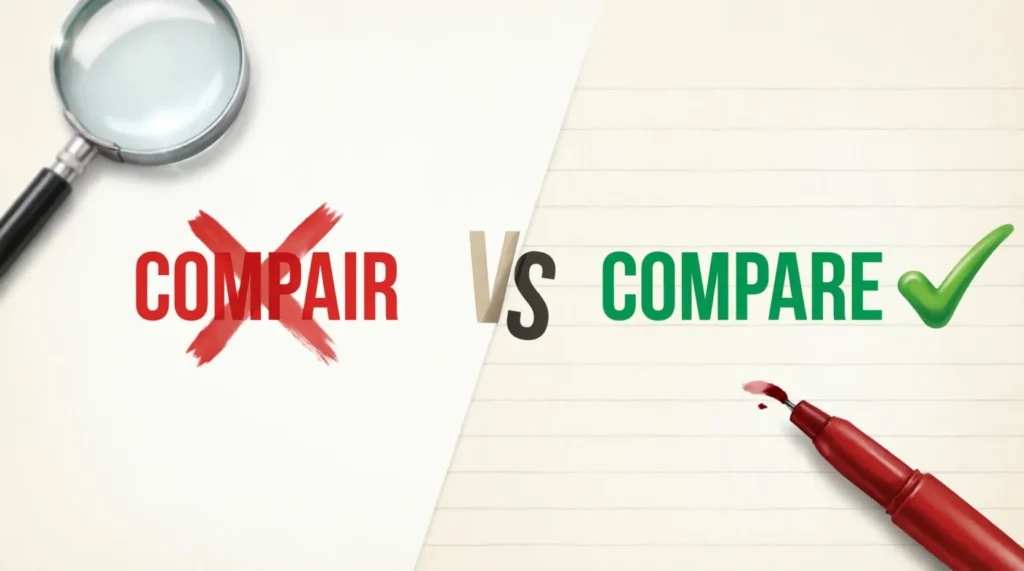
In short, compare is the correct English word meaning to examine similarities or differences between two or more things, while compair is a common misspelling with no standard meaning in modern English. This confusion shows up often in writing, especially when typing quickly, and understanding the difference will help you write more confidently and accurately going forward.
The Confusion Around compair vs compare
You’re writing an essay or maybe drafting an important email, and suddenly you pause. Should it be compair or compare? The spellings look almost identical, and your fingers might even type the wrong one without you noticing.
This moment of doubt is exactly why compair vs compare causes so much confusion for writers at all levels. You might have seen both versions online or in informal writing, which makes the uncertainty even worse.
The truth is, one of these forms is widely accepted in English, while the other is simply a spelling mistake that has become common through repetition and autocorrect habits.
What Each Word Actually Means
Let’s break down compair vs compare in simple, everyday language so you never mix them up again.
Compare is a verb. It means to look at two or more things and find similarities or differences between them. It is a standard English word used in writing, speech, and academic contexts.
For example: You can compare two smartphones to see which one has better battery life.
On the other hand, compair is not a recognized English word in standard dictionaries. It does not have a valid grammatical role such as noun, verb, or adjective in modern usage. In almost all cases, it is simply a spelling error that happens when someone intends to write “compare” but types it incorrectly.
So when you see compair vs compare, remember this clearly: only “compare” carries meaning and grammatical function in English.
SECTION 1: compair vs compare: Side-by-Side Comparison
Here is a quick breakdown to make the compair vs compare easier to compare at a glance.
Feature
compair
compare
Meaning
Misspelling of compare
Examine similarities/differences
Part of Speech
Not a valid word
Verb / noun
Formality
Incorrect usage
Neutral / formal
Common Context
Typing errors online
Writing, analysis, discussion
Example Sentence
He compair prices online
Compare prices before buying
Can They Be Swapped?
No — not a real word
No — correct form only
Why People Mix Up compair vs compare
The confusion around compair vs compare usually comes from how similar the words look and sound when spoken quickly. The difference is just one letter, which makes it easy to miss during fast typing.
Linguists often note that our brains rely heavily on pattern recognition. When a word looks “plausible,” like compair, we may assume it is correct even if it is not. This is especially true when people have only seen the word in informal writing or social media.
Another reason is phonetic similarity. When spoken aloud, “compare” and “compair” sound nearly identical in casual speech, so your brain doesn’t always register the spelling difference. Over time, this creates a mental shortcut that leads to repeated mistakes.
The Simple Rule to Remember Which Is Which
Here’s an easy way to lock in the correct form for compair vs compare:
If you are talking about examining similarities or differences, always use “compare” — because it contains the word “pare,” which relates to analyzing or cutting down differences.
A simple memory trick: “You compare to clarify.”
Now let’s see it in action:
You compare two job offers before making a decision.
When you compare prices, you make smarter financial choices.
Students compare answers to learn from mistakes.
Every time you feel unsure, just remind yourself that “compare” is the only word that belongs in correct English writing.
Common Mistakes People Make With compair vs compare
Here are some realistic errors writers make when dealing with compair vs compare:
Using “compair” in formal writing: I compair these two theories in my essay. → Corrected: I compare these two theories in my essay.
Relying on autocorrect blindly: She compair the results carefully. → Corrected: She compare the results carefully.
Assuming both spellings are acceptable: You can compair options before choosing. → Corrected: You can compare options before choosing.
Each mistake usually comes from fast typing or lack of awareness, not lack of intelligence.
Real-World Examples: compair vs compare Used Correctly
Here are clear examples showing how “compare” works properly in real life:
Casual conversation: Let’s compare our schedules and find a free day to meet. This shows everyday spoken English where clarity matters.
Professional writing: The report compares quarterly sales across different regions. This is formal business language where precision is important.
Academic writing: Researchers compare data sets to identify meaningful patterns. This demonstrates structured analysis in education or research.
Creative writing: She liked to compare memories of childhood with her present life. This shows expressive use in storytelling.
In every case, only “compare” fits naturally and correctly in English usage.
SECTION 2: See the Mistake, Fix the Mistake
These are real mistakes people make with the compair vs compare — and the simple fix for each one.
❌ The manager will compair the reports today. ✅ The manager will compare the reports today. 📌 Why: compair is just a spelling mistake for the correct word.
❌ Can you compair my outfit with hers? ✅ Can you compare my outfit with hers? 📌 Why: the correct spelling is used when talking about differences.
❌ Students should compair the two theories in essay. ✅ Students should compare the two theories in essay. 📌 Why: compair is incorrect and should always be replaced.
❌ The app lets you compair phone features quickly. ✅ The app lets you compare phone features quickly. 📌 Why: compair is not a valid word in digital or tech writing.
❌ I will compair these two phones before buying. ✅ I will compare these two phones before buying. 📌 Why: compare is the correct word for checking differences.
❌ People often compair prices when shopping online. ✅ People often compare prices when shopping online. 📌 Why: compair is a common spelling error in everyday writing.
British English vs. American English — Does It Affect compair vs compare?
In this case, there is no regional spelling variation affecting compair vs compare. Both British and American English use the same spelling: “compare.”
The incorrect form “compair” is not recognized in either variety of English, so you don’t need to worry about switching between regions here.
Language researchers note that this kind of universal spelling error often spreads globally because of digital communication, not because of grammar rules. So whether you are writing in London or New York, the correct choice remains the same.
What Grammar Checkers and Style Guides Say About compair vs compare
Most grammar checkers and style tools instantly flag “compair” as incorrect and suggest “compare” as the proper replacement. This is because “compair” is not listed in standard dictionaries or accepted usage databases.
Style guides consistently support only “compare” in all contexts, whether formal or informal. However, tools are not perfect, and sometimes they miss contextual errors if the surrounding sentence is unclear.
That’s why understanding compair vs compare yourself is more reliable than depending only on software corrections. Knowing the rule ensures you catch mistakes even when tools don’t.
compair vs compare in Professional and Academic Writing
Getting compair vs compare right matters more than it might seem, especially in professional or academic settings. A small spelling mistake can make your writing appear rushed or less polished, even if your ideas are strong.
In job applications, reports, or essays, correct spelling helps create a strong impression of attention to detail. Misusing “compair” can distract the reader and reduce clarity.
The good news is simple: once you internalize the correct form, you will rarely make this mistake again, and your writing will immediately feel more confident and professional.
Quick Recap: compair vs compare at a Glance
“Compare” is the correct and standard English word
“Compair” is a common misspelling with no accepted meaning
Both British and American English use “compare”
The confusion comes from similar sound and spelling
Only “compare” should be used in writing and speech
Frequently Asked Questions About compair vs compare
Is “compair” a real English word?
No, “compair” is not a recognized English word. It is simply a misspelling of “compare” and should not be used in formal or informal writing.
Why do people write compair instead of compare?
People often type “compair” due to fast typing, autocorrect errors, or because the words sound identical when spoken. It is a very common visual mistake.
Can I use compair in creative writing?
Even in creative writing, “compair” is not acceptable. If you want clear communication, always use “compare” regardless of style or tone.
Does spellcheck always catch compair vs compare mistakes?
Most spellcheck tools do catch it, but not all context-based errors are detected perfectly. That’s why understanding the correct spelling is still important.
What is the easiest way to remember the correct spelling?
Think of “compare” as the word used when you examine things closely. If you are analyzing or judging differences, “compare” is always the right choice.
Final Thoughts on compair vs compare
The difference between compair vs compare is simple once you see it clearly: only “compare” is correct, while “compair” is just a spelling mistake that slips in during fast or careless typing.
This confusion is extremely common, so you are not alone if you’ve ever hesitated between the two. Now that you understand the rule, you can confidently use the correct spelling in any situation.
With this clarity, you can move forward in your writing without second-guessing yourself — and that confidence will show in everything you write.
Frequently Asked Questions
What is the correct spelling: compair or compare?▼
The correct spelling is ‘compare,’ which means to examine similarities or differences between two or more things. ‘Compair’ is a common misspelling with no recognized meaning in modern English.
Why do people confuse compair and compare?▼
The confusion arises because ‘compair’ looks and sounds similar to ‘compare,’ leading to typing errors and phonetic similarities. Many people may also have seen ‘compair’ in informal writing, reinforcing the misconception.
How can I remember the difference between compair and compare?▼
A helpful memory trick is to remember that ‘compare’ contains the word ‘pare,’ which relates to analyzing differences. Whenever you’re uncertain, just recall that ‘compare’ is the only form that has a recognized meaning.
Can compair be used in any context?▼
No, ‘compair’ cannot be used in any context as it is not a valid word in standard English. It is simply a misspelling of the verb ‘compare,’ which is widely accepted and used in various writing and speech contexts.
What are some common mistakes people make with compair and compare?▼
Common mistakes include using ‘compair’ in place of ‘compare’ in essays, emails, or casual conversations, often due to typing quickly or phonetic confusion. This can lead to misunderstandings and a lack of clarity in communication.
How does the confusion between compair and compare affect writing?▼
Using ‘compair’ instead of ‘compare’ can undermine the credibility of your writing, as it is a spelling error. Understanding the correct usage helps ensure clarity and confidence in your communication.
What are some examples of using the word compare correctly?▼
Examples include sentences like ‘You can compare two smartphones to see which one has better battery life,’ or ‘Students compare answers to learn from mistakes.’ These demonstrate the correct application of the verb ‘compare’ in analyzing differences.
James Williams has been fascinated by the intricacies of the English language since his childhood days. Holding a Master’s degree in Linguistics from the University of Cambridge, he has spent over 15 years working as a professional editor and language consultant. James specializes in deciphering complex spelling and grammatical issues, and he is passionate about helping students and professionals alike gain confidence in their writing. His experience includes developing educational content for ESL learners, ensuring clarity and precision in communication. James is dedicated to providing readers with easy-to-follow guidance that resolves word confusions and common spelling errors, making WordlyRight an essential resource for anyone who needs quick, authoritative answers.