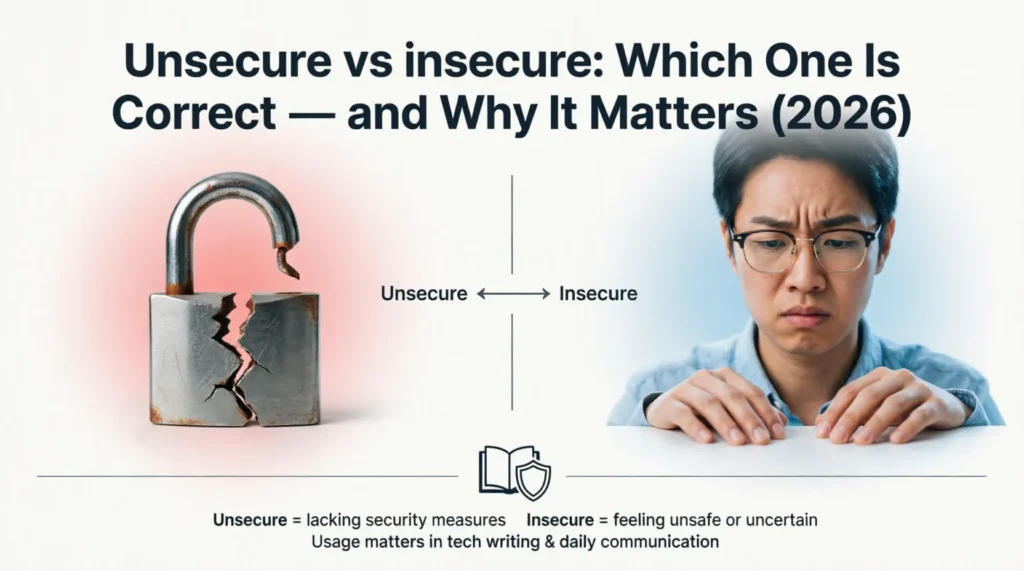
In short, insecure is the correct and widely accepted word in modern English, while unsecure is generally considered nonstandard or incorrect in most contexts. Some rare technical uses exist, but in everyday writing you should almost always choose insecure. Understanding unsecure vs insecure will help you avoid common writing mistakes and sound more confident in your communication.
The Confusion Around unsecure vs insecure
You’ve probably been there before—writing an email, finishing a school essay, or drafting a blog post—and suddenly you pause. Should you write unsecure vs insecure? It looks like both could be right. Both feel like real English words, and that hesitation can slow you down.
You’re not alone in this. Many writers second-guess themselves when they encounter unsecure vs insecure because both words appear similar in meaning. You might even see “unsecure” in casual writing online, which makes the confusion worse.
The truth is, this small doubt can shake your confidence in writing. And once you start noticing it, you begin to wonder how many other words you might be getting wrong without realizing it.
What Each Word Actually Means
Let’s break down unsecure vs insecure in simple, everyday language so you can finally see the difference clearly.
Insecure is an adjective. It means something is not safe, not stable, or lacking confidence. It is widely accepted in formal, academic, and professional English.
For example: A website can be insecure if it does not use proper encryption to protect your data.
Unsecure, on the other hand, is also used as an adjective in very limited contexts, but it is not commonly accepted in standard modern English. Some technical fields historically used it as a verb meaning “to remove security from something,” but that usage is rare today.
For example: You might see older technical documentation say to unsecure a system, meaning to disable its security features—but this is not common in everyday language.
In short, when you compare unsecure vs insecure, only one word—insecure—is reliably correct in most situations you will encounter.
unsecure vs insecure: Side-by-Side Comparison
Here is a quick breakdown to make the unsecure vs insecure easier to compare at a glance.
Feature
Unsecure
Insecure
Meaning
Not made secure
Not safe or lacking confidence
Part of Speech
Adjective
Adjective
Formality
Casual, less common
Neutral, widely accepted
Common Context
Informal tech discussions
Safety, emotions, systems
Example Sentence
This page is unsecure.
This page is insecure.
Can They Be Swapped?
Sometimes
Sometimes
Only in some tech contexts.
Not for emotional meaning.
Why People Mix Up unsecure vs insecure
The confusion around unsecure vs insecure exists for a few very understandable reasons. First, both words look logically formed. English often uses prefixes like “un-” to mean “not,” so “unsecure” seems like it should work.
Second, pronunciation plays a role. When spoken aloud, unsecure vs insecure can sound similar depending on accent and speed. This makes it harder for you to rely on intuition alone.
Finally, language researchers note that internet usage has blurred the lines between standard and nonstandard forms. When people repeatedly see “unsecure” in informal posts, they assume it might be correct. Over time, this reinforces the confusion and keeps the debate alive.
The Simple Rule to Remember Which Is Which
Here’s a simple way to lock this in your memory: if you mean “not safe” or “lacking confidence,” always use insecure.
Think of it like this—“insecure” already contains the idea of “not secure,” so adding “un-” again is unnecessary and usually incorrect.
Try this mental shortcut:
If you can replace the word with “unsafe” or “uncertain,” then insecure is the right choice.
Examples:
Your account feels insecure after the password leak.
You might feel insecure before giving a presentation.
That old website is insecure and should not be used for payments.
Once you start applying this rule, unsecure vs insecure becomes much easier to navigate in your writing.
Common Mistakes People Make With unsecure vs insecure
Here are some real mistakes you might recognize from everyday writing—and how to fix them:
Using “unsecure” to describe personal feelings Incorrect: You feel unsecure about your job interview. Correct: You feel insecure about your job interview.
Using “unsecure” in cybersecurity contexts Incorrect: This Wi-Fi network is unsecure. Correct: This Wi-Fi network is insecure.
Assuming both words are interchangeable Incorrect: The document is either unsecure or insecure. Correct: The document is insecure or not secure.
Using “unsecure” in formal essays Incorrect: The system was found unsecure during testing. Correct: The system was found insecure during testing.
Each of these mistakes happens because you’re trying to follow logic—but English doesn’t always follow logic perfectly.
Real Sentence Fix — unsecure vs insecure
See the Mistake, Fix the Mistake
These are real mistakes people make with unsecure vs insecure — and the simple fix for each one.
❌ The company website is unsecure and needs a new SSL certificate. ✅ The company website is insecure and needs a new SSL certificate. 📌 Why:Insecure is the standard word for websites that are not properly protected.
❌ After reading the comments, she felt unsecure about her drawing. ✅ After reading the comments, she felt insecure about her drawing. 📌 Why:Insecure describes a person’s lack of confidence.
❌ The report explains how unsecure networks increase cyber risks. ✅ The report explains how insecure networks increase cyber risks. 📌 Why:Insecure is the accepted word in academic and technical writing.
❌ My Wi-Fi is unsecure, so I avoid online banking. ✅ My Wi-Fi is insecure, so I avoid online banking. 📌 Why:Insecure is the normal choice for unsafe network connections.
❌ The gate is insecure because nobody locked it. ✅ The gate is unsecured because nobody locked it. 📌 Why:Unsecured means something has not been locked or protected.
❌ The bike was left insecure outside the store all afternoon. ✅ The bike was left unsecured outside the store all afternoon. 📌 Why:Unsecured is the better word when something was left without protection.
Real-World Examples: unsecure vs insecure Used Correctly
Here are clear examples that show how insecure is used correctly in different real-life situations:
Casual conversation: “I feel insecure when I have to speak in front of large groups.” This shows personal emotion in a natural, everyday way.
Professional writing: “The company identified an insecure server configuration during the audit.” This is appropriate for workplace or technical reports.
Academic writing: “The study found that insecure communication channels increase data vulnerability.” This fits formal research contexts.
Creative writing: “The insecure bridge swayed under the weight of the storm.” This shows descriptive, narrative use.
In every case, insecure works smoothly without confusion, while unsecure would feel out of place or incorrect.
British English vs. American English — Does It Affect unsecure vs insecure?
When it comes to unsecure vs insecure, there is no meaningful difference between British and American English. Both regions overwhelmingly prefer insecure in standard usage.
Linguists and style guides agree that insecure is the correct adjective in both varieties of English. You might occasionally see unsecure in niche technical writing, but it is not considered standard in either region.
So no matter where you are writing—whether for school in the UK or a business report in the US—you should confidently choose insecure.
What Grammar Checkers and Style Guides Say About unsecure vs insecure
Most modern grammar checkers will flag unsecure as incorrect or suggest insecure instead. This reflects how widely accepted usage has developed over time.
Style guides and language experts consistently recommend insecure for clarity and correctness. The reason is simple: insecure is established, widely understood, and contextually accurate across formal and informal writing.
Even though tools can help you catch mistakes, they are not perfect. You might still see unsecure slip through in informal contexts, so understanding unsecure vs insecure yourself is far more reliable than depending only on software.
unsecure vs insecure in Professional and Academic Writing
In professional and academic environments, word choice matters more than you might think. Using insecure correctly shows precision, clarity, and attention to detail.
If you use unsecure in a job application or research paper, it may distract your reader or reduce the perceived quality of your writing. Even if your overall message is strong, small language issues can affect first impressions.
The good news is that once you understand unsecure vs insecure, you will rarely make this mistake again. You’ll write with more confidence, and your communication will instantly feel more polished and professional.
Quick Recap: unsecure vs insecure at a Glance
Insecure is the standard, correct word in modern English
Unsecure is rare and generally considered nonstandard
Insecure covers safety, stability, and confidence meanings
Most style guides and grammar tools prefer insecure
You should avoid unsecure in formal writing
Frequently Asked Questions About unsecure vs insecure
Is unsecure a real word?
Yes, unsecure exists in English, but it is rarely used in modern writing. Most style guides recommend avoiding it in favor of insecure, which is clearer and more widely accepted.
What is the difference between insecure and unsecure?
Insecure means not safe or lacking confidence, while unsecure is a nonstandard form that is not commonly used in formal English. In most cases, insecure is the correct choice.
Can I use unsecure in technical writing?
In very rare or older technical documentation, unsecure may appear, but modern standards strongly prefer insecure. You should avoid it unless you are quoting legacy material.
Why does insecure mean both unsafe and emotionally uncertain?
English often uses the same adjective for physical and emotional states. Insecure covers both lack of safety and lack of confidence, depending on context.
Which word should I use in exams or professional emails?
You should always use insecure. It is the accepted, correct form in academic, professional, and everyday English writing.
Final Thoughts on unsecure vs insecure
The confusion between unsecure vs insecure is common, but the answer is actually simple once you see the pattern. Insecure is the correct and standard form in almost every situation you will encounter.
Now that you understand the difference, you no longer need to hesitate when writing. You know which word to choose, and more importantly, you know why it is correct. That kind of clarity makes you a more confident and precise writer going forward.
Frequently Asked Questions
What is the difference between unsecure and insecure?▼
Insecure is the correct term used to describe something that is not safe or lacking confidence, whereas unsecure is generally considered nonstandard in modern English. While unsecure may have limited technical uses, it should be avoided in everyday writing.
In what contexts can I use unsecure?▼
Unsecure can be used in very specific technical contexts, such as in older documentation referring to disabling security features. However, in most everyday scenarios, it’s best to stick with insecure to ensure clarity and correctness.
Why do people confuse unsecure and insecure?▼
The confusion arises because both words appear similar and follow a logical formation with the prefix ‘un-‘. Additionally, informal online usage of unsecure can mislead writers into thinking it is acceptable.
Can I use unsecure in formal writing?▼
No, unsecure is not widely accepted in formal, academic, or professional writing. It is advisable to use insecure in these contexts to maintain professionalism and clarity.
How can I remember which word to use?▼
A helpful tip is to associate insecure with the meanings of ‘unsafe’ or ‘uncertain.’ Since insecure inherently means ‘not secure,’ adding ‘un-‘ is unnecessary and often incorrect.
What are some examples of using insecure correctly?▼
You can say, ‘The website is insecure because it lacks proper encryption,’ or ‘I feel insecure when speaking in public.’ Both examples illustrate the correct use of insecure in terms of safety and confidence.
Are there any exceptions to using unsecure?▼
While unsecure may appear in some technical fields, its usage is quite rare and not recommended for general communication. Stick to insecure unless you are certain of the specific technical context.
Emily Thornton holds a Master’s degree in Linguistics from the University of Chicago and has been passionate about language education for over 15 years. Her interest in language developed at a young age, fueled by a curiosity for how intricacies in language shape communication. Emily has authored several guides on grammar usage and works extensively with ESL learners to improve their fluency and confidence in English. Dedicated to clarity, she writes content that demystifies complex spelling and grammar issues, making her contributions invaluable for professionals looking for authoritative and swift language solutions. Emily continues to explore innovative ways to bridge communication gaps through accurate and effective language use. Her blend of academic rigor and practical insight ensures learners across all levels find her advice beneficial.