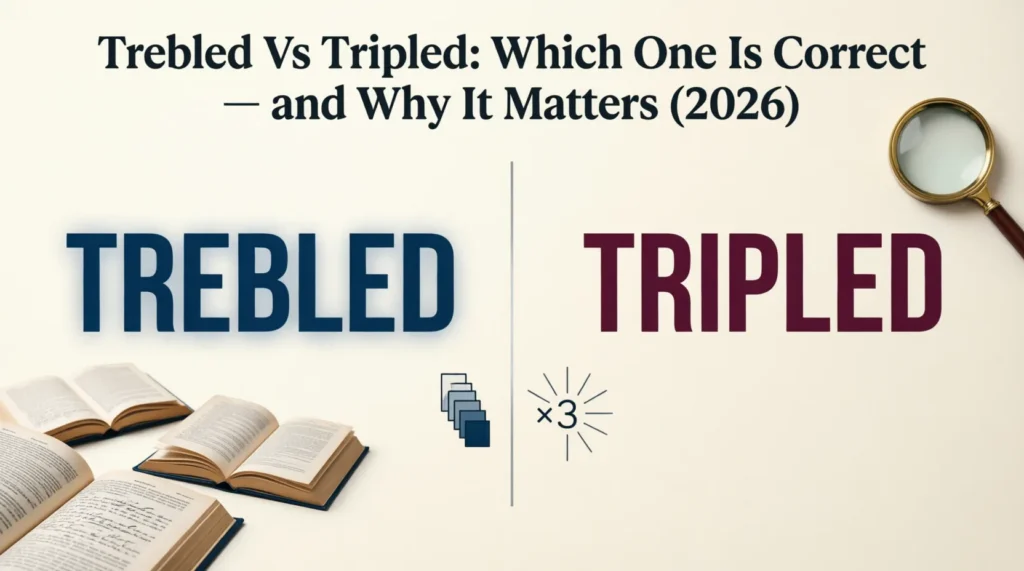
In short, both “trebled” and “tripled” are correct, but they are not always used in the same way. “Tripled” is more common in everyday English and means something became three times larger. “Trebled” is more formal and often used in British English, especially in finance or statistics. Understanding trebled vs tripled helps you choose the right word depending on tone and context, and it can instantly make your writing sound more precise and natural.
The Confusion Around trebled vs tripled
You’re writing an essay, report, or email and suddenly pause: should you say the number of users tripled or trebled? It feels like both sound right, and that’s exactly where the confusion begins.
Many people encounter trebled vs tripled in school math problems, business reports, or news articles. You might even see both used in similar contexts, which makes it even harder to trust your instinct.
The truth is, this confusion is extremely common. Even experienced writers sometimes hesitate because the words overlap in meaning but differ slightly in usage and tone. Once you understand the distinction, you’ll stop second-guessing yourself.
What Each Word Actually Means
Let’s break down trebled vs tripled in simple, practical terms so you can clearly see the difference.
“Tripled” is a verb derived from “triple,” meaning to make or become three times as large or as much. It is widely used in both American and British English. It is neutral, modern, and works in almost any context.
For example: The company’s revenue tripled in just two years.
Here, “tripled” simply means it became three times larger, and it feels natural in everyday conversation and writing.
“Trebled,” on the other hand, comes from the verb “treble,” which also means to increase threefold. It is commonly used in British English and is slightly more formal or traditional in tone. It often appears in financial, statistical, or formal reporting contexts.
For example: The charity’s donations trebled after the campaign.
Both words mean the same thing mathematically, but their usage style differs. In most casual situations, “tripled” is preferred, while “trebled” may appear in more formal or regional writing.
trebled vs tripled: Side-by-Side Comparison
Insert AFTER the “What Each Word Actually Means” section.
Here is a quick breakdown to make the trebled vs tripled easier to compare at a glance.
Feature
Trebled
Tripled
Meaning
Became three times larger
Became three times larger
Part of Speech
Verb (past tense/past participle)
Verb (past tense/past participle)
Formality
Neutral, mainly British
Neutral, widely used
Common Context
UK writing, sports, business
Everyday, business, science
Example Sentence
Sales trebled in one year.
Sales tripled in one year.
Can They Be Swapped?
Sometimes
Sometimes
Same meaning, but regional preference matters.
Same meaning, but regional preference matters.
Why People Mix Up trebled vs tripled
The confusion around trebled vs tripled exists mainly because both words share identical meanings. Linguists often point out that English tends to preserve multiple words for the same idea when they evolve from different historical roots.
Another reason is pronunciation. “Treble” and “triple” sound very similar when spoken quickly, especially in certain accents. This makes it hard for learners to distinguish them when reading or hearing the words in context.
Finally, exposure plays a role. American English heavily favors “tripled,” while British English uses both “tripled” and “trebled” depending on formality. So learners often encounter mixed usage across books, media, and academic writing, reinforcing the uncertainty.
The Simple Rule to Remember Which Is Which
Here’s a simple way to never confuse trebled vs tripled again:
Use “tripled” for everyday writing, and use “trebled” when you want a more formal or British English tone.
A quick memory trick: Think “tripled = typical” (used everywhere). Think “trebled = traditional” (more formal or British style).
Now apply it in real sentences:
The startup tripled its customer base after launching the new app. Her salary tripled after she changed jobs. The report stated that profits trebled over the last decade.
Once you apply this rule a few times, your brain starts choosing automatically without hesitation.
Common Mistakes People Make With trebled vs tripled
Here are some frequent mistakes you might be making without realizing it:
Using “trebled” in casual American English writing Incorrect: The views on the video trebled overnight. Correct: The views on the video tripled overnight.
Using “tripled” in overly formal British financial reports where “trebled” is preferred Incorrect: Earnings tripled in the fiscal year. Correct: Earnings trebled in the fiscal year.
Assuming one word is incorrect Incorrect belief: “Trebled is not real English.” Correct understanding: Both are valid, but context matters.
Mixing tone within the same document Incorrect: The population trebled, and the city tripled in size. Correct: The population tripled, and the city’s size tripled.
Each of these mistakes comes from not recognizing that trebled vs tripled is about style, not correctness alone.
Real Sentence Fix — trebled vs tripled
See the Mistake, Fix the Mistake
Insert AFTER the “Common Mistakes People Make” section.
These are real mistakes people make with the trebled vs tripled — and the simple fix for each one.
❌ Our profits triplicated last year. ✅ Our profits tripled last year. 📌 Why:Tripled is the natural word for becoming three times larger.
❌ My phone bill trebbled this month. ✅ My phone bill trebled this month. 📌 Why: The correct British spelling is trebled, not trebbled.
❌ The experiment trebled the reaction time. ✅ The experiment tripled the reaction time. 📌 Why:Tripled is more common in academic and scientific writing.
❌ Website traffic tripled by three times after the update. ✅ Website traffic tripled after the update. 📌 Why:Tripled already means three times, so the extra words are unnecessary.
❌ The price trebled to three times more overnight. ✅ The price trebled overnight. 📌 Why:Trebled already includes the idea of three times.
❌ Her savings was tripled after a year of careful budgeting. ✅ Her savings were tripled after a year of careful budgeting. 📌 Why:Savings is treated as a plural word in this sentence.
Real-World Examples: trebled vs tripled Used Correctly
Here’s how you’ll actually see these words used in different contexts:
Casual conversation: “My workload tripled after the new project started.” This works because everyday English favors “tripled.”
Business writing: “Quarterly profits trebled following the restructuring.” This sounds more formal and fits corporate reporting.
Academic context: “The experimental results showed that output tripled under controlled conditions.” Here, clarity matters more than formality, so “tripled” is common.
Creative writing: “The silence in the room trebled as tension built.” This usage adds a slightly literary, stylistic tone.
Each example shows how trebled vs tripled depends on tone, audience, and purpose rather than meaning.
British English vs. American English — Does It Affect trebled vs tripled?
Yes, but not in a strict rule-based way. British English accepts both “trebled” and “tripled,” although “trebled” appears more often in formal writing, especially in finance and statistics.
American English strongly prefers “tripled” in almost all contexts. You will rarely see “trebled” in modern U.S. publications unless it’s in a historical or stylistic context.
However, both versions are understood globally. Language researchers often note that this is a case of stylistic preference rather than a true grammatical difference. So whether you use British or American English, the key is consistency within your writing.
What Grammar Checkers and Style Guides Say About trebled vs tripled
Most grammar checkers treat both “trebled” and “tripled” as correct words. They usually do not flag either as an error because both exist in standard English.
However, these tools often prefer “tripled” because it is more widely used in modern writing. Style guides generally suggest choosing the more common form unless you are following a specific regional or formal convention.
The important takeaway is that spellcheck alone is not enough. Understanding trebled vs tripled ensures you choose the right word based on meaning, tone, and audience—not just what your software suggests.
trebled vs tripled in Professional and Academic Writing
In professional settings, the choice between trebled vs tripled can subtly affect how polished your writing appears.
Using “tripled” often makes your writing feel clear, modern, and accessible. It works well in business reports, presentations, and digital content.
Using “trebled” can make writing sound more formal or traditional, especially in British academic or financial contexts. It may give a sense of precision in older-style reporting.
In academic writing, clarity is usually more important than stylistic variation, so “tripled” tends to dominate. Once you understand this distinction, you can confidently match your word choice to your audience and never second-guess yourself again.
Quick Recap: trebled vs tripled at a Glance
Both words mean something increased threefold
“Tripled” is more common in everyday and American English
“Trebled” is more formal and often British English
Context and tone matter more than correctness
You can safely use either, depending on your audience
Frequently Asked Questions About trebled vs tripled
Is “trebled” the same as “tripled”?
Yes, both words mean something increased by three times. The difference lies in usage style rather than meaning. “Tripled” is more common in everyday English, while “trebled” is more formal or British in tone.
Is “trebled” correct English?
Yes, “trebled” is correct English and appears in dictionaries and formal writing. It is not a mistake, but it is less common in modern casual usage compared to “tripled.”
Which is more common: trebled or tripled?
“Tripled” is significantly more common in global English, especially in American usage. “Trebled” appears more in British English and formal or financial contexts.
Can I use tripled in academic writing?
Yes, “tripled” is widely accepted in academic writing because it is clear and neutral. Many writers prefer it for readability, although “trebled” may appear in some formal British publications.
Why do both words exist if they mean the same thing?
Language evolution is the reason. English often preserves multiple words from different historical roots. Linguists note that “treble” and “triple” developed separately but converged in meaning over time.
Final Thoughts on trebled vs tripled
The difference between trebled vs tripled is not about right or wrong—it’s about style, region, and tone. Both words express the same idea of something becoming three times larger, but they live in slightly different corners of English usage.
Now that you understand the distinction, you can choose confidently based on your audience and writing context. This is one of those small language details that instantly makes your writing feel more natural and precise.
And from here on, you’ll never have to pause and wonder which one to use again—you already know.
Frequently Asked Questions
What is the main difference between 'trebled' and 'tripled'?▼
The main difference is that ‘tripled’ is more common in everyday English and is used in both American and British contexts, while ‘trebled’ is more formal and often found in British English, particularly in finance and statistics.
In what contexts should I use 'trebled' instead of 'tripled'?▼
You should use ‘trebled’ in more formal or traditional contexts, such as academic writing, business reports, or when writing for a British audience. It adds a level of formality that ‘tripled’ may not convey.
Why do people often confuse 'trebled' with 'tripled'?▼
The confusion arises because both words share identical meanings and sound similar when spoken quickly. Additionally, exposure to mixed usage in American and British English can reinforce this uncertainty.
Can 'trebled' and 'tripled' be used interchangeably?▼
Yes, they can be used interchangeably as they convey the same mathematical meaning; however, regional preferences often dictate which term is more appropriate. ‘Tripled’ is preferred in casual contexts, while ‘trebled’ is more suitable for formal writing.
What is a simple rule to remember when to use 'trebled' or 'tripled'?▼
A simple rule is to use ‘tripled’ for everyday writing, as it is more widely accepted, and reserve ‘trebled’ for instances requiring a more formal tone, particularly in British English. Remember: ‘tripled = typical’ and ‘trebled = traditional’.
Can you provide examples of sentences using 'trebled' and 'tripled'?▼
Sure! An example using ‘trebled’ is: ‘The charity’s donations trebled after the campaign.’ An example with ‘tripled’ is: ‘The company’s revenue tripled in just two years.’ Both sentences indicate an increase to three times the original amount.
Is there a preferred term in American English for business contexts?▼
In American English, ‘tripled’ is the preferred term in business contexts, as it is more common and widely understood. ‘Trebled’ may be used but is less familiar among American audiences.
Emily Thornton holds a Master’s degree in Linguistics from the University of Chicago and has been passionate about language education for over 15 years. Her interest in language developed at a young age, fueled by a curiosity for how intricacies in language shape communication. Emily has authored several guides on grammar usage and works extensively with ESL learners to improve their fluency and confidence in English. Dedicated to clarity, she writes content that demystifies complex spelling and grammar issues, making her contributions invaluable for professionals looking for authoritative and swift language solutions. Emily continues to explore innovative ways to bridge communication gaps through accurate and effective language use. Her blend of academic rigor and practical insight ensures learners across all levels find her advice beneficial.