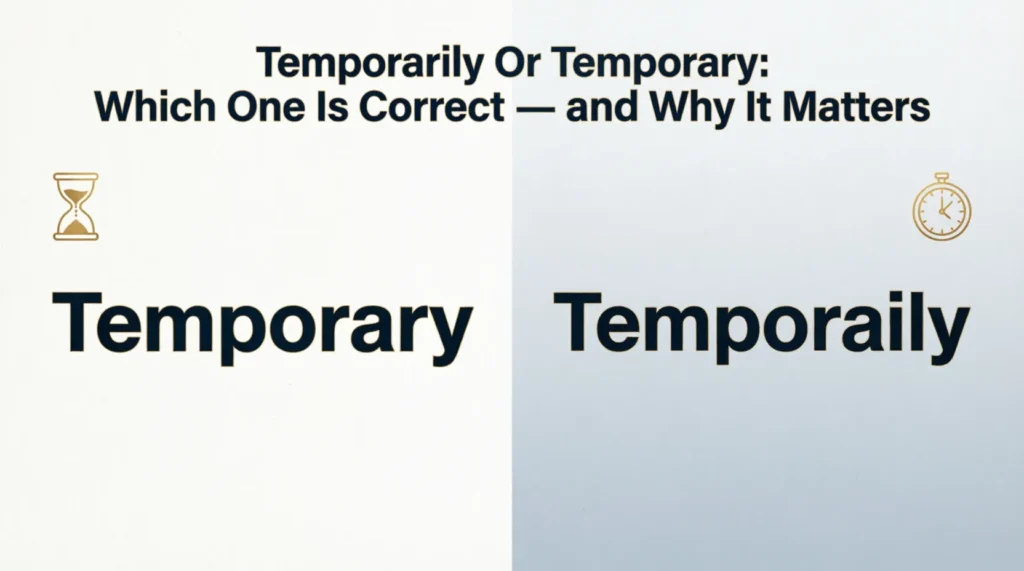
In short, temporary is the correct adjective used to describe something lasting for a short time, while temporarily is the correct adverb used to describe how something happens for a short time. The confusion in temporarily or temporary comes from their similar spelling and meaning, but they serve different roles in a sentence. By the end of this guide, you’ll know exactly when to use each one with confidence.
The Confusion Around temporarily or temporary
You’re writing an email and want to say your account is only for a short period. You pause. Should you write temporarily suspended or temporary suspended? This is exactly where the confusion around temporarily or temporary shows up for most writers.
Maybe you’re a student finishing an essay late at night, or you’re typing a professional message at work. You know the meaning you want, but the wording suddenly feels uncertain. That small moment of doubt is extremely common.
The truth is, temporarily or temporary looks like a simple choice, but it trips up even confident English users. The reason is not lack of intelligence—it’s the natural overlap in how these words are formed and used in everyday speech.
What Each Word Actually Means
Let’s clear things up in the simplest way possible so you never second-guess yourself again when dealing with temporarily or temporary.
Temporary is an adjective. It describes a noun—something that exists or happens for a short time. For example, a temporary job means the job will not last forever. You might say: “She took a temporary position while searching for a full-time role.”
On the other hand, temporarily is an adverb. It describes how an action happens. It often modifies verbs. For example: “The website is temporarily down for maintenance.” Here, temporarily explains how long the website is down.
A simple way to remember it: if you are describing a thing or situation, use temporary. If you are describing an action or state, use temporarily.
Why People Mix Up temporarily or temporary
Language researchers often point out that confusion like temporarily or temporary happens because the words share the same root: “tempus,” meaning time in Latin. That shared origin makes them feel interchangeable in everyday speech.
Another reason is sound and rhythm. When spoken quickly, “temporary” and “temporarily” sound very similar, especially in casual conversation. This leads many people to assume they can be used the same way in writing.
There is also a structural issue. English learners often expect that adding “-ly” is just a stylistic change, but in reality, it changes the grammatical role completely. That small shift is what creates most of the confusion.
The Simple Rule to Remember Which Is Which
Here’s an easy rule that makes temporarily or temporary instantly clear:
If you can replace the word with “short-term” and it describes a noun, use temporary. If it describes an action, use temporarily.
Try these examples:
“This is a temporary solution.” (You can say “short-term solution.”)
“The service is temporarily unavailable.” (You are describing how the service is unavailable.)
“He was temporarily assigned to the team.” (Describes how he was assigned.)
Once you train your brain with this rule, choosing between temporarily or temporary becomes almost automatic.
Common Mistakes People Make With temporarily or temporary
Using “temporarily” before a noun: Wrong: a temporarily fix → Correct: a temporary fix
Using “temporary” to describe a verb: Wrong: the system is temporary down → Correct: the system is temporarily down
Mixing both in formal writing: Wrong: temporarily job position → Correct: temporary job position
Overusing one form everywhere: Wrong: everything described as temporary → Correct: switch based on grammar role
Each mistake comes from misunderstanding whether you are describing a thing or an action, which is central to mastering temporarily or temporary.
Real-World Examples: temporarily or temporary Used Correctly
“The store is temporarily closed for renovations.” This works because temporarily describes the action of being closed.
“She accepted a temporary role in the marketing department.” Here, temporary describes the type of role.
“Access to the system has been temporarily restricted for security reasons.” This shows how something is restricted, not what the thing is.
“They moved into a temporary shelter after the storm.” Temporary describes the shelter itself.
Each example shows how the correct form depends entirely on whether you are modifying a verb or a noun.
British English vs. American English — Does It Affect temporarily or temporary?
There is no meaningful difference between British and American English when it comes to temporarily or temporary. Both regions use the same spellings and follow the same grammatical rules.
However, learners sometimes assume there is a regional variation because other words in English do differ (like “colour” vs “color”). In this case, linguists confirm that both forms are universally standard.
So whether you are writing for a UK audience, a US audience, or international readers, the rules remain the same.
What Grammar Checkers and Style Guides Say About temporarily or temporary
Most grammar tools and style guides treat temporary and temporarily as clearly separate parts of speech. They usually flag errors when one is used in the wrong grammatical position, especially when an adjective is incorrectly placed where an adverb should be.
However, automated tools sometimes miss subtle context errors. For example, they may not always catch awkward phrasing if the sentence still “looks” correct. That’s why understanding the rule behind temporarily or temporary is more reliable than relying on spellcheck alone.
Grammar experts consistently emphasize that context—not just spelling—is what determines correctness.
temporarily or temporary in Professional and Academic Writing
Getting temporarily or temporary right matters more than it seems, especially in formal writing. In job applications, reports, or academic essays, incorrect usage can create a sense of carelessness, even if your idea is strong.
For example, writing “a temporarily solution” in a resume or report can distract readers from your actual message. In contrast, correct usage signals clarity and attention to detail.
The good news is that once you fully understand the difference, you rarely have to think about it again. It becomes automatic, and your writing immediately feels more polished and professional.
Quick Recap: temporarily or temporary at a Glance
Temporary = adjective (describes a noun)
Temporarily = adverb (describes an action)
They come from the same root but serve different grammar roles
Confusion happens due to sound similarity and structure overlap
Context determines which one you should use
Frequently Asked Questions About temporarily or temporary
Is it temporarily or temporary when describing something short-term?
You use temporary when describing something short-term as a thing or condition, such as a job or arrangement. Use temporarily only when describing an action or state.
Can I say “temporarily job”?
No, that is incorrect. You should say temporary job because you are describing the job itself, not an action.
Why do people confuse temporarily or temporary so often?
People confuse them because they share the same root word and sound very similar in speech. The difference only becomes clear when you understand their grammar roles.
Is “temporarily” always related to time?
Yes, but it specifically describes how something happens over time, not what something is. It modifies verbs rather than nouns.
Which is more common in everyday writing: temporarily or temporary?
Both are common, but they appear in different contexts. “Temporary” is used for objects and situations, while “temporarily” is used for actions or conditions.
Final Thoughts on temporarily or temporary
The difference between temporarily or temporary is simple once you see the pattern: one describes things, and the other describes actions. That small shift in grammar makes all the difference in clarity.
This is one of those English confusions that feels bigger than it really is. Now that you understand it, you won’t need to hesitate when writing emails, essays, or professional messages.
With this rule in mind, you can move forward as a more confident writer who knows exactly when each word belongs—and your writing will reflect that clarity every time.
Emily Thornton holds a Master’s degree in Linguistics from the University of Chicago and has been passionate about language education for over 15 years. Her interest in language developed at a young age, fueled by a curiosity for how intricacies in language shape communication. Emily has authored several guides on grammar usage and works extensively with ESL learners to improve their fluency and confidence in English. Dedicated to clarity, she writes content that demystifies complex spelling and grammar issues, making her contributions invaluable for professionals looking for authoritative and swift language solutions. Emily continues to explore innovative ways to bridge communication gaps through accurate and effective language use. Her blend of academic rigor and practical insight ensures learners across all levels find her advice beneficial.