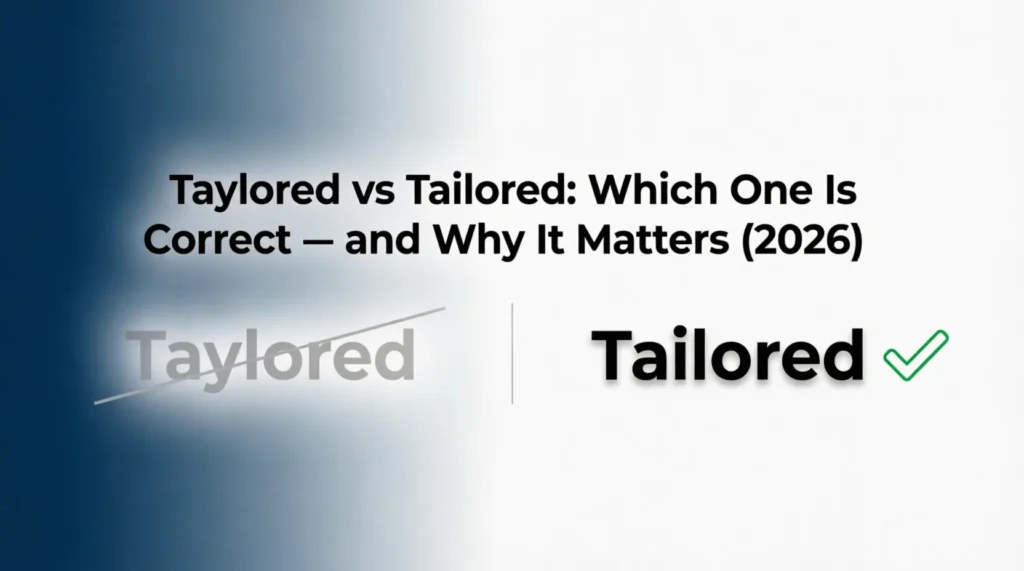
In short, “tailored” is the correct standard English spelling in almost every situation, while “taylored” is generally considered a misspelling. Because the two look and sound so similar, many writers pause over them — but once you understand the pattern behind the word, the difference becomes easy to remember.
The Confusion Around Taylored vs Tailored
You are halfway through an email, blog post, or college assignment when suddenly you stop and wonder: is it “taylored” or “tailored”? It is one of those spelling questions that can make even confident writers hesitate.
The confusion happens because “Taylor” is a very common surname and first name. When people hear the word aloud, their brain sometimes connects it to the familiar name instead of the actual spelling of the clothing-related word.
If you have searched for “taylored vs tailored,” you are definitely not alone. Language researchers regularly note that familiar names often influence how people spell everyday words, especially when the pronunciation is nearly identical.
What Each Word Actually Means
“Tailored” is the correct spelling and the standard form used in English writing. It comes from the noun “tailor,” which refers to someone who makes or adjusts clothing. As an adjective or verb form, “tailored” usually means something has been customized, fitted, or designed for a specific purpose.
Example sentence:
The company created a tailored training program for new employees.
In that sentence, “tailored” means specially designed to fit the employees’ needs.
“Taylored,” on the other hand, is not considered a standard English word in normal writing. In most cases, it is simply a spelling mistake caused by confusion with the name “Taylor.”
Example sentence:
Incorrect: We offer taylored solutions for small businesses.
Correct: We offer tailored solutions for small businesses.
There are rare situations where “Taylored” might appear as part of a business name, brand name, or personal name. For example, a fashion company could intentionally spell its brand “Taylored Style.” But outside of names and branding, standard grammar experts consider it incorrect.
Section 1 (Quick Comparison Table): Insert AFTER the “What Each Word Actually Means” section
taylored vs tailored: Side-by-Side Comparison
Here is a quick breakdown to make the taylored vs tailored easier to compare at a glance.
Feature
taylored
tailored
Meaning
Misspelling of “tailored”
Made or adjusted to fit
Part of Speech
Not a standard word
Adjective, verb (past)
Formality
Not appropriate
Neutral to formal
Common Context
Typing mistakes
Clothing, writing, services
Example Sentence
The report was taylored.
The report was tailored.
Can They Be Swapped?
No
No — only “tailored” is correct.
Why People Mix Up Taylored vs Tailored
The biggest reason people confuse “taylored vs tailored” is pronunciation. Both spellings sound exactly the same when spoken aloud. Linguists describe this as a homophone-like spelling trap, where your ears cannot help you choose the right spelling.
Another reason is the popularity of the name “Taylor.” Because many people see “Taylor” every day — in names, social media usernames, schools, and workplaces — the brain starts treating “taylored” as visually familiar, even though it is not standard English.
Autocorrect can also play a role. Some spellcheck systems fail to flag “taylored” if they interpret it as a proper noun or brand name. That means you cannot always rely on software alone to catch the mistake.
Language researchers have found that spelling confusion often increases when a word contains a recognizable name inside it. That is exactly what happens here: your brain sees “Taylor” and assumes the spelling must work.
The Simple Rule to Remember Which Is Which
Here is the easiest trick:
If the word relates to fitting, customizing, sewing, or designing something specifically for someone, use “tailored” — because it comes from “tailor.”
Think of it this way:
A tailor makes clothes, so tailored is the correct spelling.
That simple connection usually makes the answer stick immediately.
Here are a few examples:
The teacher tailored the lesson to help struggling students.
We received tailored financial advice for our business.
Her jacket was perfectly tailored for the event.
In each example, the meaning connects back to customization or fitting something carefully to a person or situation.
Common Mistakes People Make With Taylored vs Tailored
Writing “taylored services” in professional emails because the spelling looks more modern or stylish. Correct version: “tailored services”
Assuming “taylored” is the British spelling while “tailored” is American English. Correct version: “tailored” is standard in both regions.
Letting autocorrect miss the mistake in resumes or cover letters. Correct version: Always proofread manually when using “tailored.”
Confusing the word with the name “Taylor” during fast typing. Correct version: Remember that the word comes from “tailor,” not the personal name.
Section 2 (Real Sentence Fix): Insert AFTER the “Common Mistakes People Make” section
Real Sentence Fix — taylored vs tailored
See the Mistake, Fix the Mistake
These are real mistakes people make with the taylored vs tailored — and the simple fix for each one.
❌ The presentation was taylored to the client’s needs. ✅ The presentation was tailored to the client’s needs. 📌 Why: “Tailored” is the correct spelling in professional writing.
❌ This playlist is taylored just for you. ✅ This playlist is tailored just for you. 📌 Why: The word is always spelled “tailored,” even in casual posts.
❌ The lesson was taylored for beginner students. ✅ The lesson was tailored for beginner students. 📌 Why: Only “tailored” is the standard English word.
❌ The app gives taylored recommendations based on your activity. ✅ The app gives tailored recommendations based on your activity. 📌 Why: Software and websites use the correct spelling, “tailored.”
❌ She ordered a taylored jacket for the wedding. ✅ She ordered a tailored jacket for the wedding. 📌 Why: Clothing descriptions should always use the correct spelling.
❌ The travel plan was taylored for our family. ✅ The travel plan was tailored for our family. 📌 Why: “Tailored” is the correct word when something is made to suit a person or group.
Real-World Examples: Taylored vs Tailored Used Correctly
Casual conversation: “I finally bought a tailored suit that actually fits me properly.” This works because the suit was adjusted to fit the person.
Professional writing: “Our company provides tailored marketing solutions for small businesses.” Here, “tailored” means customized for specific clients.
Academic writing: “The researchers developed a tailored intervention for students with reading difficulties.” In academic contexts, the word often describes specialized approaches.
Creative writing: “The detective wore a sharply tailored coat that made him stand out in the crowd.” This example connects directly to clothing and appearance.
These examples all use the correct spelling because the word relates to fitting, adjusting, or customizing something carefully.
British English vs. American English — Does It Affect Taylored vs Tailored?
No — this is not a British-versus-American spelling issue. Both British English and American English use “tailored” as the standard spelling.
That is important because many spelling confusions do involve regional differences. For example, English changes words like “colour/color” or “organise/organize” depending on location. But “tailored” stays the same everywhere.
So if you are wondering whether “taylored” is acceptable in the UK, the US, Canada, Australia, or elsewhere, the answer is still no in standard writing. Grammar experts across major English-speaking regions agree on this point.
Precision in word choice also matters in translated academic and formal writing across many languages and traditions, especially when documents are intended for international readers.
What Grammar Checkers and Style Guides Say About Taylored vs Tailored
Most major style guides and grammar references recognize only “tailored” as the standard spelling. In formal writing, “taylored” is usually treated as an error unless it is part of a proper name.
Grammar tools often flag “taylored,” but not always. Some systems interpret it as a surname or company name, which means the mistake can slip through unnoticed. That is why context matters more than spellcheck alone.
Knowing the rule yourself is more reliable than depending entirely on autocorrect. Once you remember the connection to the word “tailor,” the correct spelling becomes much easier to spot instantly.
Taylored vs Tailored in Professional and Academic Writing
Using the correct spelling matters more than many people realize. In resumes, academic papers, client proposals, and published articles, small spelling mistakes can affect how polished your writing appears.
For example, phrases like “tailored experience,” “tailored approach,” or “tailored recommendations” are extremely common in professional communication. If you accidentally write “taylored,” readers may assume the mistake came from rushed proofreading.
The good news is that this is an easy confusion to fix permanently. Once you connect “tailored” to the word “tailor,” you will probably never second-guess yourself again.
Quick Recap: Taylored vs Tailored at a Glance
“Tailored” is the correct standard English spelling.
“Taylored” is usually a misspelling unless used in a brand or personal name.
The word comes from “tailor,” the person who adjusts clothing.
British and American English both use “tailored.”
Spellcheck may miss the error, so proofreading still matters.
Frequently Asked Questions About Taylored vs Tailored
Is “taylored” ever a real word?
Not in standard English writing. In most situations, “taylored” is considered a misspelling of “tailored.” The exception is when it appears as part of a company name, product name, or personal branding choice.
Why do people spell “tailored” as “taylored”?
The mistake usually happens because of the common name “Taylor.” Since “Taylor” looks familiar, many people accidentally insert that spelling into the word without noticing.
Is “taylored” the British spelling?
No. Both British English and American English use “tailored.” There is no regional version where “taylored” is considered standard grammar.
What does “tailored” mean in business writing?
In business contexts, “tailored” means customized or designed for a specific audience, customer, or purpose. For example, a company may offer tailored services based on client needs.
How can you remember the correct spelling of “tailored”?
The easiest trick is to think about a tailor making clothes. Since the word comes from “tailor,” the correct spelling is “tailored,” not “taylored.”
Final Thoughts on Taylored vs Tailored
The answer to “taylored vs tailored” is simple once you see the pattern: “tailored” is the correct spelling in standard English, while “taylored” is usually a spelling mistake influenced by the familiar name “Taylor.”
This confusion is incredibly common, so there is no reason to feel embarrassed if you have paused over it before. Even experienced writers double-check words that look and sound convincing.
Now that you know the difference, you can write with much more confidence — whether you are working on an essay, a business email, a blog post, or anything else that deserves polished, professional language.
Frequently Asked Questions
What is the correct spelling between taylored and tailored?▼
The correct spelling is ‘tailored,’ which is the standard English form used in writing. ‘Taylored’ is generally considered a misspelling and should be avoided in formal contexts.
Why do people confuse taylored and tailored?▼
The confusion arises mainly due to their similar pronunciation, making them sound alike. Additionally, the common surname ‘Taylor’ can lead people to mistakenly use ‘taylored’ instead of ‘tailored’ when writing.
What does tailored mean in a sentence?▼
‘Tailored’ refers to something that has been customized or designed to fit specific needs. For example, ‘The company created a tailored training program for new employees’ indicates that the program was specially designed for those employees.
Are there any situations where taylored might be acceptable?▼
The term ‘taylored’ could appear in specific contexts such as brand names or business names, like ‘Taylored Style.’ However, outside of these situations, it is considered incorrect in standard English writing.
How can I remember which spelling to use?▼
A simple rule to remember is that if the word relates to fitting, customizing, or designing, use ‘tailored,’ as it derives from ‘tailor.’ This connection can help you avoid the common mistake of using ‘taylored’ inappropriately.
What role does autocorrect play in mixing up the two spellings?▼
Autocorrect can sometimes fail to flag ‘taylored’ because it may interpret it as a proper noun or brand name. This reliance on software can lead to overlooking the mistake, so it’s essential to proofread carefully.
Can you give an example of incorrect usage of taylored?▼
An example of incorrect usage would be: ‘We offer taylored solutions for small businesses.’ The correct sentence should use ‘tailored,’ as in ‘We offer tailored solutions for small businesses.’
James Williams has been fascinated by the intricacies of the English language since his childhood days. Holding a Master’s degree in Linguistics from the University of Cambridge, he has spent over 15 years working as a professional editor and language consultant. James specializes in deciphering complex spelling and grammatical issues, and he is passionate about helping students and professionals alike gain confidence in their writing. His experience includes developing educational content for ESL learners, ensuring clarity and precision in communication. James is dedicated to providing readers with easy-to-follow guidance that resolves word confusions and common spelling errors, making WordlyRight an essential resource for anyone who needs quick, authoritative answers.