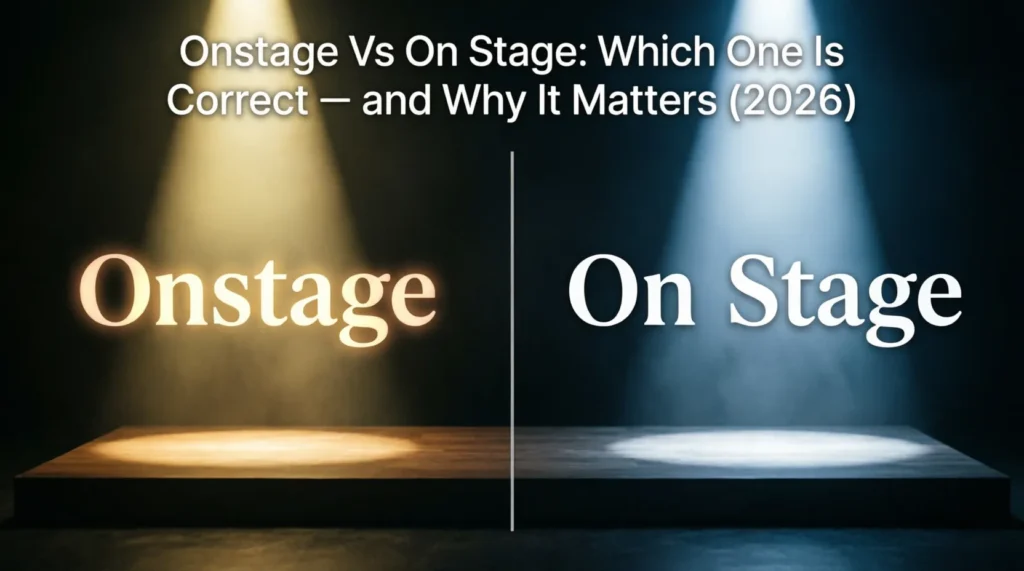
In short, “on stage” (two words) is the standard grammatically correct form when referring to being physically present on a stage, while “onstage” (one word) is also correct but used mainly as an adjective or adverb in more formal or stylistic contexts. The confusion between onstage vs on stage comes from how English compresses phrases over time, and knowing when to use each will instantly improve your writing confidence.
The Confusion Around onstage vs on stage
You’re writing an email, a caption, or maybe a school essay, and you pause for a second: should it be onstage vs on stage? It looks simple, but suddenly it doesn’t feel simple at all.
You might even type both versions, delete them, and second-guess yourself again. This tiny hesitation is exactly where most writers get stuck.
The confusion around onstage vs on stage is surprisingly common because both forms appear in real writing. You’ve probably seen performers described as being “onstage” and also heard someone say they are “on stage.” That overlap makes it feel like both must be equally correct in every situation.
What Each Word Actually Means
To understand onstage vs on stage, you need to break them into how English actually uses them in sentences.
“On stage” (two words) is a prepositional phrase. It means someone or something is physically located on a performance stage. It is commonly used as an adverbial phrase.
Example: The singer walked on stage with confidence before the crowd erupted.
Here, “on stage” describes where the action is happening.
“Onstage” (one word) is a single adverb or adjective. It describes something related to performances happening on a stage, often used in more formal or written contexts.
Example: Her onstage performance received standing ovations from the audience.
So in onstage vs on stage, the difference is not meaning, but grammar structure. One describes location (on stage), and the other describes performance-related action or quality (onstage).
Why People Mix Up onstage vs on stage
The confusion around onstage vs on stage happens because spoken English doesn’t clearly separate the two forms. When you hear them in conversation, they sound identical.
Linguists often point out that English tends to “compress” common phrases over time. That’s why “on stage” sometimes becomes “onstage” in writing, especially in entertainment journalism or promotional content.
Another reason is exposure. You might read theater reviews where writers prefer “onstage” for style, while casual writing sticks with “on stage.” This inconsistency trains your brain to treat both as interchangeable, even though they are not always used in the same grammatical way.
Finally, autocorrect and informal writing habits blur the line further, making onstage vs on stage one of those subtle grammar questions that even confident writers pause over.
The Simple Rule to Remember Which Is Which
Here’s an easy rule for onstage vs on stage that you can rely on every time:
If you are talking about physical location or movement, use “on stage.” If you are describing something related to performance style or acting as a descriptive word, use “onstage.”
Think of it like this: on stage = where, onstage = describing how or what kind.
Examples:
The actor stepped on stage and forgot his lines.
Her onstage presence was powerful and unforgettable.
The band is currently on stage performing their final song.
Once you apply this rule, onstage vs on stage becomes much easier to manage in real writing situations.
Common Mistakes People Make With onstage vs on stage
Using “onstage” for physical movement Mistake: He ran onstage during the concert. Correction: He ran on stage during the concert.
Using “on stage” as a descriptive adjective Mistake: The on stage performance was impressive. Correction: The onstage performance was impressive.
Mixing both forms in the same sentence Mistake: The actor went onstage and gave an on stage speech. Correction: The actor went on stage and gave an onstage speech.
Assuming both forms are always interchangeable Mistake: Treating onstage vs on stage as identical in all contexts. Correction: They serve different grammatical roles depending on usage.
Real-World Examples: onstage vs on stage Used Correctly
Casual conversation: “I got nervous when I stepped on stage for the first time.” This shows physical placement during a live moment.
Professional writing: “The performer’s onstage confidence set her apart from others.” This highlights a descriptive quality of performance.
Academic writing: “Students analyzed how presence on stage affects audience perception.” This focuses on spatial and behavioral context.
Creative writing: “She froze on stage, while her onstage persona slowly cracked under pressure.” This contrasts location with performance identity.
British English vs. American English — Does It Affect onstage vs on stage?
When it comes to onstage vs on stage, both British and American English recognize the same distinction. There is no major regional disagreement here.
However, American English tends to prefer the single-word form “onstage” more frequently in journalism and entertainment writing. British English often leans slightly more toward “on stage” in descriptive contexts.
Despite this small stylistic difference, both audiences understand both forms. The key is consistency: once you choose a style in your writing, stick with it.
What Grammar Checkers and Style Guides Say About onstage vs on stage
Most grammar tools will accept both onstage vs on stage, but they usually suggest changes depending on context. If you use “onstage” where a location is implied, you may get a suggestion to split it into two words.
Style guides generally treat “on stage” as the default for physical placement, while “onstage” is reserved for descriptive or adjectival use.
The important takeaway is simple: tools can help, but they don’t always understand meaning perfectly. Human judgment still matters more when deciding between onstage vs on stage.
onstage vs on stage in Professional and Academic Writing
In professional writing, small details like onstage vs on stage can shape how polished your work appears. Using the wrong form might not break your sentence, but it can make it feel slightly inconsistent.
In academic contexts, clarity and precision matter even more. Writers are expected to choose the correct grammatical structure based on meaning, not convenience.
In job applications, reviews, or published content, using on stage and onstage correctly shows attention to detail. Once you understand the difference, you stop guessing and start writing with confidence.
Quick Recap: onstage vs on stage at a Glance
“On stage” = physical location or movement
“Onstage” = descriptive adjective or performance-related context
Both are correct, but not interchangeable in every case
Context determines which form you should use
Understanding the difference improves writing clarity
Frequently Asked Questions About onstage vs on stage
Is “onstage” one word or two words?
“Onstage” is one word and is used mainly as an adjective or adverb describing performance-related actions. However, “on stage” is also correct when referring to physical location, so both forms exist depending on context.
When should I use on stage instead of onstage?
Use “on stage” when you are describing someone physically being on a stage. For example, walking, standing, or performing in a specific place. This helps avoid confusion in onstage vs on stage usage.
Is it wrong to write onstage in all cases?
No, it is not wrong, but it can be incorrect depending on context. Using “onstage” for physical location may sound unnatural, so understanding onstage vs on stage rules is important.
Why do writers use onstage instead of on stage?
Writers often prefer “onstage” for stylistic reasons or when describing performance qualities. It creates a smoother, more compact expression in professional or entertainment writing.
Do style guides prefer onstage or on stage?
Most style guides prefer “on stage” for physical placement and “onstage” for descriptive use. The key is using each correctly rather than choosing one universally.
Final Thoughts on onstage vs on stage
The difference between onstage vs on stage is small, but it has a big impact on clarity. Once you understand that one is about location and the other is about description, the confusion disappears.
This is one of those grammar questions that trips up many writers at first, but becomes second nature with practice. Now that you know the rule, you can use both forms confidently without second-guessing yourself.
And the next time you pause before typing it, you won’t hesitate — you’ll just know.
Rebecca Nguyen brings a diverse background in journalism and education to her role at WordlyRight. A graduate of the University of Toronto with a focus in English and Linguistics, she has spent over 12 years honing her skills as a writer and educator. Rebecca’s expertise lies in her ability to simplify daunting grammar rules and rectify frequent spelling mistakes in a way that resonates with students and professionals alike. Her articles on WordlyRight zero in on the most common word confusions encountered by writers, turning complex concepts into clear, actionable insights. With a passion for lifelong learning, Rebecca continually seeks to refine her understanding of language to better serve her audience.