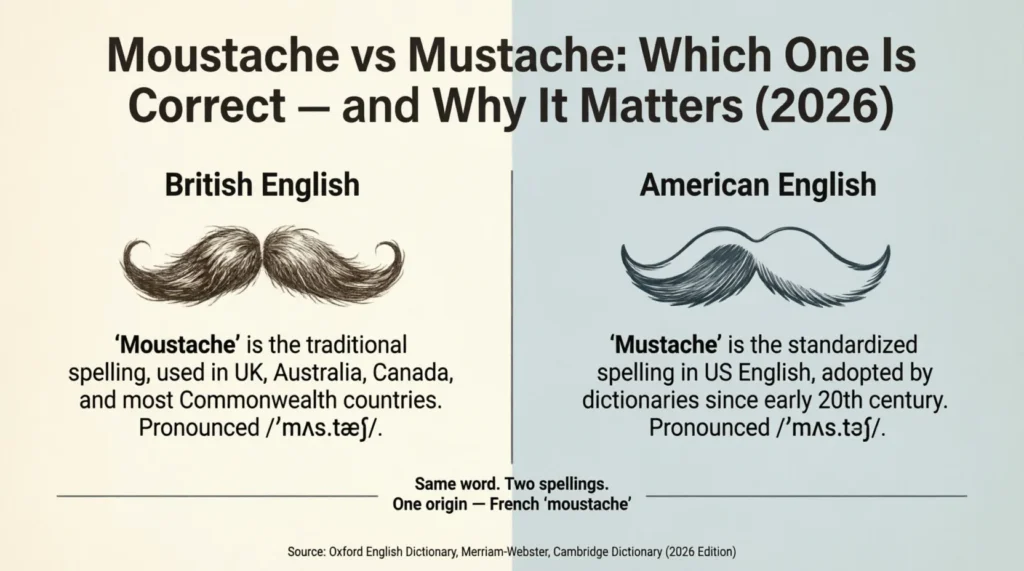
In short, both “moustache” and “mustache” are correct, but they belong to different varieties of English. “Moustache” is the traditional British English spelling, while “mustache” is the simplified American English form. You will see both used in writing, and understanding when each appears will instantly improve your confidence as a writer going forward.
The Confusion Around Moustache vs Mustache
You’re writing a school essay, and you pause mid-sentence: is it “moustache” or “mustache”? It looks like both should be right, but something feels off. That small moment of doubt is exactly where most people get stuck with moustache vs mustache.
Maybe you’re typing a caption for social media, or drafting a professional email, and suddenly the spelling doesn’t look familiar anymore. You start second-guessing yourself, even though you’ve seen both versions before.
This confusion is extremely common, and it happens to you more often than you realize. The good news is that once you understand the pattern behind moustache vs mustache, you’ll never have to hesitate again.
What Each Word Actually Means
Let’s clear this up in a simple, practical way so you can use it correctly every time.
The word “moustache” is a noun. It refers to the strip of facial hair that grows above a person’s upper lip. This is the traditional British English spelling and is widely used in countries influenced by British spelling rules.
Example: He trimmed his moustache before attending the wedding.
Now, “mustache” is also a noun with the exact same meaning. The only difference is spelling. It is the standard American English form and is used in the United States and many digital platforms that follow American conventions.
Example: He grew a thick mustache during the winter.
So in the debate of moustache vs mustache, neither word changes meaning. They are two spellings for the same concept, shaped by regional writing traditions rather than grammar differences.
moustache vs mustache: Side-by-Side Comparison
Here is a quick breakdown to make the moustache vs mustache easier to compare at a glance.
Feature
Moustache
Mustache
Meaning
Hair above the upper lip
Hair above the upper lip
Part of Speech
Noun
Noun
Formality
Neutral
Neutral
Common Context
British English writing
American English writing
Example Sentence
His moustache looks well-groomed.
His mustache looks well-groomed.
Can They Be Swapped?
Sometimes — depends on regional spelling.
Sometimes — depends on regional spelling.
Why People Mix Up Moustache vs Mustache
The confusion exists mainly because English is a language with multiple standardized versions. Linguists often point out that British and American English evolved separately, especially in spelling simplification trends.
In this case, “mustache” was simplified in American English by removing the silent “o,” making it shorter and more phonetic. British English retained the older French-influenced spelling “moustache,” which reflects its historical roots.
Another reason you get confused is exposure. You might read American content online during the day and British books or academic material at night. Your brain naturally blends both forms, making moustache vs mustache feel like a spelling test you never studied for.
The Simple Rule to Remember Which Is Which
Here’s a quick trick that works every time you’re unsure about moustache vs mustache:
Think: “U = UK, A = America.”
“MOUSTACHE” has a “U,” so it belongs to UK English.
“MUSTACHE” has no “U,” so it belongs to American English.
This simple visual cue sticks surprisingly well once you use it a few times.
You might say: He wrote “moustache” in his British literature essay. She prefers “mustache” in her American blog posts. You will always pick the correct spelling once you link the “U” with British usage.
Common Mistakes People Make With Moustache vs Mustache
Here are some real-world errors you might recognize in your own writing:
Using “moustache” in American academic writing Wrong: He has a stylish moustache in his job application essay. Correct: He has a stylish mustache in his job application essay.
Switching spellings within the same document Wrong: The character’s moustache was thick. Later, his mustache was gray. Correct: The character’s mustache was thick. Later, his mustache was gray.
Overcorrecting based on spellcheck assumptions Wrong: Changing every “mustache” to “moustache” in an American article. Correct: Keeping “mustache” consistent in US English writing.
Thinking one spelling is “wrong” Wrong: Claiming moustache is incorrect. Correct: Understanding both forms are valid depending on region.
Real Sentence Fix — moustache vs mustache
See the Mistake, Fix the Mistake
These are real mistakes people make with moustache vs mustache — and the simple fix for each one.
❌ The company profile says he has a moustache, but the rest of the document uses American spelling. ✅ The company profile says he has a mustache, but the rest of the document uses American spelling. 📌 Why: Match the spelling style used throughout the document.
❌ My new mustache looks great in this selfie! (posted using British English) ✅ My new moustache looks great in this selfie! 📌 Why: Use the spelling that matches your usual variety of English.
❌ The article described the detective’s mustache in a paper written in British English. ✅ The article described the detective’s moustache in a paper written in British English. 📌 Why: Academic writing should stay consistent with one spelling style.
❌ The avatar editor lets you add a moustache. (on a U.S. app interface) ✅ The avatar editor lets you add a mustache. 📌 Why: Many American apps use the American spelling.
❌ My dad trimmed his mustache before dinner. (spoken and written in British English) ✅ My dad trimmed his moustache before dinner. 📌 Why: British English normally uses moustache.
❌ The barber gave him a beard and a mustache. (written for a UK salon flyer) ✅ The barber gave him a beard and a moustache. 📌 Why: Choose the spelling that fits the audience and location.
Real-World Examples: Moustache vs Mustache Used Correctly
Casual conversation: “Your mustache looks great with that new haircut.” This works naturally in everyday American-style speech.
Professional writing: “The brand’s mascot features a stylized mustache for recognition.” Clear and consistent with American editorial standards.
Academic writing: “Victorian-era fashion often emphasized the moustache as a symbol of masculinity.” Appropriate British spelling in historical context.
Creative writing: “The old sailor’s moustache curled like waves in a storm.” Adds stylistic authenticity in descriptive storytelling.
British English vs. American English — Does It Affect Moustache vs Mustache?
Yes, it absolutely does, and this is the core reason behind the moustache vs mustache difference.
British English prefers “moustache,” preserving the older French-influenced spelling. American English prefers “mustache,” simplifying it for easier spelling and pronunciation alignment.
Both are technically correct, and neither is considered a grammatical error. However, consistency matters more than preference. If you start with one spelling style, you should continue using it throughout your writing.
In global online content, American spelling is more common simply because of digital influence, but British spelling remains standard in formal education systems in many countries.
What Grammar Checkers and Style Guides Say About Moustache vs Mustache
Most grammar tools recognize both “moustache” and “mustache” as valid spellings. Instead of marking one as incorrect, they usually suggest consistency based on your chosen language setting.
Style guides generally agree that regional consistency is more important than personal preference. If your document is set to American English, “mustache” will be preferred. If it’s set to British English, “moustache” will be expected.
This is why relying only on autocorrect can be risky. It may not understand your intended audience, so you should always decide consciously which version of moustache vs mustache fits your context.
Moustache vs Mustache in Professional and Academic Writing
In professional environments, small spelling inconsistencies can affect how polished your writing appears. Using the correct version of moustache vs mustache shows attention to detail, especially in resumes, essays, and published content.
In academic writing, consistency is even more important. If you switch between spellings, it may look like a proofreading error rather than a regional choice.
The encouraging part is that once you understand the rule, you no longer need to guess. You simply choose a style and stick with it confidently, and your writing instantly looks more professional.
Quick Recap: Moustache vs Mustache at a Glance
“Moustache” = British English spelling
“Mustache” = American English spelling
Both mean facial hair above the upper lip
The difference is spelling style, not meaning
Consistency matters more than choice
Frequently Asked Questions About Moustache vs Mustache
Is moustache or mustache correct?
Both are correct, but they depend on English variety. “Moustache” is British English, while “mustache” is American English. Neither is wrong, and your choice depends on your audience.
Why does moustache have an extra “o”?
The “o” comes from older French spelling influences. British English retained it, while American English simplified it by removing silent letters over time.
Should I use moustache or mustache in writing?
You should match your audience. Use “mustache” for American readers and “moustache” for British or international academic contexts that follow UK spelling rules.
Is mustache a spelling mistake?
No, it is not a mistake. It is the standard American English spelling and is widely accepted in formal and informal writing.
Can I mix moustache and mustache in the same document?
It is not recommended. Even though both are correct, mixing them can make your writing look inconsistent or unedited.
Final Thoughts on Moustache vs Mustache
At the end of the day, moustache vs mustache is not a question of right or wrong, but of regional style and consistency. Once you understand this, the confusion disappears completely.
You’ve now learned that both spellings are valid, both are widely used, and both are recognized in formal writing. What matters most is your awareness of audience and your ability to stay consistent.
From here on, you won’t need to hesitate when you see this word again. You’ll choose confidently, write clearly, and move forward like someone who understands how English really works in the real world.
Frequently Asked Questions
What is the difference between 'moustache' and 'mustache'?▼
The difference lies in regional spelling; ‘moustache’ is the traditional British English spelling, while ‘mustache’ is the American English form. Both words refer to the same concept: the strip of facial hair above the upper lip.
Why do people often confuse 'moustache' and 'mustache'?▼
Confusion arises because English has multiple standardized versions, and exposure to both British and American content can lead to blending of the two forms. Additionally, the spelling simplification trends in American English contribute to this mix-up.
How can I remember which spelling to use?▼
A simple trick is to think of the letters: ‘U = UK’ and ‘A = America.’ Since ‘moustache’ contains a ‘U,’ it corresponds to UK English, while ‘mustache’ without a ‘U’ belongs to American English.
Are there any common mistakes people make with these terms?▼
Yes, common mistakes include using ‘moustache’ in American academic settings or vice versa. It’s essential to be aware of the regional context in which you are writing to avoid these errors.
Can I use 'moustache' and 'mustache' interchangeably?▼
In casual contexts, they can sometimes be swapped; however, it’s best to use the appropriate spelling based on the regional writing conventions of your audience. For example, choose ‘moustache’ for British audiences and ‘mustache’ for American readers.
What is the historical background of the spelling differences?▼
The spelling ‘mustache’ was simplified in American English by removing the silent ‘o,’ making it more phonetic. In contrast, British English retained the older French-influenced spelling, ‘moustache,’ reflecting its historical roots.
How does understanding these terms improve my writing?▼
Knowing when to use ‘moustache’ or ‘mustache’ enhances your confidence and credibility as a writer. It allows you to communicate more effectively with your intended audience by adhering to their regional spelling conventions.
Rebecca Nguyen brings a diverse background in journalism and education to her role at WordlyRight. A graduate of the University of Toronto with a focus in English and Linguistics, she has spent over 12 years honing her skills as a writer and educator. Rebecca’s expertise lies in her ability to simplify daunting grammar rules and rectify frequent spelling mistakes in a way that resonates with students and professionals alike. Her articles on WordlyRight zero in on the most common word confusions encountered by writers, turning complex concepts into clear, actionable insights. With a passion for lifelong learning, Rebecca continually seeks to refine her understanding of language to better serve her audience.