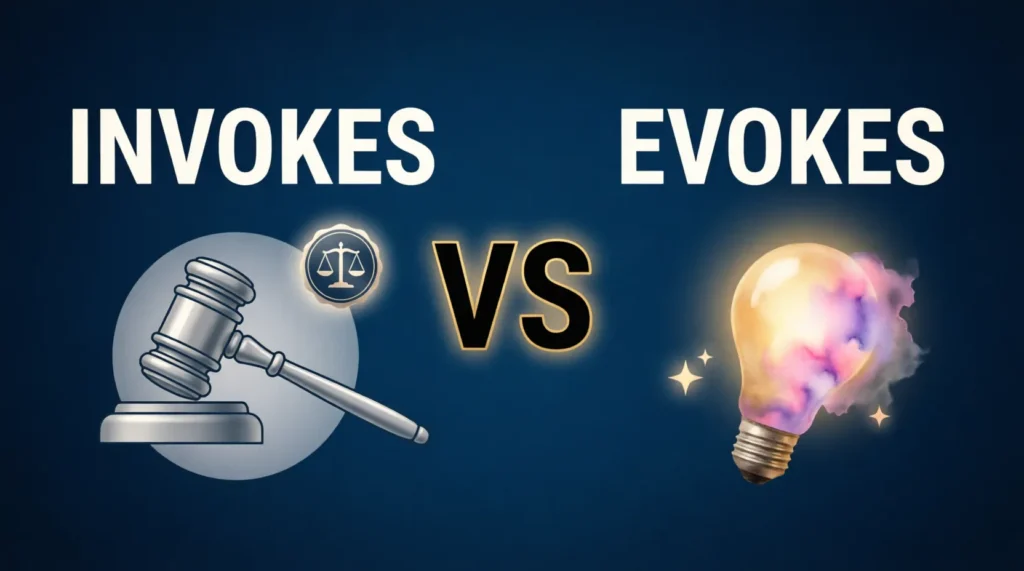
In short, invokes vs evokes are both correct words, but they are not interchangeable. “Invoke” means to call upon something directly, while “evoke” means to bring out feelings, memories, or reactions indirectly. Once you understand the emotional vs action-based difference, you’ll stop mixing them up and write with much more confidence going forward.
The Confusion Around invokes vs evokes
You’re writing an essay, and everything is flowing smoothly—until you hit one sentence. Should you say the scene “invokes emotion” or “evokes emotion”? You pause, your cursor blinks, and suddenly the simplest decision feels uncertain.
If you’ve ever second-guessed yourself over invokes vs evokes, you’re definitely not alone. Even experienced writers hesitate because these words look and sound similar, yet carry very different meanings.
This confusion shows up in emails, blog posts, and academic writing all the time. You might feel like one word is right, but the other somehow seems equally correct. That’s exactly why understanding invokes vs evokes clearly can make your writing instantly more precise and professional.
What Each Word Actually Means
Let’s break it down in a simple, practical way so you can actually use both words correctly in your writing.
Invoke is a verb. It means to call upon something directly—like authority, rules, support, or even a higher power. When you invoke something, you are actively bringing it into effect or requesting it.
Example: “The lawyer invoked a legal precedent to support the argument.”
Here, you can clearly see action. Someone is actively calling on something formal or structured.
Now, evoke is also a verb, but it works very differently. It means to bring out feelings, memories, images, or reactions—usually in an indirect or emotional way.
Example: “The old photograph evoked childhood memories.”
In this case, nothing is being “called upon” directly. Instead, something triggers a feeling inside you.
So when comparing invokes vs evokes, the key difference is simple: one is active and direct, the other is emotional and indirect.
invokes vs evokes: Side-by-Side Comparison
Here is a quick breakdown to make the invokes vs evokes easier to compare at a glance.
Feature
Invokes
Evokes
Meaning
Calls upon or brings into effect
Brings out a feeling or memory
Part of Speech
Verb
Verb
Formality
Neutral to formal
Neutral
Common Context
Law, computing, requests, authority
Emotions, memories, art, writing
Example Sentence
The app invokes the function.
The song evokes childhood memories.
Can They Be Swapped?
Sometimes; meanings differ by context.
Sometimes; meanings differ by context.
Why People Mix Up invokes vs evokes
Language researchers often point out that confusion like invokes vs evokes comes from phonetic similarity. The words sound close, share Latin roots, and appear in similar sentence structures, which makes your brain treat them as interchangeable.
Another reason is context overlap. Both words often appear in writing about emotions, reactions, or abstract ideas. So you might see “invoke emotion” and “evoke emotion” used in different contexts, which adds to the confusion.
Also, your brain tends to rely on pattern recognition when writing quickly. If you’ve seen either word used loosely online, you might unconsciously assume both are correct in all cases. That’s how small misunderstandings turn into repeated writing habits.
The Simple Rule to Remember Which Is Which
Here’s a super easy way to lock this in your memory:
Invoke = In (call in authority or action) Evoke = Emotion (bring out feelings)
Think of it like this: when you invoke something, you are calling it in. When you evoke something, you are pulling something out emotionally from someone.
Now apply that to invokes vs evokes:
“The judge invoked the law.” “The music evoked sadness.” “The speaker invoked tradition.”
Once you see the pattern, your brain starts choosing the correct word automatically, and you stop overthinking it.
Common Mistakes People Make With invokes vs evokes
Using “invoke memories” incorrectly instead of “evoke memories” Wrong: “The smell invoked memories of summer.” Correct: “The smell evoked memories of summer.”
Using “evoke authority” instead of “invoke authority” Wrong: “He evoked his right to remain silent.” Correct: “He invoked his right to remain silent.”
Assuming both words mean “to cause” in every situation Wrong: “The speech invoked strong emotions in the audience.” Correct: “The speech evoked strong emotions in the audience.”
Overusing one word because it “sounds smarter” Wrong: Mixing both randomly in essays without checking meaning Correct: Choosing based on whether it’s emotional (evoke) or formal/action-based (invoke)
Real Sentence Fix — invokes vs evokes
See the Mistake, Fix the Mistake
These are real mistakes people make with invokes vs evokes — and the simple fix for each one.
❌ The new policy evokes company rules during emergencies. ✅ The new policy invokes company rules during emergencies. 📌 Why: Use invokes when something officially calls a rule or authority into action.
❌ That old family photo invokes happy memories. ✅ That old family photo evokes happy memories. 📌 Why: Use evokes when something brings back feelings or memories.
❌ The author invokes a feeling of loneliness throughout the novel. ✅ The author evokes a feeling of loneliness throughout the novel. 📌 Why: Use evokes because the writing creates an emotion in the reader.
❌ This command evokes the backup process automatically. ✅ This command invokes the backup process automatically. 📌 Why: Use invokes when software starts or calls a function or process.
❌ The smell of fresh bread invokes my childhood. ✅ The smell of fresh bread evokes my childhood. 📌 Why: Use evokes because a smell can bring back memories.
❌ The judge evoked a legal precedent before making the decision. ✅ The judge invoked a legal precedent before making the decision. 📌 Why: Use invoked when referring to using a law, rule, or legal authority.
Real-World Examples: invokes vs evokes Used Correctly
“The commander invoked emergency powers during the crisis.” This is correct because it involves formal authority and direct action.
“The film evokes a sense of nostalgia for the 1990s.” This works because it describes emotional response, not direct action.
“She invoked her right to speak during the meeting.” This is correct because rights are being formally called upon.
“The painting evokes feelings of peace and solitude.” This is correct because art triggers emotional response indirectly.
Each example shows how your choice between invokes vs evokes depends on whether you’re dealing with authority or emotion.
British English vs. American English — Does It Affect invokes vs evokes?
Good news: there is no significant difference between British and American English when it comes to invokes vs evokes. Both words are spelled and used the same way across regions.
Linguists generally agree that this is a meaning-based distinction rather than a regional one. So whether you’re writing in London, New York, or Karachi, the rule stays the same.
That means your focus should not be spelling differences, but meaning accuracy—especially whether you are dealing with emotional response or formal action.
What Grammar Checkers and Style Guides Say About invokes vs evokes
Most grammar tools will not flag invokes vs evokes as spelling errors, because both are valid English words. However, they may not always correct misuse if the sentence structure still “looks” acceptable.
Style guides emphasize meaning over automation. In other words, knowing the difference matters more than relying on spellcheck. Grammar experts often highlight this pair as a classic example of semantic confusion rather than spelling confusion.
So while tools can help you catch typos, they cannot reliably understand whether you intended emotional or formal meaning. That’s why your understanding is more important than any software.
invokes vs evokes in Professional and Academic Writing
In professional writing, precision matters more than ever. Using invokes vs evokes incorrectly can subtly change the meaning of your sentence, especially in legal, academic, or business contexts.
For example, invoking a law is completely different from evoking an idea. If you mix them up, your message may feel unclear or even incorrect to a careful reader.
The same applies in academic essays, where clarity and correctness shape your credibility. The good news is that once you fully understand invokes vs evokes, you won’t have to second-guess yourself again—you’ll naturally choose the right word based on meaning.
Quick Recap: invokes vs evokes at a Glance
Invoke = to call upon something directly (authority, rules, rights)
Evoke = to bring out emotions, memories, or images
Invoke is formal and action-based
Evoke is emotional and indirect
They are not interchangeable, even though they sound similar
Frequently Asked Questions About invokes vs evokes
Is it “invoke memories” or “evoke memories”?
It is “evoke memories.” Memories are not formally called upon; they are triggered or brought out emotionally. So when you describe something bringing back the past, evoke is the correct choice.
Can invokes vs evokes ever be used interchangeably?
No, they cannot. Even though they sometimes appear in similar sentences, their meanings are fundamentally different. One deals with authority and action, the other with emotional response.
Why do people confuse invokes vs evokes so often?
People confuse them because they sound similar and often appear in abstract writing. Your brain also associates both with “causing something,” which adds to the confusion.
Is “invoke emotions” ever correct?
Yes, but it is less common and usually refers to deliberately calling upon or using emotion in a formal or rhetorical sense. However, in most natural contexts, “evoke emotions” is preferred.
Which one should I use in essays or professional writing?
Use “invoke” when referring to rules, authority, or formal action. Use “evoke” when referring to feelings, memories, or reactions. Choosing correctly improves clarity and professionalism.
Final Thoughts on invokes vs evokes
The difference between invokes vs evokes comes down to one simple idea: action versus emotion. Once you remember that invoke is about calling something in formally, and evoke is about bringing something out emotionally, the confusion disappears.
This is one of those word pairs that trips up many writers, but now you have a clear, reliable way to handle it. With a bit of practice, you’ll start choosing the right word naturally without hesitation.
And from here on, you can write with more confidence knowing you’ve mastered one of the most commonly confused word pairs in English.
Frequently Asked Questions
What is the main difference between 'invokes' and 'evokes'?▼
The main difference is that ‘invoke’ means to call upon something directly, while ‘evoke’ refers to bringing out feelings, memories, or reactions indirectly. Understanding this distinction can help improve the precision of your writing.
Can 'invokes' and 'evokes' be used interchangeably?▼
They cannot be used interchangeably, as they have different meanings. Context matters; sometimes they may seem similar, but using the wrong word can alter the intended message.
In what contexts is 'invoke' commonly used?▼
‘Invoke’ is typically used in contexts related to law, computing, requests, and authority. For example, you might say, ‘The lawyer invoked a legal precedent to support the argument.’
What are some common mistakes people make with 'invokes' and 'evokes'?▼
Common mistakes include using ‘invoke’ when discussing emotions or memories, which should use ‘evoke’. Many people confuse the words due to their phonetic similarity and overlapping contexts.
How can I remember when to use 'invokes' versus 'evokes'?▼
A simple rule to remember is: ‘Invoke’ relates to calling in authority or action, while ‘Evoke’ is associated with bringing out emotions. Associating ‘Invoke’ with ‘In’ and ‘Evoke’ with ‘Emotion’ can also help solidify your understanding.
Can you provide examples of 'invokes' and 'evokes' in sentences?▼
Sure! An example of ‘invoke’ is, ‘The judge invoked the law.’ In contrast, an example of ‘evoke’ is, ‘The music evoked sadness.’ These examples illustrate the direct action of invoking and the emotional response from evoking.
Why do people often confuse 'invokes' and 'evokes'?▼
People often confuse these terms due to their similar sounds, shared Latin roots, and the contexts in which they appear. This phonetic similarity leads to assumptions that they can be used interchangeably, which is not the case.
Emily Thornton holds a Master’s degree in Linguistics from the University of Chicago and has been passionate about language education for over 15 years. Her interest in language developed at a young age, fueled by a curiosity for how intricacies in language shape communication. Emily has authored several guides on grammar usage and works extensively with ESL learners to improve their fluency and confidence in English. Dedicated to clarity, she writes content that demystifies complex spelling and grammar issues, making her contributions invaluable for professionals looking for authoritative and swift language solutions. Emily continues to explore innovative ways to bridge communication gaps through accurate and effective language use. Her blend of academic rigor and practical insight ensures learners across all levels find her advice beneficial.