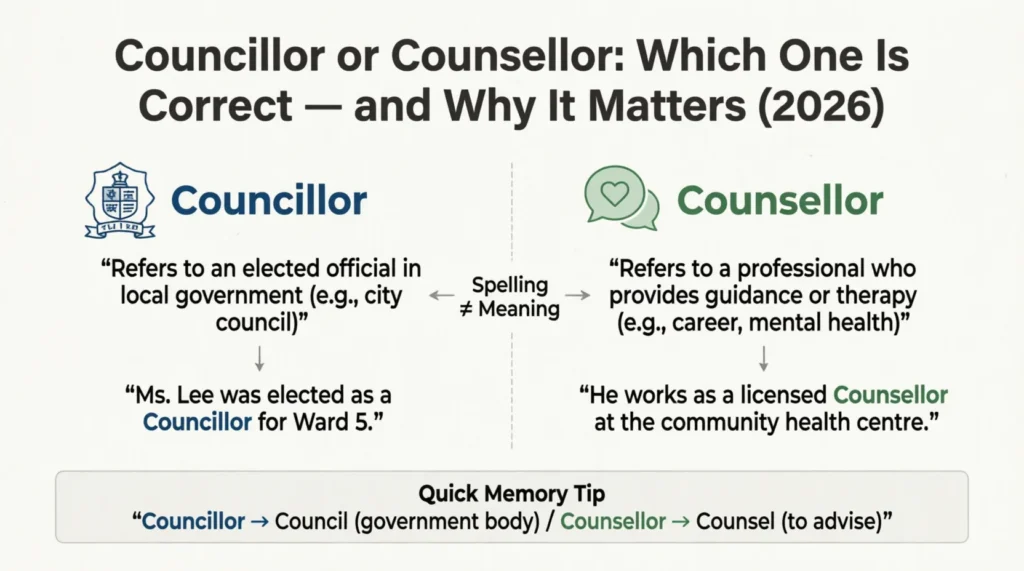
In short, both councillor and counsellor are correct, but they mean completely different things. “Councillor” refers to an elected local government representative, while “counsellor” refers to someone who gives guidance or therapy. Understanding this difference in councillor or counsellor will instantly improve your writing confidence, especially in formal or academic contexts.
The Confusion Around Councillor or Counsellor
You’re writing an email, maybe updating a CV, or finishing a school essay, and suddenly you pause. Is it councillor or counsellor? They sound identical when spoken, but on the page, they feel like they could mean very different things—and they do.
This is exactly where most people get stuck with councillor or counsellor. You’re not alone if you’ve ever second-guessed yourself here. Even confident writers pause because both words look equally “correct.”
The real problem is that English often gives you words that sound the same but serve totally different roles. And when you’re under pressure, your brain tends to pick the one that just looks right.
What Each Word Actually Means
Let’s clear this up in the simplest way possible so you can use both words correctly without hesitation.
A councillor (noun) is an elected member of a local council. They make decisions about public services, community issues, and local policies. You’ll often see this word in politics and government contexts.
Example: The local councillor approved a new park renovation plan for the neighborhood.
A counsellor (noun) is a person who gives advice, emotional support, or professional guidance. This can be a school counsellor, a mental health counsellor, or even a legal or financial advisor in some contexts.
Example: The school counsellor helped students manage exam stress and personal challenges.
When you compare councillor or counsellor, the difference is not pronunciation—it’s meaning and profession. One belongs to governance, the other to guidance and care.
councillor or counsellor: Side-by-Side Comparison
Insert AFTER the “What Each Word Actually Means” section.
Here is a quick breakdown to make the councillor or counsellor easier to compare at a glance.
Feature
Councillor
Counsellor
Meaning
Elected local government member
Person who gives advice or therapy
Part of Speech
Noun
Noun
Formality
Formal
Formal
Common Context
Local councils, politics
Schools, therapy, careers
Example Sentence
The councillor approved the plan.
The counsellor offered helpful advice.
Can They Be Swapped?
No — different jobs
No — different roles
Why People Mix Up Councillor or Counsellor
There are a few very real reasons why this confusion keeps happening, and linguists often point to spelling evolution in English as the main cause.
First, both words come from the same root idea: “counsel,” meaning advice or guidance. Over time, English split the meanings into different professional roles, but the pronunciation stayed almost identical.
Second, regional spelling habits make things worse. British English tends to use double letters in certain words, while American English simplifies them. That makes your brain assume both versions are interchangeable.
Finally, when you’re typing quickly, your mind relies on sound rather than spelling logic. Since councillor or counsellor sounds exactly the same, your fingers often choose whichever version feels more familiar.
The Simple Rule to Remember Which Is Which
Here’s a very easy way to lock this in your memory so you never confuse councillor or counsellor again:
If it involves government or city decisions → use councillor
If it involves advice, emotions, or personal guidance → use counsellor
Think of it this way: a councillor runs council matters, while a counsellor gives counsel (advice).
Example sentences:
The councillor voted on the new housing policy.
My school counsellor helped me choose my subjects.
The city councillor met residents to discuss traffic issues.
Once you connect the word “council” to politics and “counsel” to advice, the confusion disappears quickly.
Common Mistakes People Make With Councillor or Counsellor
Here are some real-world errors people often make when using councillor or counsellor, especially in essays, emails, and job applications:
Using “counsellor” for politics Wrong: The counsellor approved the budget. Correct: The councillor approved the budget.
Using “councillor” for therapy roles Wrong: She works as a councillor at the school. Correct: She works as a counsellor at the school.
Assuming both spellings are interchangeable Wrong: I met a councillor for emotional support. Correct: I met a counsellor for emotional support.
Misspelling due to typing speed Wrong: counsellor written in political context Correct: councillor used when referring to government roles
Each mistake usually comes from rushing or relying on sound instead of meaning. Once you slow down, you naturally choose the correct form.
Feature
Councillor
Counsellor
Meaning
Elected local government member
Person who gives advice or therapy
Part of Speech
Noun
Noun
Formality
Formal
Formal
Common Context
Local councils, politics
Schools, therapy, careers
Example Sentence
The councillor approved the plan.
The counsellor offered helpful advice.
Can They Be Swapped?
No — different jobs
No — different roles
Real Sentence Fix — councillor or counsellor
See the Mistake, Fix the Mistake
Insert AFTER the “Common Mistakes People Make” section.
These are real mistakes people make with councillor or counsellor — and the simple fix for each one.
❌ The school councillor helped me choose my classes. ✅ The school counsellor helped me choose my classes. 📌 Why: A counsellor gives guidance, while a councillor is an elected official.
❌ Our counsellor voted on the new parking rules. ✅ Our councillor voted on the new parking rules. 📌 Why: A councillor makes decisions in local government.
❌ The city hired a new counsellor to represent our neighborhood. ✅ The city hired a new councillor to represent our neighborhood. 📌 Why: A councillor represents people in a local council.
❌ Please email the councillor if you need help with your career plan. ✅ Please email the counsellor if you need help with your career plan. 📌 Why: A counsellor helps with career and personal guidance.
❌ My friend suggested talking to the town counsellor about the broken streetlight. ✅ My friend suggested talking to the town councillor about the broken streetlight. 📌 Why: Problems with local services are handled by a councillor.
❌ The university councillor gave students tips for managing exam stress. ✅ The university counsellor gave students tips for managing exam stress. 📌 Why: A counsellor supports students with advice and wellbeing.
Real-World Examples: Councillor or Counsellor Used Correctly
Here are some clear examples so you can see how councillor or counsellor works in everyday writing:
Casual conversation: “My neighbour is a councillor, so she knows a lot about local road projects.” This is correct because it refers to local government work.
Professional writing: “The counsellor recommended stress management techniques during the session.” This fits because it involves emotional and mental support.
Academic writing: “Research shows that access to a school counsellor improves student wellbeing.” This is correct in an educational and research context.
Creative writing: “The young hero spoke to a wise counsellor before making his decision.” This works because it reflects guidance and advice.
Each sentence shows how meaning—not spelling alone—guides the correct choice.
British English vs. American English — Does It Affect Councillor or Counsellor?
In this case, the difference is not really British vs. American English, but rather meaning-based spelling.
However, British English tends to prefer “counsellor” with double “l” more consistently in advisory roles. American English often uses “counselor” with a single “l” for guidance roles.
Interestingly, “councillor” (political role) remains consistent in British English, while in American English the equivalent is usually “council member” rather than councillor.
So when you’re dealing with councillor or counsellor, the confusion is more about profession than geography.
What Grammar Checkers and Style Guides Say About Councillor or Counsellor
Grammar tools and style guides usually treat these words as completely separate entries. They don’t flag them as interchangeable because context matters more than spelling alone.
Style guides emphasize that meaning must guide your choice. Spellcheck tools may not always catch misuse if the word is spelled correctly but used in the wrong context.
That’s why relying only on autocorrect is risky. You still need to understand whether you’re referring to governance or personal guidance when using councillor or counsellor.
Councillor or Counsellor in Professional and Academic Writing
In professional writing, getting councillor or counsellorright is more important than it first appears. A single wrong word can change the entire meaning of a sentence.
If you’re writing a CV, using “councillor” instead of “counsellor” could make it look like you worked in politics instead of mental health or education. That can confuse employers.
In academic writing, precision matters even more. You want your reader to trust your clarity and attention to detail. Using the correct form shows you understand both language and context.
The good news is that once you fully understand this difference, you rarely make the mistake again.
Quick Recap: Councillor or Counsellor at a Glance
Councillor = elected government representative
Counsellor = advisor or therapist
Sound is identical, but meaning is completely different
Context always decides the correct spelling
Confusion is common but easy to fix with practice
Frequently Asked Questions About Councillor or Counsellor
Is councillor or counsellor the correct spelling?
Both are correct, but they are used in different contexts. “Councillor” refers to a government role, while “counsellor” refers to someone who gives advice or therapy. Choosing the right one depends entirely on meaning.
Can counsellor and councillor be used interchangeably?
No, they cannot. Even though they sound the same, they describe completely different jobs. Using them interchangeably can change the meaning of your sentence and confuse readers.
What is the difference between a counsellor and a therapist?
A counsellor typically provides guidance and support for emotional or life issues, while a therapist may focus more on clinical mental health treatment. However, the terms sometimes overlap depending on the country.
Why do councillor and counsellor sound the same?
They are homophones, meaning they share pronunciation but differ in spelling and meaning. This happens often in English due to historical language changes and shared word roots.
How can I remember councillor or counsellor easily?
Link “councillor” with “council” (government) and “counsellor” with “counsel” (advice). That simple connection makes it much easier to choose the correct word every time.
Final Thoughts on Councillor or Counsellor
The confusion between councillor or counsellor is one of the most common in English, but it becomes simple once you focus on meaning instead of sound. One word belongs to government, and the other belongs to guidance and support.
Now that you understand the difference clearly, you can use both words with confidence in emails, essays, and professional writing. And more importantly, you won’t have to second-guess yourself the next time you see them.
You’ve now got a clear, practical understanding that will make your writing more accurate and confident going forward.
Frequently Asked Questions
What is the difference between a councillor and a counsellor?▼
A councillor is an elected member of a local government council, responsible for making decisions about public services and community issues. In contrast, a counsellor provides advice or therapy, helping individuals manage personal challenges or emotional support.
Why do people often confuse councillor and counsellor?▼
The confusion arises mainly due to the similar pronunciation of both words, despite their different meanings. Additionally, regional spelling differences and the shared root meaning of ‘counsel’ contribute to this mix-up.
Can councillor and counsellor be used interchangeably?▼
No, they cannot be swapped as they represent entirely different roles and professions. A councillor deals with governance while a counsellor focuses on guidance and emotional support.
What are some common contexts for using the word councillor?▼
Councillor is typically used in political and local government contexts, such as discussing community issues or public policy decisions. For example, you might say, ‘The local councillor approved a new park renovation plan for the neighborhood.’
In what situations would I use the term counsellor?▼
The term counsellor is used in contexts involving advice and emotional support, such as educational, therapeutic, or career-related settings. For instance, you might say, ‘The school counsellor helped students manage exam stress and personal challenges.’
How can I remember which term to use?▼
A simple rule is to remember that if it involves government or city decisions, you should use ‘councillor.’ If it pertains to advice, emotions, or personal guidance, then ‘counsellor’ is the correct choice.
What are examples of common mistakes people make with these terms?▼
Common mistakes include using ‘councillor’ when referring to someone providing emotional support, or the reverse. It’s important to focus on the context of governance versus guidance to avoid these errors.
James Williams has been fascinated by the intricacies of the English language since his childhood days. Holding a Master’s degree in Linguistics from the University of Cambridge, he has spent over 15 years working as a professional editor and language consultant. James specializes in deciphering complex spelling and grammatical issues, and he is passionate about helping students and professionals alike gain confidence in their writing. His experience includes developing educational content for ESL learners, ensuring clarity and precision in communication. James is dedicated to providing readers with easy-to-follow guidance that resolves word confusions and common spelling errors, making WordlyRight an essential resource for anyone who needs quick, authoritative answers.