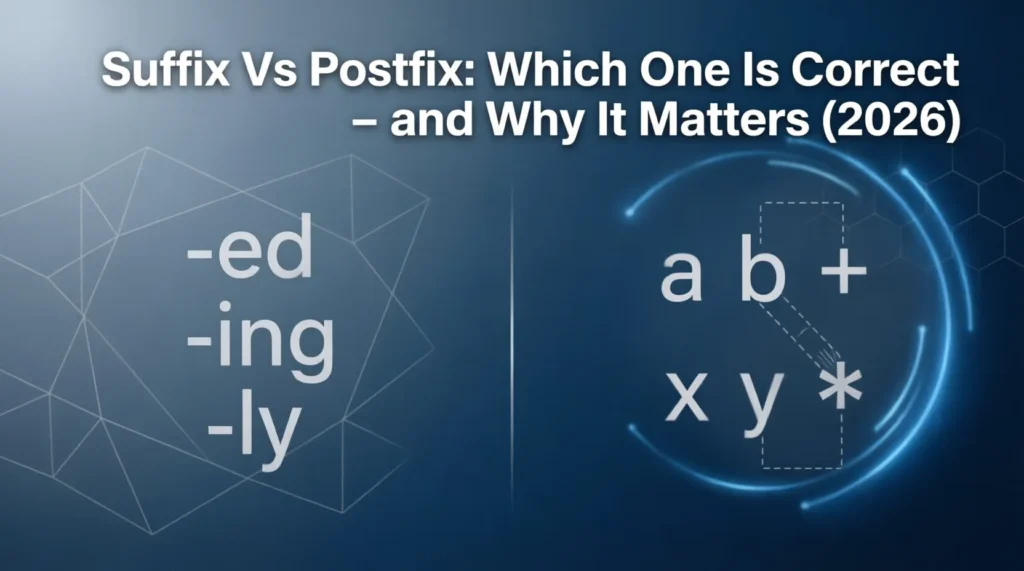
In short, suffix and postfix are both correct, but they are used in completely different contexts. A suffix is a linguistic element added to the end of a word, while postfix is a technical term used mainly in mathematics and programming to describe notation or placement after a value. Understanding the difference will help you write more accurately and confidently in both academic and technical situations.
The Confusion Around suffix vs postfix
You are writing an essay or coding notes, and suddenly you pause. Should you say suffix or postfix? It feels like both mean “something at the end,” so you hesitate. This moment of doubt is exactly where most people get stuck with suffix vs postfix.
You might see both words online, in textbooks, or even in programming tutorials, and assume they are interchangeable. That assumption is where the confusion begins. Even experienced writers and students often mix them up when switching between language study and technical subjects.
The truth is, your confusion is completely normal. The English language borrows heavily across fields, and when two words feel similar in meaning, your brain naturally treats them as identical—even when they are not.
What Each Word Actually Means
To fully understand suffix vs postfix, you need to separate language rules from technical terminology.
A suffix is a noun in linguistics. It refers to a letter or group of letters added to the end of a word to change its meaning or grammatical function. For example, in the word “happiness,” the “-ness” is a suffix that turns an adjective into a noun. You use suffixes every day in writing without even noticing it.
Example sentence: You can change “happy” into “happiness” by adding a suffix.
A postfix, on the other hand, is a noun used in mathematics and computer science. It refers to a notation where the operator comes after the operands, also known as postfix notation or reverse Polish notation. It is not used in general English grammar.
Example sentence: In programming, the expression “3 4 +” uses postfix notation instead of traditional infix notation.
So when comparing suffix vs postfix, you are not comparing two versions of the same idea—you are comparing two different fields entirely: linguistics and computing.
suffix vs postfix: Side-by-Side Comparison
Insert AFTER the “What Each Word Actually Means” section
Here is a quick breakdown to make the suffix vs postfix easier to compare at a glance.
Feature
Suffix
Postfix
Meaning
Ending added to a word
Operator placed after an operand
Part of Speech
Noun
Noun
Formality
Neutral
Neutral
Common Context
Grammar, spelling, linguistics
Programming, computer science
Example Sentence
-ness is a common suffix.
Use the postfix increment operator.
Can They Be Swapped?
No
No — they belong to different fields.
Why People Mix Up suffix vs postfix
The confusion around suffix vs postfix comes mainly from how similar the ideas feel, even though they belong to different disciplines.
Both words suggest something that comes “after” or “at the end,” and your brain naturally groups them together. Language researchers explain that this is a classic case of semantic overlap, where two terms share a directional concept but not a functional meaning.
Another reason is exposure. You might learn about suffixes in school English classes and encounter postfix later in programming or math. Because both describe “end placement,” your memory blends them together, even though they operate in separate systems.
Finally, the structure of the words themselves adds to the confusion. “Suffix” and “postfix” look and sound similar, which makes it easier for your brain to assume they are interchangeable when they are not.
The Simple Rule to Remember Which Is Which
Here is an easy way to permanently separate suffix vs postfix in your mind:
If you are talking about words and grammar, use suffix.
If you are talking about math or programming, use postfix.
Think of it like this: “suffix sticks to words, postfix sticks to formulas.”
If you apply that mental shortcut, you will rarely make mistakes again.
Example sentences:
You can identify a suffix when you see “-ed” added to a verb like “walked.” In programming, you may evaluate expressions using postfix notation for faster computation. When you are analyzing English vocabulary, you are always dealing with suffix, not postfix.
Common Mistakes People Make With suffix vs postfix
You write “postfix” when discussing English grammar: You might say “-ing is a postfix,” but the correct term is “suffix.”
You use “suffix” in programming contexts: Saying “this is a suffix expression” is incorrect; it should be “postfix expression.”
You assume both words are interchangeable: This leads to confusion in academic writing where precision matters.
You rely on intuition instead of context: You guess based on meaning rather than subject area, which often leads you astray.
Real-World Examples: suffix vs postfix Used Correctly
Real Sentence Fix — suffix vs postfix
See the Mistake, Fix the Mistake
Insert AFTER the “Common Mistakes People Make” section
These are real mistakes people make with the suffix vs postfix — and the simple fix for each one.
❌ The app uses a suffix operator to increase the value after the line runs. ✅ The app uses a postfix operator to increase the value after the line runs. 📌 Why: A postfix operator is a programming term, while a suffix belongs to words.
❌ Please remove the postfix -ing from this document before printing. ✅ Please remove the suffix -ing from this document before printing. 📌 Why: -ing is a word ending, so it is called a suffix.
❌ The teacher asked us to list five postfixes in English. ✅ The teacher asked us to list five suffixes in English. 📌 Why: English word endings are called suffixes, not postfixes.
❌ That word has a strange postfix at the end. ✅ That word has a strange suffix at the end. 📌 Why: A word ending in language is called a suffix.
❌ The code failed because I used the suffix increment operator. ✅ The code failed because I used the postfix increment operator. 📌 Why: In programming, an operator after a value is called postfix.
❌ My friend said -less is her favorite postfix. ✅ My friend said -less is her favorite suffix. 📌 Why: -less is a word ending used in English, so it is a suffix.
In casual learning: You add “-ly” as a suffix to turn “quick” into “quickly.” This is correct because you are working with English word formation.
In programming documentation: The calculator evaluates expressions using postfix notation for efficiency. This is correct because it refers to computational structure.
In academic writing: The study of morphology explains how a suffix modifies meaning within a word. This is correct because it describes linguistic rules.
In creative explanation: Think of a suffix as a small tag that attaches to the end of a word to change its role. This is correct because it simplifies grammar for understanding.
Each example works because you are matching the term to its proper field of use, not just its general meaning.
British English vs. American English — Does It Affect suffix vs postfix?
There is no meaningful British or American English variation when it comes to suffix vs postfix. Both terms are standardized across regions and used in the same way in academic and technical contexts.
Unlike spelling differences such as “colour” vs “color,” this confusion is not regional—it is conceptual. People worldwide struggle with suffix vs postfix for the same reason: the overlap in how the words feel, not how they are spelled.
So no matter where you are writing from, the rule stays the same. Context, not geography, determines the correct word.
What Grammar Checkers and Style Guides Say About suffix vs postfix
Most grammar tools correctly identify suffix-related usage in English writing, but they do not always flag misuse when you confuse suffix vs postfix in technical contexts. That is because postfix is not a grammar error—it is a valid technical term.
Style guides emphasize that context is everything. If you are writing linguistics content, suffix is expected. If you are writing computational expressions, postfix is correct.
This means you cannot rely entirely on automated tools. You need to understand the underlying rule yourself, because context determines correctness more than spelling alone.
suffix vs postfix in Professional and Academic Writing
In professional and academic settings, using suffix vs postfix correctly shows that you understand your subject deeply. If you misuse them, it can create confusion or signal a lack of precision in your writing.
For example, in a linguistics paper, using “postfix” instead of “suffix” may make your argument unclear. In a computer science assignment, using “suffix” instead of “postfix notation” may suggest you are unfamiliar with core concepts.
The good news is that once you clearly understand the distinction, you will rarely hesitate again. You will start choosing the correct term automatically, especially when you are aware of the subject you are working in.
Quick Recap: suffix vs postfix at a Glance
Suffix belongs to linguistics and word formation
Postfix belongs to mathematics and programming notation
They are not interchangeable in any context
Confusion comes from similar meaning of “end position”
Context is the only reliable way to choose correctly
Frequently Asked Questions About suffix vs postfix
Is postfix the same as suffix?
No, postfix and suffix are not the same. A suffix is used in language to modify words, while postfix is used in mathematics and programming to describe a type of notation. They may feel similar, but they belong to completely different fields.
When should I use suffix instead of postfix?
You should use suffix when you are dealing with grammar, spelling, or word formation in English. If you are analyzing how words change their meaning or structure, suffix is the correct term.
What is an example of postfix notation?
A simple example of postfix notation is writing “3 4 +” instead of “3 + 4.” The operator comes after the numbers, which is why it is called postfix.
Why do suffix vs postfix get confused so often?
They are confused because both relate to something coming at the end. However, linguists and technical experts stress that they serve completely different purposes in language and computation.
Is postfix used in everyday English?
No, postfix is not used in everyday English conversation. It is mainly used in mathematics, programming, and computational theory, while suffix is part of everyday language.
Final Thoughts on suffix vs postfix
The key distinction in suffix vs postfix is simple once you see it clearly: one belongs to language structure, and the other belongs to technical notation systems. That single idea removes most of the confusion instantly.
This is one of those word pairs that looks tricky at first but becomes effortless once you understand the context rule. You are now equipped to choose correctly every time, whether you are writing an essay or studying programming concepts.
With this clarity, you will no longer second-guess yourself—you will simply know which term fits, and your writing will feel more precise and confident going forward.
Frequently Asked Questions
What is the primary difference between a suffix and a postfix?▼
A suffix is a linguistic element added to the end of a word to alter its meaning or grammatical function, while a postfix is a technical term used in mathematics and programming to describe a notation where the operator comes after the operands.
Can suffix and postfix be used interchangeably?▼
No, suffix and postfix cannot be swapped as they belong to different fields. Suffixes are used in grammar and linguistics, while postfixes are specific to programming and mathematical notation.
Why do people often confuse suffix and postfix?▼
The confusion arises because both terms suggest something that comes ‘after’ or ‘at the end,’ leading to semantic overlap. Furthermore, their similar structure and sound can make it easy for people to assume they mean the same thing.
Can you provide an example sentence using a suffix?▼
Certainly! An example sentence would be: ‘You can change the word ‘happy’ into ‘happiness’ by adding the suffix ‘-ness’ to it.’ This illustrates how suffixes function in language.
What is an example of postfix notation in programming?▼
In programming, an example of postfix notation is the expression ‘3 4 +’ which indicates that you add 3 and 4 together after stating the numbers. This is different from traditional infix notation where the operator is placed between the operands.
How does understanding the difference between suffix and postfix help in writing?▼
Understanding the difference allows you to use the correct terminology in both academic and technical contexts, enhancing your clarity and confidence in writing. It helps to avoid confusion when switching between subjects like linguistics and computer science.
What should I remember to distinguish between suffix and postfix?▼
A simple rule to remember is that a suffix relates to language and grammar, while a postfix pertains to programming and mathematics. Keeping their respective fields in mind will help you differentiate between the two.
Quick Tip: Spotting Suffixes vs Postfix Operators Fast
If you are editing a document, you almost always want “suffix” — it is the grammar term (like -ing or -ed). If you are reading code or a calculator manual, “postfix” is the one you want, since it describes an operator placed after its operands (like Reverse Polish Notation). A fast mental check: does the sentence involve letters and words, or numbers and operators? Letters and words → suffix. Numbers and operators → postfix.
Emily Thornton holds a Master’s degree in Linguistics from the University of Chicago and has been passionate about language education for over 15 years. Her interest in language developed at a young age, fueled by a curiosity for how intricacies in language shape communication. Emily has authored several guides on grammar usage and works extensively with ESL learners to improve their fluency and confidence in English. Dedicated to clarity, she writes content that demystifies complex spelling and grammar issues, making her contributions invaluable for professionals looking for authoritative and swift language solutions. Emily continues to explore innovative ways to bridge communication gaps through accurate and effective language use. Her blend of academic rigor and practical insight ensures learners across all levels find her advice beneficial.