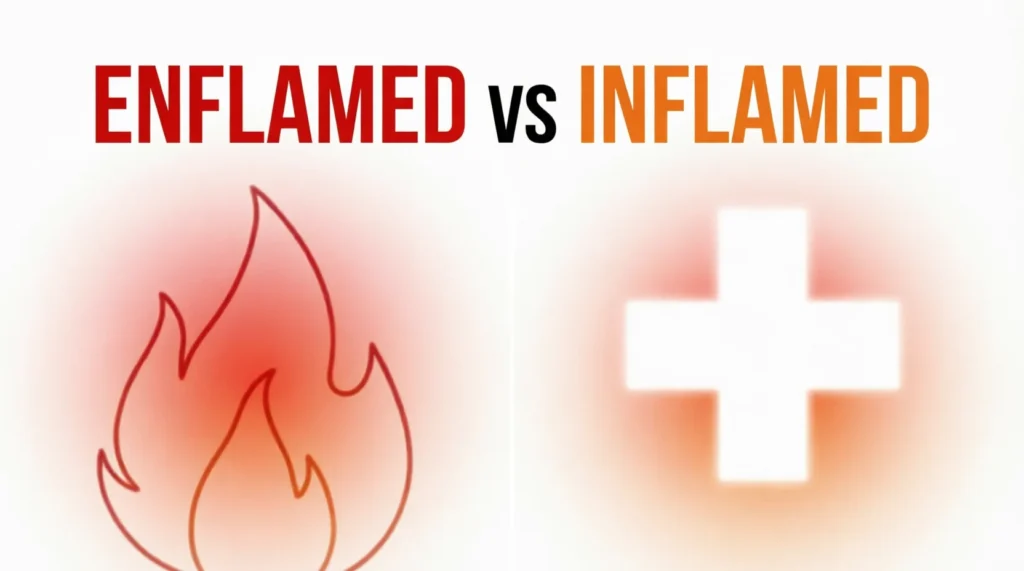
In short, both “enflamed” and “inflamed” are real words, but inflamed is far more common and is usually the preferred choice in modern English. While both can mean “made red, swollen, irritated, or emotionally stirred up,” understanding when and why each appears will help you write with greater confidence.
The Confusion Around Enflamed or Inflamed
Imagine you’re writing a school essay, a medical report, or even a blog post about a health condition. You type a sentence about a swollen joint and suddenly pause: should it be “enflamed” or “inflamed”?
You’re not alone. The confusion around enflamed or inflamed catches many writers off guard because both words look legitimate, sound similar, and seem to express the same idea.
Even experienced writers sometimes stop to double-check. The good news is that once you understand the relationship between these two words, the choice becomes much easier.
What Each Word Actually Means
Let’s start with the word most people encounter regularly.
Inflamed
“Inflamed” is the past participle and adjective form of the verb “inflame.” It describes something that has become irritated, swollen, red, or intensely emotional.
You will often see it in medical, scientific, and everyday writing.
Example:
“The patient’s throat was inflamed after the infection.”
You can also use it figuratively.
Example:
“The controversial speech inflamed tensions within the community.”
enflamed or inflamed: Side-by-Side Comparison
Here is a quick breakdown to make Enflamed or Inflamed easier to compare at a glance.
Feature
enflamed
inflamed
Meaning
Variant of inflamed; less common
Swollen, irritated, or intensely angry
Part of Speech
Adjective, past participle
Adjective, past participle
Formality
Less common, less preferred
Neutral and standard
Common Context
Older or literary writing
Medical, everyday, and figurative writing
Example Sentence
The speech enflamed the crowd.
Her ankle became inflamed overnight.
Can They Be Swapped?
Sometimes
Sometimes — inflamed is usually preferred today.
Enflamed
“Enflamed” is also a real word. It comes from the verb “enflame,” which means to set on fire, excite strongly, or arouse intense feelings.
Example:
“The speech enflamed the crowd’s emotions.”
However, modern English overwhelmingly favors “inflame” and “inflamed.” As a result, “enflamed” appears much less frequently and may seem unusual or old-fashioned to many readers.
When discussing physical inflammation, such as a swollen knee or irritated skin, “inflamed” is almost always the preferred choice.
Why People Mix Up Enflamed or Inflamed
The confusion exists because the words are closely related in meaning and history. Both developed from roots connected to fire and burning.
Language researchers note that English contains many pairs beginning with “en-” and “in-” that developed over centuries. In some cases, both forms survived even though one eventually became more popular.
Another reason is pronunciation. In everyday speech, “enflamed” and “inflamed” sound extremely similar. If you’ve only heard the words spoken and haven’t seen them written often, it’s easy to assume either spelling is interchangeable.
Linguists also point out that many people recognize the verb “inflame” but are less familiar with “enflame.” Since both exist, spellcheck may not always alert you when you’ve chosen the less common form.
The Simple Rule to Remember Which Is Which
Here’s the easiest rule:
If you’re talking about swelling, irritation, redness, infection, or medical inflammation, use “inflamed.”
Think of it this way: doctors, medical journals, and health professionals almost always write “inflamed.”
Examples:
“The athlete’s knee became inflamed after the game.”
“The dentist noticed inflamed gums during the examination.”
“Her skin looked inflamed after the allergic reaction.”
When discussing strong emotions, either word can technically work, but “inflamed” remains the more common and natural choice for most modern readers.
Common Mistakes People Make With Enflamed or Inflamed
Writing “The doctor diagnosed an enflamed appendix.” This sounds unusual in modern medical writing. Correct version: “The doctor diagnosed an inflamed appendix.”
Assuming “enflamed” is a misspelling. It is actually a real word, just much less common. Correct understanding: Both exist, but inflamed is usually preferred.
Using the words differently when they mean the same thing. In many contexts, both can express strong emotional arousal. Correct approach: Choose inflamed unless you have a specific stylistic reason to use enflamed.
Trusting spellcheck alone. Since both words are legitimate, spelling tools may not flag the less suitable choice. Correct approach: Consider the context, especially in medical writing.
Real Sentence Fix — enflamed or inflamed
See the Mistake, Fix the Mistake
These are real mistakes people make with enflamed or inflamed — and the simple fix for each one.
❌ The doctor said my knee was enflamed after the fall. ✅ The doctor said my knee was inflamed after the fall. 📌 Why: Inflamed is the standard word in modern medical writing.
❌ The manager reported that customer complaints were enflamed by the delay. ✅ The manager reported that customer complaints were inflamed by the delay. 📌 Why: Business writing usually prefers the standard spelling inflamed.
❌ The article explains how polluted air can leave the lungs enflamed. ✅ The article explains how polluted air can leave the lungs inflamed. 📌 Why: Academic writing almost always uses inflamed.
❌ The software update enflamed users after it removed the feature. ✅ The software update inflamed users after it removed the feature. 📌 Why: Inflamed is the more common choice for making people angry.
❌ My skin feels enflamed after being in the sun all day. ✅ My skin feels inflamed after being in the sun all day. 📌 Why: Everyday health discussions normally use inflamed.
❌ That comment really inflamed my finger after I cut it. ✅ That cut really inflamed my finger. 📌 Why: A comment cannot make a finger swell, but a cut can.
Real-World Examples: Enflamed or Inflamed Used Correctly
Casual conversation: “My ankle is still inflamed from yesterday’s hike.” Here, inflamed clearly refers to physical swelling and irritation.
Professional writing: “The investigation inflamed public concern about workplace safety.” The word describes emotions becoming stronger or more intense.
Academic writing: “Researchers observed inflamed tissue around the affected area.” Scientific and academic contexts strongly favor inflamed.
Creative writing: “The unfair accusation inflamed his anger until he could barely speak.” The figurative use highlights rising emotions and intensity.
These examples show why inflamed dominates modern English across a wide range of situations.
British English vs. American English — Does It Affect Enflamed or Inflamed?
Unlike some spelling debates, enflamed or inflamed is not primarily a British-versus-American English issue.
Writers in both the United States and the United Kingdom overwhelmingly prefer “inflamed” in contemporary usage. The same pattern appears in Canada, Australia, and other English-speaking regions.
Because the difference is not regional, readers worldwide tend to experience the same uncertainty. The confusion comes from the existence of two valid but unevenly used words rather than from national spelling conventions.
What Grammar Checkers and Style Guides Say About Enflamed or Inflamed
Most grammar experts and style guides recognize both words as correct. However, they generally favor the form that readers encounter most often: inflamed.
Autocorrect and spellcheck tools may not always help because “enflamed” is not technically wrong. A document can pass every spelling check while still using the less expected word.
This is one reason style guides emphasize context and audience awareness. Knowing the distinction yourself is more reliable than depending entirely on software.
Enflamed or Inflamed in Professional and Academic Writing
In professional and academic settings, word choice affects clarity. Readers expect familiar language, especially when discussing medicine, science, healthcare, law, or research.
If you write “enflamed tissue” in a medical paper, your audience will probably understand you. Still, many readers may pause because they expected “inflamed tissue” instead.
Precision matters in every field. In translated documents, scholarly writing, and cross-cultural communication, choosing the most widely recognized term helps prevent confusion.
The encouraging news is that this is an easy distinction to master. Once you know that inflamed is the standard modern choice in most contexts, you’ll rarely hesitate again.
Quick Recap: Enflamed or Inflamed at a Glance
Both “enflamed” and “inflamed” are real English words.
“Inflamed” is far more common in modern usage.
Medical and scientific writing almost always uses “inflamed.”
“Enflamed” often sounds old-fashioned or uncommon to modern readers.
When in doubt, choose inflamed.
Frequently Asked Questions About Enflamed or Inflamed
Is enflamed a real word?
Yes. Enflamed is a legitimate English word derived from the verb “enflame.” However, it is much less common than inflamed in modern writing and speech.
Which is more correct: enflamed or inflamed?
Neither is inherently more correct because both exist in standard English. However, inflamed is the preferred and expected form in most modern contexts, especially medical ones.
Why do doctors use inflamed instead of enflamed?
Medical professionals overwhelmingly use inflamed because it has become the standard term in healthcare and scientific communication. Readers immediately recognize and understand it.
Can enflamed and inflamed mean the same thing?
Yes. In many situations, they share similar meanings related to irritation, excitement, or heightened emotion. The main difference is frequency of use rather than meaning.
Should I avoid using enflamed?
You do not have to avoid it entirely. However, if your goal is clarity and modern style, inflamed is usually the safer and more natural choice for your audience.
Final Thoughts on Enflamed or Inflamed
The answer to enflamed or inflamed is surprisingly simple: both words are valid, but inflamed is the standard choice in modern English. It is the form most readers expect, especially when discussing medical conditions, irritation, swelling, or strong emotions.
If you’ve ever paused while writing and wondered which version belonged in your sentence, you’re in good company. This is a common point of confusion because both words have legitimate historical roots and similar meanings.
Now that you understand the difference, you can choose confidently. The next time you encounter enflamed or inflamed, you’ll know exactly which word fits your audience and purpose.
Frequently Asked Questions
What is the main difference between 'enflamed' and 'inflamed'?▼
‘Inflamed’ is the more commonly used term in modern English, describing something that is swollen, irritated, or intensely emotional. ‘Enflamed’ is a variant that is less common and often considered old-fashioned, though it also relates to the idea of excitement or strong emotions.
In what contexts should I use 'inflamed'?▼
‘Inflamed’ should be used when discussing physical conditions like swelling or irritation, such as in medical writing. For example, you might say, ‘The patient’s throat was inflamed,’ which aligns with its common usage in health-related contexts.
Can 'enflamed' and 'inflamed' be used interchangeably?▼
They can sometimes be used interchangeably, but ‘inflamed’ is generally preferred in modern contexts, especially in medical writing. Using ‘enflamed’ in such contexts may sound unusual to most readers.
Why do people confuse 'enflamed' with 'inflamed'?▼
The confusion arises because both words are closely related in meaning and sound very similar when spoken. Additionally, many people are more familiar with ‘inflame’ than ‘enflame’, leading to uncertainty about which term to use.
What are some common mistakes people make with these words?▼
A common mistake is using ‘enflamed’ in medical contexts, such as saying ‘The doctor diagnosed an enflamed appendix,’ which sounds awkward. The correct usage would be ‘inflamed,’ as it is the standard term health professionals prefer.
Is there a simple rule to remember which word to use?▼
Yes, a simple rule is to use ‘inflamed’ when discussing swelling, irritation, or redness related to medical conditions. For strong emotions, either word can work, but ‘inflamed’ is usually the more natural choice.
Where does the word 'enflamed' come from?▼
‘Enflamed’ comes from the verb ‘enflame,’ which means to excite strongly or arouse intense feelings. Despite its legitimate usage, it has fallen out of favor in contemporary writing compared to ‘inflamed’.
James Williams has been fascinated by the intricacies of the English language since his childhood days. Holding a Master’s degree in Linguistics from the University of Cambridge, he has spent over 15 years working as a professional editor and language consultant. James specializes in deciphering complex spelling and grammatical issues, and he is passionate about helping students and professionals alike gain confidence in their writing. His experience includes developing educational content for ESL learners, ensuring clarity and precision in communication. James is dedicated to providing readers with easy-to-follow guidance that resolves word confusions and common spelling errors, making WordlyRight an essential resource for anyone who needs quick, authoritative answers.