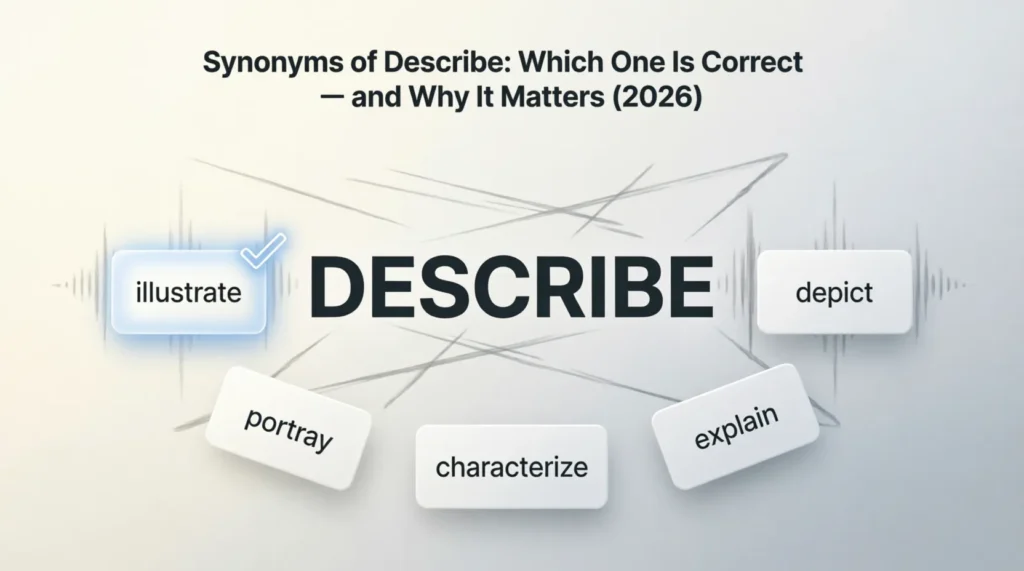
In short, “synonyms of describe” refers to words that can replace “describe” depending on your context, tone, and purpose. While many people use these words interchangeably, each synonym carries a slightly different meaning, and understanding those differences can make your writing much clearer and more natural.
The Confusion Around Synonyms of Describe
You are halfway through an essay, trying not to repeat the same word over and over. You already used “describe” three times in one paragraph, so you pause and search for synonyms of describe. Suddenly, you find dozens of options like “explain,” “outline,” “portray,” and “depict” — but which one actually fits?
The confusion is incredibly common. Students, bloggers, professionals, and even experienced writers often struggle with choosing the right synonym because many of these words seem similar at first glance.
You may also notice that some synonyms sound more formal, while others feel casual or creative. That tiny difference can completely change how your sentence feels to the reader.
What Each Word Actually Means
The verb “describe” means to explain what someone or something is like using words. You use it when you want to give details, paint a picture, or help another person understand something more clearly.
Example: “She described the restaurant as cozy and quiet.”
When people search for synonyms of describe, they usually encounter several common alternatives. Each one works differently.
“Explain” is a verb used when you want to make something understandable, especially an idea or process.
Example: “The teacher explained the math problem step by step.”
“Depict” is often used in art, literature, or visual storytelling. It means to show or represent something vividly.
Example: “The novel depicts life in a small village.”
“Portray” is similar to “depict,” but it often focuses on character or emotion.
Example: “The actor portrayed the historical figure beautifully.”
“Outline” means to give the main points without too much detail.
Example: “The manager outlined the project goals during the meeting.”
“Illustrate” can mean to explain something with examples or visuals.
Example: “The speaker illustrated her point with a real-life story.”
“Characterize” means to describe the distinctive features of someone or something.
Example: “Researchers characterized the climate as extremely dry.”
These words are all related to “describe,” but they are not perfectly interchangeable. Grammar experts often point out that choosing the wrong synonym can make your sentence sound awkward or unclear.
synonyms of describe: Side-by-Side Comparison
Here is a quick breakdown to make the synonyms of describe easier to compare at a glance.
Feature
Describe
Explain
Meaning
Give details about something
Tell why or how something works
Part of Speech
Verb
Verb
Formality
Neutral
Neutral
Common Context
Stories, reports, observations
Instructions, reasons, teaching
Example Sentence
Please describe the scene.
Please explain the process.
Can They Be Swapped?
Sometimes
Sometimes — depends on details or reasons
Why People Mix Up Synonyms of Describe
One reason people struggle with synonyms of describe is that English contains many overlapping verbs. Several words can seem correct in the same sentence, even though one fits better than the others.
For example, “describe,” “explain,” and “illustrate” all involve giving information. But linguists note that each one focuses on a different goal. “Describe” paints a picture, “explain” clarifies meaning, and “illustrate” supports understanding with examples.
Another reason is repetition anxiety. Many writers worry about using the same word too often, so they replace “describe” with random alternatives without checking the exact meaning. That can accidentally change the tone of the sentence.
Language researchers also explain that readers learn words through context, not strict dictionary definitions. Because you may have seen these synonyms used in similar situations, your brain naturally groups them together — even when subtle differences exist.
The Simple Rule to Remember Which Is Which
Here is the easiest trick:
Use “describe” when you are telling what something is like. Use a synonym only if you need a more specific purpose.
If you are:
Clarifying an idea → use “explain”
Creating imagery → use “depict” or “portray”
Giving main points → use “outline”
Using examples → use “illustrate”
That simple logic test helps you choose naturally instead of guessing.
Examples:
“Can you describe the room?” works because you are asking what it looks like.
“Can you explain the instructions?” works because you want understanding, not imagery.
“The painting depicts a stormy sea.” works because the focus is visual representation.
Once you connect each synonym to a purpose, the confusion becomes much easier to manage.
Common Mistakes People Make With Synonyms of Describe
Using “explain” when talking about appearance. Incorrect: “She explained her new dress.” Correct: “She described her new dress.”
Using “outline” when detailed information is needed. Incorrect: “The witness outlined the suspect’s face in detail.” Correct: “The witness described the suspect’s face in detail.”
Using “depict” in casual everyday conversation where it sounds too formal. Incorrect: “Can you depict your weekend plans?” Correct: “Can you describe your weekend plans?”
Replacing “describe” with a synonym just to avoid repetition, even when “describe” is still the best choice. Incorrect: “The guide portrayed the hotel amenities.” Correct: “The guide described the hotel amenities.”
Real Sentence Fix — synonyms of describe
See the Mistake, Fix the Mistake
These are real mistakes people make with the synonyms of describe — and the simple fix for each one.
❌ Please describe why the system crashed. ✅ Please explain why the system crashed. 📌 Why: Explain is the better choice when giving reasons.
❌ Can you explain your new backpack? ✅ Can you describe your new backpack? 📌 Why: Describe is used to give details about how something looks or feels.
❌ The report describes how climate change happens. ✅ The report explains how climate change happens. 📌 Why: Use explain when showing how something works.
❌ Describe the error message so I know why the app failed. ✅ Describe the error message so I know what it says. 📌 Why: Describe tells what something is like, not why it happened.
❌ She explained the beautiful sunset in her journal. ✅ She described the beautiful sunset in her journal. 📌 Why: A sunset is usually described with details, not explained.
❌ The teacher asked us to explain the main character’s appearance. ✅ The teacher asked us to describe the main character’s appearance. 📌 Why: Appearance is best presented with descriptive details.
Real-World Examples: Synonyms of Describe Used Correctly
Casual conversation: “Can you describe the movie without spoilers?” This works because the speaker wants details and impressions.
Professional writing: “The report outlines the company’s long-term strategy.” “Outline” fits because the document summarizes key points instead of giving every detail.
Academic writing: “The study illustrates how sleep affects memory.” “Illustrates” works well because the research provides evidence and examples.
Creative writing: “The poem depicts the loneliness of winter.” “Depicts” creates a more artistic and emotional tone than “describes.”
These examples show why context matters so much. The best synonym depends on what you are actually trying to communicate.
British English vs. American English — Does It Affect Synonyms of Describe?
Unlike some spelling debates in English, synonyms of describe are not mainly a British-versus-American issue. Both forms of English use words like “describe,” “depict,” “illustrate,” and “outline” in largely the same way.
However, style preferences can vary slightly. British academic writing sometimes favors more formal verbs like “portray” or “characterize,” while American business writing often prefers simpler choices like “describe” or “explain.”
The confusion exists worldwide because it comes from meaning overlap, not regional spelling differences. Whether you are writing in British English or American English, context still determines which synonym sounds most natural.
What Grammar Checkers and Style Guides Say About Synonyms of Describe
Most grammar tools will not warn you if you choose the wrong synonym of describe because the issue is usually about meaning, not spelling or grammar. A sentence may be technically correct but still sound unnatural.
Style guides generally encourage precision over variety. In other words, it is better to repeat “describe” once or twice than to force a fancy synonym that weakens your meaning.
Autocorrect can catch spelling mistakes, but it cannot always understand intent. That is why grammar experts consistently recommend learning the subtle differences yourself instead of depending completely on software.
Synonyms of Describe in Professional and Academic Writing
In professional settings, word choice affects how clear and polished your writing feels. If you use the wrong synonym, your message may sound vague, overly formal, or confusing.
For example, a job application that says you “depicted customer concerns” sounds strange because “described” or “explained” would fit better. Small word choices like this shape the impression your writing creates.
In academic writing, precision matters even more. Researchers and professors expect language that matches the exact purpose of the sentence. In translated scholarly and academic contexts, including Arabic-adjacent writing traditions, accurate word choice is especially important because subtle meaning differences can affect interpretation.
The good news is that once you understand the purpose behind each synonym, your confidence grows quickly. You stop second-guessing yourself and start choosing words more naturally.
Quick Recap: Synonyms of Describe at a Glance
“Describe” means to tell what something is like.
“Explain” focuses on making something understandable.
“Depict” and “portray” are more visual or artistic.
“Outline” gives main points without full detail.
The best synonym depends on your purpose, not just variety.
Frequently Asked Questions About Synonyms of Describe
What is the best synonym for describe?
The best synonym depends on your sentence. “Explain” works for clarification, “depict” works for imagery, and “outline” works for summaries. In many situations, though, “describe” is still the clearest choice.
Can “explain” and “describe” mean the same thing?
Sometimes they overlap, but they are not identical. “Describe” tells what something is like, while “explain” tells how or why something works. You can describe a person’s appearance, but you usually explain a process or idea.
Is “depict” more formal than “describe”?
Yes, in many contexts it sounds more formal or artistic. Writers often use “depict” in literature, art criticism, or creative writing rather than everyday conversation.
Why do writers search for synonyms of describe?
Most writers want to avoid repetition and make their writing more engaging. The challenge is that not every synonym fits every situation, so understanding nuance matters.
Should I always replace repeated uses of “describe”?
No. Style guides and language experts often recommend clarity over forced variety. Repeating “describe” is usually better than using an unnatural synonym that changes your meaning.
Final Thoughts on Synonyms of Describe
The key thing to remember is simple: “describe” is the general word for giving details, while its synonyms each add a more specific purpose or tone. Once you understand that distinction, choosing the right word becomes much easier.
You are definitely not alone if this confusion has slowed down your writing before. It is one of the most common vocabulary challenges in English because so many related words overlap in meaning.
Now that you understand how these synonyms work, you can write with more precision, confidence, and clarity — without second-guessing every sentence.
Frequently Asked Questions
What are some common synonyms of 'describe'?▼
Common synonyms of ‘describe’ include ‘explain,’ ‘depict,’ ‘portray,’ ‘outline,’ ‘illustrate,’ and ‘characterize.’ Each of these words has a unique nuance that can affect the clarity and tone of your writing.
How does the meaning of 'explain' differ from 'describe'?▼
While ‘describe’ focuses on providing details to paint a picture, ‘explain’ is used to clarify understanding, especially of ideas or processes. For example, you would use ‘describe’ to give a vivid picture of a scene, whereas ‘explain’ would be more appropriate for breaking down a complex concept.
Why should I be careful when choosing a synonym for 'describe'?▼
Choosing the wrong synonym can lead to awkward or unclear sentences, as each word carries a different emphasis. For instance, ‘illustrate’ is better suited for providing examples, while ‘portray’ focuses on character and emotion.
Can 'describe' and 'explain' be used interchangeably?▼
They can sometimes be swapped, but it depends on the context. If you want to give detailed imagery, ‘describe’ is ideal, while ‘explain’ is more appropriate when you need to clarify or make something understandable.
What is 'repetition anxiety' and how does it affect word choice?▼
Repetition anxiety is the concern writers have about using the same word too frequently, which can lead to randomly replacing ‘describe’ with synonyms that may not fit well. This can alter the intended tone and clarity of your writing.
How can I decide which synonym to use in my writing?▼
Consider the specific context and what you aim to convey. Think about whether you want to paint a vivid picture, clarify a concept, or provide examples, and choose the synonym that aligns with that goal.
What is the role of context in understanding synonyms?▼
Context plays a critical role in language comprehension, as readers learn to associate words with specific situations rather than just definitions. This can sometimes lead to confusion when synonyms seem interchangeable but actually have distinct meanings.
Rebecca Nguyen brings a diverse background in journalism and education to her role at WordlyRight. A graduate of the University of Toronto with a focus in English and Linguistics, she has spent over 12 years honing her skills as a writer and educator. Rebecca’s expertise lies in her ability to simplify daunting grammar rules and rectify frequent spelling mistakes in a way that resonates with students and professionals alike. Her articles on WordlyRight zero in on the most common word confusions encountered by writers, turning complex concepts into clear, actionable insights. With a passion for lifelong learning, Rebecca continually seeks to refine her understanding of language to better serve her audience.