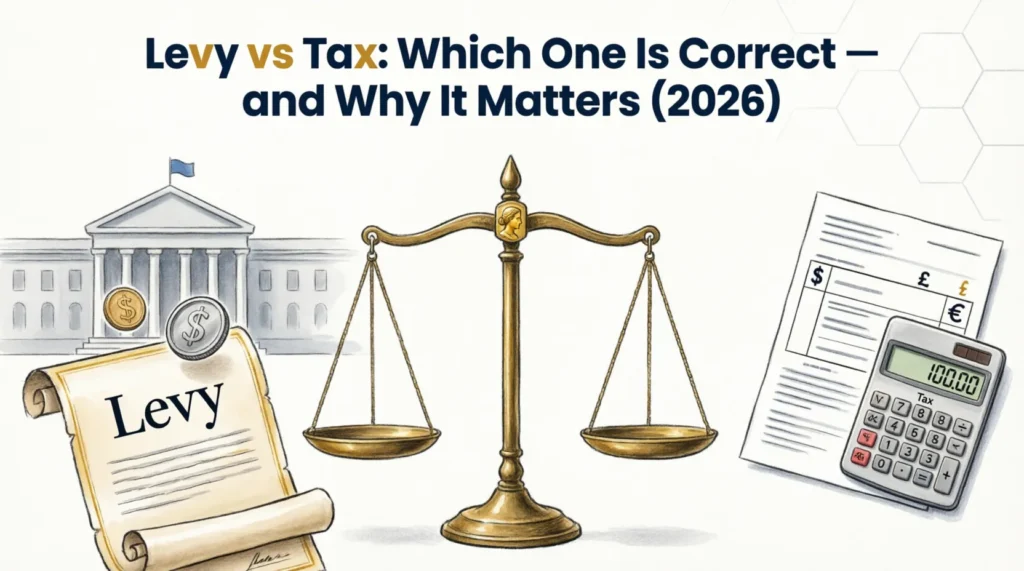
In short, both “levy” and “tax” are correct, but they are not the same thing. A tax is the actual charge or payment imposed by a government, while a levy is the act of imposing that charge or a specific fee collected for a purpose. Understanding the difference can make your writing sound far more precise and professional.
The Confusion Around Levy vs Tax
You are writing an economics essay, reading a government notice, or listening to a news report about new fuel charges. Then you pause: should it say “tax” or “levy”?
This confusion happens more often than you might think. Many people use the two words interchangeably because they both involve money collected by governments or authorities. In everyday conversation, you may even hear journalists and professionals switch between them casually.
The problem is that levy vs tax is not just a vocabulary issue. The two words have related meanings, but they work differently in legal, financial, and everyday contexts. Once you understand that distinction, the confusion becomes much easier to handle.
What Each Word Actually Means
A “tax” is usually a compulsory payment collected by a government. It is the actual money you pay on income, goods, property, or services. “Tax” is most commonly used as a noun, though it can also work as a verb.
For example:
“The government increased the sales tax this year.”
In that sentence, “tax” refers to the actual charge being paid.
As a verb, it can also mean to place a financial burden on someone:
“The state plans to tax luxury imports.”
A “levy,” on the other hand, is often the act of imposing or collecting a charge. It can also refer to a specific fee raised for a particular purpose. “Levy” can be both a noun and a verb.
For example:
“The city plans to levy a new environmental fee.”
Here, “levy” means “to impose.”
You may also hear it used as a noun:
“The school levy will help fund local education projects.”
In that case, the levy is a targeted charge collected for a defined reason.
So while a tax is generally the payment itself, a levy often emphasizes the action of imposing the payment or a specialized type of charge.
levy vs tax: Side-by-Side Comparison
Here is a quick breakdown to make the levy vs tax easier to compare at a glance.
Feature
Levy
Tax
Meaning
Charge imposed by authority
Required government payment
Part of Speech
Noun / Verb
Noun / Verb
Formality
Formal
Neutral / Formal
Common Context
Legal fees, penalties
Income, sales, government finance
Example Sentence
The council imposed a levy
The government raised tax rates
Can They Be Swapped?
Sometimes — context matters
Sometimes — depends on usage
Why People Mix Up Levy vs Tax
The biggest reason people confuse levy vs tax is that both words appear in government, financial, and legal language. In many situations, they overlap so closely that the difference feels invisible.
Language researchers point out that people naturally group related financial terms together. Since both words involve required payments, your brain may treat them as synonyms even when they are not perfectly interchangeable.
Another reason is that news headlines often simplify language. A report may call something a “fuel levy” in one paragraph and a “fuel tax” in the next. Technically, the writer may be highlighting different aspects of the same policy, but to readers, the distinction can seem blurry.
There is also a grammar issue involved. “Levy” frequently appears as an action word, while “tax” more commonly names the payment itself. If you are not paying close attention to sentence structure, it is easy to swap them accidentally.
Linguists also note that legal and financial English tends to preserve older terminology. That is why you still see words like “levy,” “duty,” “tariff,” and “assessment” alongside the more familiar word “tax.”
The Simple Rule to Remember Which Is Which
Here is the easiest way to remember levy vs tax:
Use “tax” for the money being paid, and use “levy” for the act of imposing it or for a special-purpose charge.
Think of it this way:
Governments levy taxes.
Citizens pay taxes.
That one sentence clears up most confusion instantly.
Here are a few examples:
“The government will levy a new road charge next year.”
“Residents are unhappy about the higher property tax.”
“The council approved a local levy for public transport improvements.”
If you can replace the word with “impose,” then “levy” is usually the correct choice.
Common Mistakes People Make With Levy vs Tax
“The government tax a new environmental fee yesterday.” The problem is verb form and word choice. A corrected version would be: “The government levied a new environmental fee yesterday.”
“Citizens must pay the new levy tax.” This is unnecessarily repetitive because the terms overlap. A cleaner version would be: “Citizens must pay the new tax.”
“The city imposed a tax on residents to levy more money.” This sentence mixes the concepts awkwardly. A better version is: “The city imposed a tax on residents to raise more money.”
“The company was levy additional charges.” “Levy” is being used incorrectly as an adjective. The corrected version is: “The company was charged additional taxes” or “The government levied additional charges on the company.”
Real-World Examples: Levy vs Tax Used Correctly
Casual conversation: “I did not realize how much fuel tax I was paying every month.” Here, “tax” refers to the actual money added to fuel prices.
Professional writing: “The city plans to levy additional fees on commercial waste disposal.” In this sentence, “levy” correctly describes the act of imposing charges.
Academic writing: “Economists often study how tax increases influence consumer behavior.” “Tax” is the correct noun because the focus is on the payment itself.
Creative writing: “The villagers feared the king would levy another harsh tribute before winter.” “Levy” works well because it emphasizes authority and imposition.
These examples show how context guides the correct choice. Once you notice the pattern, you will start spotting it everywhere.
See the Mistake, Fix the Mistake
These are real mistakes people make with the levy vs tax — and the simple fix for each one.
❌ The city will tax a levy on late business permits ✅ The city will levy a fee on late business permits 📌 Why: A levy is something imposed, not taxed.
❌ They tax an entry levy for the concert tickets ✅ They levy an entry tax for the concert tickets 📌 Why: Levies are imposed, while taxes are collected.
❌ The paper explains how governments tax environmental levies ✅ The paper explains how governments levy environmental taxes 📌 Why: Governments impose levies and taxes correctly in the opposite order here.
❌ The app taxes a service levy for premium users ✅ The app levies a service tax for premium users 📌 Why: Apps or companies usually impose charges, not tax them.
❌ The hotel will tax a tourist levy on each room ✅ The hotel will levy a tourist tax on each room 📌 Why: Levy is used when adding a new charge to something.
❌ We were taxed a parking levy at the mall ✅ We were levied a parking tax at the mall 📌 Why: The charge is something imposed, so levy is used as the action.
British English vs. American English — Does It Affect Levy vs Tax?
Unlike some English word pairs, levy vs tax is not mainly a British-versus-American spelling issue. Both words are standard in British English and American English.
However, there can be slight differences in frequency and tone. In British and Commonwealth English, “levy” sometimes appears more often in government and public-policy language. You may hear terms like “council levy” or “health levy” more frequently in official documents.
In American English, people generally use “tax” more often in everyday speech. Even so, “levy” remains common in legal, financial, and administrative contexts.
So if you are writing for an international audience, you do not need to change the spelling. The real challenge is understanding the difference in meaning, not regional variation.
What Grammar Checkers and Style Guides Say About Levy vs Tax
Most grammar tools will not flag levy vs tax as an error because both words are legitimate English terms. That means spellcheck alone usually cannot help you choose the right one.
Style guides and grammar experts generally focus on precision. They encourage writers to use “levy” when discussing the imposition of a charge and “tax” when discussing the charge itself. In formal writing, that distinction matters because it improves clarity.
Autocorrect may catch a spelling mistake, but it cannot always understand context. That is why knowing the rule yourself is more reliable than depending entirely on software.
Levy vs Tax in Professional and Academic Writing
In professional writing, using the wrong term can make your message sound less precise. If you are drafting a business report, legal document, policy memo, or academic essay, readers may notice the difference immediately.
For example, saying “the government taxed a new fee” may sound awkward to professionals who expect the phrase “levied a new fee.” Small wording choices like this shape how polished and credible your writing appears.
In academic and translated legal contexts, especially where financial terminology must stay exact across languages and traditions, choosing the correct term becomes even more important.
The good news is that once you understand levy vs tax, you will probably never struggle with it again. The distinction is actually very logical once you see how each word functions in a sentence.
Quick Recap: Levy vs Tax at a Glance
A tax is usually the actual payment collected by a government.
A levy is often the act of imposing a charge or a special-purpose fee.
Governments levy taxes.
Citizens and businesses pay taxes.
Spellcheck may not catch misuse because both words are correct English words.
Frequently Asked Questions About Levy vs Tax
Is a levy the same thing as a tax?
Not exactly. A tax is generally the payment itself, while a levy often refers to imposing the payment or collecting a targeted charge. In practice, the terms can overlap, but they are not perfect synonyms.
Why do governments call something a levy instead of a tax?
Sometimes governments use “levy” because the charge is tied to a specific purpose, such as transportation, education, or environmental programs. The word can also sound more technical or administrative in official language.
Can levy be used as a verb?
Yes. “Levy” is commonly used as a verb meaning “to impose” or “to collect.” For example: “The state plans to levy additional charges on imported goods.”
Is levy more formal than tax?
Usually, yes. “Levy” tends to appear more often in legal, governmental, and financial writing. “Tax” is more common in everyday conversation and general news reporting.
Do British and American English use levy differently?
Both varieties of English use the word correctly, but British and Commonwealth English may use “levy” slightly more often in official government language. The core meaning remains the same in both regions.
Final Thoughts on Levy vs Tax
The difference between levy vs tax comes down to function and emphasis. A tax is generally the payment itself, while a levy is often the act of imposing that payment or a specialized charge tied to a specific purpose.
If you have mixed these words up before, you are definitely not alone. Even experienced writers occasionally pause over financial terminology because the meanings overlap so closely.
Now that you understand the pattern, though, you can use both words with confidence. The next time you see levy vs tax in an article, report, or conver
Frequently Asked Questions
What is the primary difference between a levy and a tax?▼
A tax is the actual payment imposed by a government, while a levy refers to the act of imposing that charge or a specific fee collected for a designated purpose. Understanding this distinction helps clarify financial and legal discussions.
Can the terms levy and tax be used interchangeably?▼
While there are contexts where they may overlap, levy and tax are not always interchangeable. The usage depends on the specific context; for example, ‘levy’ often emphasizes the action of imposing a charge, whereas ‘tax’ refers to the payment itself.
In what contexts do people typically confuse levy and tax?▼
People often mix up levy and tax in legal, financial, and everyday language, especially when discussing government fees or charges. News reports may also simplify language, leading to confusion about whether a charge is a levy or tax.
How can I ensure I'm using levy and tax correctly in my writing?▼
To use levy and tax correctly, pay attention to the context and the role of each term. ‘Tax’ refers to the payment itself, while ‘levy’ highlights the action of imposing that payment or a specific fee.
Are there specific examples that illustrate the difference between levy and tax?▼
Yes, for instance, a government may raise sales tax, which refers to the actual charge on purchases. In contrast, a school might impose a levy to fund local education projects, highlighting the action of collecting a specific fee.
Why might journalists use levy and tax interchangeably in news articles?▼
Journalists may use these terms interchangeably to simplify complex financial discussions for the reader. However, this can blur the distinction and lead to misunderstandings regarding the nature of the charges being discussed.
What should I consider when discussing financial terms to avoid confusion?▼
When discussing financial terms, it’s important to recognize the specific meanings and contexts of words like levy and tax. Being precise in your language can enhance clarity and professionalism in your writing.
Rebecca Nguyen brings a diverse background in journalism and education to her role at WordlyRight. A graduate of the University of Toronto with a focus in English and Linguistics, she has spent over 12 years honing her skills as a writer and educator. Rebecca’s expertise lies in her ability to simplify daunting grammar rules and rectify frequent spelling mistakes in a way that resonates with students and professionals alike. Her articles on WordlyRight zero in on the most common word confusions encountered by writers, turning complex concepts into clear, actionable insights. With a passion for lifelong learning, Rebecca continually seeks to refine her understanding of language to better serve her audience.