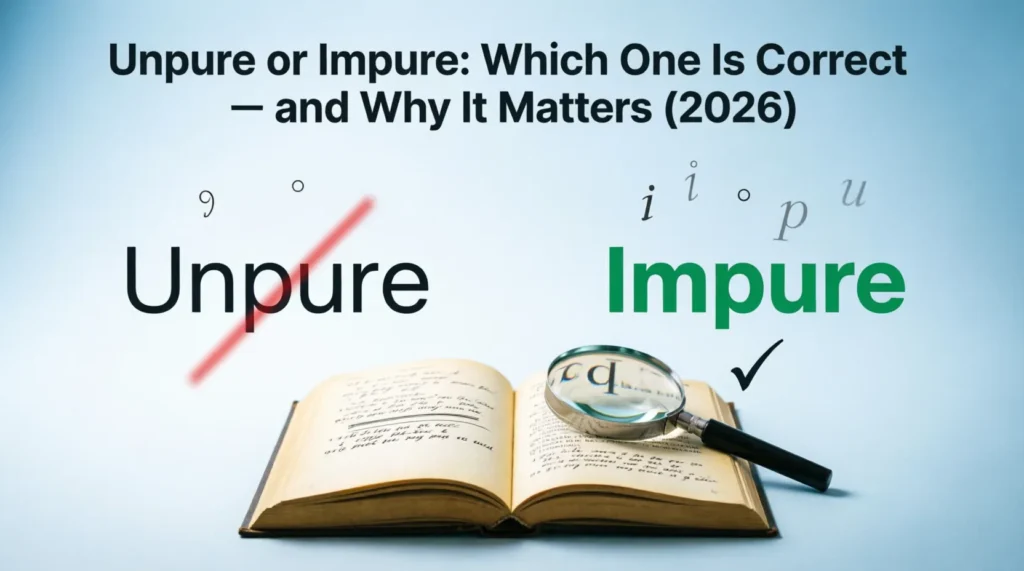
In short, “impure” is the correct and standard English word, while “unpure” is considered non-standard and is rarely used in modern writing. Both may be understood, but only “impure” is accepted in formal, academic, and professional contexts. Understanding this difference will help you avoid a very common writing mistake and sound more confident in your English.
The Confusion Around unpure or impure
You’re writing an important email, essay, or blog post, and suddenly you pause. You want to describe something that is not clean or not mixed correctly. You type “unpure”… then stop. It looks right, but something feels off.
This exact moment is where many people get stuck with unpure or impure. You’ve probably seen both versions online, and your brain naturally assumes they might be interchangeable.
The confusion is completely normal. English often uses “un-” to form negatives, so your instinct pushes you toward “unpure.” But language doesn’t always follow instinct—it follows usage and history.
What Each Word Actually Means
Let’s break down unpure or impure in a simple way so you can clearly see the difference.
Impure is an adjective. It means something is not clean, not pure, or contains unwanted elements. It is the standard and widely accepted form in modern English.
For example: “The water in the river became impure after the storm.”
This is correct, natural, and what native speakers expect to read.
Now, unpure is also technically formed like an adjective, but it is not considered standard English. Most grammar experts and style guides treat it as incorrect or outdated.
For example: “The mixture is unpure.” ❌ (This sounds unnatural and is generally considered wrong in formal English.)
Instead, writers are expected to use “impure” in almost every situation.
So when you’re dealing with unpure or impure, the real choice is not between two equal words—it’s between a correct word and a non-standard one.
[unpure or impure]: Side-by-Side Comparison
Here is a quick breakdown to make [KEYWORD] easier to compare at a glance.
Feature
unpure
impure
Meaning
Not pure; uncommon form
Not pure; contains impurities
Part of Speech
Adjective
Adjective
Formality
Rare, informal
Standard, neutral
Common Context
Occasional speech or writing
Science, health, everyday English
Example Sentence
The water looked unpure.
The water was impure.
Can They Be Swapped?
Sometimes
Sometimes
Reason
“Impure” is usually preferred.
Standard choice in most situations.
Why People Mix Up unpure or impure
Language researchers point out that confusion like unpure or impure usually comes from pattern guessing. English learners often rely on common prefixes like “un-” to form negatives (unhappy, unclear, unfair).
So naturally, “unpure” feels logical. It follows a familiar pattern, even though English doesn’t actually use it in standard vocabulary.
Another reason is exposure. You may see “unpure” in informal writing, social media posts, or non-native English content. Once your brain sees it enough, it starts to feel acceptable.
There’s also a psychological factor. When a word sounds right, your brain tends to trust it—even if grammar tradition disagrees. That’s exactly what happens with unpure or impure.
The Simple Rule to Remember Which Is Which
Here’s an easy rule you can rely on every time:
If you are describing something not pure, always use “impure.” Never use “unpure” in formal writing.
Think of it like this: English already “assigned” the job to “impure,” so “unpure” is unnecessary.
Try this mental shortcut: If you’re tempted to write “unpure,” pause and replace it with “impure” automatically.
Example sentences:
The scientist tested whether the solution was impure before using it in the experiment.
The air in the city became impure due to heavy traffic pollution.
A small mistake made the entire sample impure, so it had to be discarded.
Once you train yourself with this rule, unpure or impure stops being confusing almost immediately.
Common Mistakes People Make With unpure or impure
Here are some real-world mistakes people often make, along with corrections:
Using “unpure” in essays Incorrect: The water was unpure after the flood. Correct: The water was impure after the flood.
Assuming both words are interchangeable Incorrect: He thought unpure and impure meant the same thing. Correct: He learned that impure is the correct standard term.
Copying informal online usage Incorrect: This product is unpure and unsafe. Correct: This product is impure and unsafe.
Overapplying “un-” prefixes Incorrect: The metal is unpure due to mixing. Correct: The metal is impure due to mixing.
These mistakes are extremely common, especially when you’re learning English patterns and trying to apply them quickly.
Real Sentence Fix — [KEYWORD]
See the Mistake, Fix the Mistake
These are real mistakes people make with [KEYWORD] — and the simple fix for each one.
❌ The lab report showed the sample was unpure. ✅ The lab report showed the sample was impure. 📌 Why: “Impure” is the standard word used in scientific writing.
❌ This juice tastes unpure to me. ✅ This juice tastes impure to me. 📌 Why: “Impure” is the natural word most people use.
❌ The essay discussed unpure substances in the experiment. ✅ The essay discussed impure substances in the experiment. 📌 Why: Academic writing normally uses “impure.”
❌ The software flagged the data as unpure. ✅ The software flagged the data as impure. 📌 Why: Technical and digital contexts usually prefer “impure.”
❌ The air in the room felt unpure after the fire. ✅ The air in the room felt impure after the fire. 📌 Why: “Impure” is the accepted adjective for contaminated air.
❌ The company worried that unpure ingredients reached customers. ✅ The company worried that impure ingredients reached customers. 📌 Why: Professional writing almost always uses “impure.”
Real-World Examples: unpure or impure Used Correctly
Here are correct, natural uses of the word “impure” in different contexts:
Casual writing: “I avoided drinking the water because it looked impure.” This shows everyday awareness of cleanliness and safety.
Professional context: “The lab results indicated that the sample was impure.” This is the kind of phrasing you’ll see in workplace or scientific reports.
Academic writing: “The presence of impurities made the compound impure and unstable.” This fits formal scientific explanation.
Creative writing: “He felt the air was impure, heavy with dust and silence.” This shows descriptive, emotional usage.
In all these cases, “impure” fits naturally, while “unpure” would feel awkward or incorrect.
British English vs. American English — Does It Affect unpure or impure?
When it comes to unpure or impure, there is no meaningful difference between British and American English. Both varieties agree that “impure” is the correct standard form.
You might occasionally see “unpure” in older texts or informal writing, but it is not considered standard in either region today.
Linguists note that while English does have regional spelling differences in other words, this is not one of them. So no matter where you are writing—London, New York, or anywhere else—“impure” is the safe and correct choice.
What Grammar Checkers and Style Guides Say About unpure or impure
Most grammar tools and professional style guides consistently flag “unpure” as incorrect or suggest replacing it with “impure.”
Style conventions in formal writing strongly favor established vocabulary over constructed forms that don’t exist in standard usage.
Autocorrect systems may sometimes fail to catch “unpure,” especially in informal apps, but that doesn’t mean it’s acceptable. In many cases, context matters more than spellcheck suggestions.
The key takeaway is simple: tools can help, but they are not perfect. Knowing that “impure” is the correct form gives you real control over your writing.
unpure or impure in Professional and Academic Writing
In professional emails, job applications, academic essays, and published content, using the correct form matters more than you might think.
If you write “unpure,” readers may notice it as a grammatical error or non-native phrasing. Even if your message is clear, small language mistakes can slightly reduce credibility.
On the other hand, using “impure” correctly shows precision and attention to detail. It signals that you understand standard English conventions.
Once you fully understand unpure or impure, you won’t need to second-guess yourself in high-stakes writing situations. That confidence shows in your communication.
Quick Recap: unpure or impure at a Glance
“Impure” is the correct and standard English word
“Unpure” is non-standard and generally incorrect
Both words are often confused due to the “un-” prefix pattern
Use “impure” in all formal, academic, and professional writing
Grammar guides and linguists consistently support “impure” as correct
Frequently Asked Questions About unpure or impure
Is “unpure” a real English word?
“Unpure” exists in informal usage, but it is not considered standard English. Most grammar experts recommend avoiding it in formal writing and using “impure” instead. If you want to sound correct and natural, always choose “impure.”
Why is “impure” correct but not “unpure”?
English does not apply the “un-” prefix to every adjective. While “un-” is common, historical usage established “impure” as the accepted form. Over time, “impure” became standardized while “unpure” did not.
Can I use “unpure” in casual writing?
You might see it in casual or social media writing, but it is still considered incorrect in standard English. Even in informal settings, “impure” is safer and more widely understood.
Is there any difference in meaning between unpure or impure?
No meaningful difference in intended meaning exists, but only “impure” is grammatically accepted. “Unpure” may be understood, but it is not standard usage.
Will using “unpure” affect my writing score or grades?
Yes, in academic or professional contexts, using “unpure” may be marked as an error. Teachers and examiners expect “impure” because it follows standard grammar rules.
Final Thoughts on unpure or impure
The difference between unpure or impure is actually very simple once you see the pattern: only “impure” is correct in standard English. The other form may feel logical, but it does not follow accepted usage rules.
This is one of those small grammar details that can quietly improve your writing clarity and confidence. And now that you understand it, you’ll never have to hesitate again when choosing the right word.
With this knowledge, you’re writing more accurately, more professionally, and with much greater confidence than before.
Frequently Asked Questions
What is the correct word to use, unpure or impure?▼
The correct and standard word to use is ‘impure.’ ‘Unpure’ is considered non-standard and rarely used in modern writing, making ‘impure’ the preferred choice in formal contexts.
Why do people confuse unpure and impure?▼
People often confuse ‘unpure’ and ‘impure’ due to pattern guessing, as English learners might rely on common prefixes like ‘un-‘ to form negatives. Additionally, exposure to informal writing or social media can lead to the perception that ‘unpure’ is acceptable.
Can I use unpure in any writing context?▼
While ‘unpure’ may be used occasionally in casual speech, it is not recommended for formal writing. In academic or professional settings, it’s best to stick with ‘impure’ to ensure clarity and correctness.
What does impure mean?▼
‘Impure’ is an adjective that describes something that is not clean, not pure, or contains unwanted elements. For example, it can refer to contaminated water or a mixture that is not properly combined.
How can I remember to use impure instead of unpure?▼
A simple rule to remember is to always use ‘impure’ when describing something not pure. If you find yourself tempted to write ‘unpure,’ pause and replace it with ‘impure’ automatically.
Are both words interchangeable in any context?▼
While both words may be understood, they are not interchangeable in formal writing. ‘Impure’ is the standard choice and should be used in most situations, while ‘unpure’ is considered incorrect.
What are some examples of impure used in sentences?▼
Examples of ‘impure’ in sentences include: ‘The scientist tested whether the solution was impure before using it in the experiment,’ and ‘The air in the city became impure due to heavy traffic pollution.’ These sentences illustrate the appropriate use of the word.
James Williams has been fascinated by the intricacies of the English language since his childhood days. Holding a Master’s degree in Linguistics from the University of Cambridge, he has spent over 15 years working as a professional editor and language consultant. James specializes in deciphering complex spelling and grammatical issues, and he is passionate about helping students and professionals alike gain confidence in their writing. His experience includes developing educational content for ESL learners, ensuring clarity and precision in communication. James is dedicated to providing readers with easy-to-follow guidance that resolves word confusions and common spelling errors, making WordlyRight an essential resource for anyone who needs quick, authoritative answers.