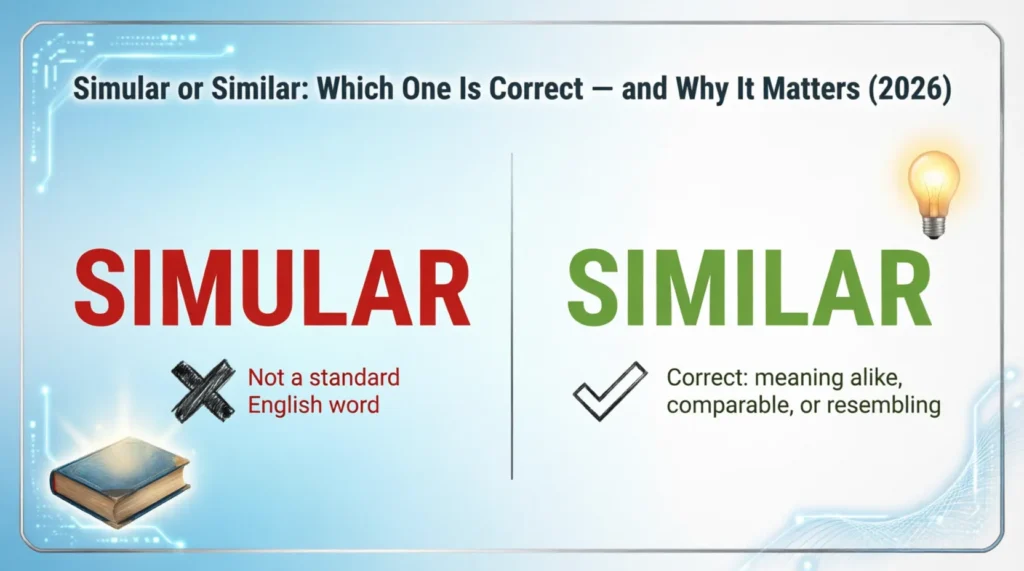
In short, similar is the correct English word, while simular is considered a misspelling in standard English. Many people accidentally type or write simular because it sounds close to similar, but only similar is accepted in formal and everyday writing. Once you understand why the confusion happens, remembering the correct spelling becomes much easier.
The Confusion Around [simular or similar]
You are not alone if you have ever paused mid-sentence and wondered whether to write “simular” or “similar.” It happens all the time in essays, emails, social media captions, and even professional reports.
Maybe you were typing quickly and your brain filled in the spelling automatically. Or perhaps you saw simular online somewhere and started questioning yourself. That small moment of hesitation is surprisingly common.
The confusion around simular or similar exists because the words look and sound close enough that your brain assumes both might be valid. English spelling patterns do not always make things easy, especially when pronunciation and spelling do not perfectly match.
What Each Word Actually Means
The word similar is a real English adjective. It describes two or more things that are alike in some way but not completely identical.
For example:
“The two phones look similar, but they have different features.”
In this sentence, similar means the phones share certain qualities or appearances.
On the other hand, simular is not considered a standard English word. It is generally treated as a spelling mistake of similar rather than a separate word with its own meaning.
For example, this would be incorrect:
“The results were simular to last year’s report.”
The corrected sentence is:
“The results were similar to last year’s report.”
Grammar experts and language researchers consistently classify simular as a misspelling rather than an alternative spelling. That means you should avoid using it in academic, professional, and everyday writing.
One reason this matters is that spelling affects clarity. When you use the accepted spelling, your reader understands you instantly without distraction.
SECTION 1: Quick Comparison Table Here is a quick breakdown to make simular or similar easier to compare at a glance.
Feature
simular
similar
Meaning
Incorrect spelling of similar
Alike or resembling
Part of Speech
Misspelling / error
Adjective
Formality
Nonstandard / incorrect
Neutral
Common Context
Typing mistakes in writing
Comparing things or ideas
Example Sentence
“Simular is often a typo.”
“These colors are similar.”
Can They Be Swapped?
No — spelling error
No — correct word only
Why People Mix Up [simular or similar]
The biggest reason people confuse simular or similar is pronunciation. When spoken quickly, similar can sound softer in the middle syllable, making it easy for your brain to imagine the spelling with a “u” instead of an “i.”
Linguists often explain that readers and writers rely heavily on sound patterns when spelling unfamiliar or less frequently written words. Because English contains many words ending in “-ular,” like circular or particular, simular can feel visually believable even though it is incorrect.
Typing habits also play a role. If you are writing quickly on your phone or keyboard, your fingers may naturally swap letters without you noticing. Autocorrect sometimes catches the mistake, but not always.
Another reason is visual memory. Many people remember the overall shape of a word instead of every letter. Since simular and similar look close at a glance, your brain may not immediately spot the difference.
That is why even experienced writers occasionally second-guess themselves with simular or similar.
The Simple Rule to Remember Which Is Which
Here is the easiest rule:
If you mean “alike,” always use similar — with an “i” in the middle.
A simple memory trick is this:
“Similar things are identical in some ways — and identical has an i.”
That little connection helps many people remember the correct spelling instantly.
Here are a few examples:
“Your writing style is similar to your brother’s.”
“These two jackets look similar from a distance.”
“The teacher said our answers were similar but not exactly the same.”
In every case, similar is the correct word because it describes resemblance or likeness.
Once you connect similar with the idea of “identical in some ways,” the spelling becomes much easier to remember naturally.
Common Mistakes People Make With [simular or similar]
Writing “simular” in professional emails because it looks correct at first glance. Correct version: “Our goals are similar to last year’s targets.”
Assuming simular is a British English spelling variation. Correct version: Both British and American English use “similar.”
Trusting spellcheck too much and missing the typo in a long document. Correct version: Always proofread carefully even if software does not flag every issue.
Using similar incorrectly with “too” instead of “to.” Correct version: “Her experience is similar to mine.”
These mistakes are common, and they do not mean your English is weak. They simply show how tricky spelling patterns can be.
SECTION 2: Real Sentence Fix — simular or similar These are real mistakes people make with simular or similar — and the simple fix for each one.
❌ The results are simular to last quarter report. ✅ The results are similar to last quarter report. 📌 Why: The correct spelling is needed for comparison words in reports.
❌ Your post is simular to mine lol ✅ Your post is similar to mine lol 📌 Why: The word is spelled wrong when comparing social posts.
❌ The two theories are simular in structure. ✅ The two theories are similar in structure. 📌 Why: Academic writing requires the correct form of comparison words.
❌ This app looks simular to the older version. ✅ This app looks similar to the older version. 📌 Why: Product descriptions need the correct spelling to be clear.
❌ My phone case is simular to yours. ✅ My phone case is similar to yours. 📌 Why: Everyday comparisons should use the correct spelling.
❌ These two houses are simular in size. ✅ These two houses are similar in size. 📌 Why: The correct spelling is needed when describing physical similarities.
Real-World Examples: [simular or similar] Used Correctly
Casual conversation: “Your new haircut looks similar to the one you had last summer.” This works because similar compares two related appearances.
Professional writing: “The updated policy is similar to the previous version with a few minor changes.” Here, similar helps compare two workplace documents clearly.
Academic writing: “Researchers found similar patterns in both groups during the study.” Academic writing often uses similar to compare data or observations.
Creative writing: “The sky carried a similar shade of orange she remembered from childhood.” In storytelling, similar helps create emotional and visual connections.
These examples show how often you use similar in everyday English once you start noticing it.
British English vs. American English — Does It Affect [simular or similar]?
Unlike some spelling differences in English, simular or similar is not a British-versus-American issue. Both British English and American English use the spelling similar.
That means simular is not considered correct in either regional standard. Whether you are writing for a university in London or a company in New York, the accepted spelling remains the same.
This confusion affects English speakers worldwide because the mistake comes mainly from pronunciation and visual similarity rather than regional spelling traditions.
What Grammar Checkers and Style Guides Say About [simular or similar]
Most grammar tools and spellcheck systems flag simular as a misspelling and suggest similar instead. However, autocorrect is not perfect, especially if the typo appears in specialized documents or informal writing platforms.
Major style guides and grammar experts consistently recognize only similar as standard English usage. There is no formal writing context where simular is preferred.
That is why relying only on technology is not enough. Knowing the rule yourself helps you write more confidently and spot errors before someone else does.
[simular or similar] in Professional and Academic Writing
In professional writing, small spelling errors can create a surprisingly strong impression. If you write simular instead of similar in a job application, business proposal, or client email, readers may notice the mistake immediately.
The same applies in academic settings. Teachers, professors, and editors often expect standard spelling because it helps maintain clarity and credibility. Even one incorrect word can distract from an otherwise strong piece of writing.
This is especially important in formal documents, translated material, and scholarly communication where precision matters across languages and traditions. Using the correct spelling shows attention to detail.
The good news is that once you learn the difference between simular or similar, you are unlikely to struggle with it again. It becomes one of those spelling rules your brain remembers automatically.
Quick Recap: [simular or similar] at a Glance
Similar is the correct English word.
Simular is considered a misspelling.
Similar is an adjective meaning “alike.”
Both British and American English use similar.
Remember the “i” in similar by linking it to “identical.”
Frequently Asked Questions About [simular or similar]
Is simular ever a correct word?
In standard modern English, simular is generally considered incorrect. It is treated as a misspelling of similar rather than a separate accepted word. In everyday, academic, and professional writing, you should use similar.
Why do people spell similar as simular?
People often make this mistake because of pronunciation and spelling patterns. Since many English words end in “-ular,” the spelling simular can feel visually natural even though it is incorrect.
Is similar an adjective or a verb?
Similar is an adjective. It describes things that are alike in some way. For example: “Their opinions are similar.”
Do British people use simular?
No. British English uses similar, just like American English does. There is no regional English standard where simular is officially correct.
What is the easiest way to remember similar?
A helpful trick is to connect similar with the word identical. Both contain the letter “i,” which can remind you that similar is the correct spelling when comparing things.
Final Thoughts on [simular or similar]
The answer to simular or similar is straightforward: similar is the correct spelling, and simular is a common mistake. The confusion happens because the words sound close and English spelling patterns can sometimes feel inconsistent.
If you have ever mixed them up, you are in very good company. Even confident writers occasionally pause over words like this, especially when typing quickly or multitasking.
Now that you know the difference, you can write with much more confidence. The next time you see simular or similar, you will know exactly which one belongs on the page.
Frequently Asked Questions
What is the correct spelling between simular and similar?▼
The correct spelling is similar, which is an accepted word in English. Simular is considered a misspelling and should be avoided in all forms of writing.
Why do people confuse simular with similar?▼
The confusion arises primarily from pronunciation; when spoken quickly, similar may sound like it has a ‘u’ instead of an ‘i.’ Additionally, visual memory can lead some to mistakenly believe simular is correct due to its resemblance to other words ending in ‘-ular.’
In what contexts is simular commonly used?▼
Simular is typically seen in typing mistakes, especially in informal writing such as emails or social media captions. It is not an accepted term in formal or academic writing, where clarity is essential.
What is the meaning of the word similar?▼
Similar is an adjective that describes two or more items that share common qualities but are not identical. For instance, you might say, ‘These colors are similar,’ indicating they resemble each other in some way.
How can I remember to use similar instead of simular?▼
A helpful trick is to associate the word similar with the word identical, which also contains an ‘i.’ Remembering that similar things are alike can reinforce the correct spelling.
What are the consequences of using simular in writing?▼
Using simular can lead to confusion and distract readers, as it is considered a spelling error. Maintaining the correct spelling of similar enhances clarity and professionalism in your writing.
Are there any exceptions to using the word similar?▼
No, there are no exceptions; similar is the only correct form to use when you intend to convey likeness. Simular should not be used in any context, as it is not recognized as a standard English word.
James Williams has been fascinated by the intricacies of the English language since his childhood days. Holding a Master’s degree in Linguistics from the University of Cambridge, he has spent over 15 years working as a professional editor and language consultant. James specializes in deciphering complex spelling and grammatical issues, and he is passionate about helping students and professionals alike gain confidence in their writing. His experience includes developing educational content for ESL learners, ensuring clarity and precision in communication. James is dedicated to providing readers with easy-to-follow guidance that resolves word confusions and common spelling errors, making WordlyRight an essential resource for anyone who needs quick, authoritative answers.