In short, “diverse” is the correct English word in most situations, while “divers” is either an old-fashioned or highly specialized term that many people mistakenly use instead. If you have ever paused while typing diverse vs divers, you are far from alone — and the difference becomes much clearer once you see how each word actually works.
The Confusion Around Diverse vs Divers
You are writing an essay about a “diverse community,” and suddenly your spellcheck does not complain when you type “divers community.” Now you stop and wonder if both words are correct.
The same thing happens in workplace emails, blog posts, and even academic writing. Many people searching for diverse vs divers are not bad at English at all — they are simply running into two words that look closely related.
What makes this especially confusing is that “divers” is technically a real word in English, just not the one most people mean today. That tiny detail causes thousands of writers to second-guess themselves every year.
What Each Word Actually Means
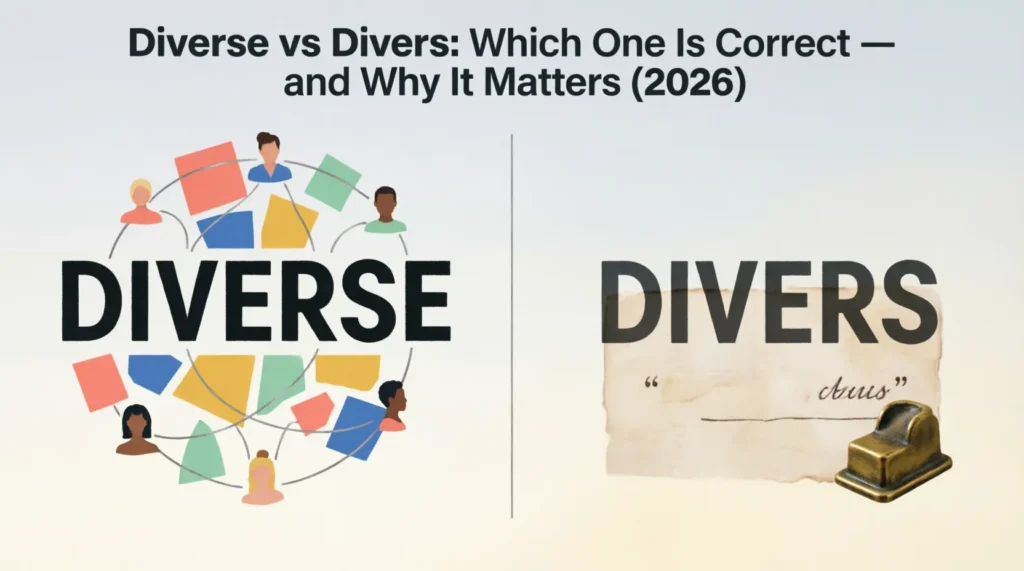
“Diverse” is an adjective. It describes something that includes many different kinds, people, ideas, cultures, or elements.
You probably see it often in phrases like:
a diverse workplace
a diverse group of students
diverse opinions
diverse experiences
Example sentence:
The university has a diverse student population from many countries.
In modern English, this is the standard and expected word in almost every everyday situation.
“Divers,” on the other hand, is much less common. It is an older adjective that means “several” or “various.” You may occasionally see it in historical writing, legal language, or very formal old texts.
Example sentence:
The document referred to divers matters of trade and law.
To modern readers, that sentence sounds old-fashioned and unusual. Most grammar experts agree that “diverse” is the correct choice for normal contemporary writing.
There is also another completely unrelated use of “divers” as the plural of “diver,” meaning people who dive underwater.
Example sentence:
The divers explored the coral reef.
That is why the diverse vs divers confusion can feel especially tricky. One word is modern and common, while the other survives mostly in narrow or historical contexts.
diverse vs divers: Side-by-Side Comparison
Here is a quick breakdown to make the diverse vs divers easier to compare at a glance.
Feature
diverse
divers
Meaning
Showing variety or differences
People who dive underwater
Part of Speech
Adjective
Noun (plural)
Formality
Neutral
Neutral
Common Context
Groups, cultures, ideas, workplaces
Sports, jobs, underwater activities
Example Sentence
The team is diverse.
The divers entered the water.
Can They Be Swapped?
No
No
Describes variety
Refers to people who dive
Why People Mix Up Diverse vs Divers
One major reason people confuse diverse vs divers is spelling similarity. Both words begin with the same root, and your brain naturally assumes they are interchangeable.
Language researchers also point out that English keeps many older word forms alive long after everyday speech changes. “Divers” used to appear more often centuries ago, especially in formal British legal and literary writing. Because it still exists in dictionaries, writers sometimes assume it is a modern alternative to “diverse.”
Another reason is pronunciation. In fast speech, “diverse” can sound shortened, especially in casual conversation. That makes “divers” look believable when people type quickly.
Autocorrect does not always help either. Since “divers” is a valid English word in certain contexts, grammar tools may not flag it as an error even when you intended to write “diverse.”
The Simple Rule to Remember Which Is Which
Here is the easiest rule for diverse vs divers:
If you mean “different kinds,” use “diverse.”
That simple test works almost every time in modern English.
You can also remember this trick:
“Diverse” contains the word “verse,” and different verses in a song are not identical — they vary. Think of “diverse” as meaning variety.
Examples:
The company wants a diverse team of employees.
Our neighborhood is culturally diverse.
The conference included diverse viewpoints from many experts.
In all three examples, “different kinds” fits naturally. That tells you “diverse” is correct.
Now compare this older-style sentence:
The contract covered divers legal concerns.
Technically acceptable? Yes. Natural in modern writing? Not really. Most style guides would recommend “various” or “diverse” instead.
Common Mistakes People Make With Diverse vs Divers
“Our school has a divers student body.” The writer meant “diverse,” because they were describing variety. Correct version: “Our school has a diverse student body.”
“The company encourages divers perspectives.” “Divers” sounds old-fashioned here and feels unnatural in modern business English. Correct version: “The company encourages diverse perspectives.”
“She enjoys learning about divers cultures.” This mistake happens because “divers” looks grammatically correct at first glance. Correct version: “She enjoys learning about diverse cultures.”
“The article discussed divers social issues.” While older texts sometimes use “divers” this way, modern readers expect “diverse” or “various.” Correct version: “The article discussed diverse social issues.”
Real-World Examples: Diverse vs Divers Used Correctly
Casual conversation: “I love living in a diverse city where you can try food from everywhere.” Here, “diverse” correctly describes many different cultures and experiences.
Professional writing: “The company is committed to building a diverse workforce.” In business settings, “diverse” is the standard modern term.
Academic writing: “Researchers studied diverse learning styles among students.” Universities and academic journals strongly prefer “diverse” in this context.
Creative writing: “The marketplace was filled with diverse voices, colors, and music.” The word helps create a vivid sense of variety and richness.
These examples show that once you understand the meaning of “different kinds,” choosing the right word becomes much easier.
British English vs. American English — Does It Affect Diverse vs Divers?
Unlike some spelling differences in English, diverse vs divers is not mainly a British-versus-American issue.
Both British English and American English overwhelmingly use “diverse” in modern writing. You will see it in newspapers, universities, government documents, and professional communication across both regions.
“Divers” does appear slightly more often in older British legal or literary texts, but even there it sounds dated today. Linguists generally describe it as an archaic or historical form rather than a modern regional spelling.
So if you are writing for readers in the UK, the US, Pakistan, or anywhere else, “diverse” is almost always the safer and more natural choice.
Real Sentence Fix — diverse vs divers
See the Mistake, Fix the Mistake
These are real mistakes people make with diverse vs divers — and the simple fix for each one.
❌ Our company has a very divers workforce. ✅ Our company has a very diverse workforce. 📌 Why: Use diverse when describing a group with many different backgrounds.
❌ The divers menu options pleased everyone at the party. ✅ The diverse menu options pleased everyone at the party. 📌 Why: The sentence talks about variety, not people who dive.
❌ The university encourages divers perspectives in research. ✅ The university encourages diverse perspectives in research. 📌 Why: Diverse describes different viewpoints or ideas.
❌ The app serves a divers range of users worldwide. ✅ The app serves a diverse range of users worldwide. 📌 Why: Diverse is the correct word for a wide variety of users.
❌ The beach was crowded with diverse preparing for a competition. ✅ The beach was crowded with divers preparing for a competition. 📌 Why: Divers refers to people who participate in diving.
❌ Several diverse explored the coral reef during the trip. ✅ Several divers explored the coral reef during the trip. 📌 Why: The sentence needs the noun for people who dive underwater.
What Grammar Checkers and Style Guides Say About Diverse vs Divers
Most modern style guides strongly favor “diverse” for contemporary writing. Grammar experts view it as the clear standard when discussing variety, inclusion, or differences.
Grammar tools can sometimes miss this error because “divers” is technically a legitimate word. That means spellcheck alone may not save you. Context matters more than simple spelling recognition.
This is why understanding the actual distinction in diverse vs divers is more reliable than depending entirely on software. Once you know the rule, you can spot the correct choice instantly.
Diverse vs Divers in Professional and Academic Writing
Getting diverse vs divers right matters because readers notice word choice quickly in formal settings. A hiring manager, professor, or editor may see “divers” and assume it was a typo or an outdated usage.
That does not mean one small mistake ruins your credibility. English is full of confusing word pairs, and this one catches many intelligent writers off guard. Still, using the standard modern form helps your writing feel polished and current.
Precision also matters in translated academic, legal, and cross-cultural writing, where one outdated word can slightly change tone or clarity. Fortunately, once you understand that “diverse” is the modern everyday choice, the confusion usually disappears for good.
Quick Recap: Diverse vs Divers at a Glance
“Diverse” means including many different kinds or varieties.
“Divers” is an old-fashioned word meaning “various” or “several.”
In modern writing, “diverse” is almost always the correct choice.
Spellcheck may not catch the mistake because “divers” is technically a real word.
If you mean variety or differences, use “diverse.”
Frequently Asked Questions About Diverse vs Divers
Is “divers” ever correct in English?
Yes, but it is uncommon in modern everyday English. “Divers” survives mostly in historical, legal, or literary contexts where it means “various” or “several.” Most writers today should use “diverse” instead.
Why does spellcheck not flag “divers”?
Spellcheck recognizes “divers” as a legitimate English word. The problem is that software often checks spelling, not intended meaning. That is why context matters so much with diverse vs divers.
Is “diverse” the same as “various”?
They are similar, but not always identical. “Various” simply means several different things, while “diverse” often emphasizes meaningful variety among people, ideas, or groups.
Do British people use “divers” more often?
Not in normal modern conversation or writing. You might see it in older British documents or literature, but contemporary British English still strongly prefers “diverse.”
Can “divers” mean people who dive underwater?
Yes. “Divers” is also the plural form of “diver.” For example: “The divers explored the shipwreck.” That meaning is completely separate from the diverse vs divers spelling confusion.
Final Thoughts on Diverse vs Divers
The key difference in diverse vs divers is simple once you strip away the confusion: “diverse” is the standard modern word for describing variety, while “divers” is mostly old-fashioned or specialized.
If you have hesitated over these two words before, you are in very good company. Even experienced writers sometimes pause because “divers” looks surprisingly believable at first glance.
Now that you understand the distinction, you can write with much more confidence. The next time you describe different cultures, opinions, experiences, or communities, you will know exactly which word belongs on the page.
Frequently Asked Questions
What is the main difference between 'diverse' and 'divers'?▼
‘Diverse’ is an adjective used to describe a variety of different kinds or elements, while ‘divers’ is an older term that means ‘several’ or ‘various’ and is mostly used in historical contexts. In modern usage, ‘diverse’ is the correct choice for describing communities or groups.
In what contexts is 'divers' still used today?▼
‘Divers’ is primarily found in historical writing, legal language, or very formal old texts. It can also refer to the plural of ‘diver,’ meaning people who dive underwater, but it is not commonly used in everyday conversation.
Why do people confuse 'diverse' and 'divers'?▼
The confusion often arises from the spelling similarity and the fact that both words share a common root. Additionally, ‘divers’ is still a valid word in certain contexts, which can lead to mistakes in writing.
Is there a simple rule to remember when to use 'diverse'?▼
Yes, a straightforward rule is to use ‘diverse’ when you mean ‘different kinds’ or ‘variety.’ If your sentence describes a mix of cultures, ideas, or people, ‘diverse’ is the appropriate choice.
Can 'divers' and 'diverse' be used interchangeably?▼
No, ‘divers’ and ‘diverse’ cannot be swapped in sentences. They serve different grammatical functions and meanings, making them unsuitable for interchanging in modern writing.
How can I avoid making mistakes with 'diverse' and 'divers' in my writing?▼
To avoid errors, focus on the context in which you’re writing. If you’re discussing a range of ideas or communities, use ‘diverse.’ Remember that ‘divers’ is only appropriate in specific, often outdated, contexts.
Why does spellcheck not flag 'divers' as incorrect?▼
Spellcheck may not flag ‘divers’ because it is a valid English word in certain contexts, even if it’s not the word you intended to use. This can lead to confusion, especially when typing quickly or relying on autocorrect.
Rebecca Nguyen brings a diverse background in journalism and education to her role at WordlyRight. A graduate of the University of Toronto with a focus in English and Linguistics, she has spent over 12 years honing her skills as a writer and educator. Rebecca’s expertise lies in her ability to simplify daunting grammar rules and rectify frequent spelling mistakes in a way that resonates with students and professionals alike. Her articles on WordlyRight zero in on the most common word confusions encountered by writers, turning complex concepts into clear, actionable insights. With a passion for lifelong learning, Rebecca continually seeks to refine her understanding of language to better serve her audience.