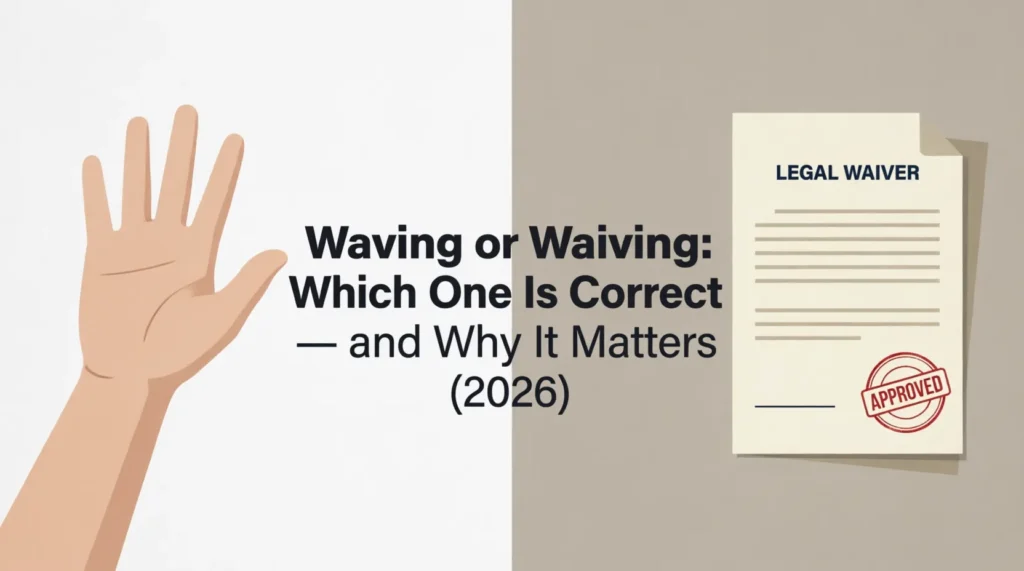
In short, both “waving” and “waiving” are correct — but they mean completely different things. “Waving” usually relates to moving your hand or something flowing in motion, while “waiving” means officially giving up a right, rule, or requirement. Understanding the difference can save you from awkward mistakes in emails, essays, and professional writing.
The Confusion Around Waving or Waiving
You’re typing an email to your professor or filling out a form at work, and suddenly you pause. Should it be “waving the fee” or “waiving the fee”? The two words sound almost identical, and that tiny spelling difference can feel surprisingly stressful.
This confusion happens to students, professionals, bloggers, and even experienced writers. Many people search for “waving or waiving” because spellcheck does not always catch the mistake. After all, both are real English words.
The problem is that these words belong in completely different situations. Once you see the difference clearly, though, you’ll probably never mix them up again.
What Each Word Actually Means
“Waving” comes from the verb “wave.” It usually describes movement. You might wave your hand to greet someone, wave a flag at a sports event, or notice hair waving in the wind. It can also describe something moving back and forth in a flowing way.
Example: “She was waving goodbye from the train window.”
In this sentence, “waving” describes a physical action or motion.
“Waiving,” on the other hand, comes from the verb “waive.” This word means voluntarily giving something up, skipping a requirement, or officially choosing not to enforce a rule. It often appears in legal, academic, medical, or business contexts.
Example: “The company is waiving the application fee this month.”
Here, “waiving” means the company has decided not to charge the fee.
This is where many people get confused with waving or waiving. Because the words sound nearly identical when spoken aloud, your brain may choose the wrong spelling while writing.
Grammar experts point out that “waive” is usually tied to permissions, rules, rights, or formal requirements. “Wave” is tied to motion or gestures.
SECTION 1: Quick Comparison Table Here is a quick breakdown to make [KEYWORD] easier to compare at a glance.
Feature
waving
waiving
Meaning
Moving hand or object
Giving up a rule or fee
Part of Speech
Verb
Verb
Formality
Neutral
Formal/neutral
Common Context
Greetings or signals
Legal or fee cancellation
Example Sentence
She is waving hello.
The bank is waiving fees.
Can They Be Swapped?
No — different meanings
No — different meanings
Why People Mix Up Waving or Waiving
The biggest reason people confuse waving or waiving is pronunciation. These words are homophones, which means they sound the same but have different meanings and spellings.
Language researchers note that homophones are one of the most common causes of writing mistakes in English. Your ears hear the same sound, so your brain has to rely on context to choose the correct spelling.
Another reason is that “waiving” is less common in everyday conversation. Most people use “waving” far more often because gestures and movement are part of normal daily speech. “Waiving” usually appears in formal situations like contracts, school policies, or financial documents.
That difference in familiarity makes “waiving” look strange to many writers. Some people even assume it must be a typo because “waving” feels more natural.
There is also a visual similarity between the two words. The only difference is one extra “i,” which makes quick typing mistakes extremely common.
The Simple Rule to Remember Which Is Which
Here’s the easiest way to remember waving or waiving:
If it involves movement, use “waving.” If it involves permission, rules, fees, or rights, use “waiving.”
A simple memory trick is this:
“Waiving” has an extra “i” because it often involves institutional or official decisions.
Examples:
“The crowd was waving flags after the victory.”
“The university is waiving late registration penalties.”
“He kept waving at his friend across the street.”
You can also test yourself with a quick replacement trick. If you can replace the word with “giving up” or “canceling,” then “waiving” is correct.
Example: “The bank is waiving overdraft charges.”
You could rewrite that as: “The bank is canceling overdraft charges.”
That confirms “waiving” is the right choice.
Common Mistakes People Make With Waving or Waiving
“The school is waving the admission fee.” The mistake happens because the writer hears the sound instead of thinking about the meaning. Correct version: “The school is waiving the admission fee.”
“She was waiving at the audience.” Here, the writer used the formal/legal spelling for a physical gesture. Correct version: “She was waving at the audience.”
“The airline is waving baggage penalties.” Since the airline is removing or canceling the penalty, “waiving” is correct. Correct version: “The airline is waiving baggage penalties.”
“He stood at the dock waiving goodbye.” This sentence describes a hand gesture, not giving up a rule. Correct version: “He stood at the dock waving goodbye.”
SECTION 2: Real Sentence Fix — [KEYWORD] These are real mistakes people make with [KEYWORD] — and the simple fix for each one.
❌ Please sign the waving fee waiver form before submission. ✅ Please sign the waiving fee waiver form before submission. 📌 Why: This fixes the word to show a fee is being removed, not a hand movement.
❌ I’m waving my late fee for this month. ✅ I’m waiving my late fee for this month. 📌 Why: This shows the fee is being canceled, not physically waved.
❌ The study discusses waving rights during protests. ✅ The study discusses waiving rights during protests. 📌 Why: This explains giving up rights, not using a hand gesture.
❌ You can start waving the subscription fee after trial. ✅ You can start waiving the subscription fee after trial. 📌 Why: This means the fee is being removed after the trial period.
❌ The bank is waving my service charge today. ✅ The bank is waiving my service charge today. 📌 Why: This means the bank is removing the charge, not waving it.
❌ She was waving her parking ticket after appeal. ✅ She was waiving her parking ticket after appeal. 📌 Why: This shows the ticket is being canceled, not physically moved.
Real-World Examples: Waving or Waiving Used Correctly
Casual conversation: “My little brother kept waving at every car that passed by.” This works because the sentence describes a physical action.
Professional writing: “The company is waiving onboarding fees for new clients this quarter.” Here, “waiving” refers to officially removing a charge.
Academic writing: “The university considered waiving attendance requirements during the emergency.” This is a formal policy decision, so “waiving” is correct.
Creative writing: “She stood alone on the windy hill, waving a lantern through the fog.” The word describes visible movement and gesture.
These examples show why context matters so much with waving or waiving. The spelling changes entirely based on meaning.
British English vs. American English — Does It Affect Waving or Waiving?
Unlike some English spelling debates, waving or waiving is not a British-versus-American issue. Both forms exist in both versions of English because they are different words, not regional spellings.
Whether you are writing in the United States, the United Kingdom, Pakistan, Canada, or Australia, the meanings stay the same. “Waving” still refers to movement or gestures, while “waiving” still means giving something up officially.
Linguists often point out that homophone confusion crosses regional boundaries because pronunciation patterns stay similar across many English-speaking countries. So if you struggle with waving or waiving, you are definitely not alone.
What Grammar Checkers and Style Guides Say About Waving or Waiving
Most grammar tools will not automatically catch mistakes involving waving or waiving because both words are spelled correctly. The software sees a real English word either way.
That means context matters more than spellcheck. If you write “The school is waving tuition fees,” many grammar checkers may let it pass even though the meaning is wrong.
Style guides and editing professionals consistently recommend slowing down around homophones. Knowing the actual meaning yourself is much more reliable than depending on autocorrect.
This is especially important in formal documents, translated materials, and academic writing, where precision in word choice matters across languages and traditions.
Waving or Waiving in Professional and Academic Writing
Using the wrong word in professional writing can create confusion instantly. Imagine receiving an email saying, “We are waving your late fees.” Most readers will still understand the message, but the mistake can make the writing seem rushed or unpolished.
In academic settings, teachers and editors often notice homophone mistakes quickly because they affect clarity. A sentence about “waiving requirements” carries a very different meaning from “waving requirements,” which sounds almost nonsensical.
In legal and financial writing, the difference becomes even more important. “Waiving rights” is a formal concept with serious implications. Using “waving” in that context could undermine credibility or confuse the reader.
The good news is that once you understand the distinction, it becomes surprisingly easy to spot. You’ll start noticing the correct usage everywhere — from contracts to advertisements to university announcements.
Quick Recap: Waving or Waiving at a Glance
“Waving” relates to motion, gestures, or movement.
“Waiving” means officially giving up or removing something.
Both words sound the same but have different meanings.
Spellcheck may miss the mistake because both are real words.
Think: movement = waving, permission/rules = waiving.
Frequently Asked Questions About Waving or Waiving
Is it waiving a fee or waving a fee?
The correct phrase is “waiving a fee.” When an organization removes or cancels a charge, it is waiving it. “Waving a fee” would literally suggest physically moving a fee around, which does not make sense in context.
What does waiving mean in legal terms?
In legal contexts, “waiving” means voluntarily giving up a right, claim, or requirement. For example, someone might waive the right to appeal a decision or waive certain contractual conditions.
Why do waving and waiving sound the same?
They are homophones, meaning they share the same pronunciation but have different spellings and meanings. English contains many word pairs like this, which is why context is so important.
Can spellcheck detect waving or waiving mistakes?
Not always. Since both words are valid English spellings, spellcheck may not recognize when the wrong one is used. Grammar experts recommend reviewing the sentence meaning carefully instead of relying only on software.
Is waiving commonly used in everyday conversation?
It appears less often in casual speech than “waving.” You are more likely to see “waiving” in formal settings like schools, banks, contracts, healthcare forms, or workplace policies.
Final Thoughts on Waving or Waiving
The difference between waving or waiving comes down to one simple idea: movement versus permission. “Waving” is about gestures or motion, while “waiving” means officially giving something up or removing a requirement.
If you have mixed these up before, you are in very good company. This is one of the most common homophone confusions in English because the words sound nearly identical when spoken aloud.
Now that you know the rule, you can spot the difference instantly in emails, essays, contracts, and everyday writing. That small distinction will make your writing feel clearer, sharper, and much more confident.
Frequently Asked Questions
What is the main difference between 'waving' and 'waiving'?▼
The main difference is that ‘waving’ refers to a physical action, such as moving your hand, while ‘waiving’ means to give up a right or requirement. Understanding this distinction is crucial to avoid confusion in both written and verbal communication.
Why do people often confuse 'waving' and 'waiving'?▼
People confuse these terms primarily because they are homophones, sounding alike but having different meanings. Additionally, ‘waving’ is more commonly used in everyday speech, making ‘waiving’ feel unfamiliar and often leading to errors.
In what contexts would I use 'waiving' instead of 'waving'?▼
You would use ‘waiving’ in formal contexts, such as legal documents, contracts, or when discussing fees and rules. For example, a company might say it is ‘waiving’ an application fee, indicating that they are not enforcing that charge.
Can 'waving' and 'waiving' be used interchangeably?▼
No, they cannot be swapped because they have completely different meanings. Using one instead of the other can lead to misunderstandings, especially in professional or academic writing.
What are some examples of 'waving' in a sentence?▼
An example of ‘waving’ in a sentence is: ‘She was waving goodbye from the train window.’ This illustrates the physical gesture of moving her hand to say farewell.
How can I remember when to use 'waving' versus 'waiving'?▼
A simple rule is to remember that if it involves movement, you should use ‘waving.’ Conversely, if it involves permissions or rules, then ‘waiving’ is the correct choice.
Are there any tips for avoiding mistakes with 'waving' and 'waiving'?▼
One tip is to pay close attention to the context in which you are writing. Since ‘waving’ is more common in casual conversation, take extra care in formal writing to ensure you’re using ‘waiving’ correctly when discussing rules or fees.
James Williams has been fascinated by the intricacies of the English language since his childhood days. Holding a Master’s degree in Linguistics from the University of Cambridge, he has spent over 15 years working as a professional editor and language consultant. James specializes in deciphering complex spelling and grammatical issues, and he is passionate about helping students and professionals alike gain confidence in their writing. His experience includes developing educational content for ESL learners, ensuring clarity and precision in communication. James is dedicated to providing readers with easy-to-follow guidance that resolves word confusions and common spelling errors, making WordlyRight an essential resource for anyone who needs quick, authoritative answers.