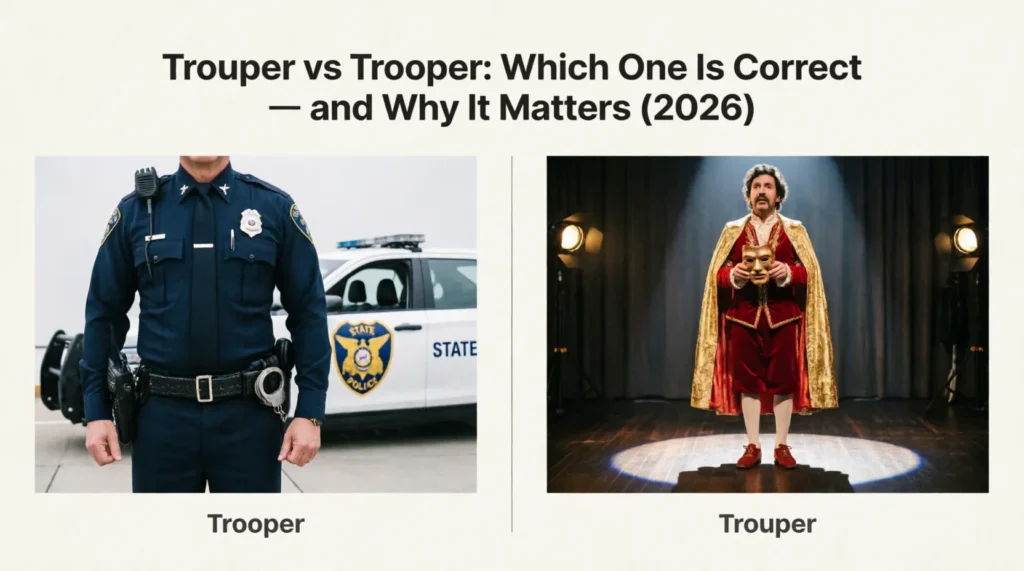
In short, both trouper and trooper are correct words, but they mean completely different things. “Trooper” usually refers to a soldier or police officer, while “trouper” describes someone dependable and resilient, especially in performance or teamwork. Understanding the difference helps you avoid one of the most common English mix-ups and write with confidence in any situation.
And once you see how different they really are, you’ll never confuse them again.
The Confusion Around trouper vs trooper
You’re writing an important email, maybe a school essay or even a job application. You want to praise someone for being reliable. You pause. Is it “trooper” or “trouper”?
That exact moment of hesitation is why the confusion around trouper vs trooper is so common. The words look almost identical, sound the same when spoken, and both feel like they could mean “someone strong or dependable.”
Even experienced writers stop and double-check this one. The difference is subtle in spelling but huge in meaning, and that’s what makes it tricky.
When you understand the real definitions, the confusion starts to disappear quickly.
What Each Word Actually Means
Let’s break down trouper vs trooper in a simple, clear way.
A trooper is a noun. It usually refers to a soldier, especially a cavalry soldier, or a police officer in certain regions like state police in the United States. It can also mean someone who shows courage in difficult situations.
Example sentence: The state trooper arrived quickly after the accident to control traffic.
A trouper is also a noun, but it has a very different meaning. It describes a person who is reliable, hardworking, and keeps going even when things are difficult. The word comes from theatrical “troupes,” meaning performing groups.
Example sentence: She’s a real trouper for finishing the project despite being sick.
So while trooper is often connected to law enforcement or military roles, trouper is about personality, attitude, and resilience.
trouper vs trooper: Side-by-Side Comparison
Here is a quick breakdown to make the trouper vs trooper easier to compare at a glance.
Feature
Trouper
Trooper
Meaning
Reliable, hardworking performer
Soldier or state police officer
Part of Speech
Noun
Noun
Formality
Neutral
Neutral
Common Context
Theater, teamwork, praise
Military, law enforcement, cavalry
Example Sentence
She’s a real trouper today.
The trooper directed traffic.
Can They Be Swapped?
No
No — each has a different meaning.
Why People Mix Up trouper vs trooper
Linguists often point out that confusion like trouper vs trooper happens because of how closely the words sound when spoken. In everyday speech, both words are pronounced almost identically, so your brain doesn’t naturally separate them by spelling.
Another reason is that both words feel emotionally similar. A trooper is brave, and a trouper is strong in character—so people assume they might be the same word or interchangeable.
There’s also a spelling trap here. English learners often expect “trouper” to be the correct spelling for someone who “troops through challenges,” which feels logical but isn’t historically accurate. That guess leads many people to swap the words incorrectly in writing.
Over time, this phonetic overlap has made trouper vs trooper one of those classic English confusion pairs that even native speakers occasionally get wrong.
The Simple Rule to Remember Which Is Which
Here’s a very easy way to lock this in your memory:
Trooper = T for Task force (military or police)
Trouper = U for “Us” (team player, dependable person)
Or even simpler:
If it’s about authority, uniforms, or official duty, use trooper. If it’s about personality, perseverance, or emotional strength, use trouper.
Examples:
The police trooper handled the roadblock efficiently.
She’s a true trouper for staying positive during tough times.
Every trooper in the unit followed orders carefully.
Once you apply this rule a few times, trouper vs trooper stops feeling confusing and starts feeling automatic.
Common Mistakes People Make With trouper vs trooper
Using “trooper” to mean a supportive friend Incorrect: He’s a real trooper for helping me move. Correct: He’s a real trouper for helping me move.
Using “trouper” in military contexts Incorrect: The trouper was deployed overseas. Correct: The trooper was deployed overseas.
Assuming both words are interchangeable Incorrect: She’s a trooper for never giving up (when meaning personality). Correct: She’s a trouper for never giving up.
Spelling based on pronunciation alone Incorrect: Writing “trooper” when describing emotional resilience. Correct: Use trouper when referring to a dependable person.
Real-World Examples: trouper vs trooper Used Correctly
Real Sentence Fix — trouper vs trooper
See the Mistake, Fix the Mistake
These are real mistakes people make with trouper vs trooper — and the simple fix for each one.
❌ Thanks for staying late to help—you were a real trooper on the project. ✅ Thanks for staying late to help—you were a real trouper on the project. 📌 Why: Use trouper to praise someone for being dependable and positive.
❌ My sister was a real trooper after helping everyone clean up the party. ✅ My sister was a real trouper after helping everyone clean up the party. 📌 Why:Trouper fits when someone keeps helping without complaining.
❌ The essay described the life of a famous trooper on the stage. ✅ The essay described the life of a famous trouper on the stage. 📌 Why: A stage performer is called a trouper, not a trooper.
❌ The game lets you play as a brave trouper in the space army. ✅ The game lets you play as a brave trooper in the space army. 📌 Why:Trooper is the correct word for a soldier or military character.
❌ A highway trouper stopped to help the stranded driver. ✅ A highway trooper stopped to help the stranded driver. 📌 Why: Police officers with that title are called troopers.
❌ Even with a sore foot, Jake was a real trooper and finished the charity walk. ✅ Even with a sore foot, Jake was a real trouper and finished the charity walk. 📌 Why:Trouper is the better choice when praising someone’s determination.
Casual conversation: “You’re such a trouper for helping me clean up after the party.” This works because it praises personal effort and attitude.
Professional writing: “The state trooper issued a formal warning at the checkpoint.” This is correct because it refers to law enforcement.
Academic writing: “Historical records describe the cavalry trooper as a key figure in battlefield mobility.” This fits the military context.
Creative writing: “The exhausted actor was a trouper, finishing the performance with a smile.” This highlights resilience and character.
British English vs. American English — Does It Affect trouper vs trooper?
The difference between trouper vs trooper is not a British vs American English issue. Both spellings are used in the same way across regions.
However, “trooper” is more commonly heard in American contexts, especially in reference to highway patrol or state police. “Trouper,” on the other hand, is widely used in both British and American English when describing someone dependable or resilient.
So no matter where you are writing from, the rule stays the same: the spelling does not change by region, only the context does.
What Grammar Checkers and Style Guides Say About trouper vs trooper
Grammar experts and style guides consistently treat trouper vs trooper as a meaning-based distinction rather than a spelling variation. Both words are considered valid, but only in their correct contexts.
Most grammar tools will not flag either word as incorrect on its own. Instead, they rely on context to judge meaning, which means you can still misuse the word without getting an error warning.
That’s why language researchers often emphasize learning the rule rather than depending on spellcheck. Tools help, but your understanding is what guarantees accuracy.
trouper vs trooper in Professional and Academic Writing
Getting trouper vs trooper right matters more than you might think in formal writing. In job applications, using the wrong word can subtly change the meaning of your praise or description.
In academic writing, especially when analyzing literature or history, incorrect usage can confuse readers or weaken your credibility. Even in everyday professional emails, using the wrong form may make your message feel less polished.
The good news is that once you clearly understand the difference, you won’t need to second-guess yourself again. It becomes one of those small but powerful writing skills that instantly improves your clarity.
Quick Recap: trouper vs trooper at a Glance
Trooper refers to soldiers, police officers, or official duty roles
Trouper refers to reliable, resilient, hardworking people
They sound identical but have completely different meanings
Context is the only reliable way to choose the correct word
Memorizing the “task force vs team player” rule makes it easy
Frequently Asked Questions About trouper vs trooper
Is it trooper or trouper for someone who never gives up?
It is trouper when you are describing someone’s personality or resilience. “Trooper” is usually reserved for military or police contexts, not emotional strength.
What is the meaning of trooper in slang?
In casual slang, “trooper” can mean someone who endures difficulty bravely, but this is informal. The more precise word for personality is still trouper.
Are trouper and trooper pronounced the same?
Yes, both words are pronounced almost identically in most English accents. This is one of the main reasons trouper vs trooper is confusing in writing.
Can trooper ever mean a good friend?
Not usually. While people sometimes use it loosely, the correct word for a supportive, dependable person is trouper.
Which word is more common in everyday English?
“Trooper” is more common in official or institutional contexts, while “trouper” appears in expressive, emotional, or descriptive language.
Final Thoughts on trouper vs trooper
The difference between trouper vs trooper comes down to meaning, not sound or spelling. One belongs to uniforms, duty, and authority, while the other belongs to character, resilience, and everyday appreciation of effort.
This is one of those English pairs that trips up many writers, but once you understand it, it becomes surprisingly simple. You now have a clear, reliable way to choose the right word every time.
And from here on out, you can write with more confidence, knowing you won’t fall into one of English’s most common spelling traps again.
Frequently Asked Questions
What is the main difference between 'trouper' and 'trooper'?▼
The main difference is that ‘trooper’ refers to a soldier or police officer, while ‘trouper’ describes someone who is reliable and resilient, particularly in performance or teamwork. Understanding these definitions helps prevent confusion in writing and communication.
Why do people often confuse 'trouper' and 'trooper'?▼
People often confuse ‘trouper’ and ‘trooper’ because they sound very similar when spoken and have related emotional connotations of strength and reliability. Additionally, English learners might incorrectly expect ‘trouper’ to relate to ‘troops’ due to phonetic similarities.
Can 'trouper' and 'trooper' be used interchangeably?▼
No, ‘trouper’ and ‘trooper’ cannot be swapped as they have distinctly different meanings. Using them incorrectly can lead to misunderstandings, especially in formal writing contexts.
How can I remember which word to use between 'trouper' and 'trooper'?▼
A simple rule to remember is: ‘Trooper’ starts with ‘T’ for Task force, relating to military or police roles, while ‘Trouper’ starts with ‘U’ for ‘Us’, which represents teamwork and dependability. This mnemonic can help clarify their usage in various contexts.
What are some example sentences using 'trouper' and 'trooper'?▼
An example sentence for ‘trooper’ is, ‘The state trooper arrived quickly after the accident to control traffic.’ For ‘trouper’, you could say, ‘She’s a real trouper for finishing the project despite being sick.’ These examples illustrate their distinct meanings.
Is there a specific context where 'trouper' is commonly used?▼
Yes, ‘trouper’ is commonly used in contexts related to theater, teamwork, or when praising someone’s perseverance in challenging situations. It highlights a person’s character and reliability under pressure.
What should I do if I’m unsure which word to use in writing?▼
If you’re unsure whether to use ‘trouper’ or ‘trooper’, consider the context of your sentence. If it relates to authority, uniforms, or official duties, use ‘trooper’; if it pertains to perseverance or teamwork, opt for ‘trouper’.
Quick Tip: The Showbiz Origin of “Trouper”
“Trouper” comes directly from “troupe” — a group of actors or performers who tour together. A “trouper” originally meant a seasoned member of a theater troupe who kept performing despite hardship, which is why “real trouper” still means someone who pushes through difficulty without complaint. “Trooper,” by contrast, has a military and law-enforcement origin (a soldier or state trooper), with no connection to the stage at all.
Maria Ramirez is an experienced editor and language consultant with over 10 years in the publishing world. She holds a Bachelor’s degree in Journalism and deeply appreciates the power of the written word. Her expertise lies in dissecting the complexities of English grammar and providing straightforward guidance for contemporary writers. Maria’s work focuses on simplifying spelling and usage rules, assisting both seasoned writers and budding authors in presenting their ideas with precision. Her involvement with WordlyRight stems from a commitment to nurture a global audience’s command over English, ensuring learners and professionals don’t just understand language nuances but use them effectively in varied contexts. As someone who passionately believes in lifelong learning, Maria continuously seeks to inspire this ethos in her readers.