In short, both “work in progress” and “work in process” are correct, but they are used in different contexts. “Work in progress” is more common in everyday writing for unfinished tasks, while “work in process” is often used in manufacturing and accounting. Understanding the difference in work in progress vs work in process helps you choose the right phrase with confidence, especially in professional writing.
You’ll never need to second-guess these two again once you understand how each one is used in real situations.
The Confusion Around work in progress vs work in process
You’re writing an email, and you want to sound professional. You pause for a second: should you say “work in progress” or “work in process”? It feels like both are correct, yet something tells you only one is right for this context.
This exact moment of hesitation is why so many people search for work in progress vs work in process. The two phrases look almost identical, and they sound like they could mean the same thing. But in real writing, choosing the wrong one can subtly change how your message is interpreted.
Maybe you’re a student finishing an assignment, or you’re updating your team on a project. You want to sound precise, not uncertain. That’s where this confusion usually shows up.
What Each Word Actually Means
To understand work in progress vs work in process, you need to break the phrases into simple, everyday meaning.
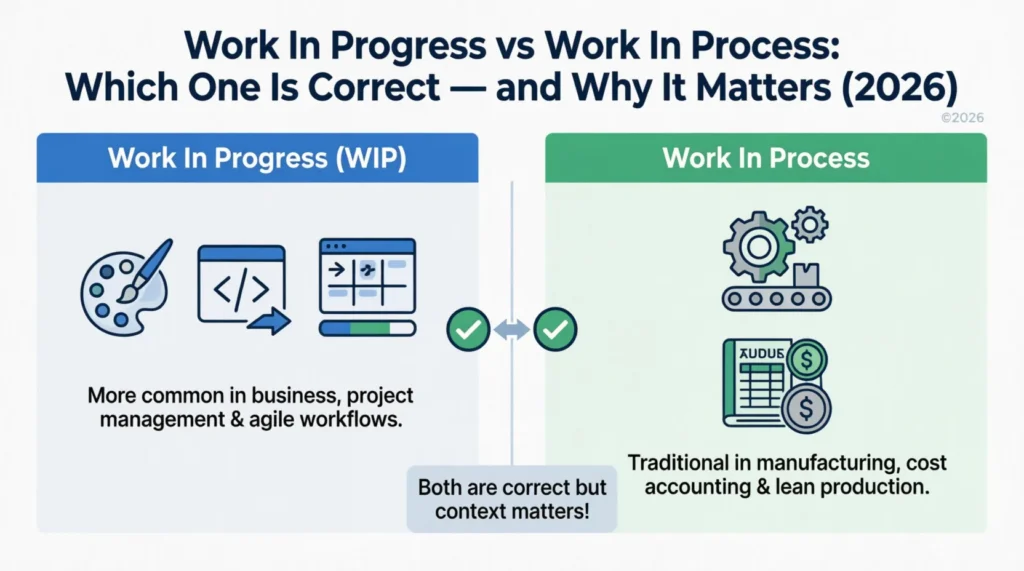
“Work in progress” is a noun phrase. It refers to something that is still being developed, improved, or completed. It’s commonly used in creative, academic, and general professional contexts. Think of it as anything unfinished but actively evolving.
Example: “This website redesign is still a work in progress.”
“Work in process” is also a noun phrase, but it is more specific. It is commonly used in manufacturing, production, and accounting. It refers to items or goods that are currently being produced but are not yet finished products.
Example: “The factory tracks all items as work in process for inventory valuation.”
In simple terms, “progress” feels broader and more general, while “process” feels technical and production-focused. That distinction is at the heart of work in progress vs work in process.
work in progress vs work in process: Side-by-Side Comparison
Insert AFTER the “What Each Word Actually Means” section
Here is a quick breakdown to make the work in progress vs work in process easier to compare at a glance.
Feature
Work in Progress
Work in Process
Meaning
Something still being completed
Items currently moving through production
Part of Speech
Noun phrase
Noun phrase
Formality
Neutral
Formal
Common Context
Writing, art, projects
Manufacturing, inventory, accounting
Example Sentence
The report is a work in progress.
The factory tracks work in process.
Can They Be Swapped?
Sometimes
Sometimes
Why People Mix Up work in progress vs work in process
Language researchers often point out that confusion like work in progress vs work in process comes from how similar the words sound and how closely related their meanings are.
Both “progress” and “process” involve movement and development, so your brain naturally groups them together. On top of that, English doesn’t always enforce strict separation between similar phrases, especially in informal writing.
Another reason is exposure. Many people see “work in progress” in everyday life—on social media, in school, or in workplace updates. Meanwhile, “work in process” shows up in specialized fields like accounting or supply chain management, so fewer people encounter it regularly. That imbalance makes one phrase feel “more correct” even though both have valid uses depending on context.
The Simple Rule to Remember Which Is Which
Here’s an easy way to lock in work in progress vs work in process:
Use “progress” when something is being developed or improved in general. Use “process” when something is being manufactured or tracked as part of production.
A quick mental test: If you’re talking about ideas, projects, writing, design, or learning → use “progress.” If you’re talking about physical goods, factories, or production stages → use “process.”
Examples:
“My novel is a work in progress.”
“The cars on the assembly line are work in process items.”
Once you apply this simple rule, work in progress vs work in process becomes much easier to navigate in real writing situations.
Common Mistakes People Make With work in progress vs work in process
Here are some of the most frequent errors people make when using work in progress vs work in process:
Using “work in process” in casual writing Incorrect: “The app redesign is a work in process.” Correct: “The app redesign is a work in progress.”
Using “work in progress” in manufacturing contexts Incorrect: “The factory reports work in progress inventory.” Correct: “The factory reports work in process inventory.”
Assuming both phrases are interchangeable everywhere Incorrect: “They mean exactly the same thing in all cases.” Correct: “They are context-dependent and used differently in industry and general writing.”
Overcorrecting based on intuition Incorrect: Choosing “process” because it sounds more formal. Correct: Choosing based on whether you’re discussing production or development.
Real Sentence Fix — work in progress vs work in process
Subtitle: See the Mistake, Fix the Mistake
Insert AFTER the “Common Mistakes People Make” section
These are real mistakes people make with the work in progress vs work in process — and the simple fix for each one.
❌ The presentation is still a work in process, so please expect changes. ✅ The presentation is still a work in progress, so please expect changes. 📌 Why: Creative and office projects usually use work in progress.
❌ My painting is finally looking better, but it’s still a work in process. ✅ My painting is finally looking better, but it’s still a work in progress. 📌 Why: Artwork and personal projects are normally called works in progress.
❌ The essay remained a work in process until the final review. ✅ The essay remained a work in progress until the final review. 📌 Why: School assignments are generally described as works in progress.
❌ The inventory report shows too much work in progress on the assembly line. ✅ The inventory report shows too much work in process on the assembly line. 📌 Why: Manufacturing and inventory reports usually use work in process.
❌ Dinner is a work in process, so it will be ready soon. ✅ Dinner is a work in progress, so it will be ready soon. 📌 Why: Everyday tasks being completed are commonly called works in progress.
❌ The software dashboard tracks every work in progress through production. ✅ The software dashboard tracks every work in process through production. 📌 Why: Production tracking systems use work in process for unfinished goods.
Real-World Examples: work in progress vs work in process Used Correctly
Casual conversation: “Don’t worry about my presentation slides—they’re still a work in progress.” This is correct because it refers to ongoing development.
Professional writing: “The marketing campaign is a work in progress and will be finalized next week.” This shows a project still being refined.
Manufacturing context: “All partially assembled units are recorded as work in process inventory.” This is correct because it refers to production tracking.
Academic writing: “The researcher described the study as a work in progress due to incomplete data.” This is appropriate for an evolving research project.
Each example highlights how work in progress vs work in process depends entirely on context rather than strict grammar rules.
British English vs. American English — Does It Affect work in progress vs work in process?
In both British and American English, “work in progress” is the dominant phrase for general use. It is widely accepted in writing, speech, and media across regions.
“Work in process,” however, is more consistently used in accounting and manufacturing terminology, especially in business documentation. This usage is fairly standard in both regions, although American business writing may use it slightly more frequently in financial reporting.
There is no major regional split in meaning. Instead, the difference in work in progress vs work in process is based on industry context rather than geography. Linguists often note that this is one of those rare cases where specialization matters more than dialect.
What Grammar Checkers and Style Guides Say About work in progress vs work in process
Most grammar tools will accept both phrases, but they may not always flag incorrect usage based on context. For example, they typically won’t question “work in process” unless the surrounding sentence clearly signals a non-manufacturing context.
Style guides generally follow practical usage rather than strict rules. In writing guidance, “work in progress” is recommended for general communication, while “work in process” is reserved for technical and financial documentation.
This means your judgment still matters. Tools can help, but they don’t always understand whether you are describing a creative project or a production line. Knowing the difference in work in progress vs work in process is more reliable than relying on automated correction alone.
work in progress vs work in process in Professional and Academic Writing
Getting work in progress vs work in process right matters more in formal contexts than in casual conversation. In job applications, reports, research papers, or business documentation, using the wrong phrase can make your writing feel slightly off or less precise.
For example, describing a research paper as “work in process” may confuse readers who expect a manufacturing meaning. On the other hand, using “work in progress” in financial inventory reporting might seem inaccurate in technical settings.
In professional writing, clarity builds credibility. Once you understand the distinction, you can express yourself more accurately without hesitation. And over time, you’ll notice you rarely need to stop and think about it again.
Quick Recap: work in progress vs work in process at a Glance
“Work in progress” is used for general unfinished projects and ideas
“Work in process” is used in manufacturing and accounting contexts
The confusion comes from similar meanings and similar wording
Context matters more than strict grammar rules
“Progress” = development, “process” = production
Frequently Asked Questions About work in progress vs work in process
Is it work in progress or work in process?
Both are correct, but they are used in different situations. “Work in progress” is used for general tasks or projects that are not finished. “Work in process” is mainly used in manufacturing or accounting contexts.
Can I use work in process instead of work in progress?
You can, but only if you are referring to production or inventory. In everyday writing, “work in progress” is almost always the better choice. Using the wrong one may sound unnatural to readers.
Why do companies use work in process?
Companies use “work in process” because it is a technical term in accounting. It helps track the value of goods that are partially completed during manufacturing. It is not typically used for creative or general projects.
Which is more common: work in progress vs work in process?
“Work in progress” is far more common in everyday language. “Work in process” is limited to specific professional fields, especially manufacturing and finance.
Does work in progress mean the same as unfinished?
Yes, in general usage it means something is not finished yet but is actively being developed. However, it often implies movement and improvement, not just being incomplete.
Final Thoughts on work in progress vs work in process
The difference between work in progress vs work in process is simpler than it first appears. One is for general development, and the other is for production and accounting contexts.
This is one of those English distinctions that can feel confusing at first but quickly becomes second nature once you see it in real examples. Many writers struggle with it, so you are not alone in questioning it.
Now that you understand the difference clearly, you can use both phrases confidently and accurately in any situation, without hesitation holding you back again.
Frequently Asked Questions
What is the main difference between 'work in progress' and 'work in process'?▼
‘Work in progress’ refers to something that is still being developed or completed, commonly used in creative and general professional contexts. In contrast, ‘work in process’ is specific to manufacturing and accounting, indicating items that are currently being produced but are not yet finished.
In which contexts should I use 'work in progress'?▼
‘Work in progress’ is best used in creative, academic, or general professional writing when referring to unfinished tasks or projects. For example, you might say, ‘The report is a work in progress’ when discussing ongoing work.
When is it appropriate to use 'work in process'?▼
‘Work in process’ is appropriate in formal settings like manufacturing, production, and accounting. It refers to items actively moving through production, such as ‘The factory tracks work in process for inventory valuation.’
Why do people confuse 'work in progress' with 'work in process'?▼
The confusion arises because the phrases sound similar and both involve movement and development. Additionally, ‘work in progress’ is more commonly encountered in everyday language, making it feel more familiar and correct to many.
Can 'work in progress' and 'work in process' be used interchangeably?▼
They can be swapped in some contexts, but it’s important to consider the specific meaning you wish to convey. Using ‘work in progress’ in a creative context and ‘work in process’ in a technical or manufacturing context will ensure clarity.
How can I remember which phrase to use in my writing?▼
A simple rule is to use ‘progress’ when referring to something that is evolving or being developed, like a project or report. Use ‘process’ when discussing items currently in production or inventory, particularly in technical fields.
What are some examples of 'work in progress' and 'work in process'?▼
An example of ‘work in progress’ is, ‘This website redesign is still a work in progress.’ An example of ‘work in process’ is, ‘The factory tracks all items as work in process for inventory valuation,’ highlighting its usage in manufacturing.
James Williams has been fascinated by the intricacies of the English language since his childhood days. Holding a Master’s degree in Linguistics from the University of Cambridge, he has spent over 15 years working as a professional editor and language consultant. James specializes in deciphering complex spelling and grammatical issues, and he is passionate about helping students and professionals alike gain confidence in their writing. His experience includes developing educational content for ESL learners, ensuring clarity and precision in communication. James is dedicated to providing readers with easy-to-follow guidance that resolves word confusions and common spelling errors, making WordlyRight an essential resource for anyone who needs quick, authoritative answers.