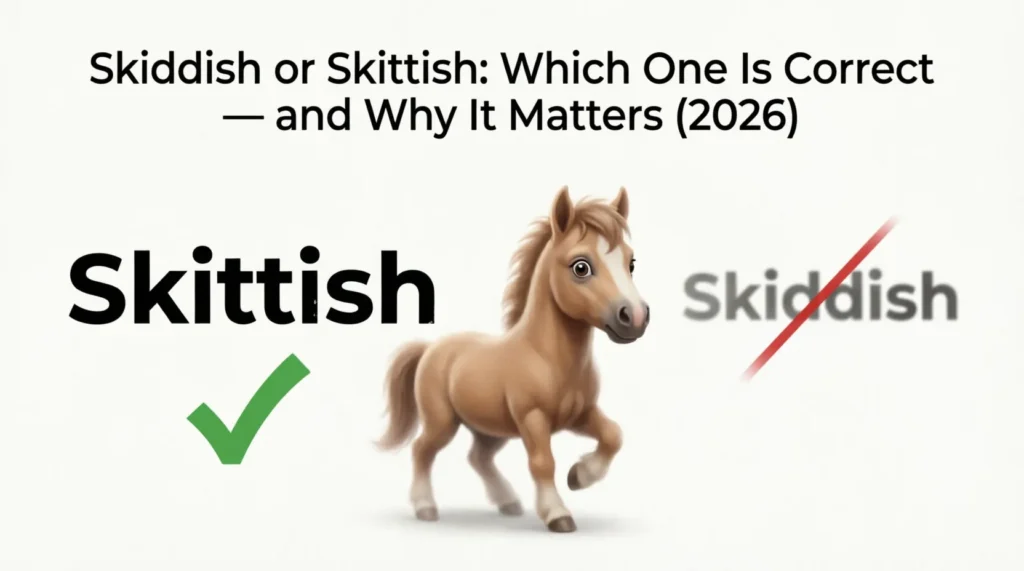
In short, the correct spelling is skittish, while “skiddish” is a common misspelling that appears due to how the word sounds when spoken quickly. People often assume there is a “d” in the middle, but standard English does not include it. Understanding this difference will help you avoid one of the most frequent spelling mistakes in everyday writing.
The Confusion Around Skiddish or Skittish
You’re writing an email, and you pause for a second. Is it “skiddish” or “skittish”? It looks familiar either way, and your fingers hover over the keyboard as autocorrect underlines it in red. That small moment of doubt is exactly where most people get stuck with skiddish or skittish.
Maybe you’ve seen both versions online. Maybe a friend uses one spelling, and your brain starts to question what’s actually right. This confusion is extremely common, especially when you’re typing quickly or relying on how the word sounds in your head.
The truth is, skiddish or skittish is not a real “either-or” situation. One is correct, and one is simply a repeated error that has spread through informal writing and social media.
What Each Word Actually Means
Let’s break this down in a simple, no-stress way so you can finally feel confident using the right form.
Skittish is a real adjective. It describes someone or something that is easily frightened, nervous, or quick to react. It is often used for animals, especially horses, but also for people who are jumpy or anxious in certain situations.
For example: A skittish horse might run away at a sudden sound, even if there is no real danger.
Now, “skiddish” is not a recognized word in standard English. It does not appear in formal dictionaries as a correct spelling. It is simply a misspelling of skittish that has become popular because of how the word is pronounced.
For example: If someone writes, “The cat is skiddish around strangers,” the correct version would be, “The cat is skittish around strangers.”
When you compare skiddish or skittish, only skittish is correct in formal, academic, and professional writing.
Why People Mix Up Skiddish or Skittish
Language researchers often point out that spelling confusion usually comes from sound-based guessing. That is exactly what happens with skiddish or skittish. When people hear the word spoken quickly, the middle consonant sound can feel like a “d” is present.
Another reason is pattern overgeneralization. English has many words ending in “-ish,” and people sometimes insert letters that feel “natural,” even when they are not part of the original spelling.
There is also a psychological factor. Your brain tries to make spelling “fit” familiar patterns, so “skiddish” looks more balanced or logical at first glance. But English spelling is not always logical in that way, and skittish simply follows its own historical form.
The Simple Rule to Remember Which Is Which
Here’s an easy way to lock it in your memory when thinking about skiddish or skittish:
If you can hear a “d” in your head, ignore it — it does not exist in the correct spelling.
The real word is skittish, with a double “t” and no “d.” Think of it as being “quick and jumpy,” just like the double “t” gives the word a quick, staccato feel.
Try these examples:
The dog became skittish during the thunderstorm and hid under the bed.
You might feel skittish before giving a big presentation, even if you are well-prepared.
The crowd grew skittish when the lights suddenly went out.
Once you train yourself to remove the “d,” skiddish or skittish becomes an easy choice every time.
Common Mistakes People Make With Skiddish or Skittish
Using “skiddish” in formal writing Correct: The horse is skittish around loud noises.
Trusting autocorrect without checking meaning Correct: He felt skittish before the interview.
Assuming pronunciation equals spelling Correct: The skittish cat avoided strangers.
Copying informal online usage Correct: She seemed skittish in unfamiliar situations.
Real-World Examples: Skiddish or Skittish Used Correctly
Casual conversation: “My cat is skittish, so she hides when guests arrive.” This works because you’re describing natural animal behavior in a relaxed tone.
Professional writing: “The market became skittish after the unexpected announcement.” Here, skittish describes unstable investor behavior in a formal context.
Academic writing: “Participants were skittish when exposed to sudden environmental changes.” This shows controlled, research-based usage of the term.
Creative writing: “The skittish deer paused at the edge of the forest before disappearing into the mist.” This adds emotional tone and imagery, making the scene more vivid.
Each example shows why skittish is the only correct choice when comparing skiddish or skittish.
British English vs. American English — Does It Affect Skiddish or Skittish?
When it comes to skiddish or skittish, there is no regional spelling difference. Both British and American English use skittish as the standard form.
That means “skiddish” is not accepted in either region’s formal writing standards. Grammar experts and style guides across English-speaking countries consistently recognize only one spelling.
So no matter where you are writing from, the correct answer stays the same.
What Grammar Checkers and Style Guides Say About Skiddish or Skittish
Most grammar tools and style references treat “skiddish” as a spelling error and automatically suggest “skittish” instead. However, context still matters, because the correction relies on recognizing the intended meaning.
Style guides consistently list skittish as the standard adjective, especially in formal writing and publishing contexts. Even advanced spellcheck tools may occasionally miss the nuance if the surrounding sentence is unclear.
The key takeaway is simple: tools help, but your understanding of skiddish or skittish is what ensures accuracy every time.
Skiddish or Skittish in Professional and Academic Writing
In professional communication, small spelling mistakes can affect how polished your writing appears. Using “skiddish” instead of skittish may not completely change your meaning, but it can distract the reader.
In academic writing, precision matters even more. Words like skittish are often used in psychology, animal behavior studies, and social analysis, where accuracy builds credibility.
Once you fully understand skiddish or skittish, you eliminate a small but noticeable error from your writing. That gives you more confidence in emails, essays, reports, and even creative work.
And the good news is simple: once you learn it, you are very unlikely to forget it.
Quick Recap: Skiddish or Skittish at a Glance
The correct spelling is skittish
“Skiddish” is a common but incorrect misspelling
The word describes nervous or easily startled behavior
No regional English variation changes the spelling
The confusion comes from pronunciation and pattern guessing
Frequently Asked Questions About Skiddish or Skittish
Is skiddish a real word?
No, “skiddish” is not recognized as a standard English word. It is simply a common misspelling of skittish that appears in informal writing.
What does skittish mean in simple terms?
Skittish means easily frightened, nervous, or jumpy. It is often used to describe animals or people who react quickly to unexpected situations.
Why do people spell skittish as skiddish?
People often add a “d” because of how the word sounds when spoken quickly. The brain tries to match pronunciation with familiar spelling patterns.
Is skittish only used for animals?
No, skittish can describe both animals and people. It is commonly used for nervous behavior in general situations, not just animal behavior.
How can I remember the correct spelling of skittish?
A simple trick is to remember: there is no “d” in skittish. Focus on the double “t,” which reflects its quick, jumpy meaning.
Final Thoughts on Skiddish or Skittish
The difference between skiddish or skittish is actually very simple once you see it clearly. One is a frequent spelling mistake, and the other is the correct, widely accepted form used in all types of writing.
Now that you understand how skittish works, you can write with more confidence and avoid one of the most common English spelling errors. Every time you use it correctly, your writing becomes a little more precise and professional — and that adds up over time.
You’ve now got a clear rule, a clear example set, and a clear understanding you can rely on going forward.
Emily Thornton holds a Master’s degree in Linguistics from the University of Chicago and has been passionate about language education for over 15 years. Her interest in language developed at a young age, fueled by a curiosity for how intricacies in language shape communication. Emily has authored several guides on grammar usage and works extensively with ESL learners to improve their fluency and confidence in English. Dedicated to clarity, she writes content that demystifies complex spelling and grammar issues, making her contributions invaluable for professionals looking for authoritative and swift language solutions. Emily continues to explore innovative ways to bridge communication gaps through accurate and effective language use. Her blend of academic rigor and practical insight ensures learners across all levels find her advice beneficial.