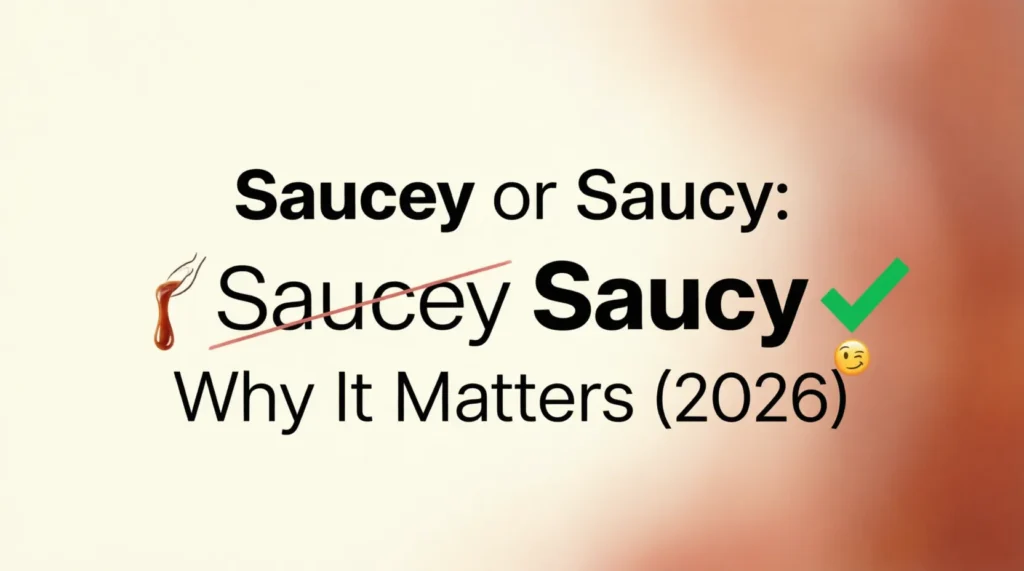
In short, the correct standard English word is “saucy,” which is an adjective meaning bold, cheeky, or full of flavor. “Saucey” is generally considered a misspelling, although you may still see it in branding or casual internet usage. Understanding this difference helps you write with more confidence and avoid a very common spelling mistake.
The Confusion Around saucey or saucy
At some point, you’ve probably paused while writing and wondered whether it’s “saucey or saucy.” Maybe you were typing a caption for social media, writing a school essay, or drafting a fun message and suddenly second-guessed yourself.
It looks like both versions could be correct, especially because English is full of strange spelling patterns. When you’re unsure, your brain tries to “fix” the word based on how it sounds, which often leads you toward “saucey or saucy” confusion.
This mix-up is extremely common because both versions look believable. But only one of them is actually accepted in standard English writing.
What Each Word Actually Means
Let’s break down “saucey or saucy” in simple terms so you can finally see the difference clearly.
The word “saucy” is a real, standard adjective. It has two main meanings depending on context. First, it can describe someone who is a bit bold, cheeky, or disrespectful in a playful way. For example, you might say, “She gave a saucy reply to her teacher,” meaning it was slightly rude but in a playful or confident way.
Second, “saucy” can describe food that is rich in sauce or has a strong, flavorful taste. For example, “This pasta is saucy and delicious” means it has plenty of sauce and flavor.
On the other hand, “saucey” is not a recognized standard English word. It is commonly a spelling mistake that comes from assuming the word should follow a simple “-y” pattern from “sauce.” In everyday writing, “saucey” is usually corrected to “saucy.”
So when you are choosing between “saucey or saucy,” only “saucy” works in proper grammar and formal communication.
saucey or saucy: Side-by-Side Comparison
Here is a quick breakdown to make the saucey or saucy easier to compare at a glance.
Feature
Saucey
Saucy
Meaning
Misspelling of saucy
Bold, cheeky, or flavorful
Part of Speech
Not a standard word
Adjective
Formality
Not appropriate
Neutral
Common Context
Typing mistakes
Food, personality, humor
Example Sentence
She looked saucey.
She made a saucy comment.
Can They Be Swapped?
No
No — saucey is a misspelling.
Why People Mix Up saucey or saucy
The confusion between “saucey or saucy” happens for a few very natural reasons. First, the word “sauce” is right there in the spelling, so your brain tries to connect it logically by adding a “-y” ending. This feels consistent, even though English spelling doesn’t always follow logic.
Second, pronunciation plays a role. When you say “saucy” out loud, it sounds like it could easily be spelled “saucey,” especially if you’re not thinking about standard spelling rules. Linguists often point out that English spelling errors usually come from sound-based assumptions rather than ignorance.
Finally, social media and informal writing make this confusion worse. You might see “saucey” used in usernames, captions, or branding, which makes it look acceptable even though it is not standard English. That repeated exposure reinforces the mistake.
The Simple Rule to Remember Which Is Which
Here’s an easy way to remember “saucey or saucy” forever: if you can hear “sauce” inside the word, drop the “e” before adding “-y.”
That’s the key rule: sauce → saucy, not “saucey.”
Try this mental shortcut: English often removes the final “e” before adding “y” to form adjectives. That pattern applies here.
For example:
The pasta is so rich and saucy, it drips with flavor.
His message was a little saucy, but everyone laughed.
That comment sounded funny, almost saucy, not serious.
Once you train your eye to spot the missing “e” rule, you will stop hesitating when you see “saucey or saucy” again.
Common Mistakes People Make With saucey or saucy
Here are some realistic mistakes people often make when using “saucey or saucy” in writing:
Writing “saucey pasta is delicious” instead of “saucy pasta is delicious” — the adjective is misspelled because of direct association with “sauce.”
Using “saucey attitude” in a school essay — the intended word is “saucy,” meaning cheeky or bold.
Assuming both spellings are correct in casual writing — only “saucy” is accepted in standard English.
Overcorrecting to “saucyy” or other variations — this happens when you try to guess the pattern instead of applying the rule.
Each mistake is understandable, especially when you are writing quickly, but correcting it makes your writing look much more polished.
Real Sentence Fix — saucey or saucy
See the Mistake, Fix the Mistake
These are real mistakes people make with saucey or saucy — and the simple fix for each one.
❌ The client liked our saucey marketing campaign. ✅ The client liked our saucy marketing campaign. 📌 Why: Saucy is the correct spelling for describing something bold or playful.
❌ That was a saucey reply to your friend. ✅ That was a saucy reply to your friend. 📌 Why: English dictionaries recognize saucy, not saucey.
❌ The author uses a saucey tone in the novel. ✅ The author uses a saucy tone in the novel. 📌 Why: The adjective saucy is the standard word in academic writing.
❌ My post got comments saying it sounded saucey. ✅ My post got comments saying it sounded saucy. 📌 Why: The spelling saucy is correct in online messages and posts too.
❌ That pasta tastes really saucey today. ✅ That pasta tastes really saucy today. 📌 Why: Saucy can describe food with plenty of sauce.
❌ Your little joke was pretty saucey. ✅ Your little joke was pretty saucy. 📌 Why: Use saucy when describing someone as cheeky or playful.
Real-World Examples: saucey or saucy Used Correctly
“The chef served a saucy pasta dish that impressed everyone at the table.” This works in food writing because “saucy” describes richness and flavor.
“She gave a saucy smile after winning the debate.” This fits informal or creative writing, where “saucy” means playful confidence.
“Your tone in this email sounds a bit saucy, so you may want to soften it.” This is professional writing where tone matters.
“The novel features a saucy character who always speaks her mind.” This shows creative storytelling usage.
Each example shows how “saucy” fits naturally, while “saucey” would immediately look incorrect in all of them.
British English vs. American English — Does It Affect saucey or saucy?
When it comes to “saucey or saucy,” there is no meaningful difference between British and American English. Both regions use “saucy” as the correct spelling.
Unlike words such as “colour/color” or “realise/realize,” this is not a regional variation issue. The spelling “saucey” is not standard in either form of English.
So no matter where you are writing—whether for school, work, or online content—you should always use “saucy.” This consistency makes it easier to avoid confusion globally.
What Grammar Checkers and Style Guides Say About saucey or saucy
Most grammar checkers and writing tools will flag “saucey” as an error and suggest replacing it with “saucy.” This is because standard style guides and grammar conventions recognize only “saucy” as correct.
Style guides also emphasize that spelling should follow established usage rather than phonetic guesswork. In this case, “saucy” is the historically accepted form.
However, tools are not perfect. Sometimes autocorrect may miss context or allow informal spellings in creative writing. That’s why understanding the rule yourself is more reliable than depending on software alone.
saucey or saucy in Professional and Academic Writing
In professional and academic writing, getting “saucey or saucy” right matters more than you might think. Even small spelling errors can affect how polished and credible your writing appears.
If you use “saucey” in a job application, essay, or published article, it may suggest carelessness, even if the rest of your writing is strong. Readers often judge writing quality quickly based on small details.
The good news is that once you know the rule, you will never need to hesitate again. Using “saucy” correctly helps you sound more confident, precise, and professional in every context.
Quick Recap: saucey or saucy at a Glance
The correct spelling is saucy
“Saucy” can mean cheeky or full of flavor
“Saucey” is a common misspelling
Both British and American English use the same form
Grammar tools will usually correct “saucey” to “saucy”
Frequently Asked Questions About saucey or saucy
Is “saucey” a real word in English?
No, “saucey” is not recognized as a standard English word. It is usually considered a spelling mistake. The correct form is “saucy,” which is used in both formal and informal writing.
What does “saucy” mean in slang?
In slang, “saucy” often means bold, cheeky, or slightly disrespectful in a playful way. It can also describe someone who is confidently teasing or humorous.
Why do people write “saucey” instead of “saucy”?
People often write “saucey” because they associate it directly with the word “sauce.” Since English pronunciation can be misleading, the extra “e” feels natural even though it is incorrect.
Can I ever use “saucey” in creative writing?
Only if you are intentionally using it for branding, a username, or stylistic effect. In standard writing, “saucy” should always be used instead.
Is “saucy” formal or informal?
“Saucy” can be both. It works in formal writing when describing food and in informal writing when describing attitude or tone, depending on context.
Final Thoughts on saucey or saucy
The difference between “saucey or saucy” is simple once you see it clearly: only “saucy” is correct in standard English, while “saucey” is a frequent but incorrect spelling variation.
This is one of those small language details that can easily trip you up, but now you have a clear rule and real examples to guide you. With this understanding, you can write more confidently in school, work, and everyday communication.
From here on, you won’t need to second-guess yourself—you already know which form is right, and that makes you a more precise and confident writer.
Frequently Asked Questions
What does the word 'saucy' mean?▼
‘Saucy’ is an adjective that describes someone who is bold, cheeky, or playful in a slightly disrespectful way. It can also refer to food that is rich in sauce or has a strong, flavorful taste, making it a versatile word in different contexts.
Why is 'saucey' considered a misspelling?▼
‘Saucey’ is not recognized as a standard English word and is typically seen as a spelling mistake. It arises from the assumption that the word should follow a simple ‘-y’ pattern from ‘sauce’, which is incorrect in formal writing.
How can I remember the difference between 'saucey' and 'saucy'?▼
A helpful rule to remember is that if you can hear ‘sauce’ in the word, drop the ‘e’ before adding ‘-y’. This means you should use ‘saucy’ instead of ‘saucey’ when forming the adjective.
What are some common contexts where people confuse 'saucey' and 'saucy'?▼
The confusion often occurs in casual writing such as social media posts, captions, or branding where ‘saucey’ might be mistakenly used. This frequent exposure can reinforce the incorrect spelling as acceptable, even though ‘saucy’ is the proper term.
Can 'saucey' and 'saucy' be used interchangeably?▼
No, they cannot be swapped because ‘saucey’ is a misspelling and not recognized in standard English. Only ‘saucy’ is appropriate for proper grammar and formal communication.
How does pronunciation contribute to the confusion between 'saucey' and 'saucy'?▼
When spoken aloud, ‘saucy’ can sound like it could be spelled ‘saucey’, leading to misunderstandings. This phonetic similarity may cause people to mistakenly assume the spelling should follow a sound-based logic instead of standard English rules.
What should I do if I’m unsure which spelling to use in my writing?▼
If you’re unsure whether to use ‘saucey’ or ‘saucy’, stick with ‘saucy’ as it is the only correct form in standard English. Additionally, you can remember the rule about dropping the ‘e’ when forming adjectives from words ending in ‘e’.
Rebecca Nguyen brings a diverse background in journalism and education to her role at WordlyRight. A graduate of the University of Toronto with a focus in English and Linguistics, she has spent over 12 years honing her skills as a writer and educator. Rebecca’s expertise lies in her ability to simplify daunting grammar rules and rectify frequent spelling mistakes in a way that resonates with students and professionals alike. Her articles on WordlyRight zero in on the most common word confusions encountered by writers, turning complex concepts into clear, actionable insights. With a passion for lifelong learning, Rebecca continually seeks to refine her understanding of language to better serve her audience.