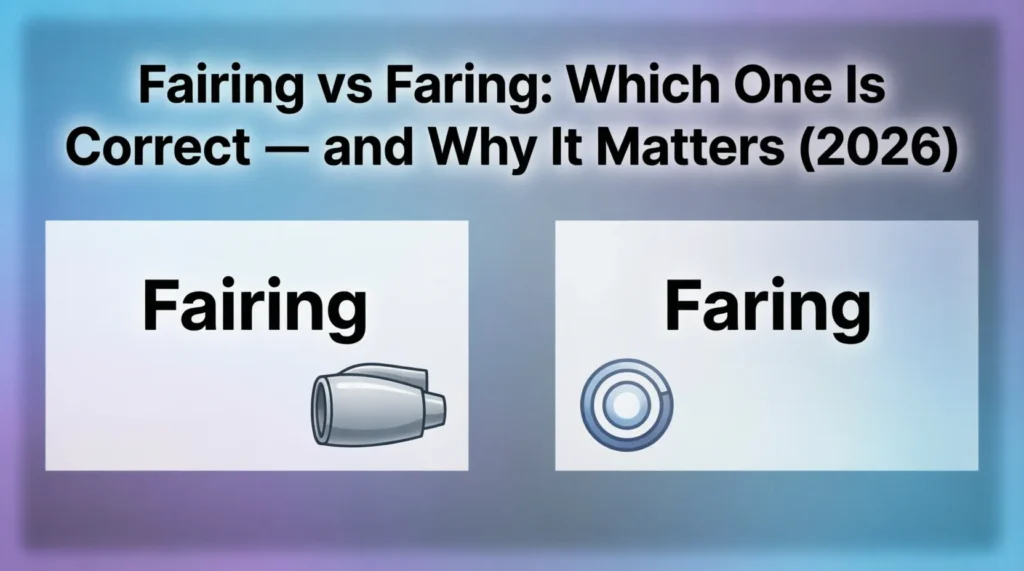
In short, “faring” is the correct word when talking about how someone is doing or coping, while “fairing” is a completely different word related to smoothing shapes in engineering or motorcycle design. The confusion in fairing vs faring is extremely common, and understanding the difference will instantly improve your writing confidence going forward.
The Confusion Around fairing vs faring
You’re halfway through writing an email, and you pause. Is it “How are you fairing?” or “How are you faring?” It looks simple, but suddenly your confidence drops, and you start second-guessing every version you type.
This exact moment happens to students, bloggers, and professionals every day. The confusion around fairing vs faring is one of those small grammar traps that can quietly slip into your writing without warning.
Even native speakers stop and hesitate here. The words sound identical when spoken, but in writing, only one actually fits the meaning you want.
What Each Word Actually Means
Let’s break this down in a clear, human way so you can finally stop guessing when you see fairing vs faring.
“Faring” comes from the verb “fare,” which means to perform, progress, or cope in a situation. It is a verb form used when talking about how someone is doing.
For example, you might say: “How are you faring after the exam?” Here, you’re asking how someone is managing or coping.
On the other hand, “fairing” is a noun or verb used mainly in engineering, aviation, and automotive design. It refers to a structure added to reduce drag or improve airflow by smoothing surfaces.
For example: “The motorcycle has a new aerodynamic fairing.” Here, “fairing” refers to a physical part, not a condition or feeling.
So when comparing fairing vs faring, only “faring” works in everyday emotional or conversational English. “Fairing” is technical and physical.
fairing vs faring: Side-by-Side Comparison
Here is a quick breakdown to make the fairing vs faring easier to compare at a glance.
Feature
Fairing
Faring
Meaning
Streamlined covering on a vehicle
Getting along or progressing
Part of Speech
Noun
Verb (present participle)
Formality
Neutral
Neutral
Common Context
Motorcycles, aircraft, engineering
Health, work, daily life
Example Sentence
The bike needed a new fairing.
She is faring well this year.
Can They Be Swapped?
No
No
Vehicle part
Describes progress or condition
Why People Mix Up fairing vs faring
Language researchers often point out that this confusion happens because both words sound identical when spoken aloud. This is called a homophone effect, where two words share pronunciation but not meaning.
Another reason fairing vs faring gets mixed up is spelling intuition. People assume “fairing” looks more correct because “fair” is a familiar word associated with correctness or quality.
There’s also a psychological pattern at play: your brain tries to connect unfamiliar grammar to familiar root words. Since “fair” is common, your mind mistakenly attaches it to emotional contexts where “faring” should actually be used.
So even if you’ve seen both words before, your memory may still push you toward the wrong one when writing quickly.
The Simple Rule to Remember Which Is Which
Here’s an easy rule that will make fairing vs faring stick instantly:
If you can replace the word with “doing” or “coping,” use faring. If you’re talking about a physical structure that smooths or covers something, use fairing.
That’s it. One is emotional or situational, the other is physical and technical.
Try these examples:
“How are you faring in your new job?” (How are you doing?)
“The athlete is faring well under pressure.” (Managing well)
“The aircraft fairing reduces air resistance.” (Physical structure)
Once you apply this rule a few times, fairing vs faring becomes much easier to separate in your mind.
Common Mistakes People Make With fairing vs faring
Here are real-world mistakes people often make when dealing with fairing vs faring:
Using “fairing” in emotional questions Wrong: “How are you fairing today?” Correct: “How are you faring today?”
Assuming “fairing” is just a spelling variation Wrong: “She is fairing well after surgery.” Correct: “She is faring well after surgery.”
Using “faring” in engineering contexts Wrong: “The bike faring is broken.” Correct: “The bike fairing is broken.”
Mixing both words in formal writing Wrong: “The system is fairing well with the new fairing design.” Correct: “The system is faring well with the new fairing design.”
Each mistake comes from pronunciation confusion, but once you slow down and check meaning, the correction becomes obvious.
Real Sentence Fix — fairing vs faring
See the Mistake, Fix the Mistake
These are real mistakes people make with the fairing vs faring — and the simple fix for each one.
❌ The manager asked how the new team was fairing after the merger. ✅ The manager asked how the new team was faring after the merger. 📌 Why: Use “faring” when talking about how someone is doing.
❌ Just checking how you’re fairing after your trip. ✅ Just checking how you’re faring after your trip. 📌 Why: “Faring” describes a person’s condition or progress.
❌ The research paper examined how students were fairing during online classes. ✅ The research paper examined how students were faring during online classes. 📌 Why: The sentence is about students’ progress, so “faring” is correct.
❌ The software dashboard shows how the servers are fairing under heavy traffic. ✅ The software dashboard shows how the servers are faring under heavy traffic. 📌 Why: “Faring” is used when describing performance or results.
❌ My brother is fairing much better since changing jobs. ✅ My brother is faring much better since changing jobs. 📌 Why: Use “faring” when talking about someone’s situation or success.
❌ The mechanic replaced the damaged faring on the motorcycle. ✅ The mechanic replaced the damaged fairing on the motorcycle. 📌 Why: “Fairing” is the name of the protective outer panel on a vehicle.
Real-World Examples: fairing vs faring Used Correctly
Here’s how fairing vs faring works in real-life situations:
Casual conversation: “I heard you moved cities—how are you faring there?” This is correct because it asks about personal adjustment.
Professional email: “We hope your team is faring well during the transition period.” This is appropriate formal usage in workplace communication.
Academic writing: “Participants faring poorly under stress were excluded from analysis.” This uses “faring” in a research context.
Technical writing: “The drone’s aerodynamic fairing improves stability at high speed.” This is correct because it describes a physical component.
Each example shows how meaning, not spelling instinct, decides the correct word in fairing vs faring.
British English vs. American English — Does It Affect fairing vs faring?
In the case of fairing vs faring, there is no significant difference between British and American English usage. Both varieties use “faring” for the verb meaning “doing or coping,” and “fairing” for mechanical or aerodynamic structures.
This confusion is global because it is based on sound, not regional spelling rules. Unlike words such as “colour/color,” both forms here exist independently with different meanings rather than being regional variants.
So no matter where you write—UK, US, or elsewhere—the same rule applies consistently.
What Grammar Checkers and Style Guides Say About fairing vs faring
Most grammar tools and style guides treat fairing vs faring as a meaning-based distinction rather than a spelling preference. They typically flag “fairing” when used in emotional or situational contexts because it is incorrect in that usage.
Spellcheck alone often fails here because both words are valid English words. That means your software might not catch the mistake if the sentence is grammatically structured correctly.
Linguists and grammar experts consistently emphasize that context matters more than spelling recognition. Understanding meaning is more reliable than depending entirely on automated correction tools.
fairing vs faring in Professional and Academic Writing
Getting fairing vs faring right matters more than it seems, especially in professional or academic writing. A single incorrect word can change how polished your writing appears to employers, professors, or readers.
In job applications or business emails, using “fairing” instead of “faring” can create confusion or make your message feel less precise. In academic writing, accuracy is even more important because word choice reflects your understanding of the subject.
The good news is that once you fully understand this distinction, you will rarely second-guess yourself again. This is one of those grammar rules that quickly becomes automatic with a little awareness.
Quick Recap: fairing vs faring at a Glance
“Faring” = how someone is doing or coping
“Fairing” = a physical aerodynamic structure
Only “faring” works in emotional or situational contexts
“Fairing” is used in engineering, motorcycles, and aviation
The confusion comes from identical pronunciation
Frequently Asked Questions About fairing vs faring
Is it “how are you fairing” or “how are you faring”?
The correct phrase is “how are you faring.” It refers to how someone is doing or coping in a situation. “Fairing” is incorrect in this context because it refers to a physical structure, not a state of well-being.
What does “faring” mean in simple English?
“Faring” means doing, coping, or managing in a situation. It is used to describe how well or poorly someone is handling something in life, work, or health.
What is a fairing on a motorcycle?
A fairing is a smooth outer covering on a motorcycle or vehicle designed to reduce air resistance. It improves speed, stability, and fuel efficiency by shaping airflow.
Why do people confuse fairing and faring?
People confuse them because they sound identical when spoken. The similarity in pronunciation makes it easy to mix them up, even though they have completely different meanings.
Can “fairing” ever mean doing well?
No, “fairing” does not mean doing well. It only refers to a physical object in engineering contexts. For performance or condition, you must use “faring.”
Final Thoughts on fairing vs faring
The difference between fairing vs faring comes down to meaning, not appearance. One describes how someone is doing, and the other describes a physical structure designed for aerodynamics.
This is one of those small English distinctions that once understood, removes a lot of writing hesitation. You’re now equipped to use both words correctly and confidently in any context.
With this clarity, you can move forward without second-guessing one of the most common word confusions in English writing.
Frequently Asked Questions
What is the difference between 'fairing' and 'faring'?▼
‘Faring’ refers to how someone is doing or coping in a situation, while ‘fairing’ is related to structures in engineering that reduce drag or improve airflow. Understanding this distinction is crucial for clear communication.
When should I use 'faring' in a sentence?▼
You should use ‘faring’ when you can replace it with words like ‘doing’ or ‘coping.’ For example, you might say, ‘How are you faring after the exam?’ to ask about someone’s well-being.
Can 'fairing' and 'faring' be used interchangeably?▼
No, ‘fairing’ and ‘faring’ cannot be swapped as they serve different purposes. ‘Fairing’ is a noun or verb related to physical structures, while ‘faring’ is a verb that describes progress or emotional states.
Why do people confuse 'fairing' and 'faring'?▼
The confusion arises from their identical pronunciation, which is a classic case of homophones. Additionally, the spelling of ‘fairing’ might seem more familiar due to the common word ‘fair,’ leading to misunderstandings.
What is a simple way to remember when to use 'faring'?▼
A straightforward rule is to use ‘faring’ when you can substitute it with ‘doing’ or ‘coping.’ If the context relates to a physical structure, use ‘fairing’ instead.
Can you provide an example of 'fairing' in a sentence?▼
Certainly! An example of ‘fairing’ used correctly would be, ‘The motorcycle has a new aerodynamic fairing.’ Here, it refers to a part that improves the vehicle’s performance.
How does understanding the difference between 'fairing' and 'faring' improve my writing?▼
Knowing the difference enhances your writing clarity and confidence, preventing common errors that can undermine your credibility. Clear distinctions between terms ensure that your intended meaning is accurately conveyed.
Maria Ramirez is an experienced editor and language consultant with over 10 years in the publishing world. She holds a Bachelor’s degree in Journalism and deeply appreciates the power of the written word. Her expertise lies in dissecting the complexities of English grammar and providing straightforward guidance for contemporary writers. Maria’s work focuses on simplifying spelling and usage rules, assisting both seasoned writers and budding authors in presenting their ideas with precision. Her involvement with WordlyRight stems from a commitment to nurture a global audience’s command over English, ensuring learners and professionals don’t just understand language nuances but use them effectively in varied contexts. As someone who passionately believes in lifelong learning, Maria continuously seeks to inspire this ethos in her readers.