In short, “piqued” is correct when you mean interest, curiosity, or emotion being triggered, while “peaked” refers to reaching the highest point of something or physical shape/height. These two words sound similar but mean completely different things, which is exactly why people confuse them. Once you understand the difference, you’ll never second-guess yourself again—and you’ll see it clearly in real writing.
The Confusion Around Piqued or Peaked
You’re writing a sentence and everything feels fine until you reach one tricky moment: should it be piqued or peaked?
Maybe you’re describing your curiosity about a topic. Or maybe you’re talking about a mountain, a graph, or someone’s performance. Suddenly, both words look “kind of right,” and you pause.
This is exactly where most people get stuck with piqued or peaked. They sound almost identical when spoken, especially in fast conversation. So your brain treats them like twins—even though they are not related at all.
Even experienced writers sometimes hesitate here. You might even see both words used incorrectly online, which makes the confusion worse. But once you break them apart, the difference becomes surprisingly simple.
What Each Word Actually Means
Let’s separate them clearly so you can finally feel confident using them.
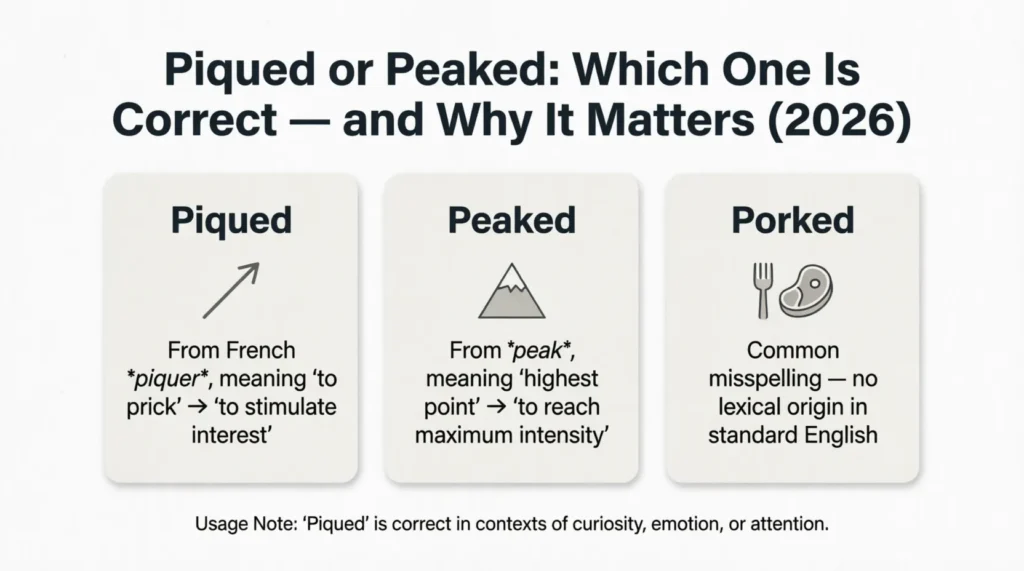
Piqued is a verb (past tense of pique) and it means to stimulate interest, curiosity, or attention. When something piques your interest, it grabs your attention in a mental or emotional way.
For example: “The trailer piqued your curiosity about the movie.”
Here, nothing is physical. It’s all about emotion and attention being triggered.
On the other hand, peaked is also a verb (past tense of peak) or an adjective. It refers to reaching the highest point, either physically or in performance.
For example: “Your excitement peaked during the final scene.”
Here, something rises to a maximum level and then may stop increasing.
So the simplest way to understand piqued or peaked is this: one is about curiosity, the other is about height or maximum level.
SECTION 1: Quick Comparison Table Here is a quick breakdown to make piqued or peaked easier to compare at a glance.
Feature
piqued
peaked
Meaning
Aroused interest or irritation
Reached highest point
Part of Speech
Verb (past form)
Verb / adjective
Formality
Neutral
Neutral
Common Context
Curiosity, interest
Performance, charts, levels
Example Sentence
Her interest was piqued.
Sales peaked in June.
Can They Be Swapped?
No — means curiosity
No — means highest point
Why People Mix Up Piqued or Peaked
The confusion between piqued or peaked happens mainly because of pronunciation. When spoken quickly, both words sound almost identical. Linguists often point out that English contains many homophones and near-homophones, which naturally leads to spelling confusion.
Another reason is that both words feel “logical” in context. If you’re talking about interest, “peaked” might feel like interest reaching a high point. That makes intuitive sense—but it’s not correct.
Also, informal writing online often spreads mistakes quickly. Once people see “peaked interest” used incorrectly enough times, it starts to look acceptable. This creates a cycle where errors feel normal.
Finally, English spelling patterns don’t always help. Both words look valid, so your brain doesn’t immediately reject either one. That’s why piqued or peaked remains one of the most common grammar mix-ups.
The Simple Rule to Remember Which Is Which
Here’s an easy way to lock it into your memory:
If you can replace the word with “sparked curiosity,” use piqued. If you can replace it with “reached the top,” use peaked.
That’s it. That’s your test.
Now let’s see it in action:
Your interest was piqued by the mystery novel’s first chapter.
The mountain climber finally peaked at the summit after hours of climbing.
The advertisement piqued your curiosity about the new phone.
If it’s about your mind, curiosity, or emotion → piqued. If it’s about height, level, or maximum point → peaked.
Once you apply this rule a few times, your brain starts choosing automatically.
Common Mistakes People Make With Piqued or Peaked
Here are some real-world mistakes you might recognize—and how to fix them:
Mistake: “The story peaked my interest.” Fix: “The story piqued my interest.” (Interest is being triggered, not reaching a physical peak.)
Mistake: “His curiosity was peaked by the message.” Fix: “His curiosity was piqued by the message.” (Curiosity is being activated.)
Mistake: “The stock market piqued last week.” Fix: “The stock market peaked last week.” (Markets reach high points, not curiosity.)
Mistake: “Her performance piqued during the final round.” Fix: “Her performance peaked during the final round.” (Performance reaches a maximum level.)
These mistakes are extremely common, especially in fast writing or texting. But once you notice the pattern, you can fix them easily.
SECTION 2: Real Sentence Fix — piqued or peaked These are real mistakes people make with piqued or peaked — and the simple fix for each one.
❌ The report peaked my interest in the project. ✅ The report piqued my interest in the project. 📌 Why: “Piqued” is used when something sparks curiosity.
❌ That meme really peaked my curiosity. ✅ That meme really piqued my curiosity. 📌 Why: “Piqued” is the correct word for growing interest.
❌ The experiment piqued at the highest temperature. ✅ The experiment peaked at the highest temperature. 📌 Why: “Peaked” means something reached its highest level.
❌ Website traffic piqued after the campaign launch. ✅ Website traffic peaked after the campaign launch. 📌 Why: “Peaked” is used for the highest amount or level.
❌ The hike piqued at the mountain summit. ✅ The hike peaked at the mountain summit. 📌 Why: “Peaked” describes reaching the top point.
❌ Her patience piqued when she read the email. ✅ Her patience peaked when she read the email. 📌 Why: “Peaked” is used when something reaches its limit.
Real-World Examples: Piqued or Peaked Used Correctly
Here’s how each word works in real situations:
“The article piqued your interest in digital marketing.” This works because your attention is being activated, not reaching a physical high point.
“Your excitement peaked just before the announcement.” This is correct because emotion rises to a maximum level.
“The documentary piqued your curiosity about space exploration.” Curiosity is being triggered here.
“Sales peaked during the holiday season.” Sales reach their highest point, making peaked the right choice.
Each sentence shows how piqued or peaked depends entirely on meaning, not sound.
British English vs. American English — Does It Affect Piqued or Peaked?
Good news: there is no British vs. American spelling difference for piqued or peaked. Both words are spelled the same in all major forms of English.
The confusion is universal because it comes from meaning, not regional spelling rules.
So whether you’re writing in the UK, US, Canada, or anywhere else, the same rule applies. Linguists agree that this is a semantic confusion, not a regional one.
What Grammar Checkers and Style Guides Say About Piqued or Peaked
Most grammar tools and style guides consistently flag “peaked interest” as incorrect when used in the wrong context. They rely on meaning recognition, not just spelling.
However, autocorrect alone is not always reliable here. Since both words are valid English terms, your software might not always catch the mistake if the sentence is structurally acceptable.
Style guides emphasize context over spelling in cases like this. That means understanding the difference yourself is far more reliable than depending on a tool.
In short, grammar systems can help—but they won’t replace your understanding of piqued or peaked.
Piqued or Peaked in Professional and Academic Writing
In professional writing, choosing the wrong word can subtly change your credibility. Saying “peaked my interest” in a job application or report may signal carelessness, even if the meaning is still understandable.
Academic writing is even stricter. Precision matters, and confusing piqued or peaked can distract readers from your ideas.
In business communication, correct usage ensures clarity. You want your reader focused on your message, not stumbling over word choices.
The good news is that once you master this difference, you eliminate one of the most common English errors permanently—and your writing instantly becomes more polished.
Quick Recap: Piqued or Peaked at a Glance
Piqued = curiosity or interest is triggered
Peaked = something reaches its highest point
They sound similar but have completely different meanings
Context is the only reliable way to choose correctly
“Interest is piqued,” never “peaked”
Frequently Asked Questions About Piqued or Peaked
Is it “piqued my interest” or “peaked my interest”?
The correct phrase is “piqued my interest.” It means your curiosity was triggered or stimulated. “Peaked my interest” is a common mistake because it sounds similar, but it is not correct in standard English usage.
Why do people confuse piqued and peaked so often?
People confuse them because they sound almost identical when spoken. In fast speech, the difference disappears, and both words seem to fit logically in sentences, even though their meanings are completely different.
Can “peaked” ever mean interest?
No, “peaked” is not used to describe curiosity or interest. It always refers to reaching a maximum point, whether physical, emotional, or numerical. Interest should always use “piqued.”
What is the origin of the word “piqued”?
“Piqued” comes from the French word piquer, meaning “to prick or stimulate.” Over time, it evolved in English to mean stimulating curiosity or attention, which is why it fits emotional and mental engagement.
Is “piqued or peaked” a common grammar mistake?
Yes, it is one of the most common confusion pairs in English. Linguists often include it in lists of frequently misused homophones because of how similar they sound but how different they are in meaning.
Final Thoughts on Piqued or Peaked
The difference between piqued or peaked comes down to meaning, not spelling complexity. One word activates curiosity, while the other describes a highest point or limit.
Once you understand this simple distinction, you stop guessing and start choosing with confidence. It’s a small grammar detail, but it makes a noticeable difference in how polished your writing appears.
Now that you know the rule, you’re far less likely to fall into this common trap again—and your writing will feel clearer and more intentional every time you use it.
Frequently Asked Questions
What is the difference between 'piqued' and 'peaked'?▼
‘Piqued’ refers to the arousal of interest, curiosity, or attention, while ‘peaked’ signifies reaching the highest point of something, whether in physical height or performance. Understanding this distinction prevents confusion in writing.
Can 'piqued' and 'peaked' be used interchangeably?▼
No, ‘piqued’ cannot be swapped with ‘peaked’ because they convey different meanings. Using them interchangeably can lead to misunderstandings in your writing.
Why do people often confuse 'piqued' and 'peaked'?▼
The confusion arises mainly from their similar pronunciation, especially when spoken quickly. Additionally, both words may feel logical in certain contexts, leading to incorrect usage.
What is a simple way to remember when to use 'piqued'?▼
If you can replace ‘piqued’ with ‘sparked curiosity,’ then it is the correct word to use. This mental test can help clarify its appropriate context.
What are some common contexts for using 'peaked'?▼
‘Peaked’ is commonly used in contexts related to performance, charts, or levels, indicating that something has reached its maximum. For example, you might say, ‘Sales peaked in June’ to describe a high point.
Are there examples of 'piqued' and 'peaked' in sentences?▼
Yes, an example of ‘piqued’ is, ‘Her interest was piqued by the intriguing article.’ An example of ‘peaked’ is, ‘His excitement peaked during the final scene of the movie.’
How can I avoid making mistakes with 'piqued' and 'peaked' in my writing?▼
To avoid mistakes, remember the rule: use ‘piqued’ when discussing interest or curiosity and ‘peaked’ when referring to a maximum level. Practicing this distinction will help solidify your understanding.
James Williams has been fascinated by the intricacies of the English language since his childhood days. Holding a Master’s degree in Linguistics from the University of Cambridge, he has spent over 15 years working as a professional editor and language consultant. James specializes in deciphering complex spelling and grammatical issues, and he is passionate about helping students and professionals alike gain confidence in their writing. His experience includes developing educational content for ESL learners, ensuring clarity and precision in communication. James is dedicated to providing readers with easy-to-follow guidance that resolves word confusions and common spelling errors, making WordlyRight an essential resource for anyone who needs quick, authoritative answers.