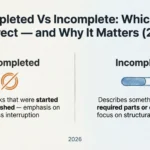
In short, between the two, “uncompleted” is more commonly seen in casual writing, but neither is the dictionary-preferred term — “incomplete” remains the standard, universally accepted word for describing something not finished.
The Core Problem
Both “incompleted” and “uncompleted” attempt to turn “complete” into a negative past-tense-style adjective, but English already has a dedicated word for this — “incomplete” — which makes both variants feel redundant to careful writers and editors.
When You Might See “Uncompleted”
“Uncompleted” shows up in technical or bureaucratic contexts (e.g. “uncompleted forms,” “uncompleted transactions”) where writers want to emphasize an action that was started but not finished, rather than a general state of incompleteness.
Why “Incompleted” Is Rarer Still
“Incompleted” combines two negative-forming strategies at once and is flagged as nonstandard by most dictionaries and grammar checkers — it’s the weaker choice of the two informal options.
The Safe Recommendation
For nearly all writing — academic, professional, or casual — “incomplete” as an adjective, or “was not completed” as a verb phrase, will read as more polished and correct than either alternative.
Frequently Asked Questions
Which is more acceptable, uncompleted or incompleted? “Uncompleted” is somewhat more widely used, but both are considered nonstandard compared to “incomplete.”
Can I use “uncompleted” in a formal report? It’s better to use “incomplete” or “not completed” for formal writing.